
1) The reserve ratio refers to the ratio of a bank’s:
A.reserves to its liabilities and net worth.
B.capital stock to its total assets.
C.checkable deposits to its total liabilities.
D.required reserves and vault cash to its checkable deposits.
2) The “future value” of a sum of money refers to:
A.the estimated value of that money invested in a stock portfolio at some future date.
B.the purchasing power of a given amount of money adjusted for price changes.
C.today’s value of a sum of money to be received in the future.
D.the amount to which some current sum of money will grow over time.
3) Under a system of freely flexible (floating) exchange rates a U.S. trade deficit with
Mexico will tend to cause:
A.the United States government to ration pesos to U.S. importers.
B.a flow of gold from the United States to Mexico.
C.an increase in the peso price of dollars.
D.an increase in the dollar price of pesos.
4) Which of the following would reduce GDP by the greatest amount?
A.a $20 billion increase in taxes
B.$20 billion increases in both government spending and taxes
C.$20 billion decreases in both government spending and taxes
D.a $20 billion decrease in government spending
5) Unions often oppose increases in the prices of complementary inputs (for example,
truck drivers may oppose increases in taxes on diesel fuel). They do this because
increases in the prices of complementary inputs might:
A.increase the supply of competing labor through the output effect.
B.increase the supply of competing labor through the substitution effect.
C.decrease the demand for union labor through the output effect.
D.decrease the demand for union labor through the substitution effect.
6) Answer the next question(s) on the basis of the following information: An economy
is employing 2 units of capital, 5 units of raw materials, and 8 units of labor to produce
its total output of 640 units. Each unit of capital costs $10, each unit of raw materials,
$4, and each unit of labor, $3.
Refer to the above information. The per-unit cost of production in this economy is:
A.$0.05.
B.$0.10.
C.$0.50.
D.$1.00.
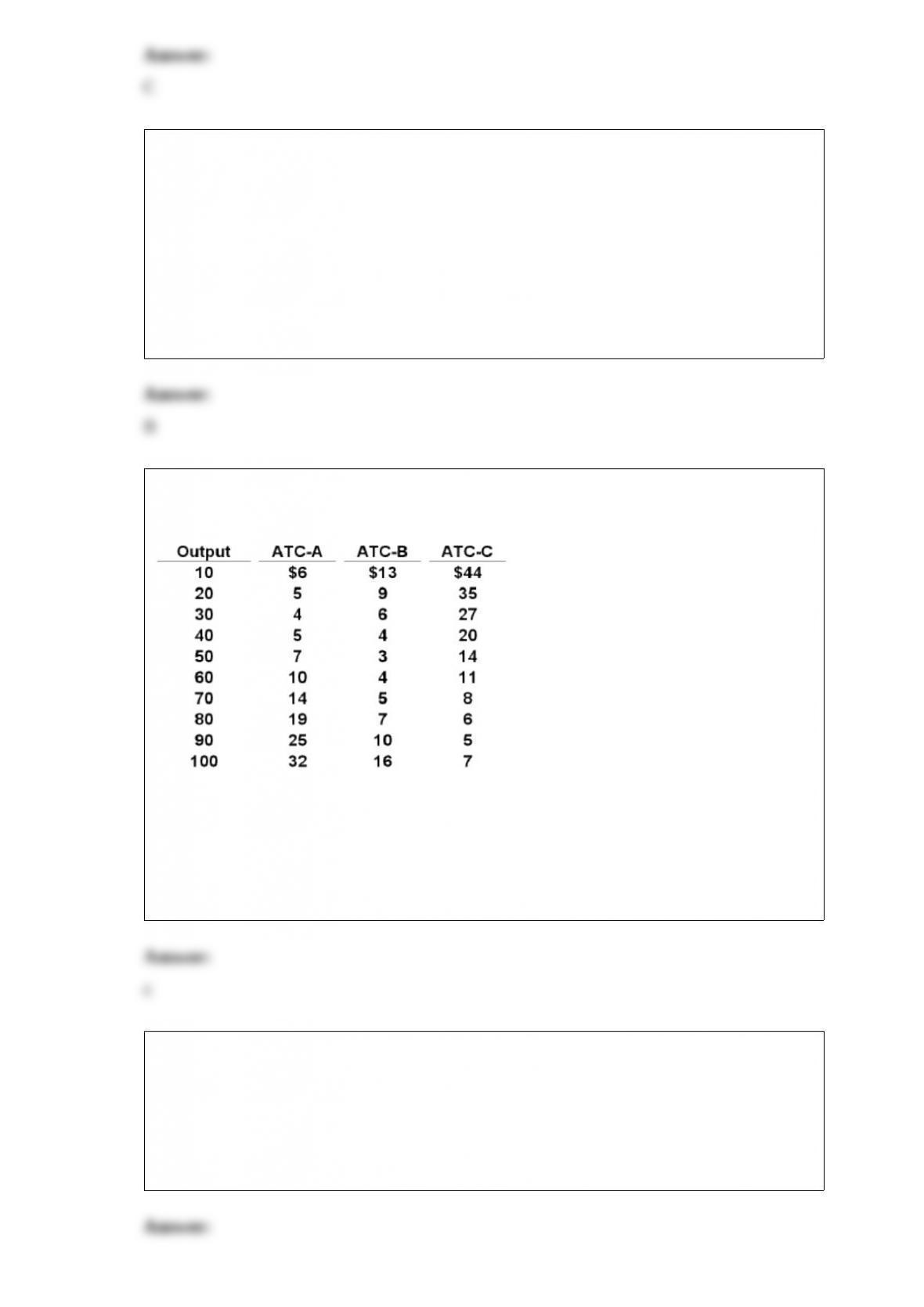
7) the letters a, b, and c designate three successively larger plant sizes.
refer to the above data. economies of scale are realized over the ___ to ___ levels of
output; diseconomies of scale exist over the ___ to ___ levels of output.
a.10, 30; 40, 100
b.10, 40; 80, 100
c.10, 50; 60, 100
d.10, 70; 80, 100
8) Assume the legal reserve ratio is 25 percent and the Fourth National Bank borrows
$10,000 from the Federal Reserve Bank in its district. As a result:
A.commercial bank reserves are increased by $10,000.
B.the supply of money automatically declines by $7,500.
C.commercial bank reserves are increased by $7,500.
D.the supply of money is automatically increased by $10,000.
9) Planned investment plus unintended increases in inventories equals:
A.actual investment.
B.consumption of fixed capital.
C.consumption minus saving.
D.unintended saving.
10) the supply of product x is inelastic (but not perfectly inelastic) if the price of x rises
by:
a.5 percent and quantity supplied rises by 7 percent.
b.8 percent and quantity supplied rises by 8 percent.
c.10 percent and quantity supplied remains the same.
d.7 percent and quantity supplied rises by 5 percent.
11)
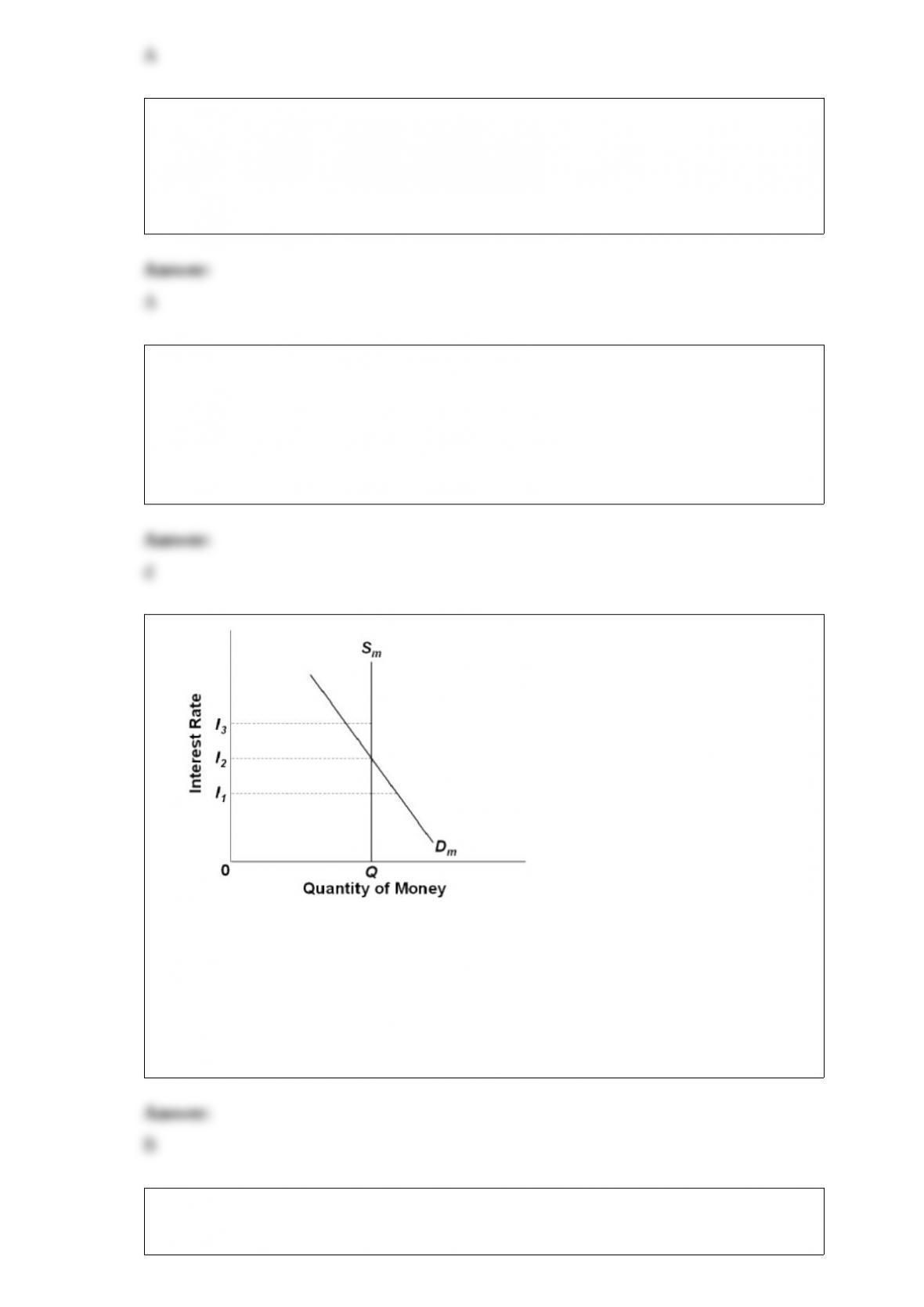
Refer to the above diagram of the market for money. The vertical money supply curve
Sm reflects the fact that:
A.bond prices and interest rates are inversely related.
B.the stock of money is determined by the Federal Reserve System and does not change
when the interest rate changes.
C.the rate at which money is spent is zero.
D.lower interest rates result in lower opportunity costs of supplying money.
12) The following table for a commercial bank or thrift:
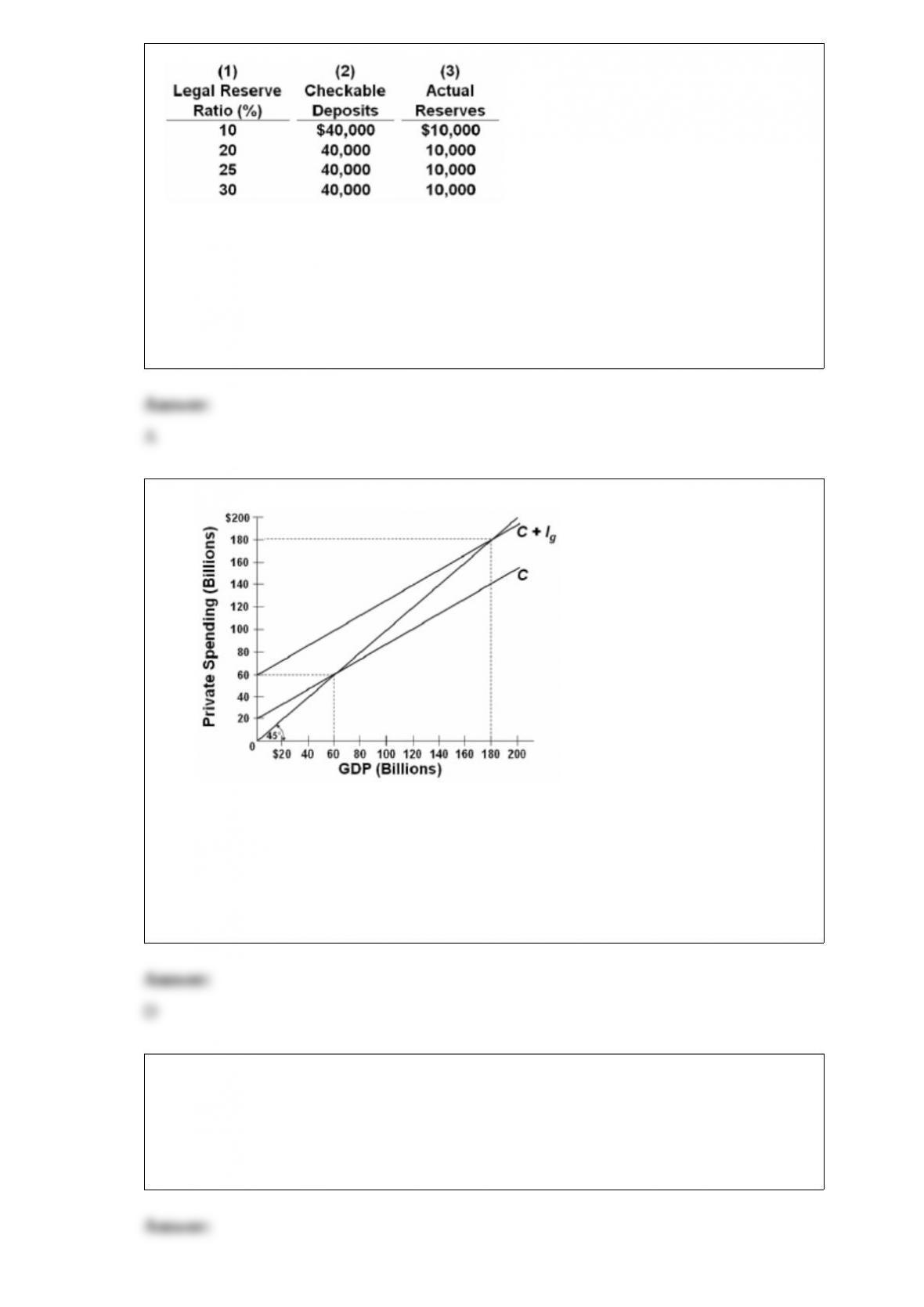
Refer to the above table. When the legal reserve ratio is 25 percent, the excess reserves
of this single bank are:
A.$0.
B.$1,000.
C.$5,000.
D.$30,000.
13)
Refer to the above diagram for a private closed economy. In this economy aggregate
expenditures:
A.do not change as GDP increases.
B.increase by $2 for every $5 increase in GDP.
C.increase by $2 for every $4 increase in GDP.
D.increase by $2 for every $3 increase in GDP.
14) MMDA stands for:
A.money maturity deposit asset.
B.money market deposit account.
C.mutual money deposit asset.
D.mature money deposit account.

15) If government increases the size of its standardized surplus, we can:
A.assume that government is causing interest rates to rise.
B.not determine government’s impact on the economy without also knowing the status
of the actual budget.
C.assume that government is having a contractionary effect on the economy.
D.assume that government is having an expansionary effect on the economy.
16) nonrivalry and nonexcludability are the main characteristics of:
a.capital goods.
b.private goods.
c.public goods.
d.consumption goods.