
Suppose the government imposes a 20-cent tax on the sellers of artificially-sweetened
beverages. The tax would shift
a. demand, raising both the equilibrium price and quantity in the market for
artificially-sweetened beverages.
b. demand, lowering the equilibrium price and raising the equilibrium quantity in the
market for artificially-sweetened beverages.
c. supply, raising the equilibrium price and lowering the equilibrium quantity in the
market for artificially-sweetened beverages.
d. supply, lowering the equilibrium price and raising the equilibrium quantity in the
market for artificially-sweetened beverages.
If a central bank reduces inflation 2 percentage points and this makes output fall 3
percentage points and unemployment rise 5 percentage points for one year, the sacrifice
ratio is
a. 5/2.
b. 3/2.
c. 2/3.
d. 2/5.
If a country experiences capital flight, which of the following curves shift right?
a. only the demand for loanable funds.
b. only the supply of dollars in the market for foreign-currency exchange.
c. only the net capital outflow curve and the supply of dollars in the market for foreign
currency exchange.
d. the demand for loanable funds, the net capital outflow curve, and the supply of
dollars in the market for foreign currency exchange.
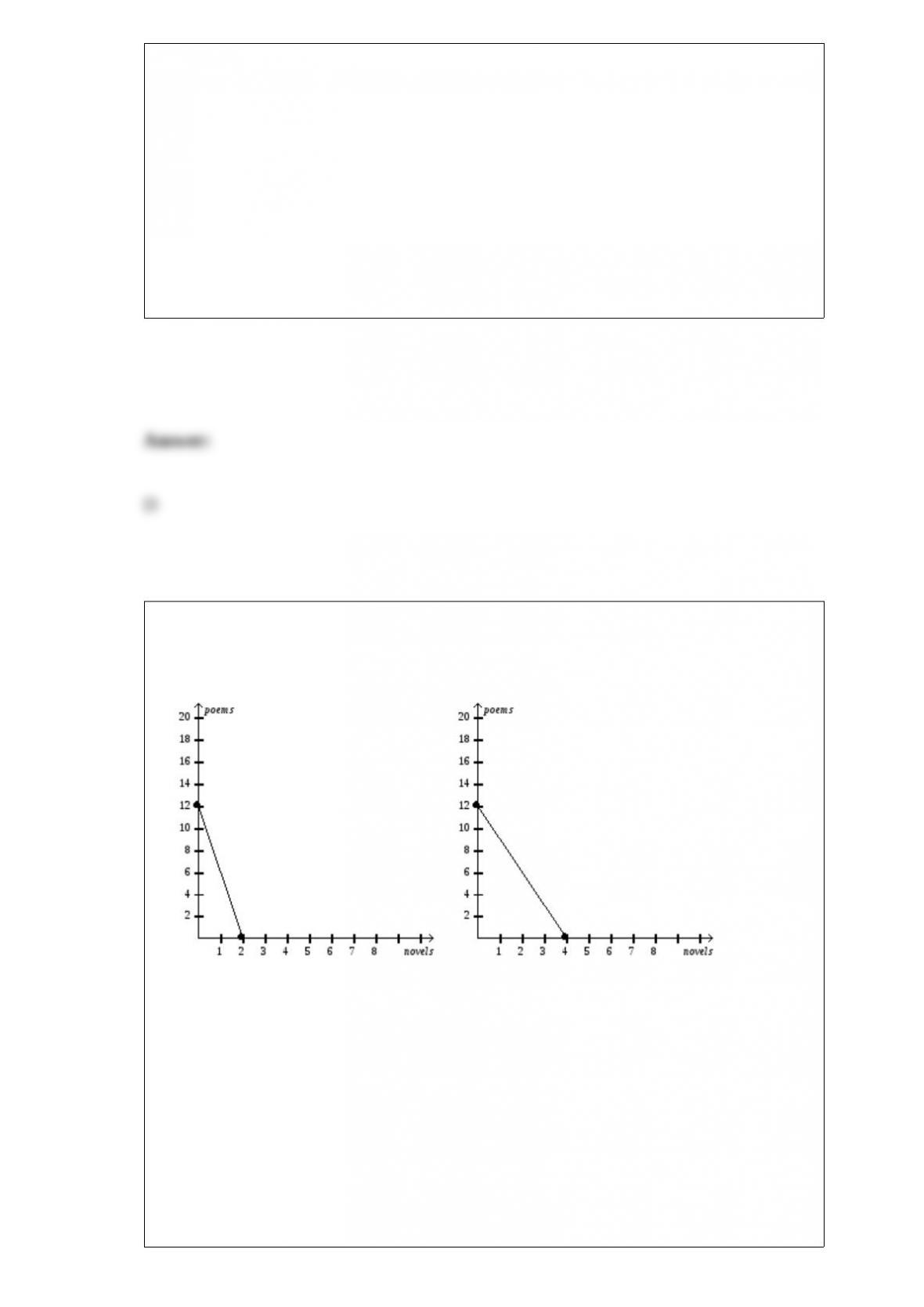
Figure 3-4
Perry’s Production Possibilities Frontier Jordan’s Production Possibilities Frontier
Refer to Figure 3-4. If the production possibilities frontiers shown are each for one
year of writing, then which of the following combinations of novels and poems could
Perry and Jordan together not write in a given year?
a. 1 novel and 21 poems
b. 2 novels and 20 poems
c. 3 novels and 15 poems
d. 5 novels and 6 poems

Marcia has four savings accounts. Which account has the largest balance?
a. $100 deposited 1 year ago at an 8 percent interest rate
b. $100 deposited 2 years ago at a 4 percent interest rate
c. $100 deposited 4 years ago at a 2 percent interest rate
d. $100 deposited 8 years ago at a 1 percent interest rate
For two individuals who engage in the same two productive activities, it is impossible
for one of the two individuals to
a. have a comparative advantage in both activities.
b. have an absolute advantage in both activities.
c. be more productive per unit of time in both activities.
d. gain from trade with each other.

Suppose Iran imposes a tariff on lumber. For the tariff to have any effect, it must be the
case that
a. Iran is an exporter of lumber.
b. the domestic quantity of lumber supplied exceeds the domestic quantity of lumber
demanded at the world price without the tariff.
c. the world price without the tariff is less than the price of lumber without trade.
d. the world price without the tariff is greater than the price of lumber without trade.
According to purchasing power parity, when a country’s central bank decreases the
money supply, a unit of money
a. gains value both in terms of the domestic goods and services it can buy and in terms
of the foreign currency it can buy.
b. gains value in terms of the domestic goods and services it can buy, but loses value in
terms of the foreign currency it can buy.
c. loses value in terms of the domestic goods and services it can buy, but gains value in
terms of the foreign currency it can buy.
d. loses value both in terms of the domestic goods and services it can buy and in terms
of the foreign currency it can buy.
Which of the following is the least likely to be a competitive market?
a. ice cream
b. soybeans
c. cable television
d. new houses
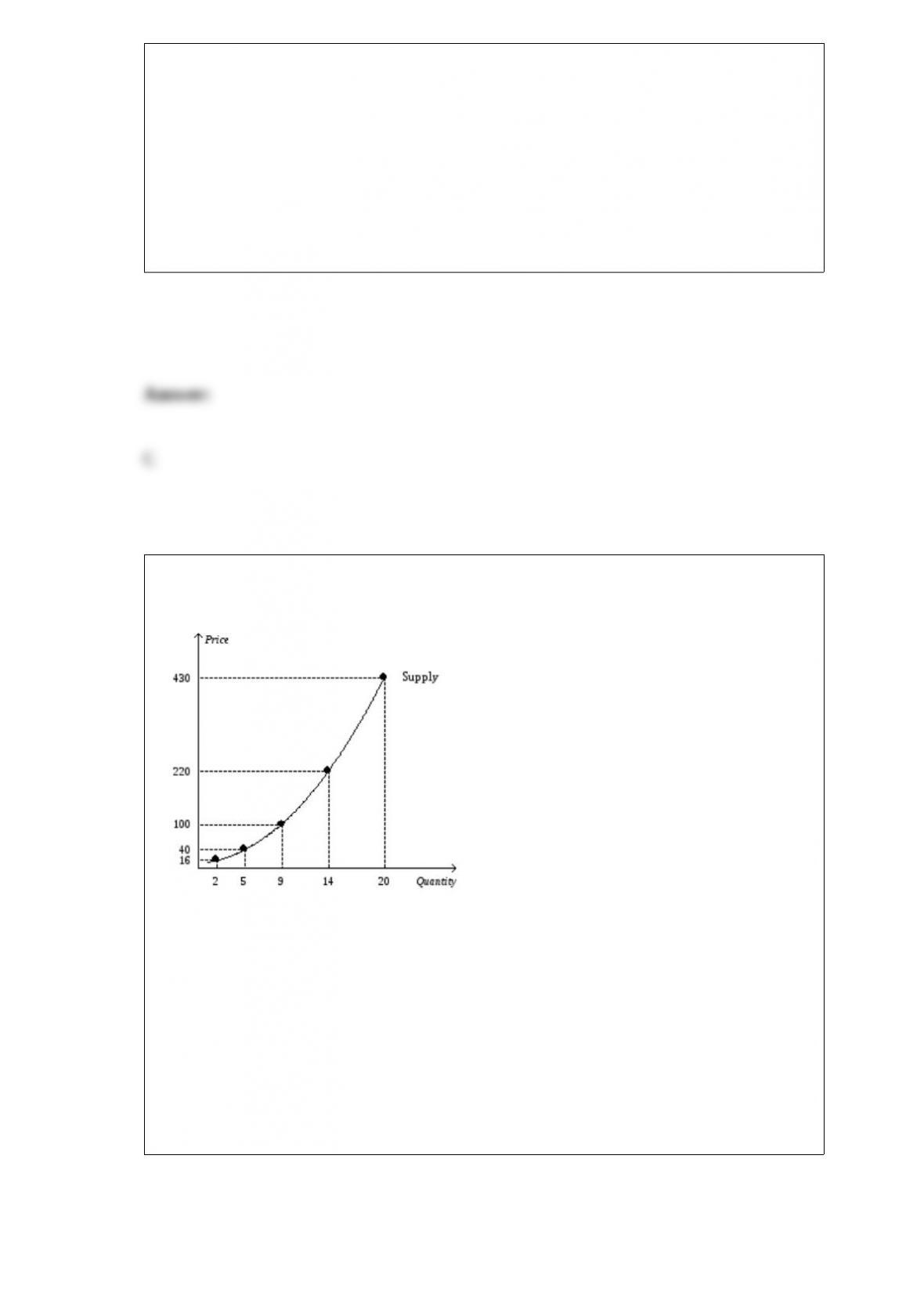
Figure 5-13
Refer to Figure 5-13. Over which range is the supply curve in this figure the most
elastic?
a. $16 to $40
b. $40 to $100
c. $100 to $220
d. $220 to $430

For a particular good, a 10 percent increase in price causes a 5 percent decrease in
quantity demanded. Which of the following statements is most likely applicable to this
good?
a. There are many close substitutes for this good.
b. The good is a necessity.
c. The market for the good is narrowly defined.
d. The relevant time horizon is long.
Last year real GDP in the imaginary nation of Populia was 907.5 billion and the
population was 3.3 million. The year before real GDP was 750 billion and the
population was 3 million. What was the growth rate of real GDP per person during the
year?
a. 10 percent
b. 14 percent
c. 17 percent
d. 21 percent

Which of the following is included in the consumption component of U.S. GDP?
a. purchases of staplers, paper clips, and pens by U.S. business firms
b. purchases of natural gas by U.S. households
c. purchases of newly constructed homes by U.S. households
d. All of the above are correct.
Concerning the labor market and taxes on labor, economists disagree about
a. the size of the tax on labor.
b. the size of the deadweight loss of the tax on labor.
c. whether or not a tax on labor places a wedge between the wage that firms pay and the
wage that workers receive.
d. All of the above are correct.
If a U.S. shirt maker purchases cotton from Egypt, U.S. net exports

a. increase, and U.S. net capital outflow increases.
b. increase, and U.S. net capital outflow decreases.
c. decrease, and U.S. net capital outflow increases.
d. decrease, and U.S. net capital outflow decreases.
High-school athletes who skip college to become professional athletes
a. obviously do not understand the value of a college education.
b. usually do so because they cannot get into college.
c. understand that the opportunity cost of attending college is very high.
d. are not making a rational decision since the marginal benefits of college outweigh the
marginal costs of college for high-school athletes.
Which of the following would likely make the interest rate on a bond higher than
otherwise?
a. both high credit risk and a long term
b. high credit risk but not a long term

c. a long term but not a high credit risk
d. neither high credit risk nor a long term
Taxes cause deadweight losses because taxes
a. reduce the sum of producer and consumer surpluses by more than the amount of tax
revenue.
b. prevent buyers and sellers from realizing some of the gains from trade.
c. cause marginal buyers and marginal sellers to leave the market, causing the quantity
sold to fall.
d. All of the above are correct.
Figure 5-4
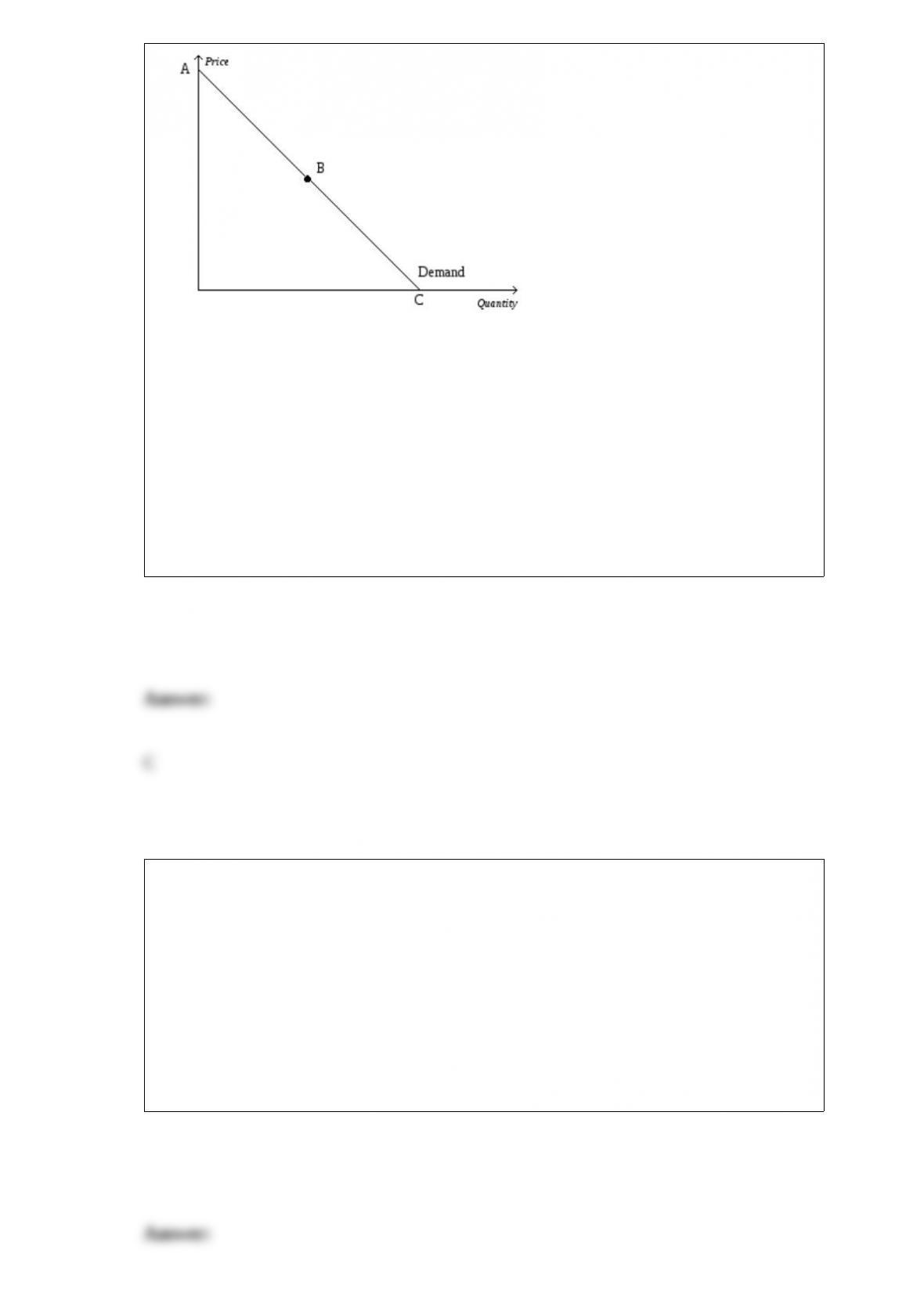
Refer to Figure 5-4. If the price decreases in the region of the demand curve between
points B and C, we can expect total revenue to
a. increase.
b. stay the same.
c. decrease.
d. first increase, then decrease until total revenue is maximized.
If the U.S. government imposes a quota on toy imports, then net exports of U.S. toys
would
a. rise.
b. not change.
c. fall.
d. rise, not change, or fall depending on what happened to the exchange rate.

If the consumer price index was 100 in the base year and 107 in the following year, then
the inflation rate was
a. 1.07 percent.
b. 7 percent.
c. 10.7 percent.
d. 107 percent.
If US goods cost 1/5 of one dollar for every kroner Danish goods cost, the real
exchange rate would be computed as how many Danish goods per U.S. goods?
a. five
b. one fifth the price of the U.S. goods
c. the amount of kroner that can be bought with 1/5 of one dollar.
d. None of the above is correct.

The Bureau of Labor Statistics produces data on unemployment and other aspects of the
labor market from a regular survey of households, called the
a. Census.
b. Labor Survey.
c. Survey of Economic Indicators.
d. Current Population Survey.
Unions contribute to
a. cyclical unemployment.
b. frictional unemployment.
c. seasonal unemployment.
d. structural unemployment.
Which of the following would cause price to increase?
a. an increase in supply
b. a decrease in demand

c. a surplus of the good
d. a shortage of the good
Which of the following would a macroeconomist consider as investment?
a. Marisa purchases a bond issued by Proctor and Gamble Corp.
b. Karlee purchases stock issued by Texas Instruments, Inc.
c. Charlie builds a new coffee shop.
d. All of the above are correct.
A decrease in the price of domestically produced nuclear reactors will be reflected in
a. both the GDP deflator and the consumer price index.
b. neither the GDP deflator nor the consumer price index.
c. the GDP deflator but not in the consumer price index.
d. the consumer price index but not in the GDP deflator.

An assistant manager at a restaurant gets a $100 a month raise. He figures that with his
new monthly salary he cannot buy as many goods and services as he could buy last
year.
a. His real and nominal salary have risen.
b. His real and nominal salary have fallen.
c. His real salary has risen and his nominal salary has fallen.
d. His real salary has fallen and his nominal salary has risen.
You could borrow $2,000 today from Bank A and repay the loan, with interest, by
paying Bank A $2,170 one year from today. Or, you could borrow X dollars today from
Bank B and repay the loan, with interest, by paying Bank B $2,712.50 one year from
today. In order for the same interest rate to apply to the two loans, X =
a. $2,366.67.
b. $2,450.00.
c. $2,500.00.
d. $2,525.50.
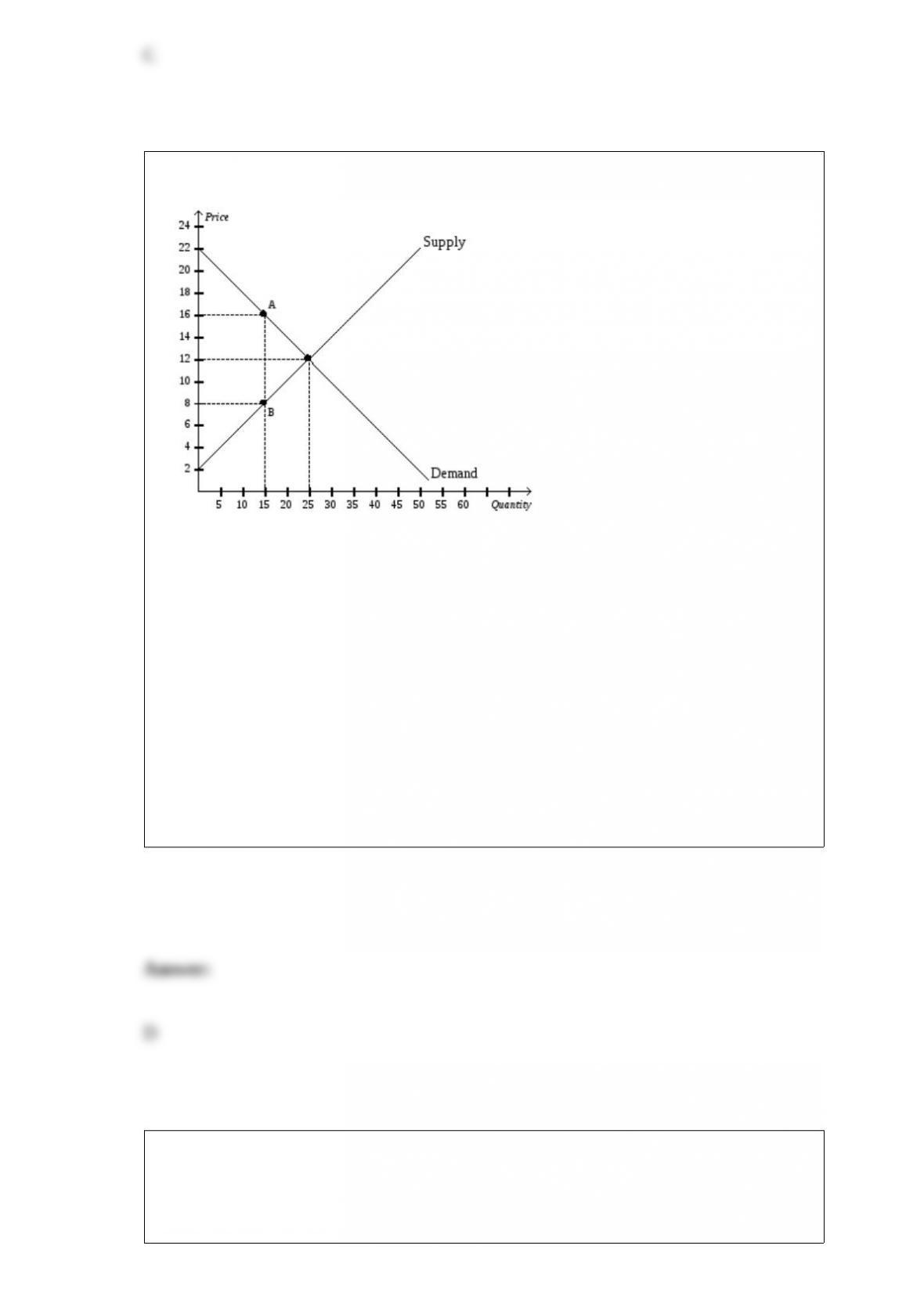
The vertical distance between points A and B represents a tax in the market.
Refer to Figure 8-7. The deadweight loss associated with this tax amounts to
a. $60, and this figure represents the amount by which tax revenue to the government
exceeds the combined loss of producer and consumer surpluses.
b. $60, and this figure represents the surplus that is lost because the tax discourages
mutually advantageous trades between buyers and sellers.
c. $40, and this figure represents the amount by which tax revenue to the government
exceeds the combined loss of producer and consumer surpluses.
d. $40, and this figure represents the surplus that is lost because the tax discourages
mutually advantageous trades between buyers and sellers.
Supply-side economists believe that a reduction in the tax rate
a. always decrease government tax revenue.
b. shifts the aggregate supply curve to the right.
c. provides no incentive for people to work more.
d. would decrease consumption.
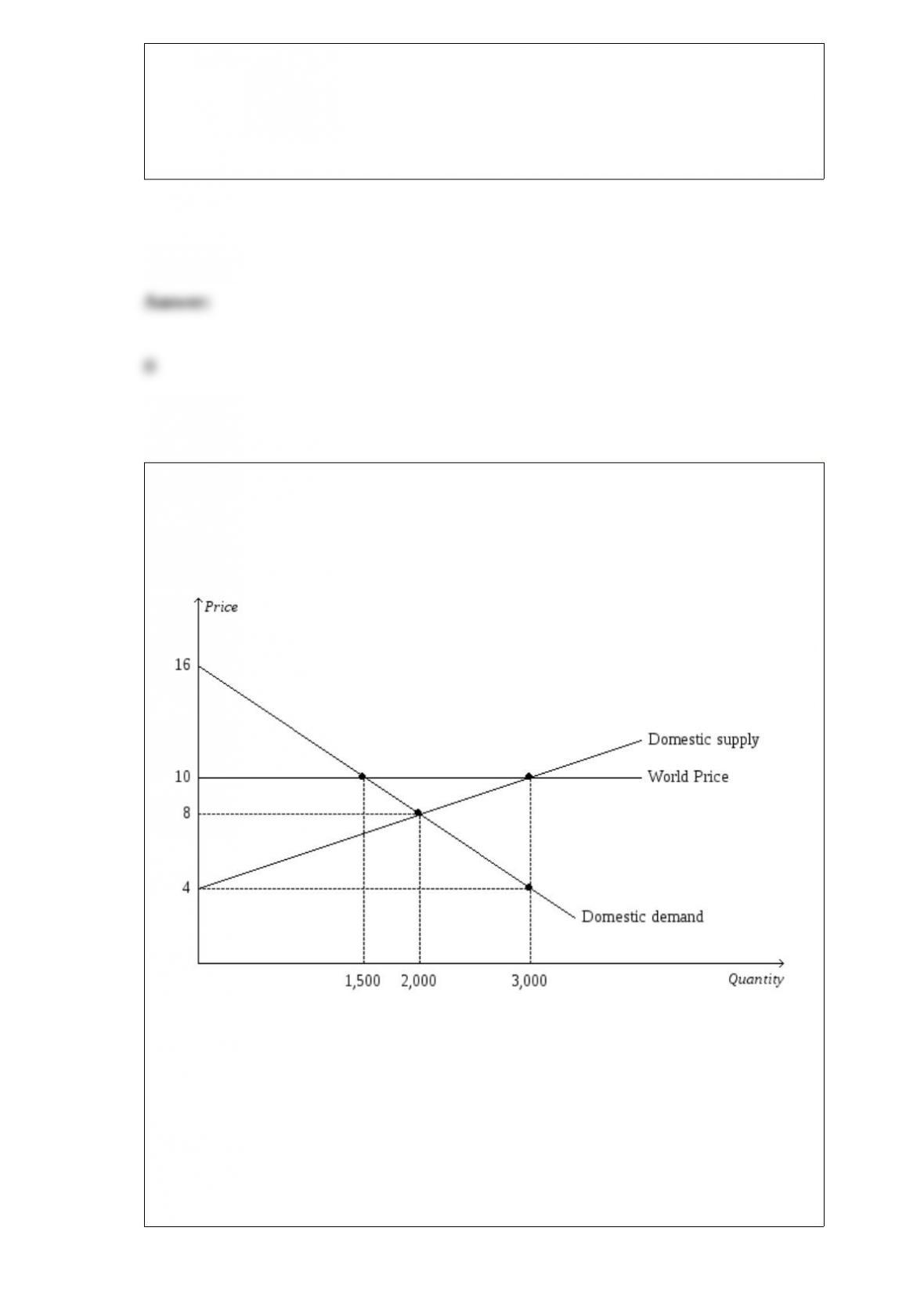
Figure 9-20
The figure illustrates the market for rice in Vietnam.
Refer to Figure 9-20. With trade, Vietnamese rice producers will produce
a. 2,000 units of rice and their producer surplus will be 4,000.
b. 2,000 units of rice and their producer surplus will be 7,500.
c. 3,000 units of rice and their producer surplus will be 7,500.
d. 3,000 units of rice and their producer surplus will be 9,000.

Consider a good to which a per-unit tax applies. The size of the deadweight that results
from the tax is smaller, the
a. less elastic is the demand for the good.
b. less elastic is the supply of the good.
c. smaller is the amount of the tax.
d. All of the above are correct.