
1) The average person in the United States generates about 10 pounds of trash per day.
2) The regulation of natural monopolies has been criticized because it creates a
tendency for regulated firms to use too much labor and too little capital in the
production process.
3) Marginal revenue product (MRP) is the change in total product (total output)
associated with hiring an additional unit of labor.
4) A recessionary expenditure gap in a mixed open economy can be measured as the
extent to which aggregate expenditures (Ca + Ig + Xn + G) fall short of real GDP at the
full-employment level of real GDP.
5) nafta is an international accord that will eliminate all tariffs and quotas worldwide by
the year 2025.
6) If the MPC is .9, a $20 billion increase in a lump-sum tax will reduce GDP by $200
billion.
7) the lower the consumer’s income, the higher his or her budget line.
8) the united states exports a higher u.s. dollar volume of goods to canada than to any
other nation.
9) Reduction of tariff barriers against DVC imports would benefit both the DVCs and
the IACs.
10) If government decreases its purchases by $20 billion and the MPC is 0.8,
equilibrium GDP will decrease by $100 billion.
11) The aggregate expenditures schedule in the mixed open economy has a negative
slope.
12) How often does the Fed offer reserves through the term auction facility?
A.Every two months.
B.Twice a year.
C.Once a week.
D.Twice a month.
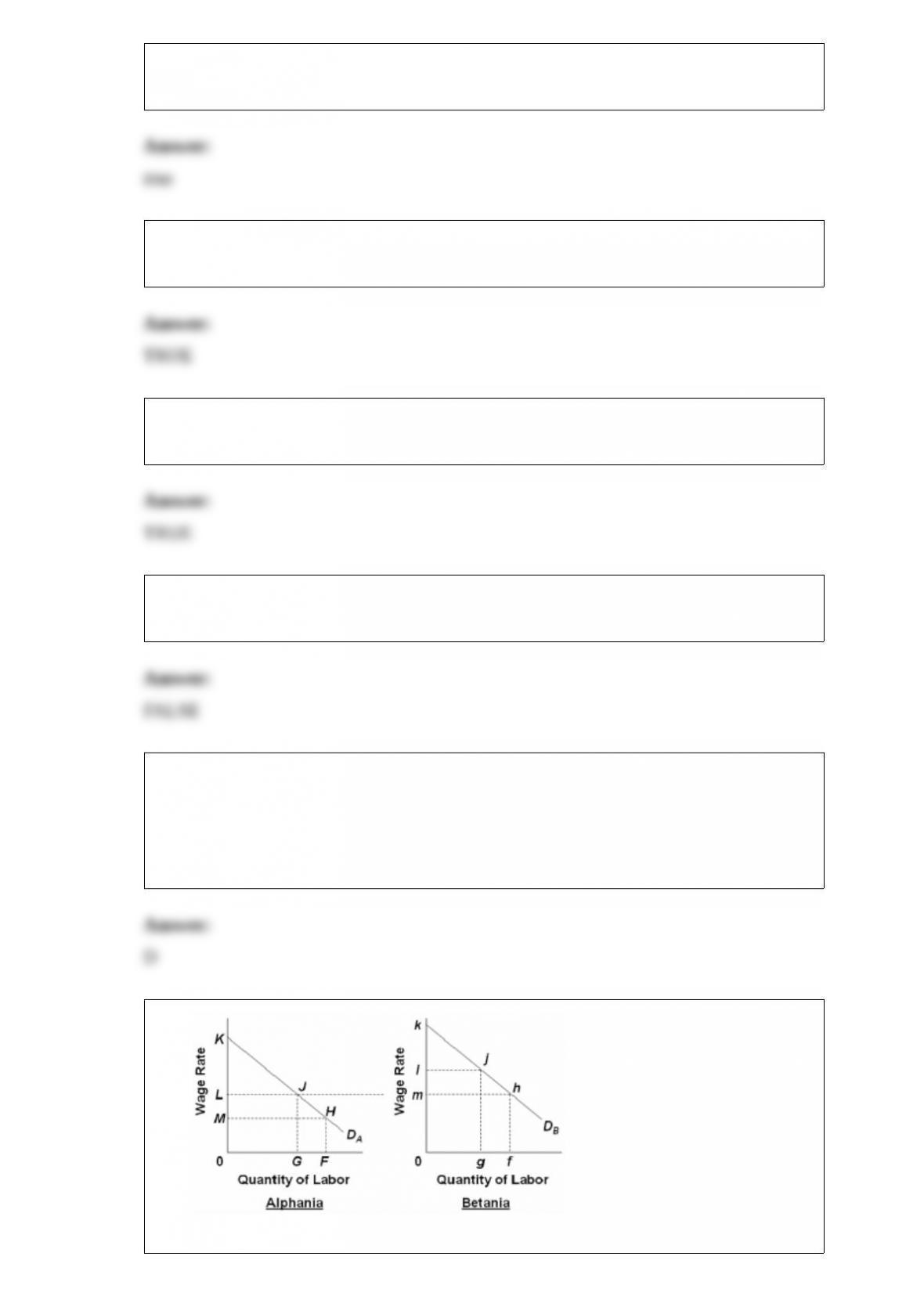
13)

assumptions: (1) the demand for labor in alphania and betania are as shown by da and
db, respectively; (2) alphania’s native labor force is f and that of betania is g; (3) wage l
in alphania is equal to wage m in betania; and (4) full employment exists in both
countries.
refer to the above diagram and assumptions. if migration is costless and unimpeded,
business income will:
a.decrease in betania, but increase in alphania.
b.increase in betania, but decrease in alphania.
c.decrease in both alphania and betania.
d.increase in both alphania and betania.
14) According to monetarists, the Great Depression in the United States largely resulted
from:
A.contractionary fiscal policy.
B.excessive imports relative to exports.
C.significant changes in technology and resource availability.
D.inappropriate monetary policy.
15) In the last half of the 1990s, the usual short-run tradeoff between inflation and
unemployment did not arise because:
A.the Fed held interest rates constant.
B.the Federal government balanced its budget.
C.the U.S. personal savings rate rose.
D.productivity (and thus aggregate supply) grew faster than previously.
16) in calculating gdp, governmental transfer payments, such as social security or
unemployment compensation, are:
a.not counted.
b.counted as investment spending.
c.counted as government spending.
d.counted as consumption spending.
17) (Advanced analysis) Answer the next question(s) on the basis of the following
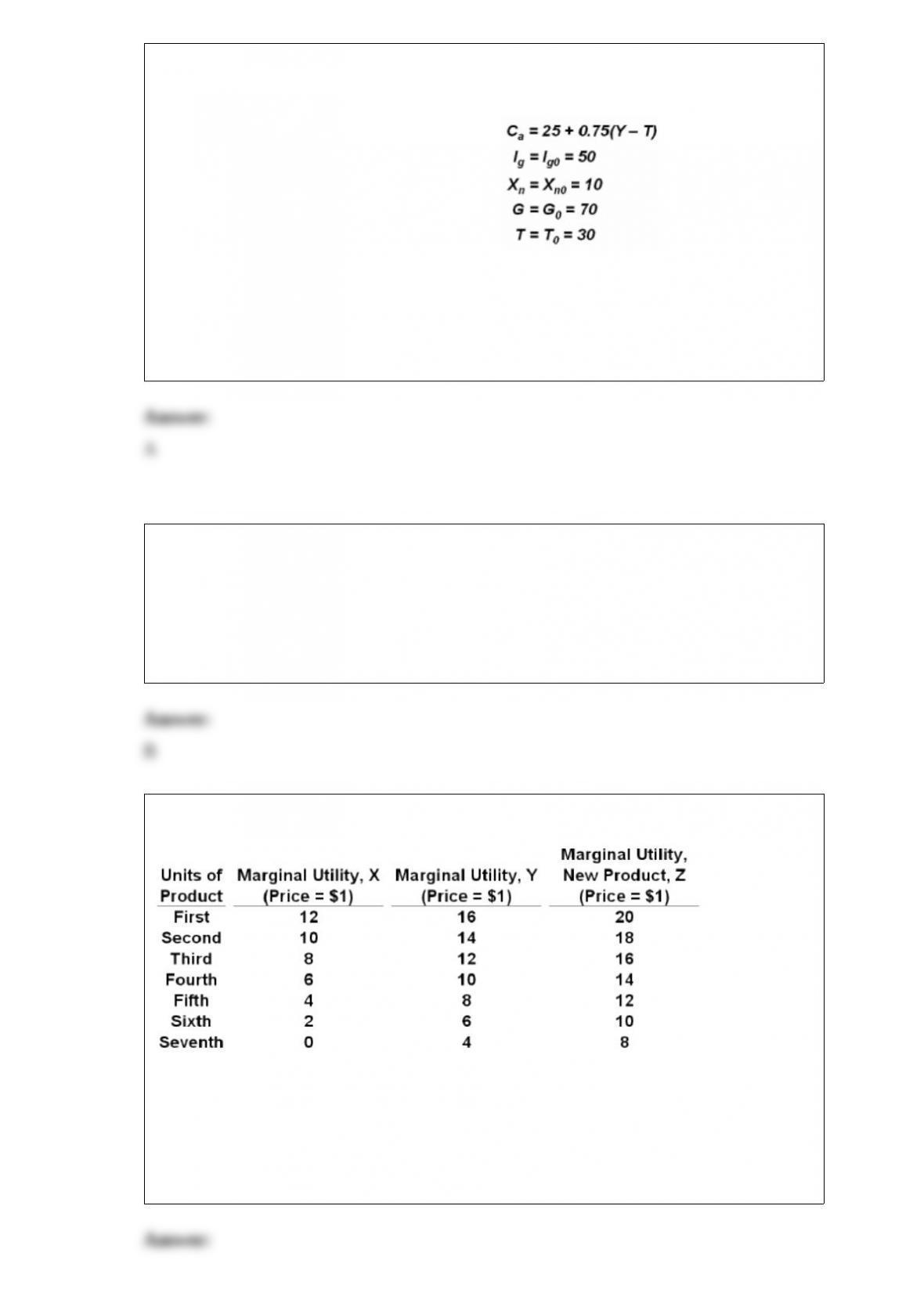
information for a mixed open economy. The letters Y, Ca, Ig, Xn, G, and T stand for
GDP, consumption, gross investment, net exports, government purchases, and net taxes
respectively. Figures are in billions of dollars.
Refer to the above information. The multiplier for this economy is:
A.4.
B.3.
C.2.
D.2.33.
18) Price fixing:
A.is prohibited by Section 7 of the Clayton Act.
B.is a per se violation of the antitrust laws.
C.may be either legal or illegal depending on whether or not it produces above-normal
profits.
D.is illegal under terms of the Federal Trade Commission Act.
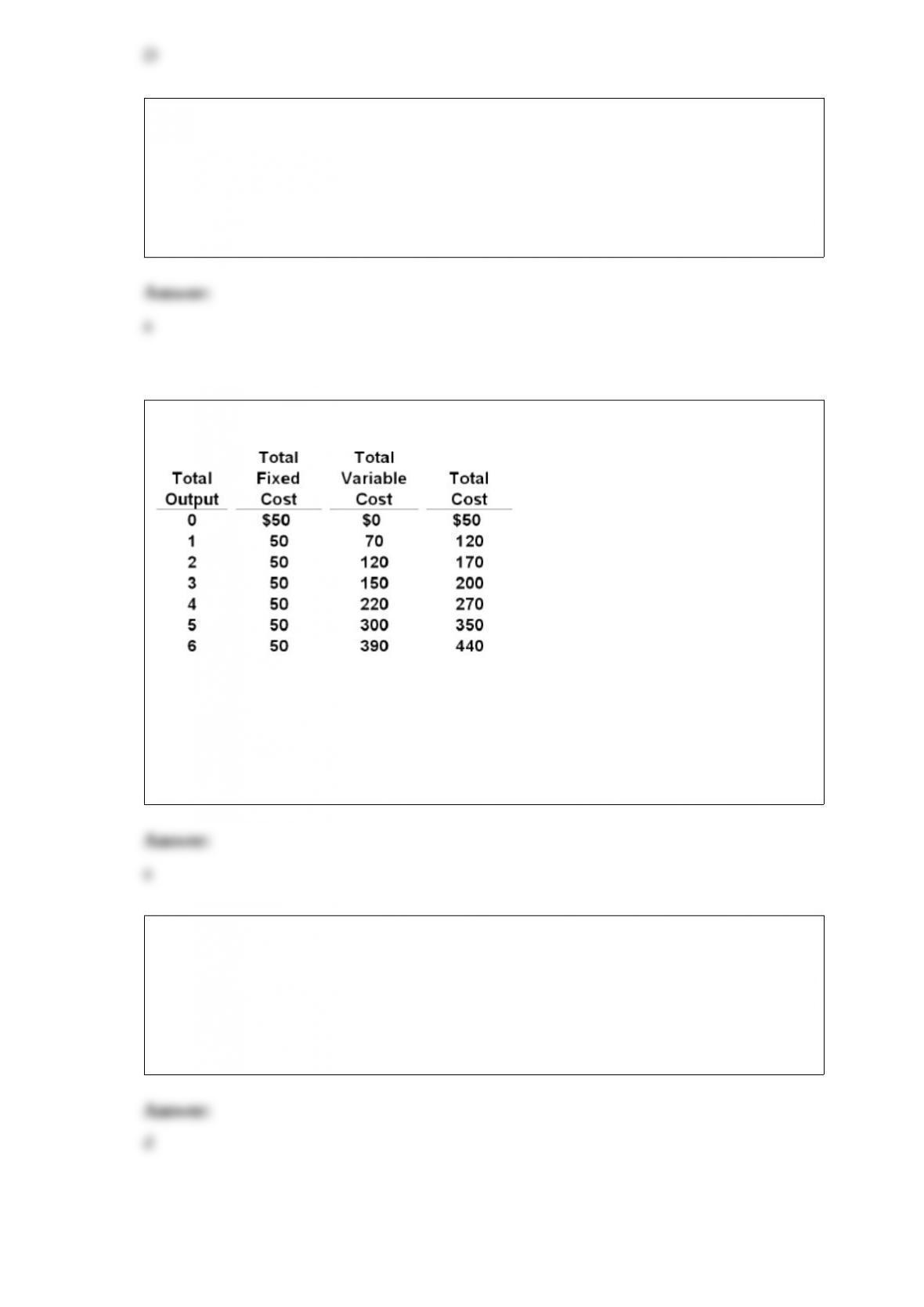
19) Consumer’s income = $12
Refer to the above data. Assume new product Z is introduced. How many units of Z
will this consumer buy, given his or her $12 budget?
A.zero units
B.2 units
C.4 units
D.6 units
20) a caller to a radio talk show states that oil companies are “greedy price gougers.”
this is an example of:
a.loaded terminology.
b.the “after this, therefore because of this fallacy.”
c.the fallacy of composition.
d.the economic perspective.
21) the following cost data for a purely competitive seller:
refer to the above data. at 5 units of output average fixed cost, average variable cost,
and average total cost are:
a.$10, $60, and $70 respectively.
b.$50, $40, and $90 respectively.
c.$10, $70, and $80 respectively.
d.$5, $25, and $30 respectively.
22) approximately what percentage of the federal government’s tax revenues are
generated from personal income taxes?
a.80 percent
b.18 percent
c.37 percent
d.45 percent
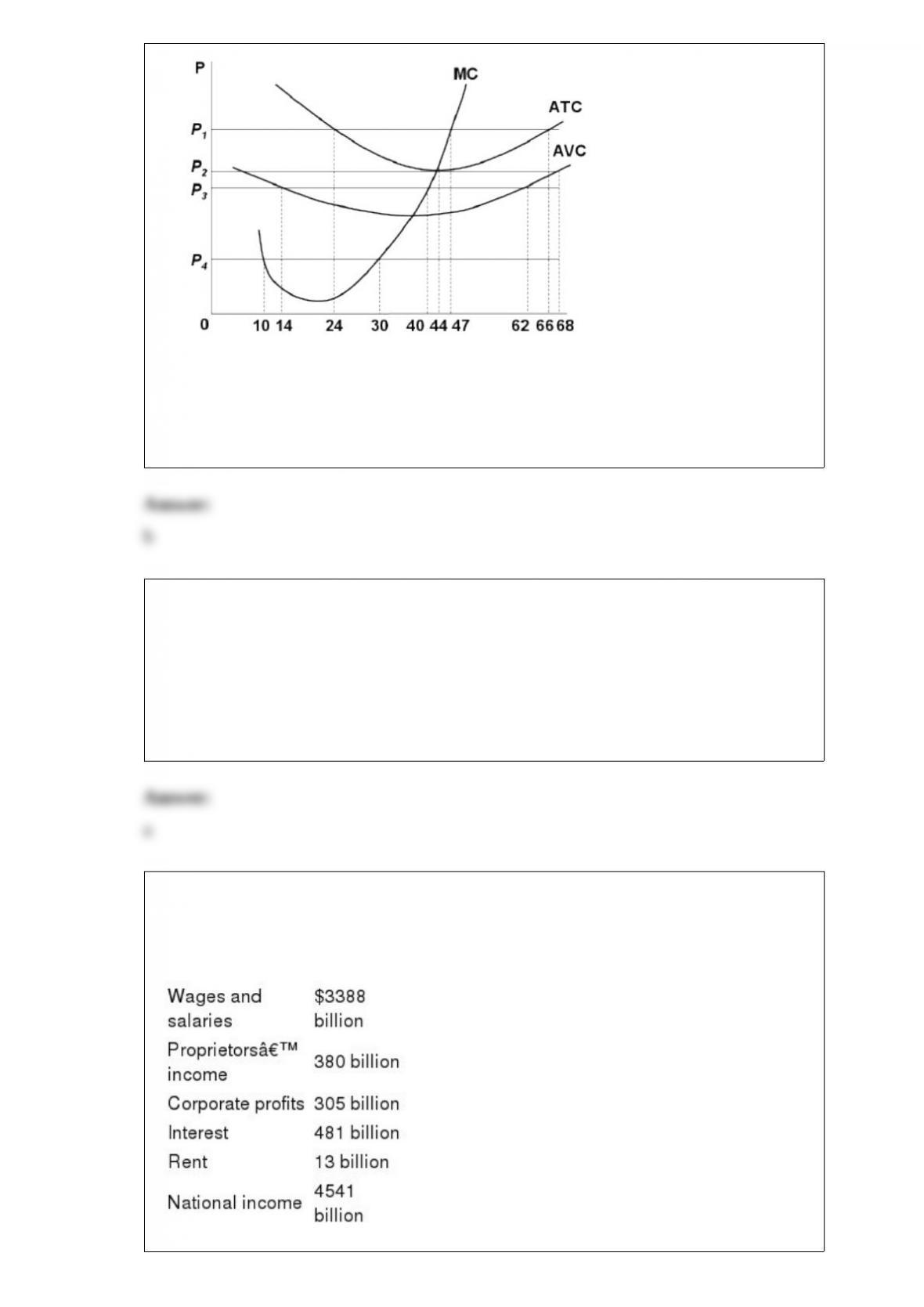
23)
refer to the above diagram. at p2, this firm will:
a.produce 44 units and realize an economic profit.
b.produce 44 units and earn only a normal profit.
c.produce 66 units and earn only a normal profit.
d.shut down in the short run.
24) network effects are:
a.increases in the value of a product to each user, including existing users, as the total
number of users rises.
b.reductions in per unit production cost as firms learn by doing.
c.increases in demand resulting from products being mentioned positively in a
television program.
d.the change in real gdp resulting from a change in investment or government spending.
25) The following table shows estimated wages and salaries, proprietors income,
corporate profits, interest, rent, and the national income of the United States in a recent
year.
(a)What were wages and salaries as a percentage of the national income?
(b)What were labors share of the national income and the capitalists share as a
percentage of national income? Show your calculations.
26)
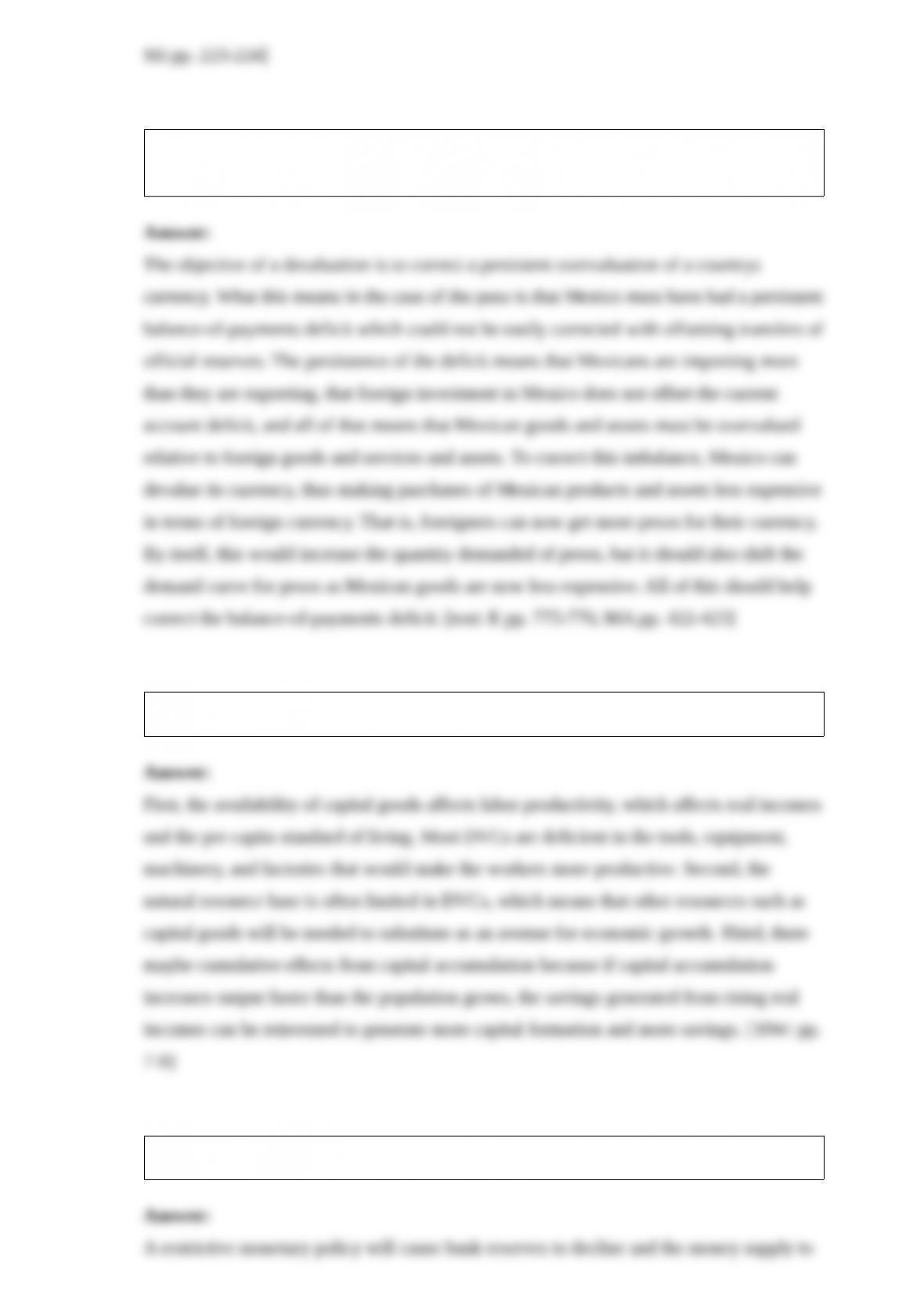
Refer to the above data. At $100 million of R&D expenditures, the:
A.marginal cost of R&D exceeds the marginal benefit.
B.marginal benefit of R&D exceeds the marginal cost.
C.expected rate of return from R&D is negative.
D.firm has exceeded its affordable level of R&D.
27) What are the major features of monopolistic competition compared to pure
competition and pure monopoly?
28) Suppose that Mexico devalues the peso. What objectives would prompt the
devaluation? Be specific.
29) Economic development in DVCs often focuses on capital accumulation. Why?
30) Trace the cause-effect chain that results from a restrictive monetary policy.
31) When a check is drawn against bank A and deposited in another bank, the first bank
loses reserves as the check is cleared. Yet the check collection involves no loss of
reserves by the banking system. Explain what significance this has for the lending
ability of the system as a whole.
32) Mainstream and new classical views are compatible perspectives on
macroeconomic issues and policies. Do you agree? Explain.
33) Suppose the stocks for two relatively identical auto makers, A and B, are selling for
$100 and $150 respectively. Both are predicted to sell for $200 in the coming year.
What action do you expect investors engaging in arbitrage to take? What will be the
ultimate effect of this action?
34) Evaluate the statement: There is no difference between the labor supply curve for
the single competitive firm and the supply curve in a competitive market for labor.
35) Contrast the factors that underlie the downsloping resource demand curve with
those which underlie the downsloping product demand curve.
36) Briefly explain the loanable funds theory of interest rate determination.