1)
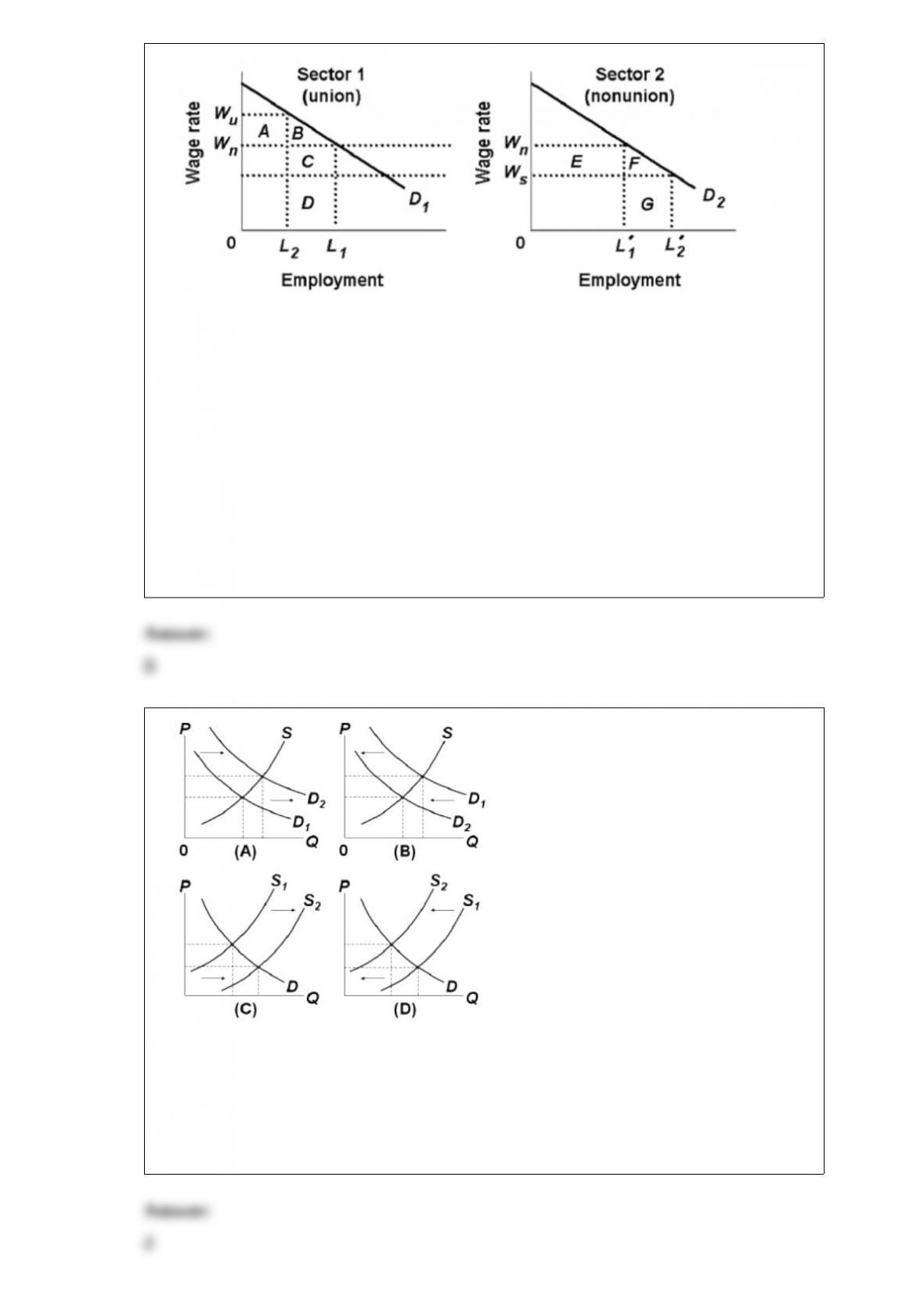
Assumptions: These two graphs show two sectors of the labor market for a particular
kind of labor. Relevant product markets are competitive. The two labor demand curves
are identical and initially the quantities of labor employed in the two sectors are L1and
L’1and the wage rate in each sector is Wn.
Refer to the above diagrams and assumptions. If all the workers who lose their jobs in
the union sector because of a Wn to Wu union wage increase are reemployed in
nonunion sector 2, output in that sector will:
A.decrease by F + G.
B.increase by F + G.
C.increase by E + F.
D.increase by E.
2)
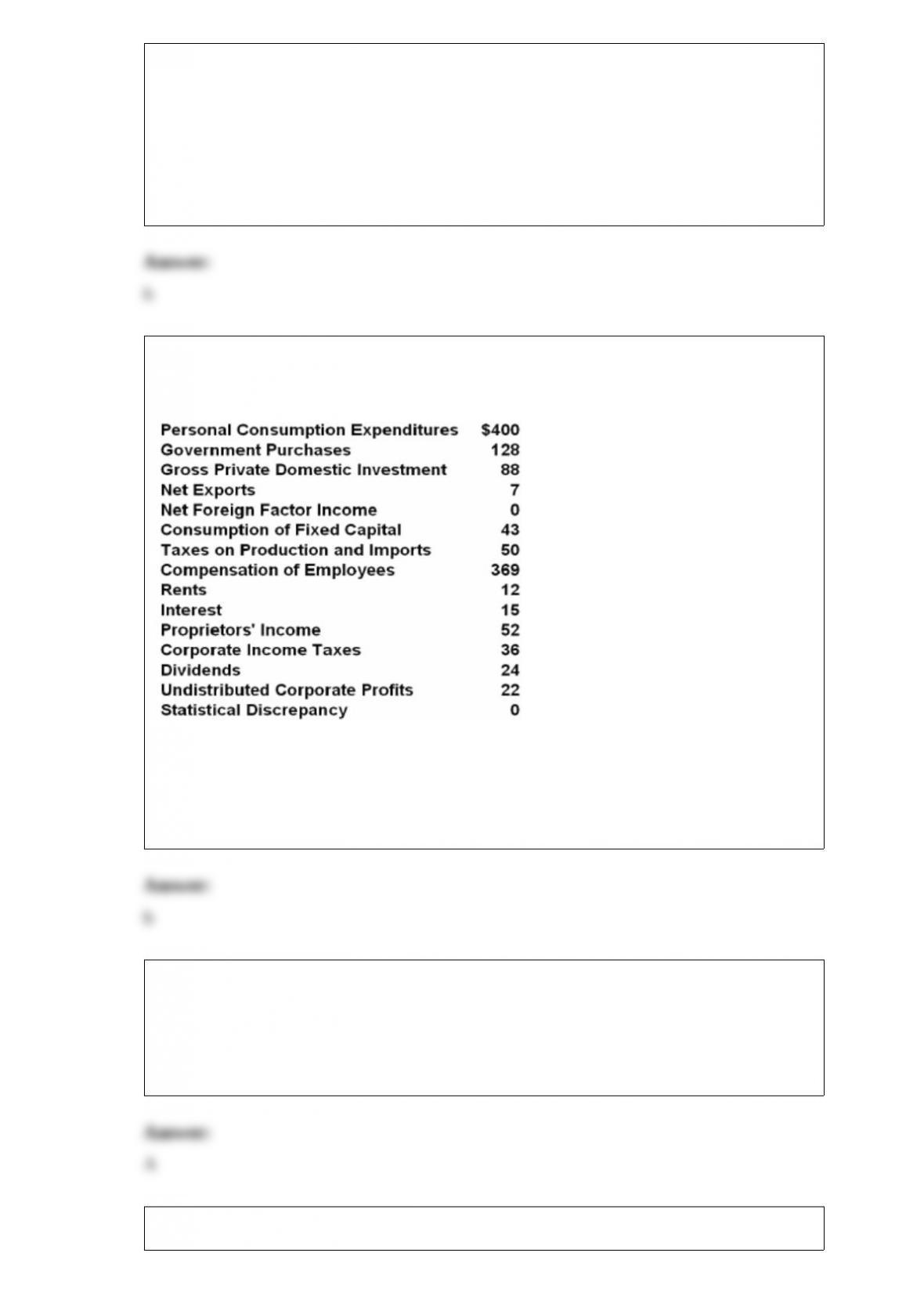
which of the above diagrams illustrate(s) the effect of an increase in automobile worker
wages on the market for automobiles?
a.a only.
b.b only.
c.c only.
d.d only.
3) to economists, the main difference between the short run and the long run is that:
a.the law of diminishing returns applies in the long run, but not in the short run.
b.in the long run all resources are variable, while in the short run at least one resource is
fixed.
c.fixed costs are more important to decision making in the long run than they are in the
short run.
d.in the short run all resources are fixed, while in the long run all resources are variable.
4) answer the next question(s) on the basis of the following national income data for the
economy. all figures are in billions of dollars.
refer to the above data. net domestic product is:
a.$520.
b.$580.
c.$623.
d.$573.
5) The shape of the immediate-short-run aggregate supply curve implies that:
A.total output depends on the volume of spending.
B.increases in aggregate demand are inflationary.
C.output prices are flexible, but input prices are not.
D.government cannot bring an economy out of a recession by increasing spending.
6) Consider the two diagrams below. Diagram A represents a typical firm in a purely
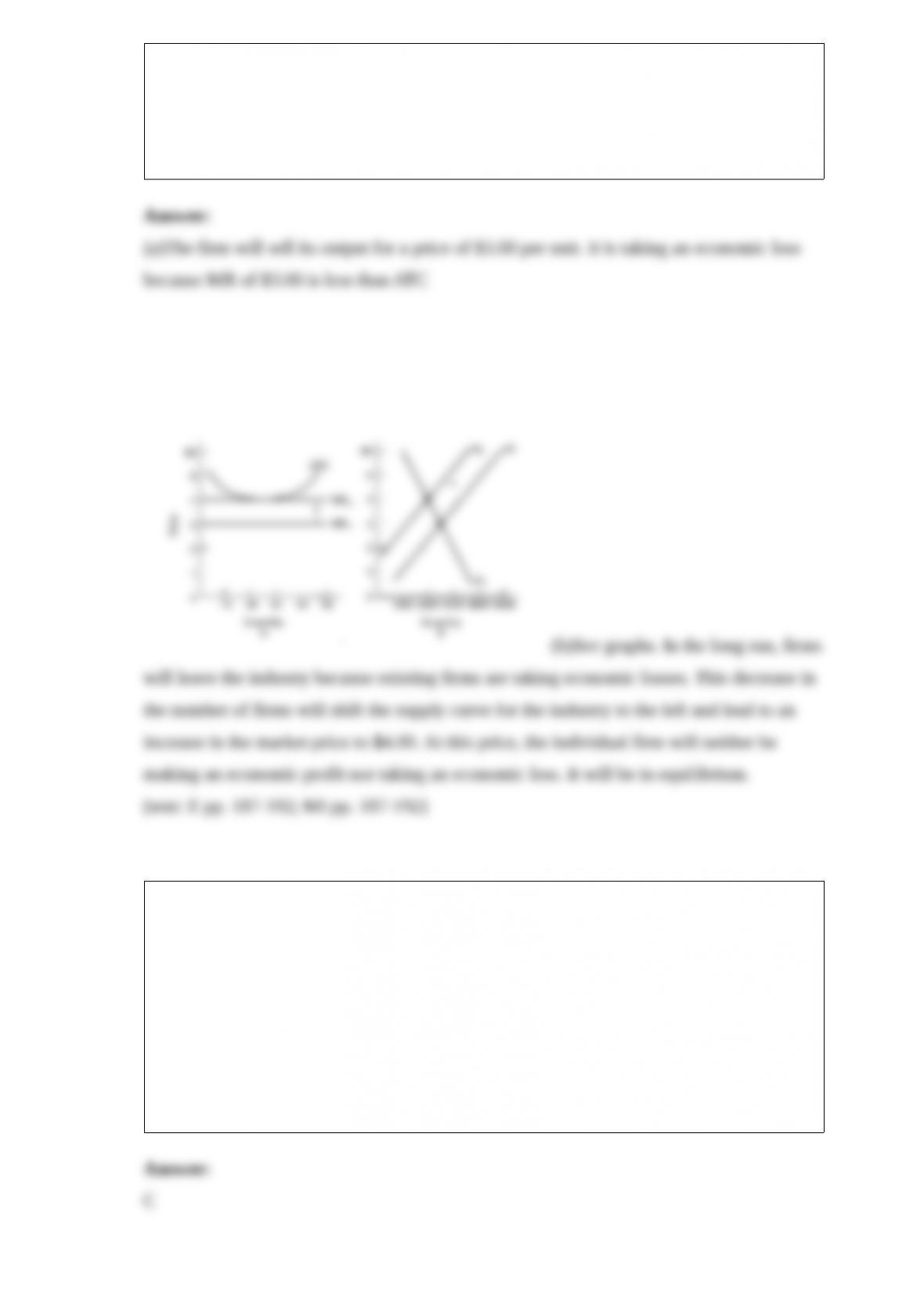
competitive industry. Diagram B represents the supply and demand conditions in that
industry.
(a)Describe the price, output, and profit situation for the individual firm in the short run.
(b)Describe what will happen to the individual firm and the industry in the long run.
Show the changes on diagrams A and B.
7) Suppose a firm hires both labor (L) and capital (C) under purely competitive
conditions. The price of labor is PL and that of capital is PC. The marginal product of
labor is MPL and that of capital is MPC. The firm sells its product competitively at a
price of PX.
Refer to the above information. In competitive labor markets, the marginal cost of an
additional unit of labor:
A.is equal to PL MPL.
B.is equal to MPL/PL.
C.is equal to PL.
D.cannot be determined from the information given.

8) in performing its stabilization function, it may be appropriate for the nation’s central
bank (the federal reserve in the united states) to:
a.raise taxes to reduce inflation.
b.increase government spending to reduce unemployment.
c.increase subsidies to businesses to reduce unemployment.
d.lower interest rates to stimulate private spending and reduce unemployment.
9) The crowding-out effect of expansionary fiscal policy suggests that:
A.government spending is increasing at the expense of private investment.
B.imports are replacing domestic production.
C.private investment is increasing at the expense of government spending.
D.saving is increasing at the expense of investment.
10) assume that the price of product x rises by 5 percent and the quantity supplied of x
increases by 15 percent. the coefficient of price elasticity of supply for good x is:
a.negative and therefore x is an inferior good.
b.positive and therefore x is a normal good.
c.less than 1 and therefore supply is inelastic.
d.more than 1 and therefore supply is elastic.
11) The velocity of money is equal to:
A.1/MPS.
B.nominal GDP/M.
C.1/reserve ratio.
D.nominal GDP/P.
12) Harry owns a barber shop and charges $6 per haircut. By hiring one barber at $10
per hour the shop can provide 24 haircuts per 8-hour day. By hiring a second barber at
the same wage rate the shop can now provide a total of 42 haircuts per day.
Refer to the above information. The MRP of the second barber:
A.is 18 haircuts.
B.is $108.
C.is 42 haircuts.

D.is $126.
13) if the secular trend of labor productivity rises from 2 percent per year to 4 percent,
the number of years that it will take for the standard of living to double will decline by
about:
a.5 years.
b.10 years.
c.17 years.
d.23 years.
14) Statistical discrimination:
A.can persist in the long run if differences in average characteristics among groups
continue.
B.will tend to diminish in the long run, because nondiscriminating firms will drive out
discriminating firms.
C.requires that employers have discrimination coefficients greater than zero.
D.is also known as occupational segregation.
15) inflows of immigrant workers tend to reduce the wages of domestic-born workers.
under which of the following circumstances is this least likely to occur?
a.migration between countries is unimpeded.
b.immigrant workers make remittances to their home country.
c.immigrant workers and domestic-born workers are substitute resources.
d.immigrant workers and domestic-born workers are complementary resources.
16) Which of the following monetary policy tools was introduced in December 2007?
A.the discount rate
B.the Federal funds rate
C.open-market operations
D.the term auction facility

17) (Advanced analysis) In a private closed economy (a) the marginal propensity to
save is 0.25, (b) consumption equals income at $120 billion, and (c) the level of
investment is $40 billion. What is the equilibrium level of income?
A.$280 billion
B.$320 billion
C.$262 billion
D.$198 billion
18) Suppose the balance on the financial account is +$200 billion and the balance on
the capital account is +$2 billion. The size of the current account is:
A.+$200 billion.
B.-$202 billion.
C.-$198 billion.
D.+$2 billion.
19) which of the following terms implies the least degree of confidence in an economic
generalization?
a.a hypothesis.
b.a theory.
c.a principle.
d.a law.
20) Which one of the following is true about the U.S. Federal Reserve System?
A.There are 10 regional Federal Reserve Banks.
B.The head of the U.S. Treasury also chairs the Federal Reserve Board.
C.There are seven members of the Federal Reserve Board of Governors.
D.The Open Market Committee is smaller in size than the Federal Reserve Board.