
1) Which of the following types of goods are rival in consumption?
a.private goods and club goods
b.private goods and common resources
c.public goods and club goods
d.public goods and common resources
2) A monopolist produces
a.more than the socially efficient quantity of output but at a higher price than in a
competitive market.
b.less than the socially efficient quantity of output but at a higher price than in a
competitive market.
c.the socially efficient quantity of output but at a higher price than in a competitive
market.
d.possibly more or possibly less than the socially efficient quantity of output, but
definitely at a higher price than in a competitive market.
3) Suppose that some firms in a competitive industry are earning zero economic profits,
while others are experiencing losses. All else equal, in the long run, we would expect
the number of firms in the industry to
a.increase.
b.decrease.
c.remain the same.
d.We do not have enough information with which to answer this question.
4) A linear, downward-sloping demand curve has a constant elasticity but a changing
slope.
a.True
b.False
5) Figure 15-1
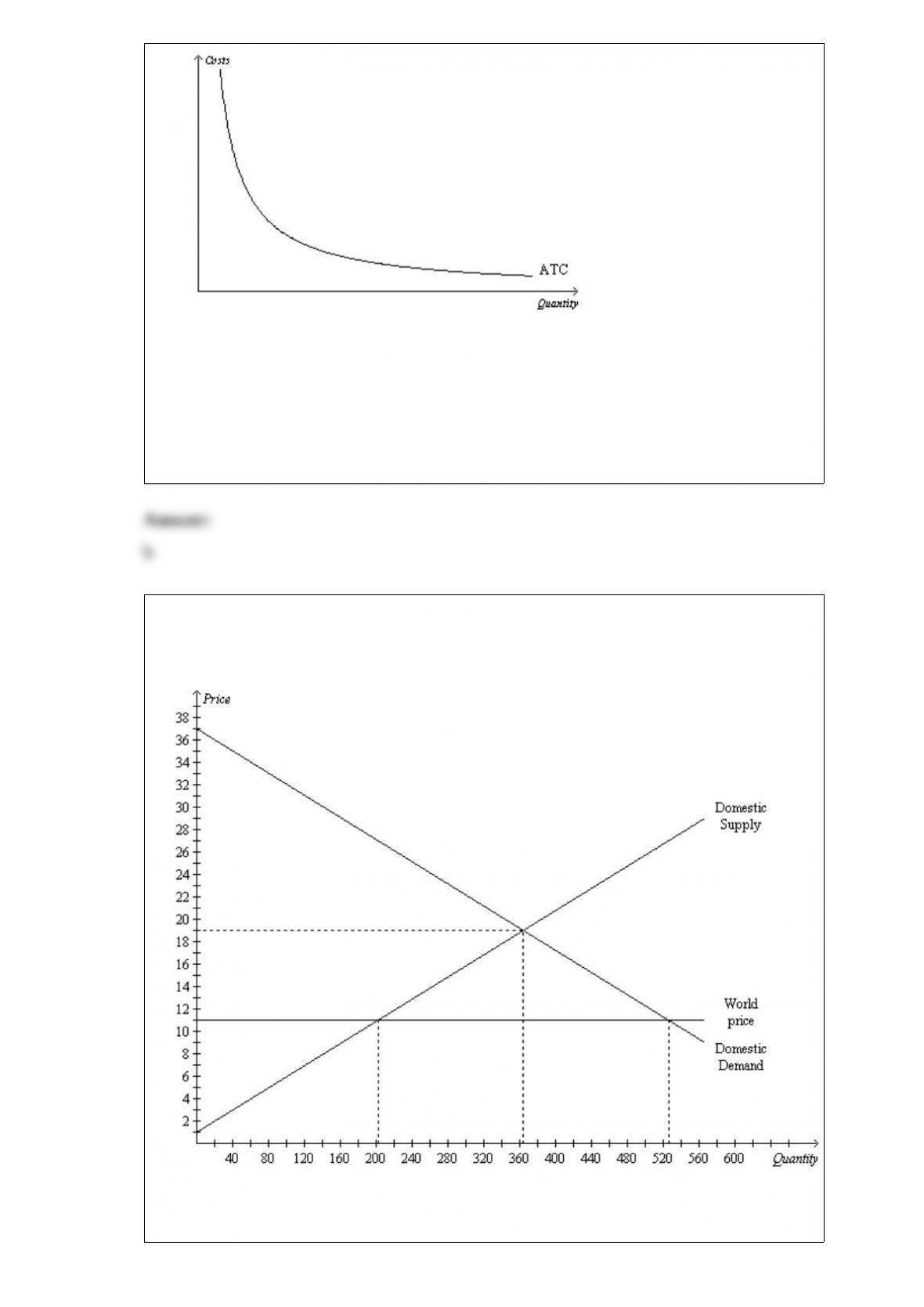
Considering the relationship between average total cost and marginal cost, the marginal
cost curve for this firm
a.must lie entirely above the average total cost curve.
b.must lie entirely below the average total cost curve.
c.must be upward sloping.
d.does not exist.
6) Figure 9-5
The figure illustrates the market for tricycles in a country.
With trade, consumer surplus is
a. $3,240.
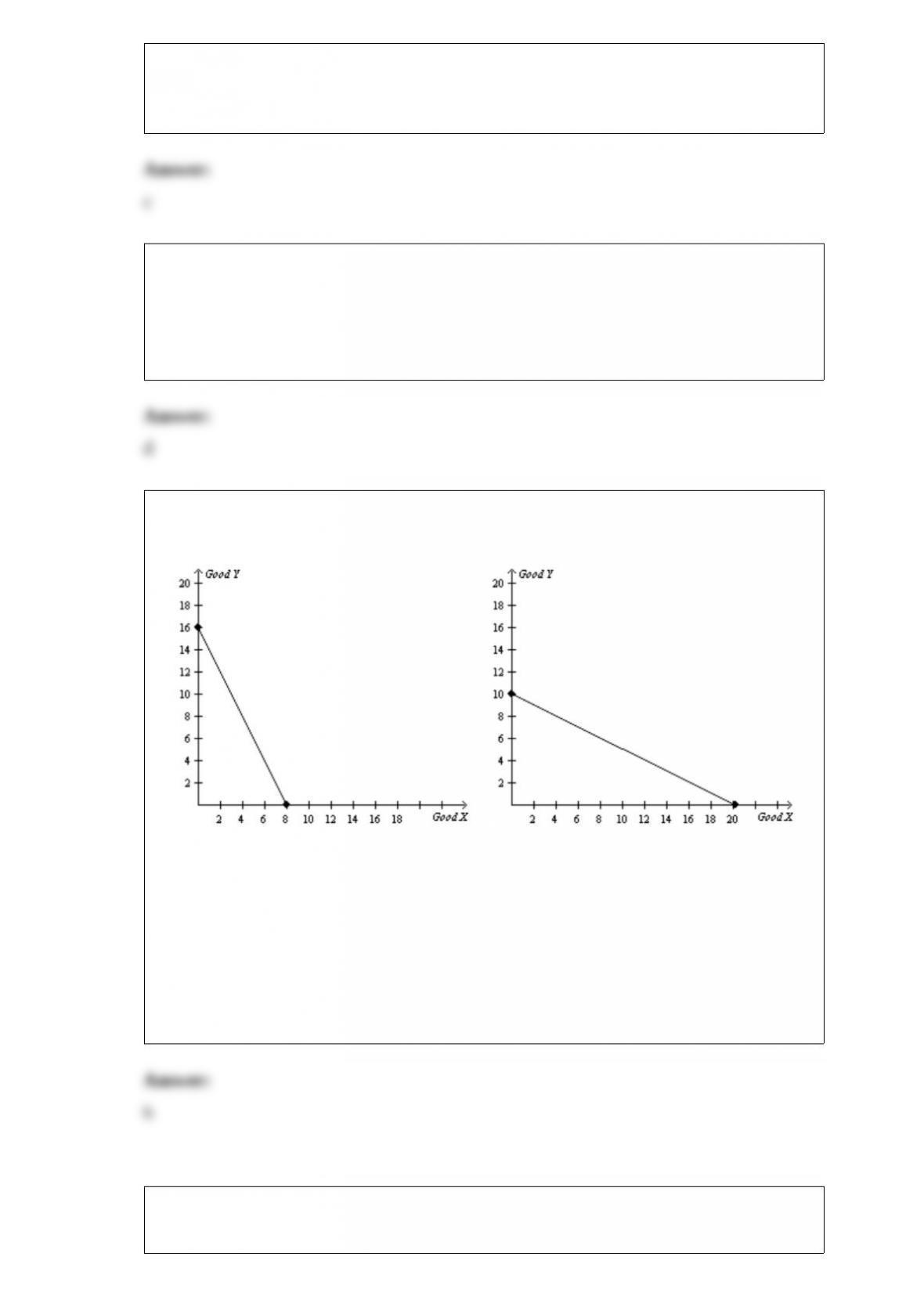
b. $6,480.
c. $6,760.
d. $13,520.
7) The short-run supply curve for a firm in a perfectly competitive market is
a.horizontal.
b.likely to slope downward.
c.determined by forces external to the firm.
d.the portion of its marginal cost curve that lies above its average variable cost.
8) Canada’s Production Possibilities FrontierMexico’s Production Possibilities
Frontier
If Canada and Mexico switch from each country dividing its time equally between the
production of Good X and Good Y to each country spending all of its time producing
the good in which it has a comparative advantage, then total production of Good X will
increase by
a.3 units.
b.6 units.
c.9 units.
d.12 units.
9) Refer to Figure 9-18. If Isoland allows international trade and if the world price of
peaches is $5, then
a.Isoland has a comparative advantage, relative to other countries, in producing
peaches.
b.Isoland will import peaches.
c.consumer surplus with trade exceeds consumer surplus without trade.
d.All of the above are correct.
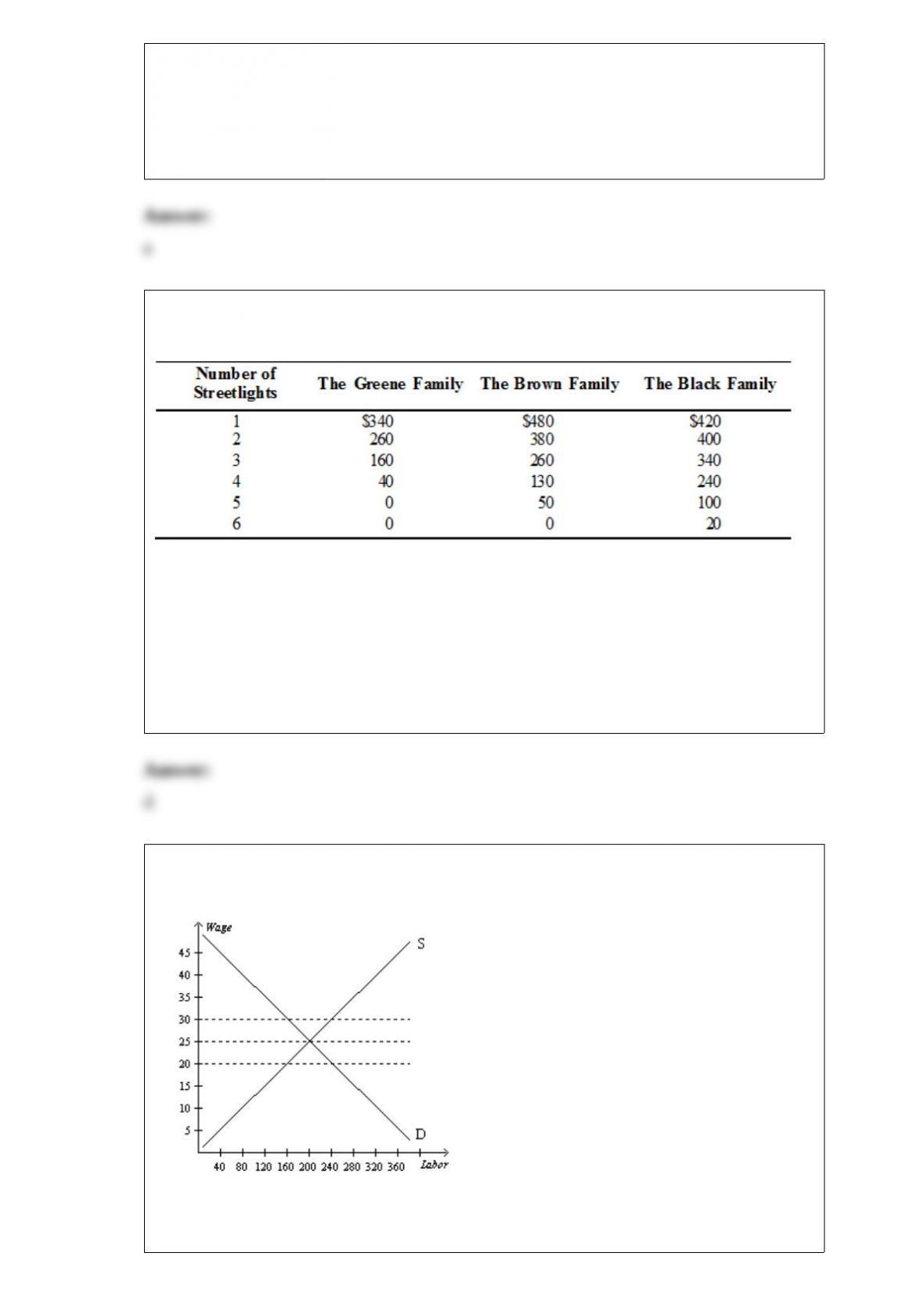
10) Figure 10-9
Suppose the cost to install each streetlight is $360 and the families have agreed to split
the cost of installing the streetlights equally. To maximize their own surplus, how many
streetlights would the Greene’s like the town to install?
a.0 streetlights
b.1 streetlight
c.2 streetlights
d.3 streetlights
17) Figure 19-3
The manufacturing labor market.
Refer to Figure 19-3. Suppose the manufacturing labor market, which is
non-unionized, is in equilibrium at a wage equal to $25. Suppose now that the

AFL-CIO (a labor organization) organizes the workers in the manufacturing market and
negotiates a wage of $30 per hour. Because of the union,
a.80 people who were once employed are now unemployed.
b.40 people who were once employed are now unemployed.
c.80 people who were once unemployed are now employed.
d.40 people who were once unemployed are now employed.
18) A corrective tax is also known as:
a.a command-and-control regulation.
b.a Coase tax.
c.a Pigovian tax.
d.a Smithian tax.
19) The United States has a more unequal income distribution than many other
developed countries such as Japan and Germany.
a.True
b.False
20) Use a graph to demonstrate why a profit-maximizing monopolistically competitive
firm must operate at excess capacity. Explain why a perfectly competitive firm is not
subject to the same constraint.
21) Assume that England and Spain can switch between producing cheese and
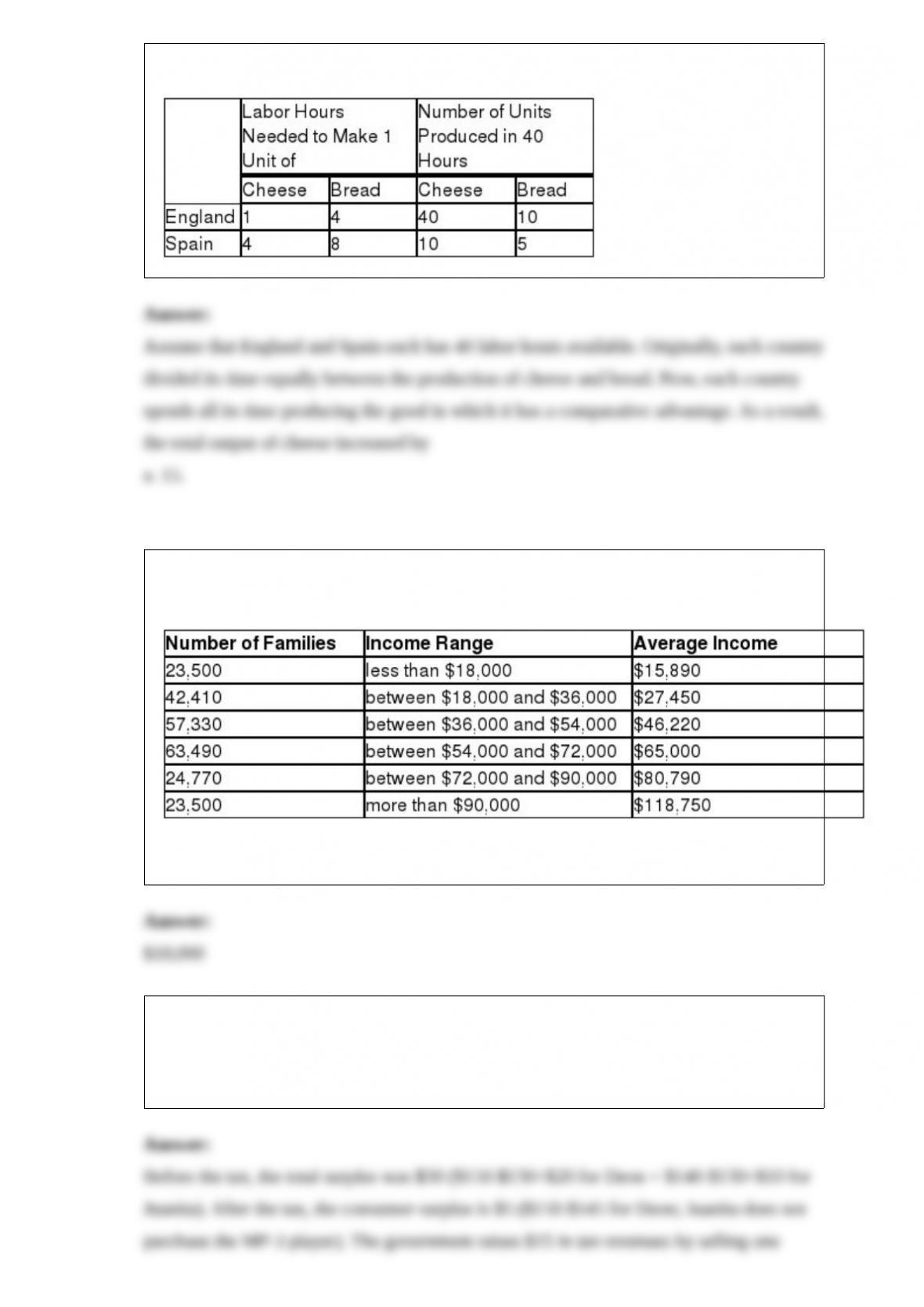
producing bread at a constant rate.
22) Table 20-13
Distribution of Income in Imagination
Refer to Table 20-13. If the poverty rate in Imagination is 10%, what is the poverty
line?
23) Suppose that Deon places a $150 value on a new MP-3 player, and Juanita places a
$140 value on it. The cost of the MP-3 player is $130. Suppose the government levies a
$15 tax on MP-3 players, which raises the price to $145. What is the deadweight loss
created by the tax?

24) One way to place a value on human life is to examine the risks that people
voluntarily take and how much they must be paid for taking them. What is the
approximate value of a human life according to studies that use this approach?