
An individual’s labor supply curve shows
A) the maximum wage rates offered to that individual by various potential employers.
B) the relationship between wages and the quantity of labor that she is willing to
supply.
C) the relationship between wages and the quantity of labor that a firm is willing to
employ.
D) the relationship between the quantity of hours worked and total income earned by
that individual.
Monetary policy can
A) shift the short-run trade-off between inflation and unemployment if it affects
expected inflation.
B) shift the long-run trade-off between inflation and unemployment through changes in
cyclical unemployment.
C) shift neither the short-run nor long-run Phillips curve trade-offs between inflation
and unemployment.
D) shift both the short-run and long-run trade-offs between inflation and unemployment
if changes in policy are credible.
Which of the following is not a major function of the Federal Reserve System?
A) lender of last resort
B) clearing checks between banks
C) setting income tax rates
D) controlling the money supply
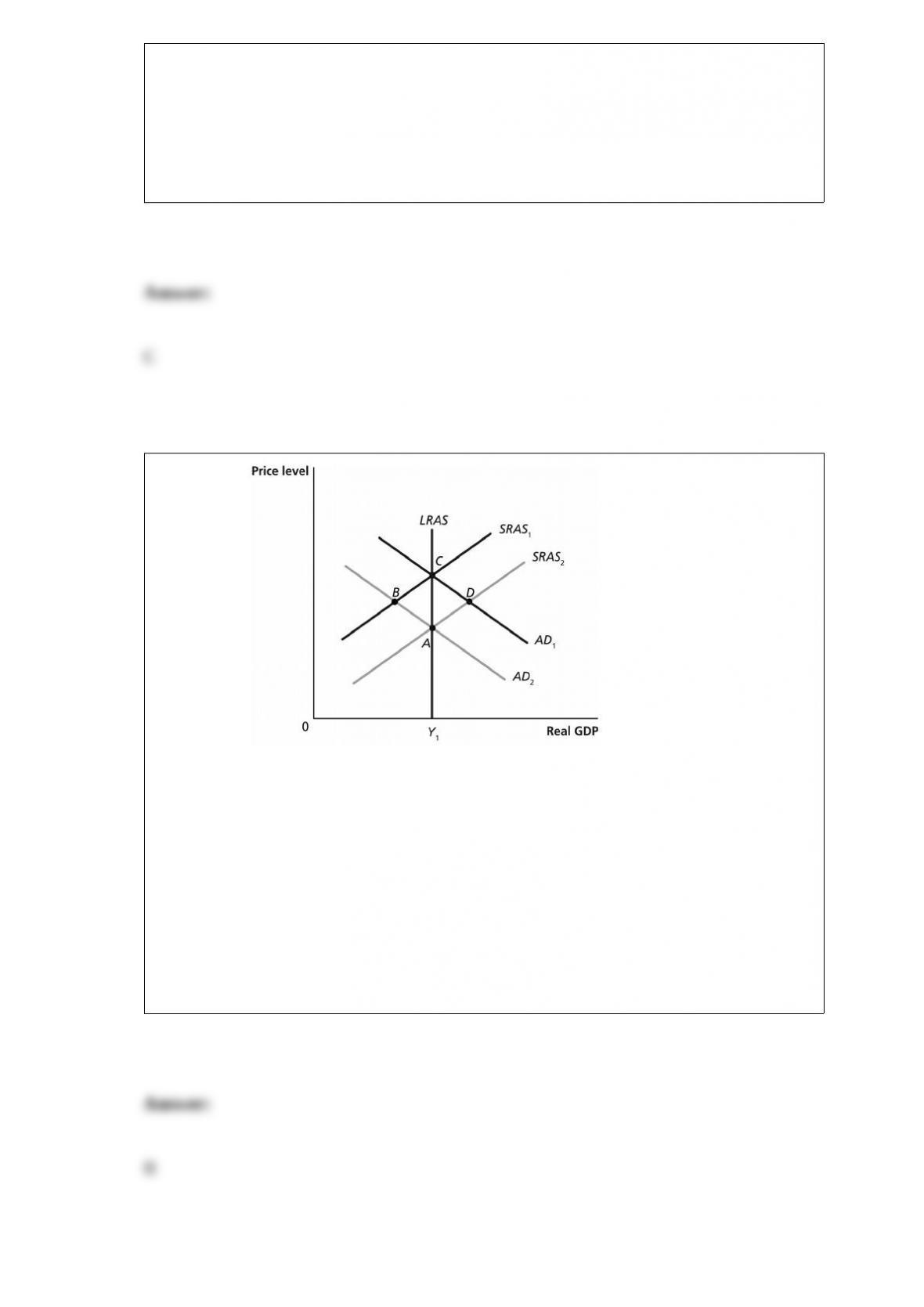
Figure 13-3
Suppose the economy is at point A. If the economy experiences a supply shock, where
will the eventual short-run equilibrium be?
A) A
B) B
C) C
D) D

Changes in the price level
A) increase the level of aggregate supply in the long run.
B) decrease the level of aggregate supply in the long run.
C) do not affect the level of aggregate supply in the long run.
D) increase the level of aggregate supply in the long run only at very high levels of
output.
Assume that emissions from electric utilities contribute to pollution in the form of acid
rain. Which of the following describes how this affects the market for electricity?
A) The equilibrium in the market is not efficient; the marginal benefit from electricity is
greater than the marginal social cost.
B) A deadweight loss occurs; at equilibrium the additional social cost of production is
greater than the additional benefit to consumers.
C) The equilibrium in the market is not efficient; because of the cost of the acid rain,
economic efficiency would be greater if more electricity were produced.
D) The equilibrium in the market is not efficient; consumer surplus is equal to producer
surplus.
Which of the following did not contributed to the overall decline in death rates in the
United States since 1981?
A) a decline in smoking

B) the decline in the population
C) the availability of new prescription drugs
D) new surgical techniques
Disagreements about whether the U.S. government should regulate international trade
A) began during the Great Depression.
B) began after World War I when government officials no longer believed in
isolationism.
C) date back to the beginning of the country.
D) did not occur until the end of the Mexican War in 1848.
High-income countries are also referred to as
A) developing countries.
B) industrial countries.
C) growing countries.
D) agrarian countries.
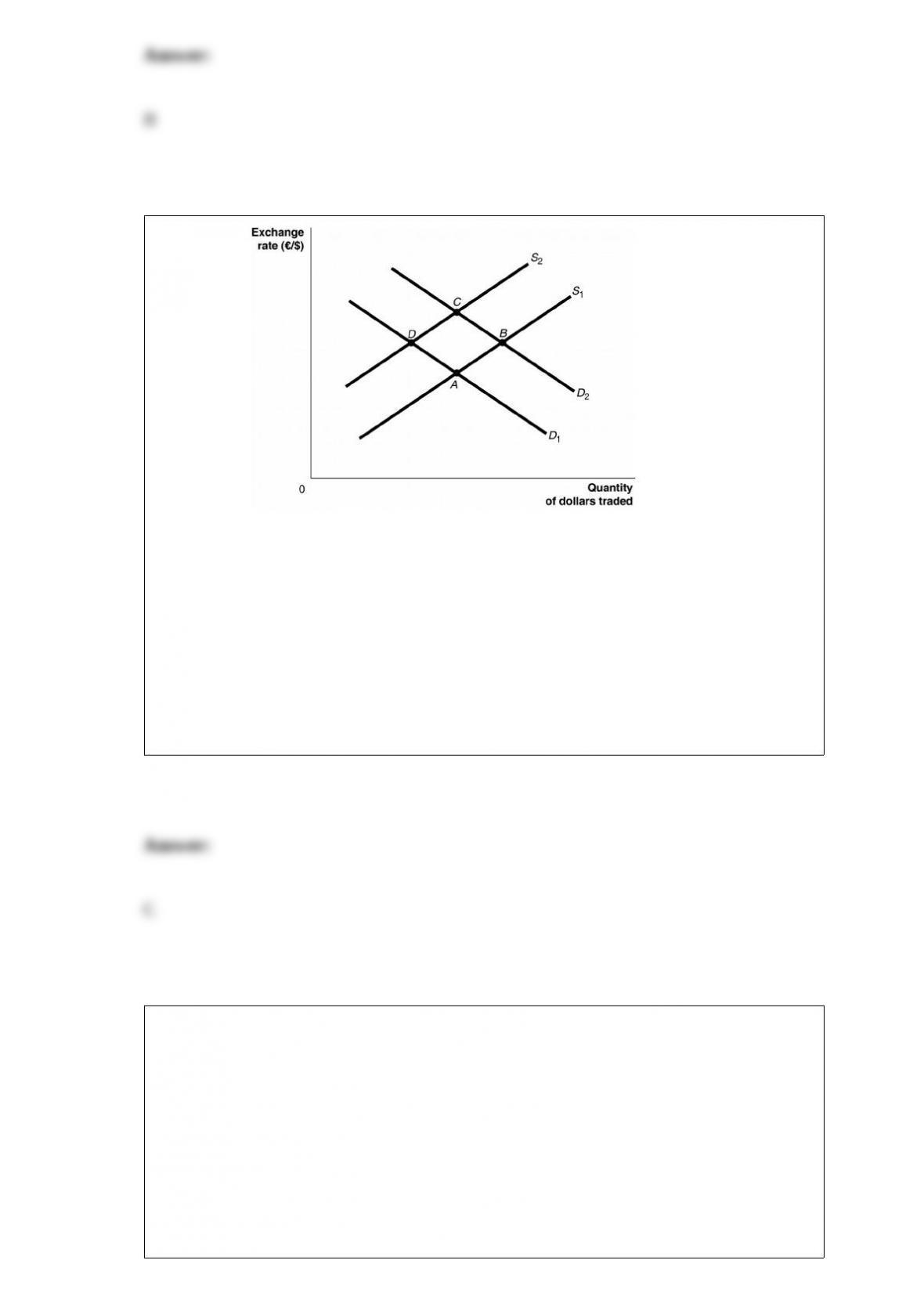
Figure 18-1
The depreciation of the euro is represented as a movement from
A) D to A.
B) C to D.
C) B to C.
D) B to A.
Cost-plus pricing would be consistent with selecting the profit-maximizing price when
A) it results in a price that causes quantity sold to be where marginal revenue equals
marginal cost.
B) a firm has no difficulty estimating its demand curve.
C) consumers value the product beyond its marginal cost.
D) the demand for the firm’s product is unit-elastic.

The Buda Agri Corporation is the sole employer in rural Hungary. In the labor market,
Buda Agri is a
A) monopolistic competitor.
B) monopsony.
C) monopoly.
D) perfect competitor.
The paradox of American farming is
A) the demand for imported luxury food products has risen as the demand for domestic
food products has fallen.
B) the demand for food has risen as the number of people who pursue farming as a
career has fallen.
C) food has become cheaper and more abundant as the number of farms has decreased.
D) the amount of food produced has increased as the average farm size has fallen.

The financial statement that sums up a firm’s revenues, costs, and profit over a period of
time is its
A) income statement.
B) balance sheet.
C) dividend yield statement.
D) price-earnings statement.
In 1980, one Zimbabwean dollar was worth 1.47 U.S. dollars. By the end of 2008, the
exchange rate was one U.S. dollar to 2 billion Zimbabwean dollars. When an economy
experiences rapid increases in the price level such as what occurred in Zimbabwe, the
economy is said to experience
A) stagflation.
B) deflation.
C) inflation.
D) hyperinflation.
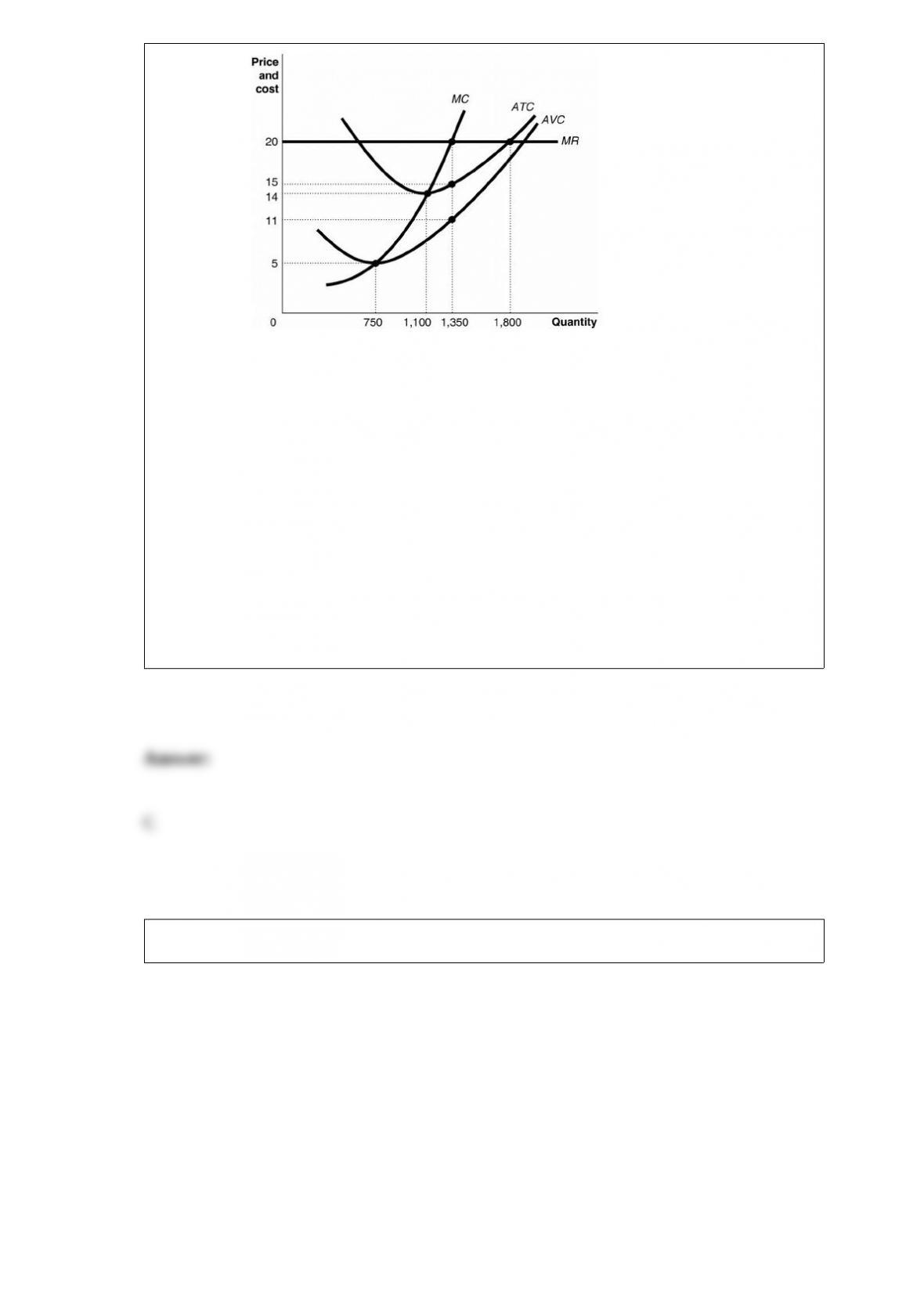
Figure 12-5 Figure 12-5 shows cost and
demand curves facing a typical firm in a constant-cost, perfectly competitive industry.
The figure shows the cost structure of a firm in a perfectly competitive market. If the
firm’s fixed cost increases by $1,000 due to a new environmental regulation, what
happens to its profit-maximizing output level?
A) It increases.
B) It decreases.
C) It remains the same.
D) It could increase, decrease or remain constant, depending on whether the firm is able
to cut costs somewhere else.
Table 13-2

Eco Energy is a monopolistically competitive producer of a sports beverage called
Power On. Table 13-2 shows the firm’s demand and cost schedules. What is the
marginal profit from producing and selling the 5th case?
A) $275
B) $145
C) $35
D) $20
Abercrombie & Fitch wants to raise $8 million to finance the construction of a new
store, and the company wishes to raise the funds through direct finance. Which of the
following methods could it use?
A) It could sell $8 million in bonds.
B) It could borrow $8 million from a bank.
C) It could issue $8 million in stocks.
D) It could choose either A or C.

Workers and firms both expect that prices will be 3% higher next year than they are this
year. As a result,
A) workers will be willing to take lower wages next year.
B) the purchasing power of wages will rise if wages increase by 3%.
C) the short-run aggregate supply curve will shift to the left as wages increase.
D) aggregate demand will increase by 3%.