
In an attempt to bring lenders and borrowers together following the financial crisis of
2008, the Federal Reserve made a large amount of new funds available to financial
markets. Any of these new funds that are loaned out by banks would be classified as
________ of the banks.
A) required reserves
B) excess reserves
C) deposits
D) liabilities
In an economy with ________, there are more prices than in an economy with
________.
A) barter; money
B) money; barter
C) fiat money; commodity money
D) fiat money; barter
Suppose the required reserve ratio is 20 percent. If banks are conservative and choose
not to loan all of their excess reserves, the real-world deposit multiplier is
A) less than 5
B) equal to 5

C) greater than 5
D) equal to 20
Southwest Airlines wants to raise $20 million to finance the renovation of their
corporate offices, and the company wishes to raise the funds through direct finance.
Which of the following methods could it use?
A) It could issue $20 million in stocks.
B) It could sell $20 million in bonds.
C) It could borrow $20 million from a bank.
D) It could choose either A or B.
Table 8-19
Refer to Table 8-19. Given the information above, calculate the GDP deflator in 2013.
A) 114
B) 105

C) 95
D) 87
When calculating GDP, the Bureau of Economic Analysis revises its quarterly data
A) a total of one time.
B) a total of two times.
C) a total of three times.
D) many times over the next several years.
If you own a $1,000 face value bond with one year remaining to maturity and a 3
percent coupon rate and new bonds are paying 14 percent, what is the most you can get
for your old bond?
A) $903.51
B) $997.19
C) $1,000
D) $1,140

In conducting monetary policy, how has the Federal Reserve enhanced its credibility?
A) by not following through with changes it has announced
B) by revealing the Fed’s target for the federal funds rate
C) by keeping the minutes of the open market committee meetings confidential
D) by marketing and increased expenditure on advertising
The natural rate of unemployment will not change following an increase in ________
unemployment.
A) cyclical
B) frictional
C) structural
D) all of the above
The financial statement that sums up a firm’s revenues, costs, and profit over a period of
time is its
A) income statement.
B) balance sheet.
C) dividend yield statement.
D) price-earnings statement.
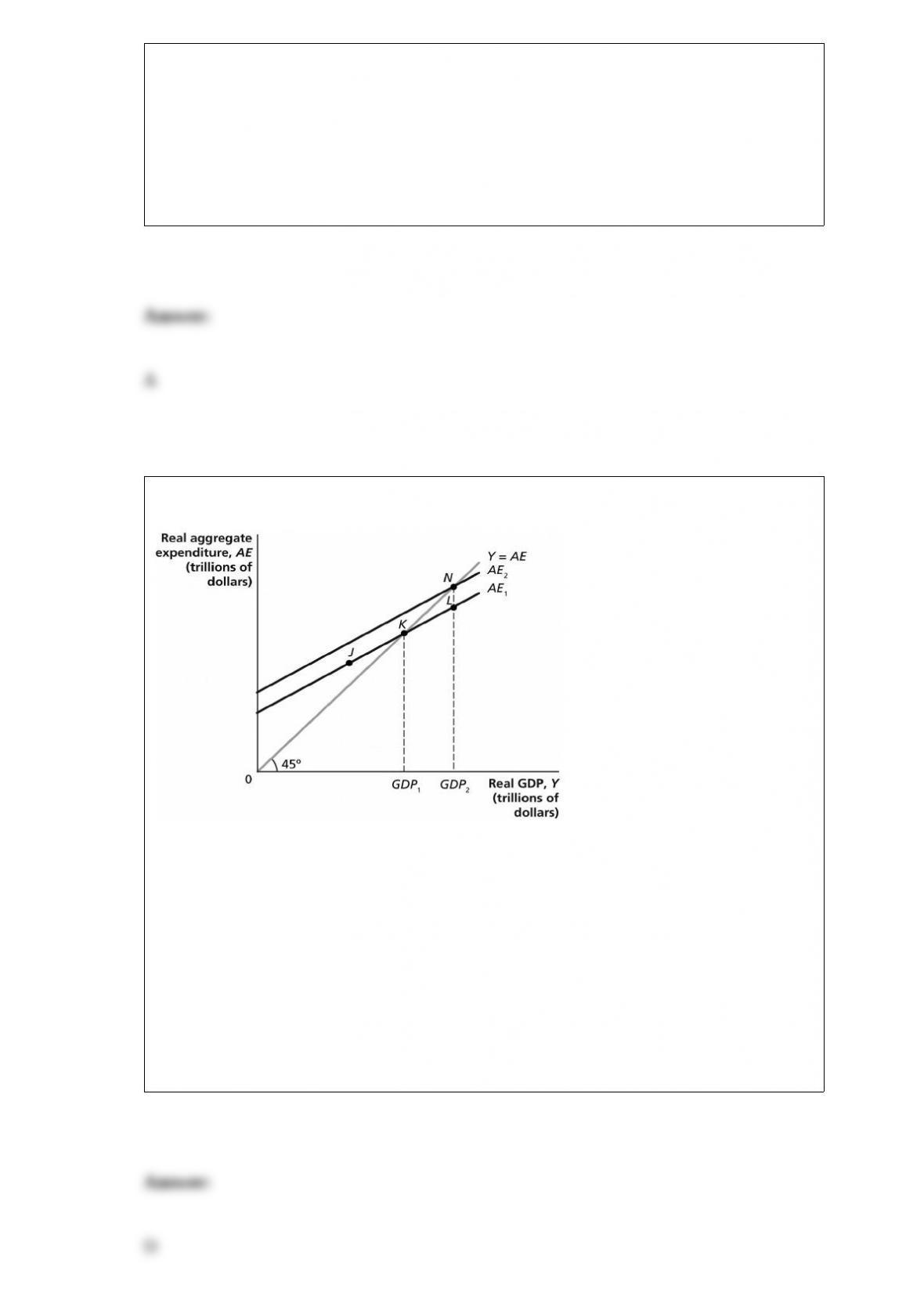
Figure 12-3
Refer to Figure 12-3. Suppose that investment spending increases by $10 million,
shifting up the aggregate expenditure line and GDP increases from GDP1 to GDP2. If
the MPC is 0.9, then what is the change in GDP?
A) $9 million
B) $10 million
C) $90 million
D) $100 million
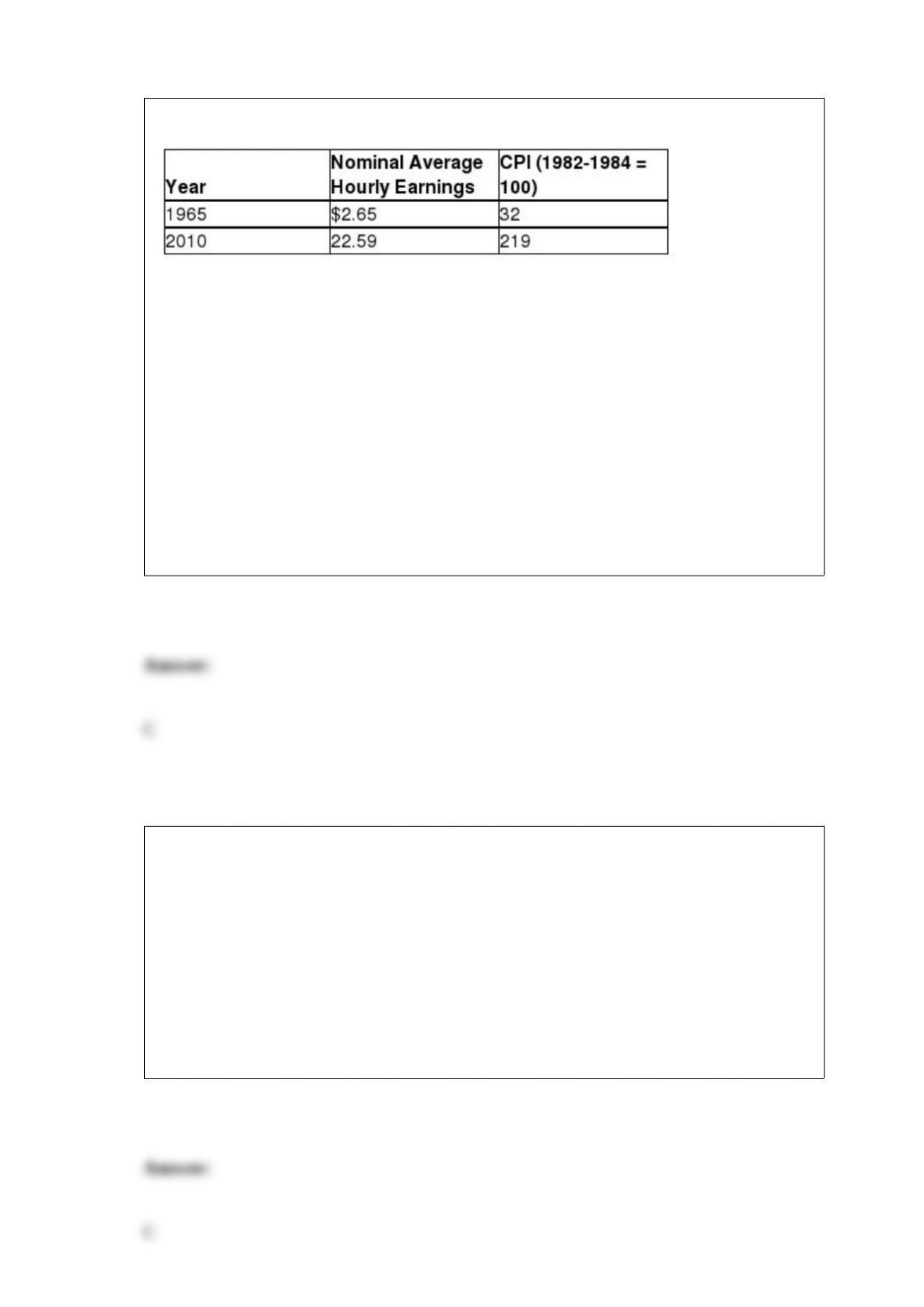
Table 9-14
The table above reports the nominal average hourly earnings in private industry and the
consumer price index for 1965 and 2010.
Refer to Table 9-14. The percentage change in real average earnings from 1965 to 2010
equals
A) 2.0 percent.
B) 19.7 percent.
C) 24.5 percent.
D) 80.3 percent.
Foreign purchases of stocks and bonds issued by U.S. corporations ________ between
1995 and 2007 and ________ in 2012.
A) increased at a slow but steady pace; increased dramatically
B) remained stagnant; declined sharply
C) increased dramatically; declined sharply
D) decreased slightly; increased slightly
a. Distinguish between a tariff and a quota.
b. In what ways are tariffs and quotas similar?
c. In what ways are tariffs and quotas different?
d. Why might a foreign producer prefer a quota rather than a tariff?
Using the money demand and money supply model, an increase in money demand
would cause the equilibrium interest rate to
A) decrease.
B) increase.
C) not change.

D) increase, then decrease.
During a(n) ________ many firms experience reduced profits, which reduces ________
and investment spending.
A) expansion; business confidence
B) recession; cash flow
C) expansion; cash flow
D) recession; government spending
Tax cuts on business income ________ aggregate demand.
A) would decrease
B) would increase
C) would not change
D) may increase or decrease

The curve showing the short-run relationship between the unemployment rate and the
inflation rate is called
A) the monetary policy curve.
B) the Phillips curve.
C) the Sargent curve.
D) the unemployment curve.
If the Fed buys U.S. Treasury securities, then this
A) increases reserves, encourages banks to make more loans, and increases the money
supply.
B) decreases reserves, causes banks to reduce their loans, and decreases the money
supply.
C) decreases reserves, causes banks to reduce their loans, and increases the money
supply.
D) increases reserves, causes banks to reduce their loans, and increases the money
supply.