
The real interest rate is the:
A) rate of interest actually paid by consumers.
B) rate of interest actually paid by banks.
C) rate of inflation minus the nominal interest rate.
D) nominal interest rate minus the rate of inflation.
Money market mutual fund shares are included in:
A) M1 only.
B) M2 only.
C) both M1 and M2.
D) neither M1 nor M2.
To minimize the disincentives of very high taxes, a policy of tax smoothing requires a
budget ______ in years of unusually low government revenue and a budget ______ in
years of unusually high government expenditures.
A) surplus; deficit
B) deficit; surplus

C) surplus; surplus
D) deficit; deficit
The unemployment resulting from wage rigidity and job rationing is called ______
unemployment.
A) frictional
B) structural
C) minimum-wage
D) insider
If Y = K0.3L0.7, then the per-worker production function is:
A) Y = F(K/L).
B) Y/L = (K/L)0.3.
C) Y/L = (K/L)0.5.
D) Y/L = (K/L)0.7.

After the Kennedy tax cut in 1964, real GDP:
A) fell and unemployment rose.
B) rose and unemployment fell.
C) and unemployment both rose.
D) and unemployment both fell.
Kuznets’ data showed a short-run consumption function with a ______ APC, and a
long-run consumption function with a ______ APC.
A) constant; constant
B) constant; falling
C) falling; constant
D) falling; falling

The endogenous growth model’s assumption of constant returns to capital is more
plausible if capital is defined to include:
A) plant and equipment.
B) knowledge.
C) depreciation.
D) technology.
Passive economic policy seeks to:
A) offset fluctuations in real GDP.
B) use monetary and fiscal policy to shift aggregate demand.
C) respond to changing economic conditions.
D) take a hands-off approach to macroeconomic policy.
Assume that two countries both have the per-worker production function y = k1/2,
neither has population growth or technological progress, depreciation is 5 percent of
capital in both countries, and country A saves 10 percent of output whereas country B
saves 20 percent. If A starts out with a capital”labor ratio of 4 and B starts out with a

capital”labor ratio of 2, in the long run:
A) both A and B will have capital”labor ratios of 4.
B) both A and B will have capital”labor ratios of 16.
C) A’s capital”labor ratio will be 4 whereas B’s will be 16.
D) A’s capital”labor ratio will be 16 whereas B’s will be 4.
Assuming there is perfect capital mobility, compared to a large open economy, a small
open economy is one in which the:
A) exchange rate is fixed.
B) exchange rate is floating.
C) domestic interest rate equals the world interest rate.
D) domestic interest rate is not equal to the world interest rate.
Across countries of Europe, greater spending on unemployment insurance tends to
_____ unemployment and more “active” labor-market policies tend to _____
unemployment.
A) increase; increase

B) increase; decrease
C) decrease; decrease
D) decrease; increase
Investment goods as measured in the GDP are purchased by:
A) business firms alone.
B) households alone.
C) business firms and households.
D) business firms, households, and governments.
High levels of government debt that raise investors’ fear of a government default on
debt will result in capital ______ and a(n) ______ of the country’s exchange rate.
A) outflows; depreciation
B) outflows; appreciation
C) inflows; depreciation
D) inflows; appreciation

If the Fed announces that it will raise the money supply in the future but does not
change the money supply today,
A) both the nominal interest rate and the current price level will decrease.
B) the nominal interest rate will increase and the current price level will decrease.
C) the nominal interest rate will decrease and the current price level will increase.
D) both the nominal interest rate and the current price level will increase.
A change in investors’ perceptions that make a fixed exchange rate untenable is known
as:
A) a speculative attack.
B) dollarization.
C) seigniorage.
D) a floating currency board.
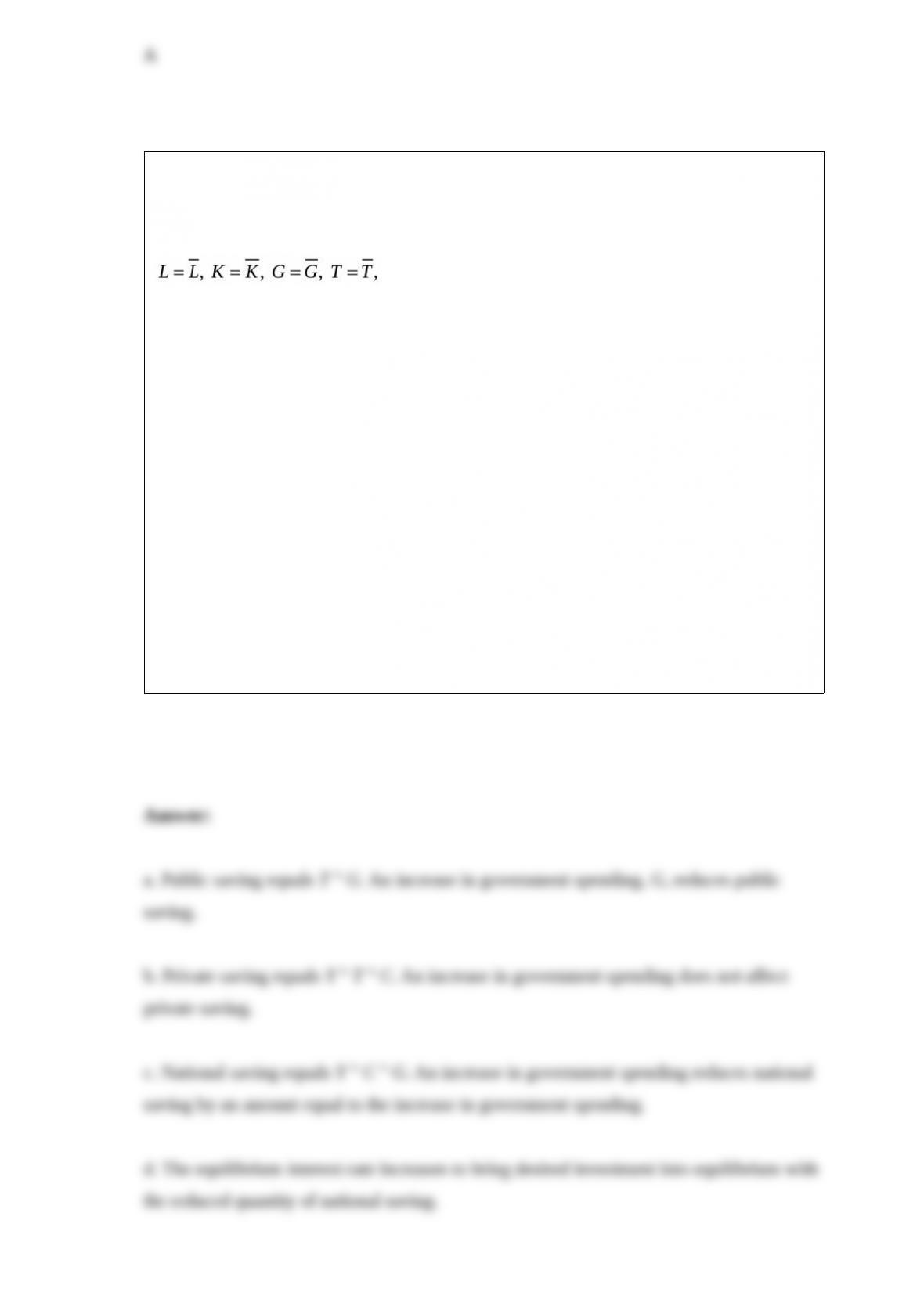
Consider a competitive economy in which factor prices adjust to keep the factors of
production fully employed, and the interest rate adjusts to keep the supply and demand
for goods and services in equilibrium. The economy can be described by the following
set of equations:
Y = AKaL(1 “a)
Y = C + I + G
C = C(Y ” T)
I = I(r)
How does an increase in government spending, holding other factors constant, affect the
level of:
a. public saving?
b. private saving?
c. national saving?
d. the equilibrium interest rate?
e. the equilibrium quantity of investment?

The current inflation rate, pt, represents the change in the price level between periods:
A) t ” 1 and t
B) t and t + 1
C) t ” 1 and t + 1
D) t and t + 2
Financial markets allow households to _____ provide resources for investment, while
financial intermediaries allow households to _____ provide resources for investment.
A) directly; indirectly
B) indirectly; directly
C) productively; unproductively
D) unproductively; productively

Which of the following statements most closely describes the variation in
unemployment rates across countries in Europe?
A) Countries with higher rates of unionization tend to have higher unemployment rates,
but this is partially mitigated if wage negotiations are coordinated among employers.
B) Countries with higher rates of unionization tend to have higher unemployment rates
and this tendency is exacerbated if wage negotiations are coordinated among
employers.
C) Countries with more generous unemployment insurance benefits tend to have higher
unemployment rates, but this is partially mitigated if the benefits are offered for a
longer period of time.
D) Countries with more generous unemployment insurance tend to have lower
unemployment rates, but this effect is completely offset if benefits are offered for a
longer period of time.
If a country chooses to have free capital flows and to maintain a fixed exchange rate,
then it must:
A) live with exchange-rate volatility.
B) restrict its citizens from participating in world financial markets.
C) give up the use of monetary policy for purposes of domestic stabilization.
D) give up the use of fiscal policy for purposes of domestic stabilization.
Although “inflation is always and everywhere a monetary phenomenon,” explain why:
a. the start of a hyperinflation is typically related to the fiscal policy situation, and
b. the end of a hyperinflation is usually related to changes in fiscal policy.
Inflation ______ the variability of relative prices and ______ allocative efficiency.
A) increases; increases
B) increases; decreases
C) decreases; decreases
D) decreases; increases
Compare and contrast the explanation for declining stock market prices according to:
a. the efficient markets hypothesis, and
b. the Keynesian “beauty contest” hypothesis.
Suppose that two countries are exactly alike in every respect except that the citizens of
country A have a higher saving rate than the citizens of country B.
a. Which country will have the higher level of output per worker in the steady state?
Illustrate graphically.
b. Which country will have the faster rate of growth of output per worker in the steady
state?
The Phillips curve in Lowland takes the form of p = 0.04 ” 0.5 (u ” 0.05), where p is the
actual inflation rate and u is the unemployment rate. The Phillips curve in Highland
takes the form of p = 0.08 ” 0.5 (u ” 0.05). The current unemployment rate in both
countries is 9 percent (0.09).
a. Explain the similarities in the Phillips curves in Highland and in Lowland.
b. Explain the difference in the Phillips curves in Highland and in Lowland.
c. In which country will policymakers face a bigger tradeoff if they try to reduce
unemployment in the short run?

A debt-financed tax cut will ______ saving in the traditional view and ______ saving in
the view of Ricardian equivalence.
A) increase; increase
B) decrease; decrease
C) decrease; increase
D) decrease; not change
Gary Becker’s criticism of government spending on infrastructure as part of President
Obama’s stimulus plan was that:
A) spending on infrastructure would not increase production in the economy.
B) there is a conflict between where spending on infrastructure would benefit
employment and where infrastructure is most needed.
C) government spending on infrastructure is less effective in increasing production than
an equal amount of private spending on infrastructure.
D) government spending on infrastructure only increases demand, but tax cuts increase
demand and supply.

Use the model developed in Chapter 3 and assume that consumption does not depend
on the interest rate. In this case, when the government lowers taxes on business
investment, thus increasing desired investment, but does not change government
spending or change any taxes that affect disposable income, then the quantity of
investment:
A) increases and the interest rate rises.
B) is unchanged and the interest rate rises.
C) and the interest rate are both unchanged.
D) decreases and the interest rate rises.
In a Cobb”Douglas production function the marginal product of labor will increase if:
A) the quantity of labor increases.
B) the quantity of capital increases.
C) capital’s share of output increases.
D) average labor productivity decreases.
While a rental firm is renting out its capital, the price of capital can change. What is the
impact of changed capital price on the firm?
Graphically illustrate: (1) what happens to the rental price of capital and the marginal
product of capital as the stock of capital increases, and (2) how the change in the
marginal product of capital changes the investment demand function. Explain in words
how this process will continue in the long run until the steady state is reached.
Assume that a government raises its own expenditures and funds those expenditures by
printing more money, thereby raising the money supply in the economy. How will this
affect the IS-LM curve and the equilibrium level of income and the interest rate
Who propounded the concept of “creative destruction”? What does this concept mean?
In an economy, if 5 percent of the employed lose their job every month (s = 05) while
15 percent of the unemployed find a job every month (f = 15), what is the steady rate of
unemployment of the economy?
What is the difference between the short run and the long run?
Income per person exceeds $25,000 in many countries, but it is below $1,000 per
person in many other countries. Based on the Solow growth model, suggest at least four
possible explanations for this gap in living standards.
Explain how technological changes that have reduced the demand for low-skilled
workers can change the natural rate of unemployment.
Monetary policy can be either a stabilizing influence on the economy or a source of
instability. Give an explanation for both possibilities.
The government of an economy has increased its spending and taxes by the same
amount. What is the effect on investment?
Briefly describe the Mundell-Fleming model .
If 250 workers are unemployed for a period of 1 month, 150 for the period of 6 months
and 100 for the period of 12 months in a given year, how many spells and months of
unemployment occur during a year?
The real interest rates and real exchanges rates are constant and equal in North Country
and South Country. The Fisher equation and purchasing-power parity hold in both
countries. If the nominal interest rate is 8 percent in North Country and 10 percent in
South Country, do you expect North Country’s nominal exchange rate to appreciate,
depreciate, or remain the same? Explain.
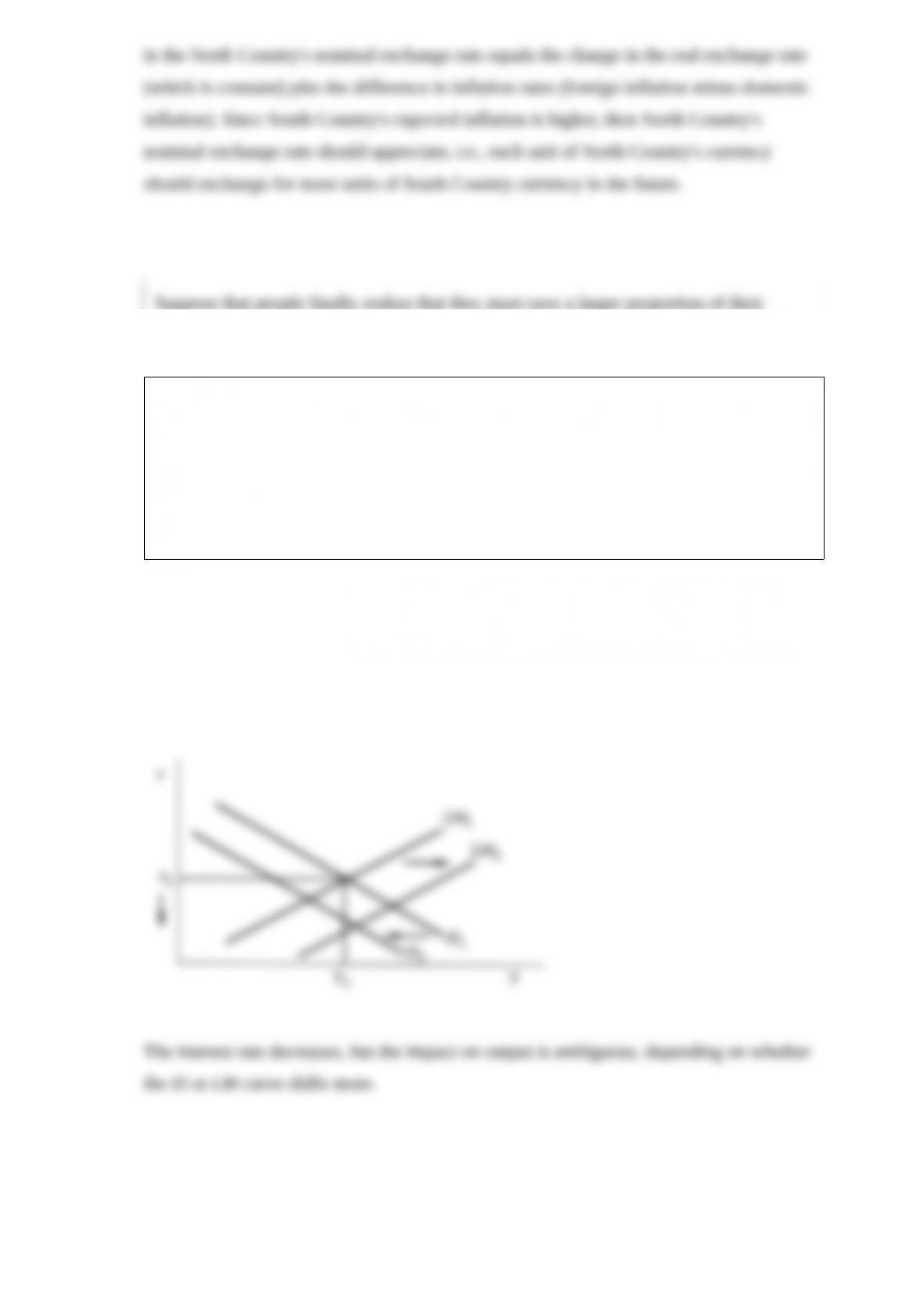
Suppose that people finally realize that they must save a larger proportion of their
income in order to retire and that they simultaneously begin to use new technology that
allows them to reduce their holdings of real cash balances as a proportion of their
income. Use the IS“LM model to illustrate graphically the impact of these two changes
in household behavior on output and interest rates. Be sure to label: i. the axes; ii. the
curves; iii. the initial equilibrium values; iv. the direction the curves shift; and v. the
terminal equilibrium values.