1) Suppose the price level is fixed, the MPC is .8, and the GDP gap is a negative $320
billion. To achieve full-employment output (exactly), government should:
A.increase government expenditures by $320 billion.
B.increase government expenditures by $80 billion.
C.reduce taxes by $320 billion.
D.reduce taxes by $80 billion.
2)
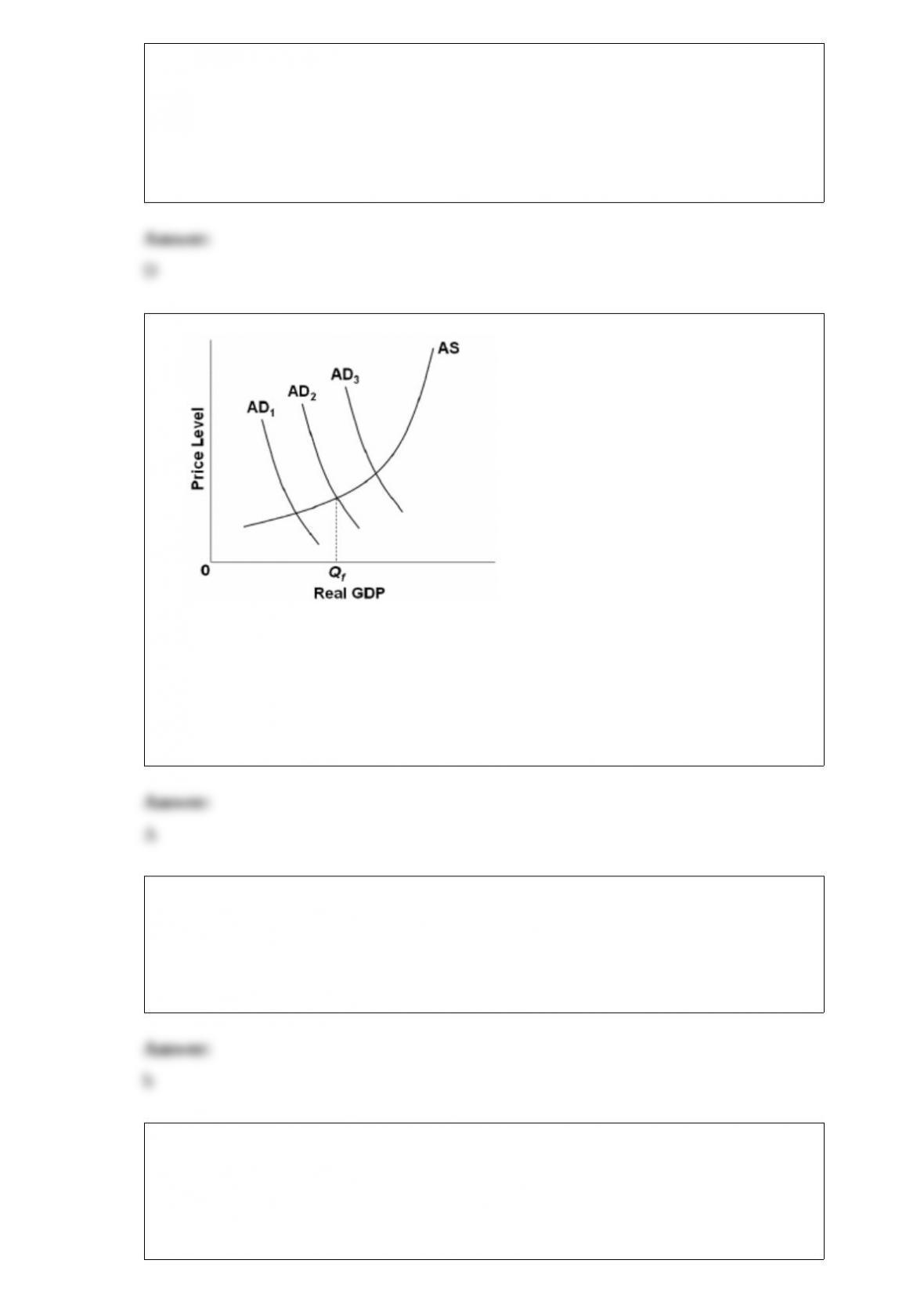
Refer to the above diagram, in which Qf is the full-employment output. The shift of the
aggregate demand curve from AD1 to AD2 is consistent with:
A.an expansionary fiscal policy.
B.a major recession.
C.a contractionary fiscal policy.
D.severe demand-pull inflation.
3) which of the following might shift a nation’s production possibilities curve inward?
a.improved technology.
b.devastation by war.
c.improved health care.
d.a business downturn in which unemployment temporarily rises.
4) If the nominal GDP is $477 billion and the velocity of money is 4.5, then the money
supply is:
A.$122 billion.
B.$98 billion.
C.$106 billion.
D.$477 billion.
5) if the income elasticity of demand for lard is -3.00, this means that:
a.lard is a substitute for butter.
b.lard is a normal good.
c.lard is an inferior good.
d.more lard will be purchased when its price falls.
6) What will be the elasticity of resource demand in the following cases?
(a)unit wages rise by 10% and the number of employed workers falls by 5%
(b)unit wages rise by 4% and the number of employed workers falls by 6%
(c)unit wages rise by 3% and the number of employed workers falls by 3%
7)
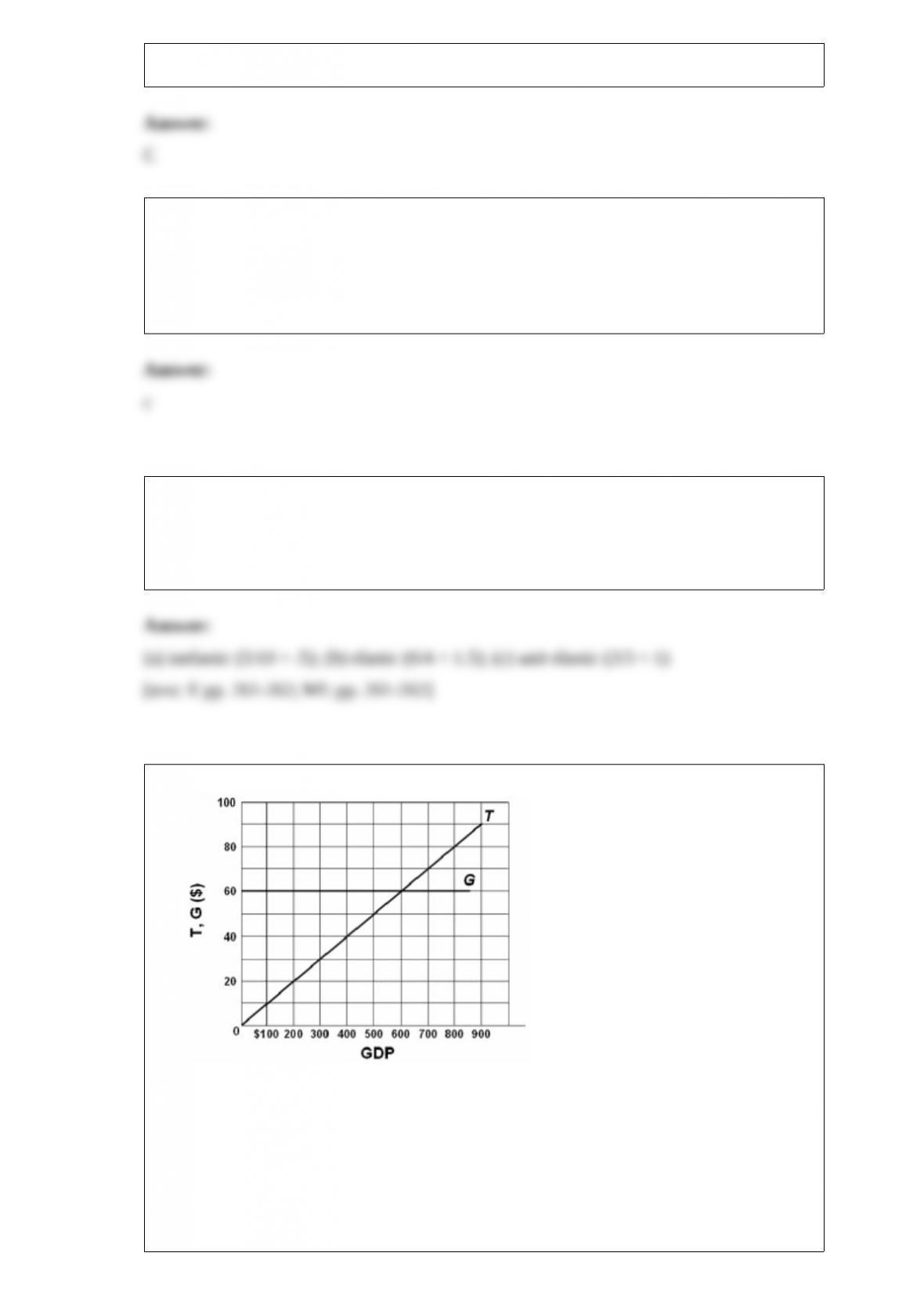
Refer to the above diagram where T is tax revenues and G is government expenditures.
All figures are in billions of dollars. If the full-employment GDP and actual GDP are
each $400 billion, this economy will realize a:
A.standardized deficit of $20 billion.
B.cyclical deficit of $20 billion.
C.cyclical surplus of $20 billion.
D.standardized deficit of zero.
8) Required payments to parties injured by firms found to have violated the Sherman
Act are known as:
A.antitrust fines.
B.treble damages.
C.economic reparations.
D.loss carry-forwards.
9)
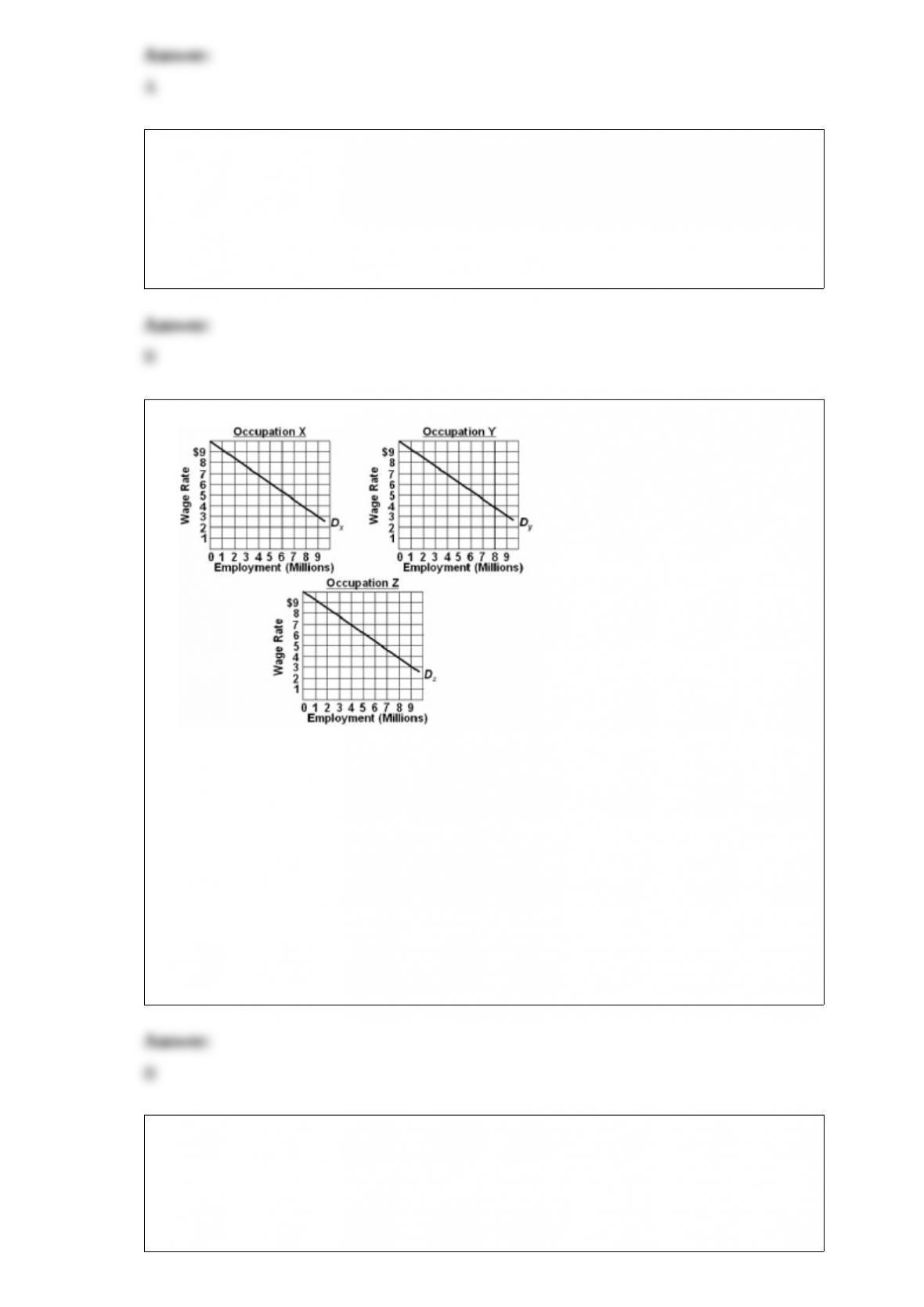
Assumptions: (1) the labor force is comprised of 9 million men and 9 million women
workers; (2) the economy has 3 occupations, X, Y, and Z, each having identical demand
curves for labor; (3) men and women workers are homogeneous with respect to their
labor-market capabilities; (4) women are discriminated against by being excluded from
occupations X and Y and are confined to Z; and (5) aside from discrimination, the
economy is competitive.
Refer to the above diagram and list of assumptions. If discrimination is ended, women:
A.and men will both receive a wage rate of $4.
B.and men will both receive a wage rate of $5.
C.and men will both receive a wage rate of $6.
D.will receive a wage rate of $4 and men will receive a wage rate of $5.
10) The MRP curve for labor:
A.is downsloping and shows the relationship between wage rates and the quantity of
labor demanded.
B.is perfectly elastic if the firm is selling its output competitively.
C.is upsloping and lies above the labor supply curve.

D.will shift location when the wage rate changes.