
Which of the following statements is NOT compatible with explanations for why
peak-load pricing is more profitable than charging a single price?
A) Consumer willingness to pay for the product varies a lot across different time
periods.
B) Marginal cost of production is much higher under peak demand.
C) Marginal revenue changes a lot across different time periods.
D) Marginal revenue must be the same across different time periods.
Which of these is an example of a negative network externality?
A) Bandwagon effect
B) Pollution
C) Snob effect
D) Two-part tariff
Use the following two statements to answer this question:
I. If the marginal product of labor is zero, the total product of labor is at its maximum.
II If the marginal product of labor is at its maximum, the average product of labor is

falling.
A) Both I and II are true.
B) I is true, and II is false.
C) I is false, and II is true.
D) Both I and II are false.
In 1992, the Occupational Safety and Health Authority passed the Bloodborne
Pathogens Standard (BBP), which regulates dental office procedures. This regulation is
designed to minimize the transmission of infectious disease from patient to dental
worker. The effect of this regulation was both to increase the cost of providing dental
care and to ease the fear of going to the dentist as the risk of contracting an infectious
disease.
Under what circumstances will the equilibrium level of output of dental care remain the
same?
A) If supply shifts more than demand.
B) If demand shifts more than supply.
C) If both demand and supply shift by the same magnitude.
D) If supply and demand shift in the same direction.

Use the following two statements to answer this question:
I. The price elasticity of demand is constant along the entire length of a linear demand
curve.
II. The price elasticity of demand is the special name that economists give to the slope
of a demand curve.
A) I and II are true.
B) I is true, and II is false.
C) I is false, and II is true.
D) I and II are false.
Suppose you are an attorney, and you are defending a client in a wrongful death suit.
The deceased was a pilot for an aerial acrobatics team, and the opposing attorney has
prepared an an estimate of the value of lost income that includes the mortality rate for
all pilots. You should argue that the attorney’s estimate of lost earnings is too ________
because the mortality rate for aerial acrobats is ________ than for other types of pilots.
A) low, lower
B) low, higher
C) high, lower
D) high, higher

Alfred derives utility from consuming iced tea and lemonade. For the bundle he
currently consumes, the marginal utility he receives from iced tea is 16 utils, and the
marginal utility he receives from lemonade is 8 utils. Instead of consuming this bundle,
Alfred should:
A) buy more iced tea and less lemonade.
B) buy more lemonade and less iced tea.
C) buy more iced tea and lemonade.
D) buy less iced tea and lemonade.
E) none of the above is necessarily correct.
Several years ago, Alcoa was effectively the sole seller of aluminum because the firm
owned nearly all of the aluminum ore reserves in the world. This market was not
perfectly competitive because this situation violated the:
A) price-taking assumption.
B) homogeneous product assumption.
C) free entry assumption.
D) A and B are correct.
E) A and C are correct.

Why don’t some firms in monopolistic competition earn losses in the long run?
A) The firms have enough monopoly power to ensure they always earn profits.
B) Free entry allows enough firms to remain in the market and maintain the critical
mass of firms required to attract customers.
C) Free exit implies that any unprofitable firms leave the market in the long run.
D) In the long run, firms will build enough brand loyalty among customers to ensure a
profitable level of sales.
Which of the following will cause the demand curve for Beatles’ compact discs to shift
to the right?
A) An increase in the price of the discs
B) A decrease in consumers’ incomes
C) An increase in the price of Phil Collins’ latest compact disc (a substitute)
D) all of the above
E) none of the above

What is the shape of the total revenue curve derived from a horizontal demand curve?
A) Horizontal
B) Vertical
C) U-shaped
D) Upward sloping, with a positive slope
The first term in an NPV calculation is usually
A) positive, because firms consider only positive returns.
B) positive, because interest charges do not accrue until the second period.
C) zero, because interest charges do not accrue until the second period.
D) negative, because funds for the project have to be borrowed up front before it is
begun.
E) negative, because the cost of the project is immediate, but revenue streams from the
project come later.
The indifference curves of two investors are plotted against a single budget line.
Indifference curve A is shown as tangent to the budget line at a point to the left of
indifference curve B’s tangency to the same line.

A) Investors A and B will hold the same portfolio.
B) Investors A and B will have different portfolios of the same standard deviation.
C) Investors A and B will have different portfolios of the same rate of return.
D) Investors A and B will have different portfolios but have the same level of risk
aversion.
E) Investor A will expect to earn a lower rate of return than investor B.
Customers attending basketball games at the local arena must pay for parking on the
grounds and then pay for a ticket needed to enter the arena. If the arena manager knows
that the customers’ identical demands can be expressed collectively as
P = 25 – 0.000625Q
how much of a parking fee could the management collect if the marginal cost of
providing entertainment were a constant MC = $10 per seat?
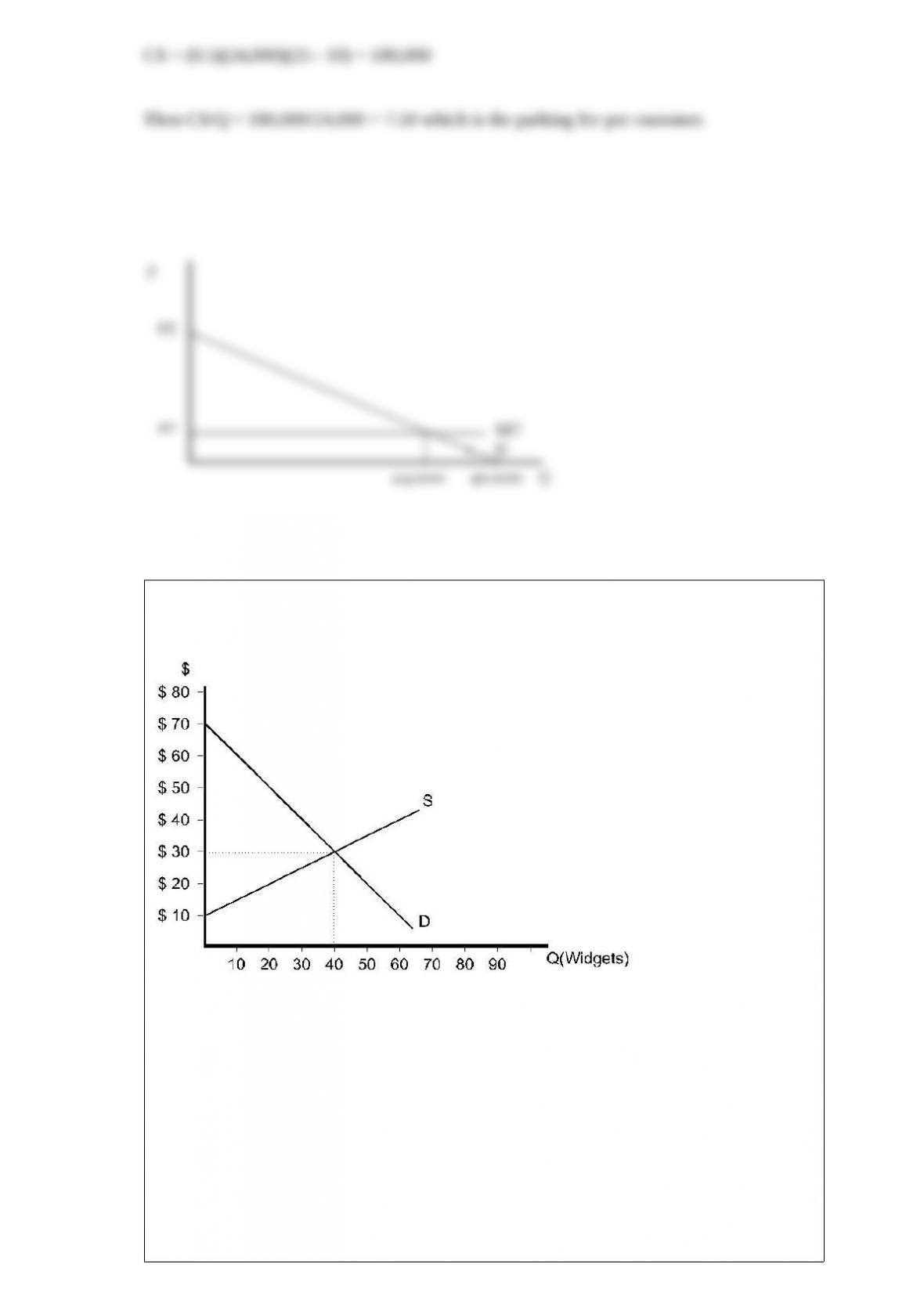
Figure 9.4
Suppose the market in Figure 9.4 is currently in equilibrium. If the government
establishes a price floor of $40, consumer surplus will
A) fall by $50.
B) fall by $350.
C) remain the same.
D) rise by $50.

E) rise by $350.
Suppose a plant manager ignores some implicit marginal costs of production so that the
perceived MC curve is below the actual MC curve. What is the likely outcome from this
error?
A) Firm produces less than optimal quantity and earns lower profits
B) Firm produces less than optimal quantity and earns higher profits
C) Firm produces more than optimal quantity and earns lower profits
D) Firm produces more than optimal quantity and earns higher profits
For U.S. consumers, the income elasticity of demand for fruit juice is 1.1. If the
economy enters a recession next year and consumer income declines by 2.5%, what is
the expected change in the quantity of fruit juice demanded next year?
A) -2.75%
B) +2.75%
C) -27.5%
D) +27.5%

The completion of a degree or course of study is a good labor market signal
A) only if what is learned in that educational process relates directly to the job the
individual is being considered for.
B) only if there is a positive correlation between academic success and wage income.
C) primarily because individuals develop good habits in college that serve them well in
other areas later on.
D) because all individuals have the opportunity (in the United States) to pursue higher
education.
E) because people who possess the traits that make them more productive in the
workplace have an easier time completing an education than those who don’t.
The trade-offs facing consumers include:
A) how to allocate income across goods and serves.
B) how to allocate income between consumption and savings.
C) both A and B
D) none of the above

The Lerner index measures
A) a firm’s potential monopoly power.
B) the amount of monopoly power a firm chooses to exercises when maximizing
profits.
C) a firm’s potential profitability.
D) an industry’s potential market power.
The concept of a risk premium applies to a person that is
A) risk averse.
B) risk neutral.
C) risk loving.
D) all of the above

Gasoline and bicycles are substitutes in consumption. Suppose we increase the federal
gasoline tax to $1 per gallon. Initially, the gasoline price rises due to the tax, and the
demand curve for bicycles shifts rightward because these goods are substitutes. Then,
the bicycle price rises, and the demand curve for gasoline shifts rightward. Assuming
the general equilibrium is achieved in both markets after these two steps, which of the
following statements is NOT true?
A) Partial equilibrium analysis only focuses in the first-round changes in the gasoline
market (ignoring the secondary effects that arise from changes in the bicycle market).
B) Partial equilibrium analysis would predict a larger shift in the price and quantity
demanded for gasoline than a general equilibrium analysis.
C) The price increase in gasoline is larger under the general equilibrium approach, but
the change in the quantity of gasoline demanded is smaller than under partial
equilibrium analysis.
D) All of these statements are true.
Suppose you are in charge of product pricing and marketing strategy for a
pharmaceutical company. You will have greater ability to independently set prices for
your product if:
A) there are no close substitutes for your product.
B) there are lots of other firms selling closely related products in your market.
C) your market is perfectly competitive.
D) none of the above

After the imposition of a tax of $2 per unit of output, what is the profit maximizing
price?
A) 11
B) 21
C) 31
D) 41
E) none of the above
Which of the following statements does not explain why US health care expenditures
are higher than in other countries?
A) Government policies have shifted the health care production function downward
over time.
B) Consumer incomes have increased, which allows consumers to purchase more health
care.
C) The US health care system is relatively inefficient compared to other countries.
D) Demand for health care in the US has increased, so health care production occurs at
a higher point on the total product curve than in other countries.
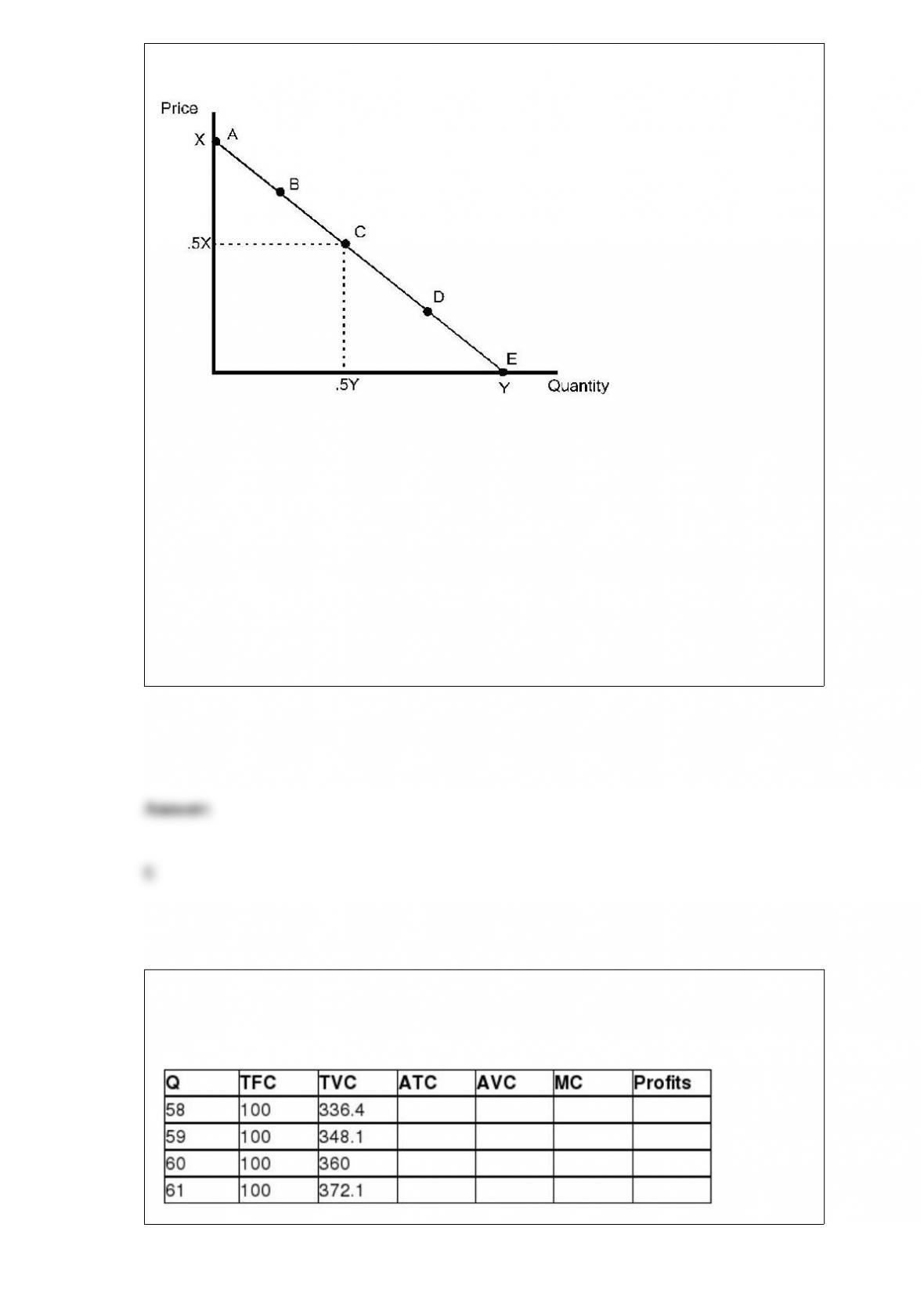
At point A, demand is:
A) completely inelastic.
B) inelastic, but not completely inelastic.
C) unit elastic.
D) elastic, but not infinitely elastic.
E) infinitely elastic.
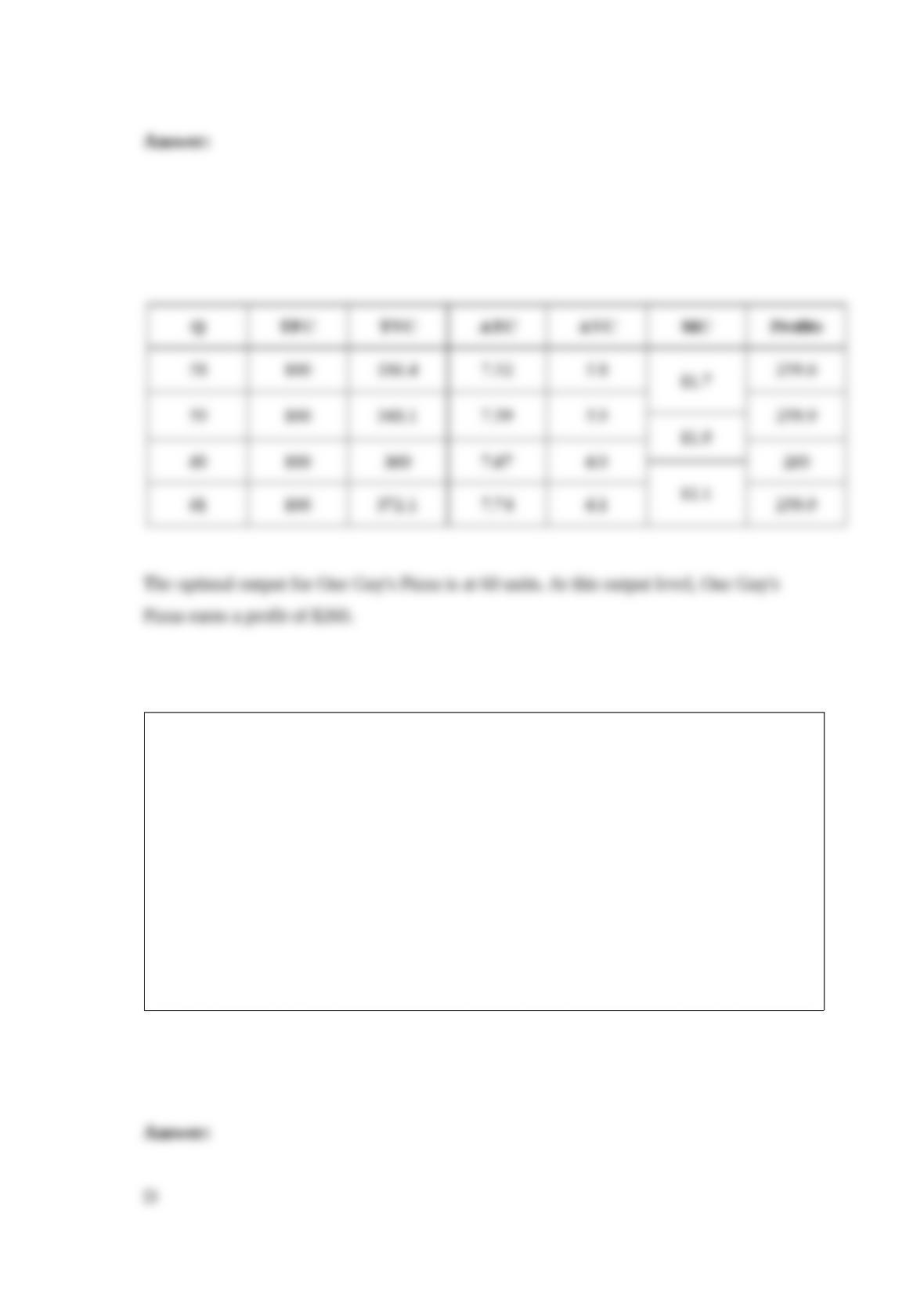
The table below lists the short-run costs for One Guy’s Pizza. If One Guy’s can sell all
the output they produce for $12 per unit, how much should One Guy’s produce to
maximize profits? Does One Guy’s Pizza earn an economic profit in the short-run?
A firm purchases a factor of production in a competitive market. At the current purchase
rate the MRP of the factor is greater than the marginal expenditure for the factor. Thus,
the firm
A) can increase profit by reducing the employment of the factor of production.
B) is now maximizing profit.
C) should not use this factor of production because it has no potential in generating a
profit.
D) can increase profit by expanding the employment of the factor of production.

Blanca would prefer a certain income of $20,000 to a gamble with a 5 probability of
$10,000 and a 0.5 probability of $30,000. Based on this information:
A) we can infer that Blanca neutral.
B) we can infer that Blanca is risk averse.
C) we can infer that Blanca is risk loving.
D) we cannot infer Blanca’s risk preferences.
Scenario 5.1:
Aline and Sarah decide to go into business together as economic consultants. Aline
believes they have a 50-50 chance of earning $200,000 a year, and that if they don’t,
they’ll earn $0. Sarah believes they have a 75% chance of earning $100,000 and a 25%
chance of earning $10,000.
Refer to Scenario 5.1. The probabilities discussed in the information above are
A) objective because they are single numbers rather than ranges.
B) objective because they have been explicitly articulated by the individuals involved.
C) objective because the event hasn’t happened yet.
D) subjective because the event hasn’t happened yet.
E) subjective because they are estimates made by individuals based upon personal
judgment or experience.

In the dominant firm model, the smaller fringe firms behave like:
A) competitive firms.
B) Cournot firms.
C) Stackelberg firms.
D) Bertrand firms.
E) monopolists.
Joe owns a small coffee shop, and his production function is q = 3KL where q is total
output in cups per hour, K is the number of coffee machines (capital), and L is the
number of employees hired per hour (labor). If Joe’s capital is currently fixed at K=3
machines, what is his short-run production function?
A) q = 3L
B) q = 3L2
C) q = 9L
D) q = 3K2

Use the following statements to answer this question:
I. The efficient amount of recycling of scrap materials is the amount that equates the
marginal social cost of scrap disposal to the marginal cost of recycling.
II. The efficient amount of recycling of scrap materials occurs when society recycles all
recyclable wastes.
A) Both I and II are true.
B) I is true, and II is false.
C) I is false, and II is true.
D) Both I and II are false.
Which of the following goods is NOT a likely component of the Consumer Price Index?
A) Hamburger
B) 87 octane gasoline
C) Structural steel beams
D) Movie tickets