
If the marginal propensity to consume is 0.75 and investment spending decreases by
$20 billion, what will be the overall effect on GDP?
a. GDP will decrease by $20 billion
b. GDP will increase by $15 billion
c. GDP will decrease by $80 billion
d. GDP will decrease by $30 billion
e. GDP will decrease by $26.7 billion
The Fed can decrease money supply by
a. buying government bonds.
b. increasing the reserve requirement.
c. printing less currency.
d. making open market purchases.
e. decreasing the discount rate.
An individual would be most likely to increase the amount of money he wants to hold if
a. the price level declines
b. the price level declines and the interest rate increases
c. his real income increases
d. the interest rate increases
e. the interest rate and his real income decrease
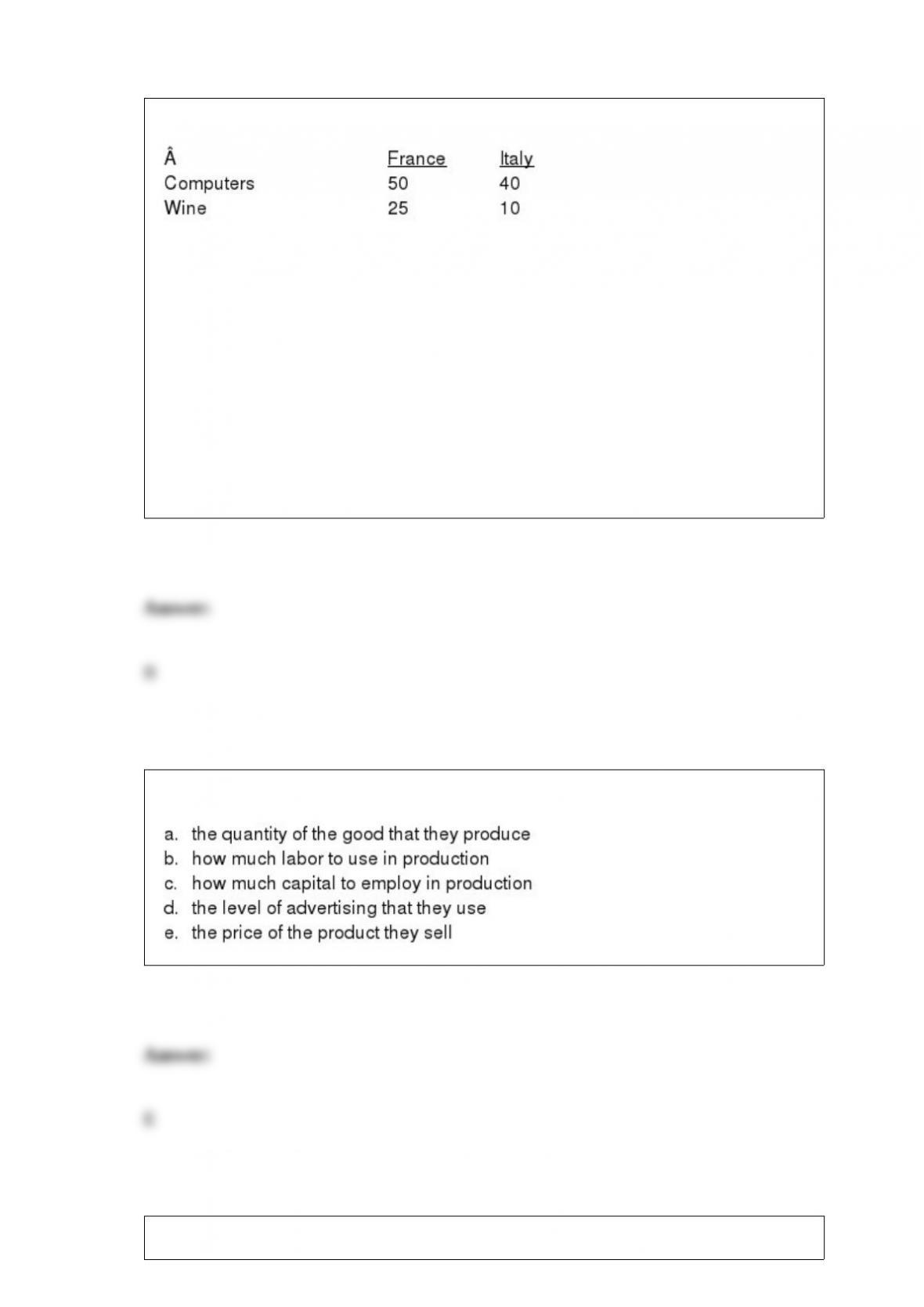
Consider the following table on output producible per 100 labor hours:
Which of the following statements is correct?
a. All of the following are correct.
b. France has a comparative advantage in producing computers.
c. Italy’s opportunity cost is 4 units of wine per computer.
d. France produces more computers than Italy does.
e. France produces more wine than Italy does.
Firms in a perfectly competitive market cannot influence
Taking a course in computer repair will increase an individual’s yearly income by

$10,000 per year, starting the year after the course is completed. After three years, the
skills learned will be obsolete. What is the present value of taking the course if the
interest rate is 8 percent (0.08) per year?
Which of the following must be true in order to engage in advantageous international
trade?
a. It must be producing at a point on its production possibilities frontier.
b. It must be economically efficient.
c. It must have a comparative advantage in producing one of the goods being traded.
d. There must be no potential Pareto improvements available in the economy.
e. It must have an absolute advantage in producing one good being traded.
Figure 4-1 shows the supply and demand for socks. If a price ceiling of $4 per pair is
imposed by the government, the number of pairs actually purchased will be

In 1996, an advisory committee of economists that studied the CPI found
a. no bias in the CPI
b. that in a typical year the CPI overstates the inflation rate by at least 1.1 percent per
year
c. that the CPI consistently overestimates the inflation rate by less than 1 percent per
year
d. that the CPI typically underestimates the inflation rate
e. that the CPI is somewhat erratic; it occasionally underestimates and occasionally
overestimates the inflation rate
If the cross-price elasticity of demand is positive, then the
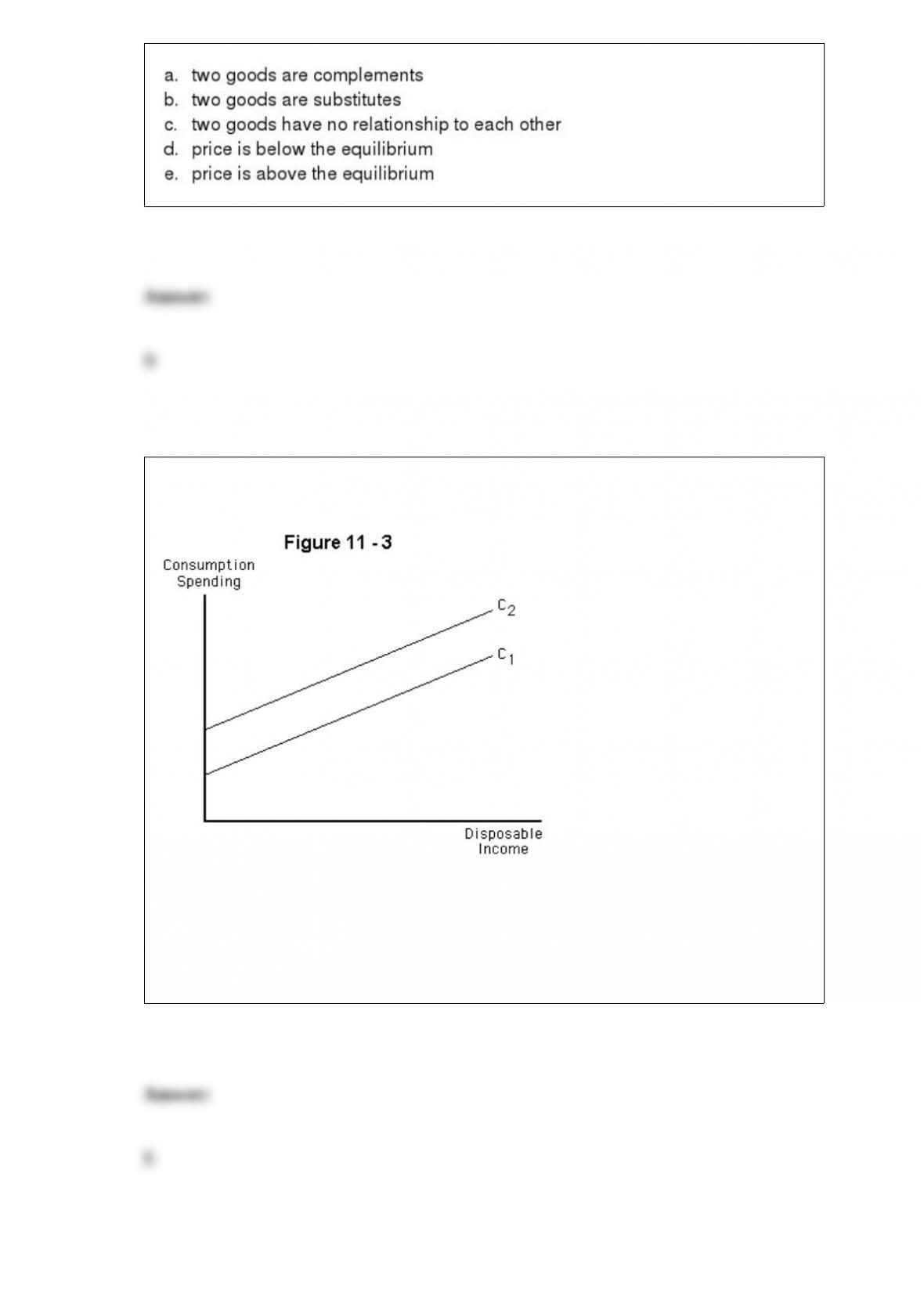
Refer to Figure 11-3. Which of the following could explain the shift from C1to C2?
a. An increase in disposable income
b. An increase in net taxes that increases the marginal propensity to consume
c. A decrease in net taxes that increases the marginal propensity to consume
d. An increase in net taxes that increases autonomous consumption spending
e. A decrease in net taxes that increases autonomous consumption spending

Which of the following sequences results from an increase in the price level?
a. the money demand curve shifts leftward, the interest rate decreases, investment
spending and autonomous consumption increase, the aggregate expenditure line shifts
downward and there is a leftward movement along the aggregate demand curve.
b. the money demand curve shifts rightward, the interest rate increases, investment
spending and autonomous consumption decrease, the aggregate expenditure line shifts
downward and there is a leftward movement along the aggregate demand curve.
c. the money demand curve shifts leftward, the interest rate increases, investment
spending and autonomous consumption increase, the aggregate expenditure line shifts
downward and there is a leftward movement along the aggregate demand curve.
d. the money demand curve shifts leftward, the interest rate drops, investment spending
and autonomous consumption decrease, the aggregate expenditure line shifts downward
and there is a leftward movement along the aggregate demand curve.
e. the money demand curve shifts rightward, the interest rate increases, investment
spending and autonomous consumption increase, the aggregate expenditure line shifts
downward and there is a rightward movement along the aggregate demand curve.
If prejudice originates with employers, market forces work to reduce discrimination and
lower wage differences between the favored and unfavored groups.
If production creates a negative externality, social welfare can be increased through

For any resource it hires, a firm’s marginal revenue product