The supply of loanable funds has a ________ slope because the greater the interest rate,
the ________ the reward to saving, and the ________ the quantity of loanable funds
supplied.
A) positive; lesser; lesser
B) positive; greater; lesser
C) negative; lesser; greater
D) positive; greater; greater
Table 5-1
In an effort to maintain privacy and enhance property values, three homeowners,
Deidre, Eugene and Farhad, are considering leasing a portion of adjoining vacant land
for a private park. Table 5-1 shows each person’s willingness to pay for each quantity of
the land. a. Complete the column in Table 5-1.
b. Graph the marginal social benefit curve.
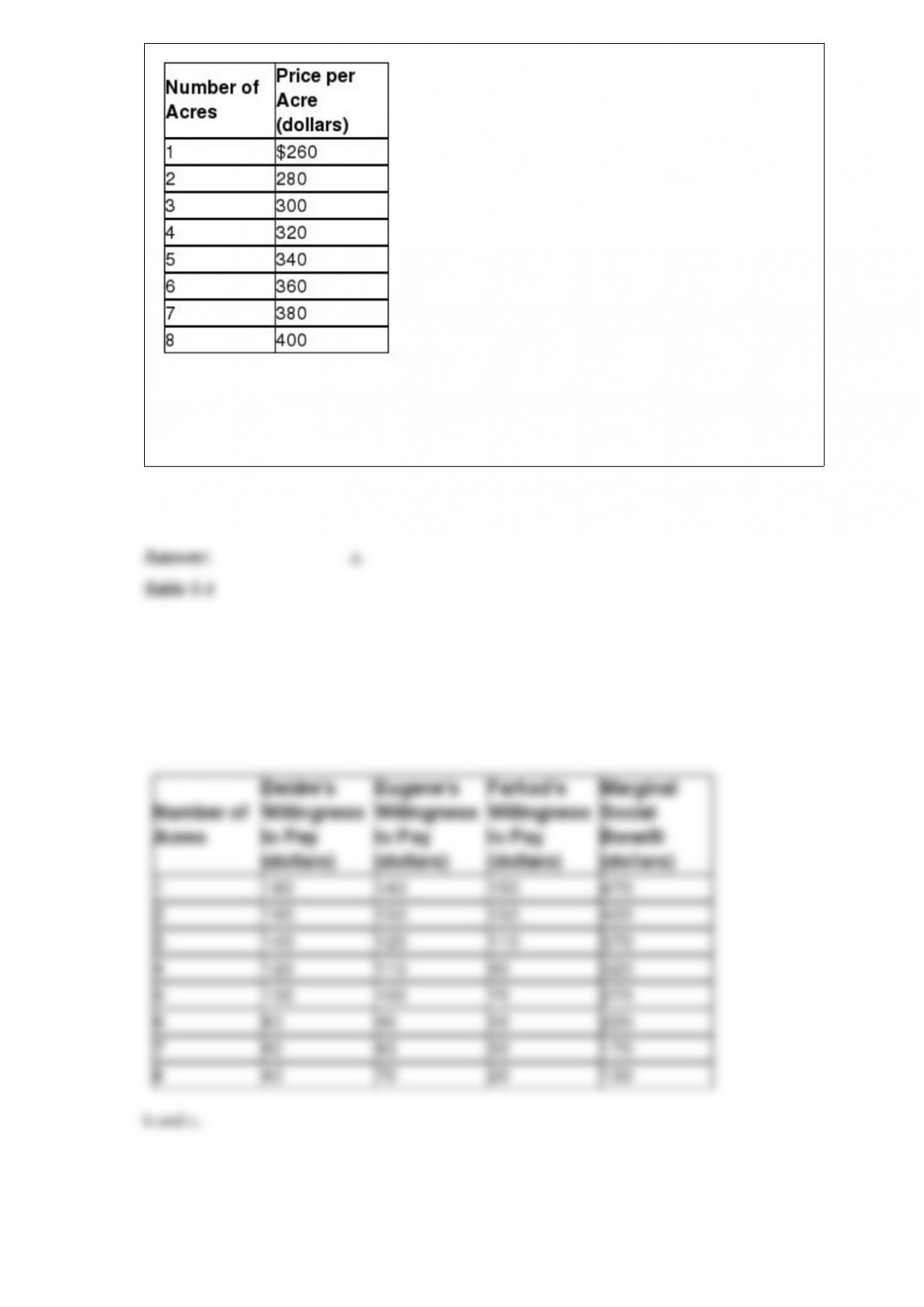
c. Suppose the landowner is willing to lease a portion of her land according to the
following supply schedule given in Table 5-2. On the same diagram, graph the supply
curve. Table 5-2
d. What is the optimal quantity of land that homeowners should lease? Explain your
answer.
e. Explain why a park of 5 acres is not optimal.
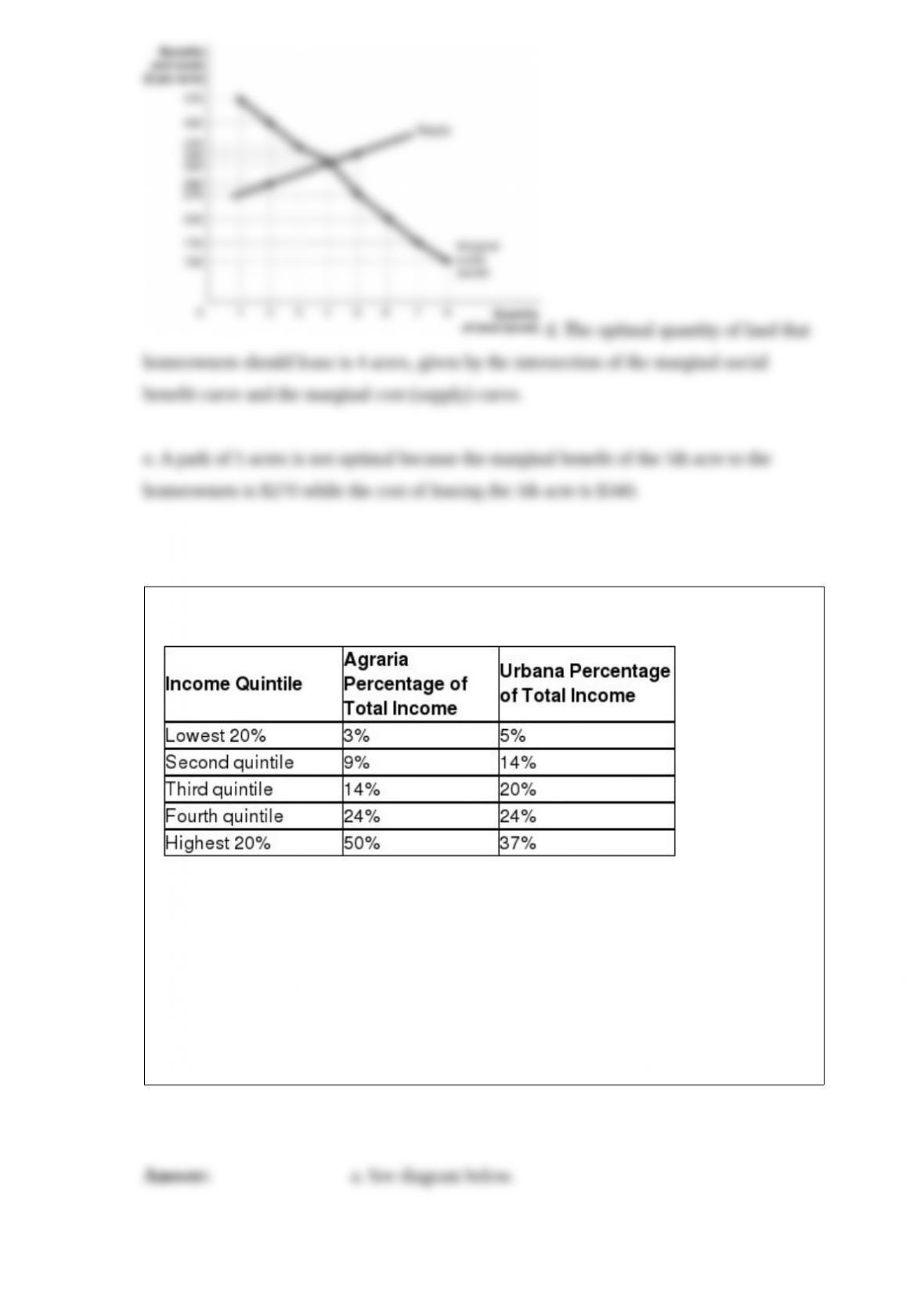
Table 18-12
Table 18-12 shows income distribution data for two countries. Use this data to answer
the following questions.
a. Draw a Lorenz curve for each country.
b. Which country has the more equal distribution of income?
c. Based on the Lorenz curve for the two countries, can you determine which country
has the more progressive tax system? Explain your answer.
Suppose the equilibrium price in a perfectly competitive industry is $10 and a firm in
the industry charges $12. Which of the following will happen?
A) The firm will sell more output than its competitors.
B) The firm’s revenue will increase.
C) The firm will not sell any output.
D) The firm’s profits will increase.
The exchange rate system agreed to in 1944, in which the U.S. government agreed to
buy or sell gold at a fixed price of $35 per ounce, is referred to as
A) the gold standard.
B) the Bretton Woods System.
C) a floating currency standard.

D) a flexible exchange rate system.
By offering more generous unemployment insurance programs, European countries can
expect
A) to pay less in taxes than in the United States.
B) workers to gain new skills quickly in response to fluctuations in the labor market.
C) shorter periods of unemployment for their workers.
D) longer periods of unemployment for their workers.
Lowering the interest rate will
A) decrease spending on consumer durables.
B) increase investment projects by firms.
C) decrease spending on new homes.
D) decrease the value of the dollar and lower net exports.
The measure of production that values production using current prices is called
A) value-added GDP.
B) nominal GDP.
C) real GDP.
D) underground GDP.
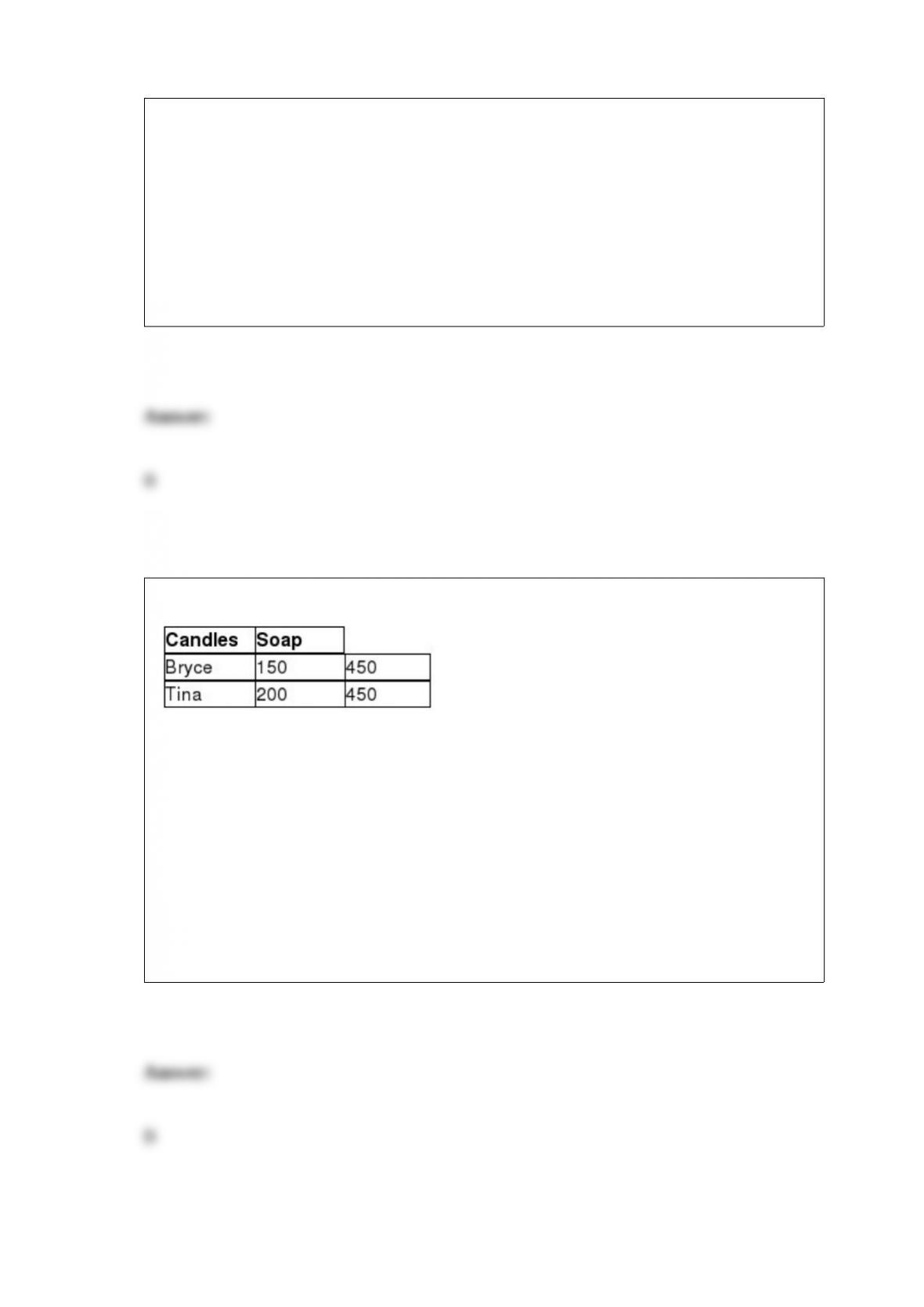
Table 9-3
Bryce and Tina are artisans who produce homemade candles and soap. Table 9-3 lists
the number of candles and bars of soap Bryce and Tina can each produce in one month.
Select the statement that accurately interprets the data in the table.
A) Tina has a comparative advantage in making soap.
B) Bryce has a comparative advantage in making soap.
C) Tina has a comparative advantage in making candles and making soap.
D) Neither Bryce nor Tina has a comparative advantage in making soap.

Suppose a developing country receives more machinery and capital equipment as
foreign entrepreneurs increase the amount of investment in the economy. As a result,
A) the long-run aggregate supply curve will shift to the right.
B) the long-run aggregate supply curve will shift to the left.
C) the economy will move up along the long-run aggregate supply curve.
D) the economy will move down along the long-run aggregate supply curve.
The current exchange rate system has which of the following characteristics?
A) The United States allows the dollar to float against other major currencies.
B) All developing countries allow their currencies to float against the dollar and other
major currencies.
C) The countries of the European Union have adopted the gold standard.
D) Several developing countries in Asia have adopted the Bretton Woods system.
E) The current global foreign exchange system is a fixed system.
Some policymakers have argue that products like cigarettes, alcohol, and sweetened
soda generate negative externalities in consumption. All else equal, if the government
decided to impose a tax on soda, the equilibrium quantity of soda would ________ and
the equilibrium price of soda would ________.
A) increase; increase
B) increase; decrease
C) decrease; increase
D) decrease; decrease
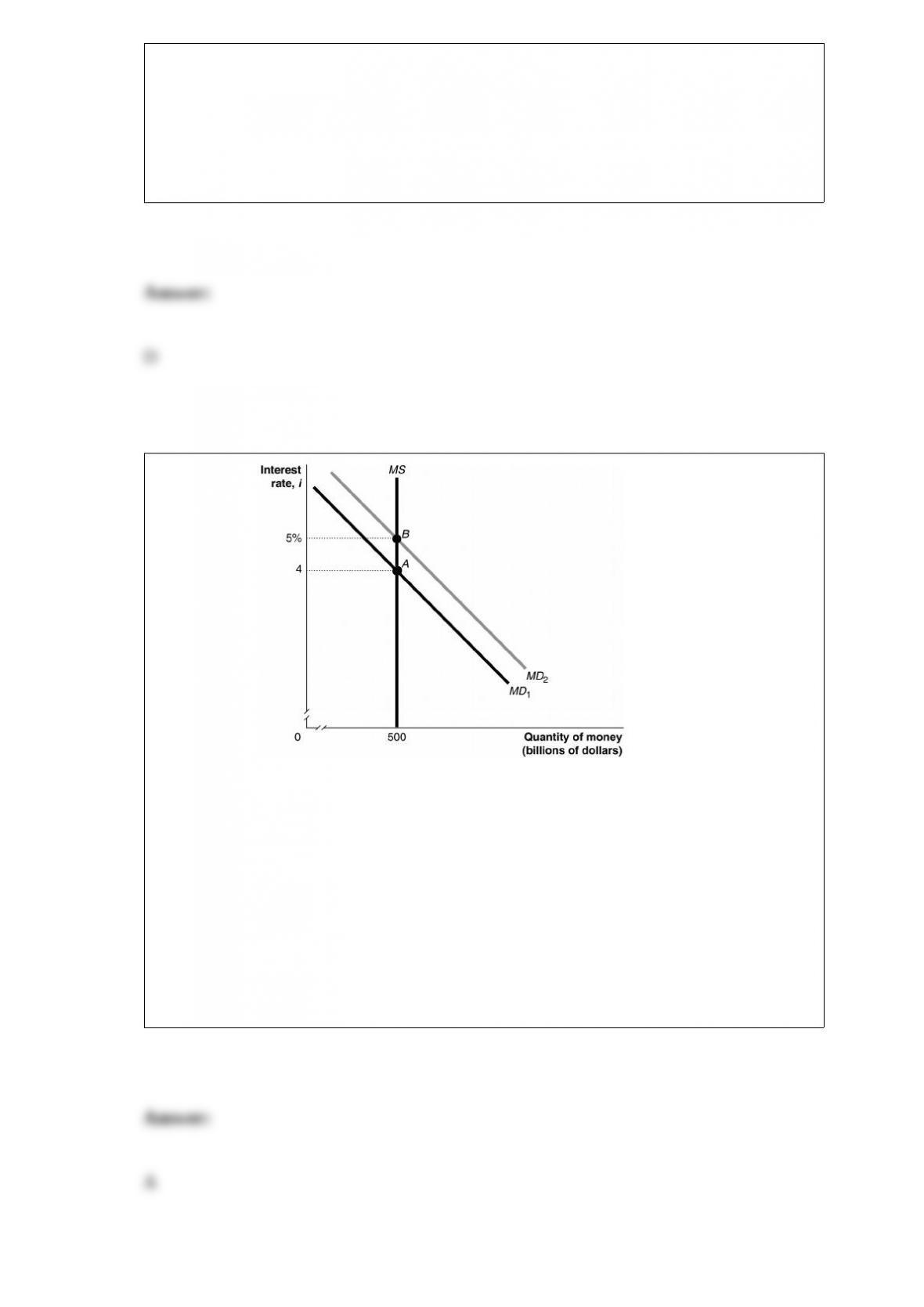
Figure 26-13
In the figure above, if the economy in Year 1 is at point A and expected in Year 2 to be
at point B, then the appropriate monetary policy by the Federal Reserve would be to
A) lower interest rates.
B) raise interest rates.
C) lower income taxes.
D) raise income taxes.

An advantage of imposing a tax on the producer that generates pollution is that
A) it forces the polluting producer to internalize the external cost of the pollution.
B) the government can keep tabs on exactly what is produced in an industry.
C) it will eliminate pollution.
D) a producer can pass the cost of the pollution to consumers.
Table 2-11
Table 2-11 shows the number of labor hours required to produce a motorcycle and a
guitar in Ireland and Scotland.
Ireland has a comparative advantage in the production of
A) both products.
B) guitars.
C) motorcycles.
D) neither product.

Suppose your expenses for this term are as follows: tuition: $28,000, room and board:
$9,000, books and other educational supplies: $2,500. Further, during the term, you can
only work part-time and earn $16,000 instead of your full-time salary of $42,000. What
is the opportunity cost of going to college this term, assuming that your room and board
expenses would be the same even if you did not go to college?
A) $36,500
B) $56,500
C) $65,500
D) $72,500
Some factors that allow firms to make economic profits are beyond its control. All but
one of the following is an uncontrollable factor. Which factor is controllable?
A) input prices
B) consumer tastes
C) chance events
D) product differentiation