1) Which of the following is not generally regarded by economists as a legitimate
reason for the government to intervene in a market?
a.to promote efficiency
b.to promote equality
c.to enforce property rights
d.to protect an industry from foreign competition
2) In economics, a difference in access to relevant knowledge is called a behavioral
asymmetry.
a.True
b.False
3) When the price of an inferior good increases,
a.both the income and substitution effects encourage the consumer to purchase more of
the good.
b.both the income and substitution effects encourage the consumer to purchase less of
the good.
c.the income effect encourages the consumer to purchase more of the good, and the
substitution effect encourages the consumer to purchase less of the good.
d.the income effect encourages the consumer to purchase less of the good, and the
substitution effect encourages the consumer to purchase more of the good.
4) The country of Gerance produces two goods, cars and wine. Last year, it produced
1,000 cars and 15,000 cases of wine. This year, it produced 1,300 cars and 20,000 cases
of wine. Given no other information, which of the following events could not explain
this change?
a.Gerance experienced a reduction in unemployment.
b.Gerance experienced an improvement in car-making technology.
c.Gerance acquired more resources.
d.Any of these events could explain the change.
5) Monopolistic competition is characterized by
i)efficient scale
ii)markup pricing over marginal cost
iii)deadweight loss
iv)excess capacity
a.i) and ii) only
b.ii) and iv) only
c.i), ii), and iii) only
d.ii), iii), and iv) only
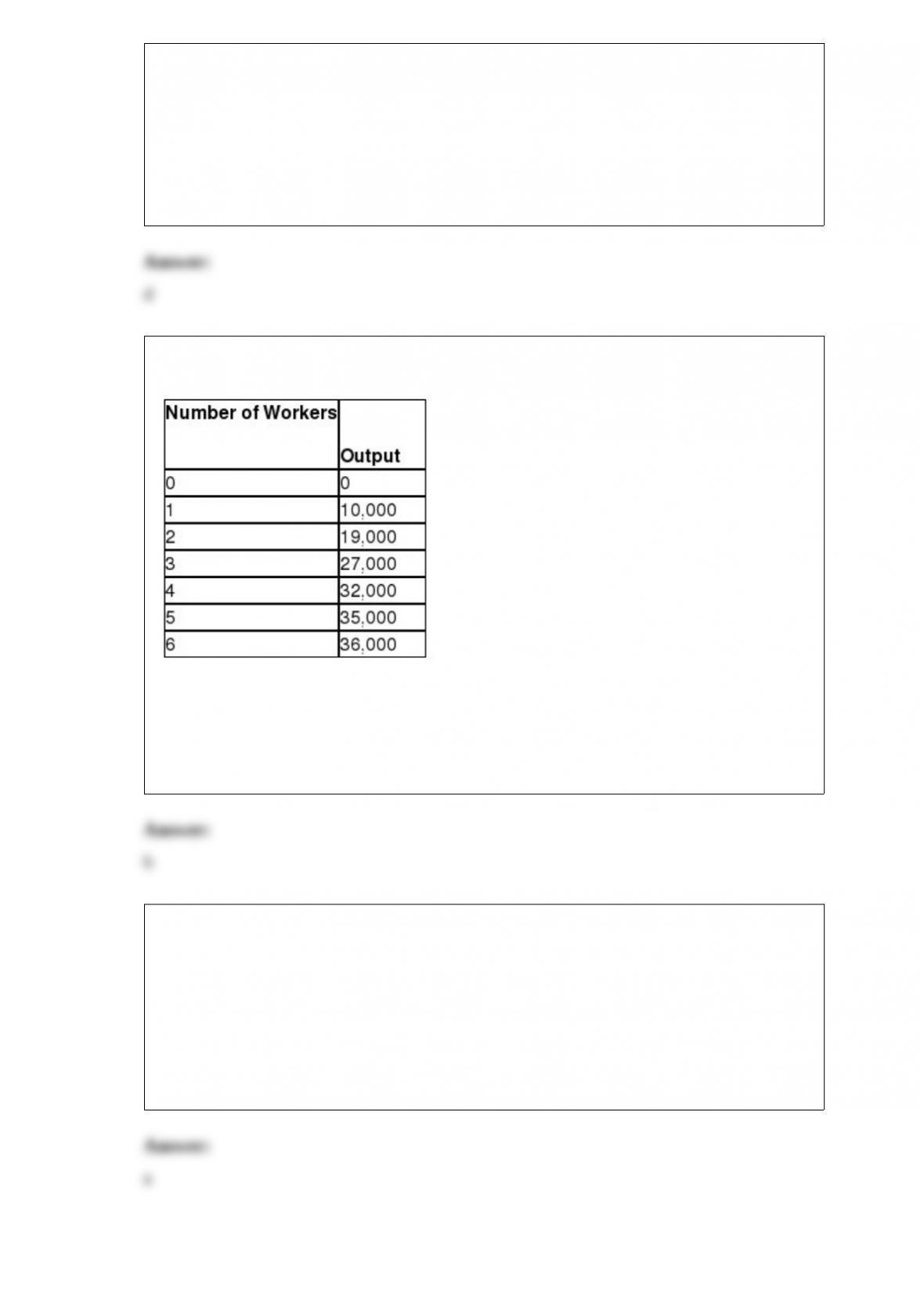
6) Table 13-5
Diminishing marginal product begins with the addition of the
a.second worker.
b.third worker.
c.fourth worker.
d.fifth worker.
7) Which of the following is correct?
a.Efficiency deals with the size of the economic pie, and equality deals with how fairly
the pie is sliced.
b.Equality can be judged on positive grounds whereas efficiency requires normative
judgments.
c.Efficiency is more difficult to evaluate than equality.
d.Equality and efficiency are both maximized in a society when total surplus is
maximized.

8) Suppose there is a 6 percent increase in the price of good X and a resulting 6 percent
decrease in the quantity of X demanded. for X is
a.0
b.1
c.6
d.36
9) While in college, John and Bethany each buy five packages of mac-n-cheese per
week. After they graduate and have full-time jobs, John buys six packages per week,
but Bethany buys only two packages per week. When looking at income elasticity of
demand for macncheese, John’s
a.is negative, and Bethany’s is positive.
b.is positive, and Bethany’s is negative.
c.is zero, and Bethany’s approaches infinity.
d.approaches infinity, and Bethany’s is zero.
10) For maximum profit, a firm hires labor up to the point at which the wage equals
(i)the value of the marginal product of labor.
(ii)the marginal cost of an additional unit of output.
(iii)output price multiplied by the marginal product of labor.
a.(i) and (ii) only
b.(i) and (iii) only
c.(ii) and (iii) only
d.(i), (ii), and (iii)
11) Table 17-29
Suppose that two firms, Wild Willy’s Wonderdrink (Firm W) and Hyper Hank’s
Hydration (Firm H), comprise the market for energy drinks. Each firm determines that
it could lower its costs and increase its profits if both firms reduced their advertising
budgets. But for the plan to work, each firm must agree to refrain from advertising.
Each firm believes that advertising works by increasing the demand for the firm’s
energy drinks, but each firm also believes that if neither firm advertises, the cost
savings will outweigh the lost sales. The table below lists each firm’s individual profits:
Firm W
Breaks agreement Maintains agreement
and advertises and does not advertise
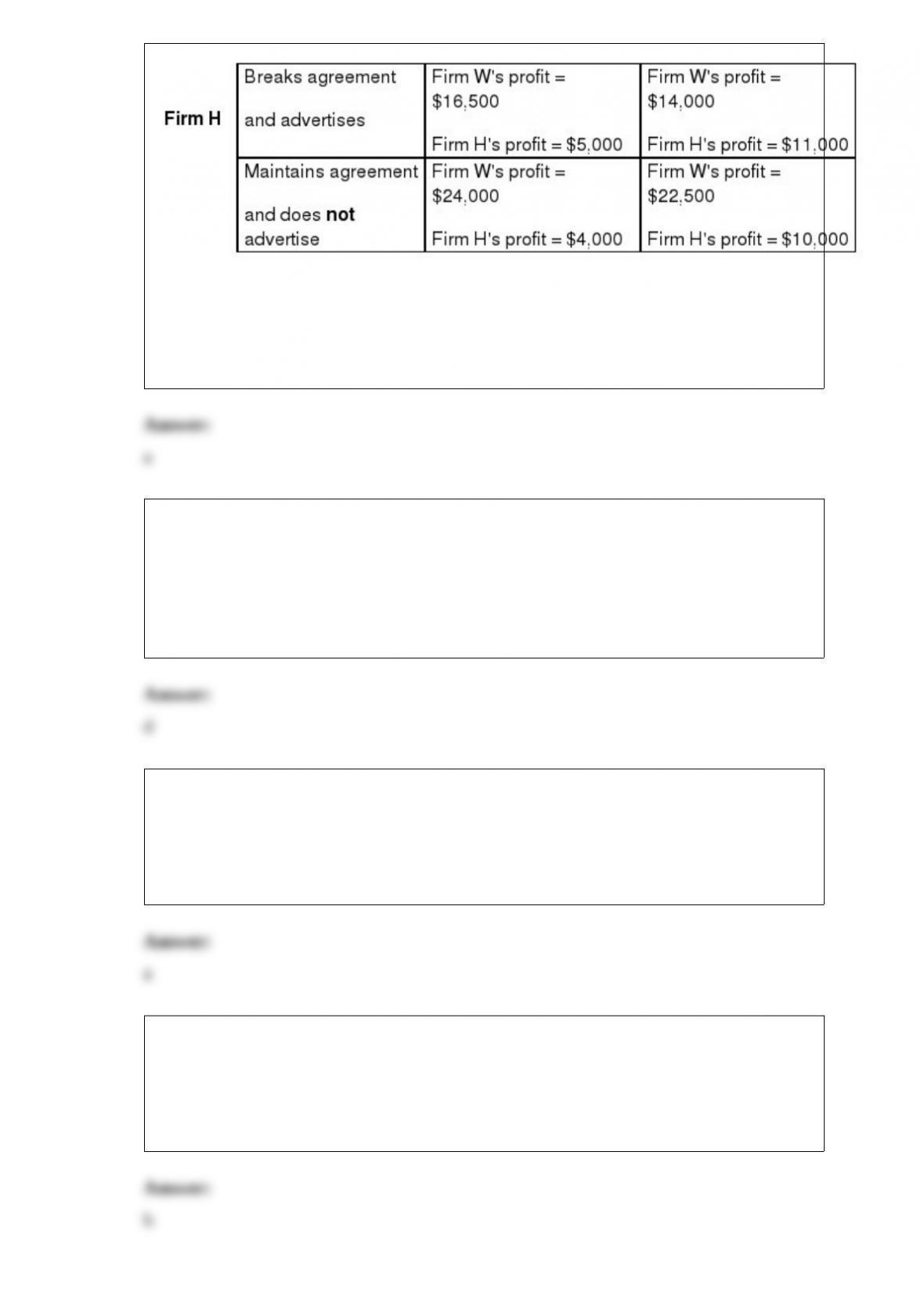
Refer to Table 17-29 Does either Firm W or Firm H have a dominant strategy?
a.Both Firm W and Firm H have a dominant strategy.
b.Neither Firm W nor Firm H has a dominant strategy.
c.Firm W has a dominant strategy, but Firm H does not.
d.Firm W does not have a dominant strategy, but Firm H does.
12) In considering how to allocate its scarce resources among its various members, a
household considers
a.each member’s abilities.
b.each member’s efforts.
c.each member’s desires.
d.All of the above are correct.
13) A payroll tax is a tax on
a.the wages that a firm pays its workers.
b.earned and unearned income.
c.specific goods like gasoline and cigarettes.
d.corporate profits.
14) Economists normally assume that the goal of a firm is to
a.maximize its total revenue.
b.maximize its profit.
c.minimize its explicit costs.
d.minimize its total cost.
15) If one producer is able to produce a good at a lower opportunity cost than some
other producer, then the producer with the lower opportunity cost is said to have an
absolute advantage in the production of that good.
a.True
b.False
16) Alice and Betty’s Production Possibilities in one 8hour day.
Alice’s Production Possibilities FrontierBetty’s Production Possibilities Frontier
25) A travel agency offers a money-back guarantee for vacationers taking their first
cruise in case they do not enjoy the experience. This guarantee is an example of
26) Some economists argue that changes in U.S. trade flows have altered the gap
between wages of skilled and unskilled workers. Explain.
27) Explain how an attempt by the government to lower inflation could cause
unemployment to increase in the short-run.