
Maintaining a strong dollar in international currency markets is not one of the four
monetary policy goals of the Fed listed in the textbook.
If inflation is higher than expected, this helps borrowers (by reducing the real interest
rate they pay) and hurts lenders (by reducing the real interest rate they receive).
Inflation usually increases during a recession and decreases during an expansion.
The tax multiplier is calculated as “one minus the government purchases multiplier.”

If the price of a product is expected to increase in the future, the supply today will
increase.
If the marginal propensity to save is 0.4, the multiplier is 2.5.
Monetarists believe that the quantity of money should be increased at an increasing
rate.
If the demand curve for a product shifts to the right and the supply curve for the product
shifts to the left, equilibrium price and equilibrium quantity will both increase.

Foreign currency prices of the U.S. dollar are currently determined by a managed float
exchange rate system.
A college must decide if it wants to offer more evening and weekend classes. This
decision involves answering the economic question of “for whom to produce.”
In the market for factors of production, households earn income by supplying factors of
production to firms.
Optimal decisions are made at the point where marginal benefit is maximized.

Assuming no change in the nominal exchange rate, how will a higher rate of inflation in
the United States relative to France affect the real exchange rate between the two
countries? (Assume the United States is the “domestic” country.)
A) The real exchange rate will rise.
B) The real exchange rate will fall.
C) The real exchange rate will be unaffected.
D) The impact on the real exchange rate cannot be predicted.
Significant economic growth did not begin in the world until
A) 1000 A.D.
B) 1750 A.D.
C) 1820 A.D.
D) the 20th century A.D.
When the value of a currency is determined ________, the exchange rate system is
defined as a floating exchange rate system.
A) only by supply and demand
B) by its issuing government
C) mostly by supply and demand, but with occasional government intervention

D) by its issuing government, with occasional readjustments in value
Studies have shown that
A) firms often cut nominal wages during recessions and allow inflation to gradually
increase real wages.
B) firms are reluctant to cut nominal wages during recessions but instead increase
workers’ nominal wages and allow inflation to gradually increase real wages.
C) firms are reluctant to cut nominal wages during recessions but instead freeze
workers’ nominal wages and allow inflation to gradually reduce real wages.
D) firms often freeze workers’ nominal wages during a recession and keep the wages
frozen well after the recession has ended.
During the turmoil in the market for subprime mortgages in 2007 and 2008, the Fed
increased the volume of discount loans. The goal of the Fed was to
A) reduce the rate of inflation.
B) stimulate economic growth.
C) reduce unemployment.
D) reassure financial markets and promote financial stability.
E) reduce the current account deficit.
The health care system in ________ is referred to as a universal health insurance
system, under which every resident is required to enroll in either a private or the
government-provided health insurance program.
A) Canada
B) Japan
C) the United Kingdom
D) the United States
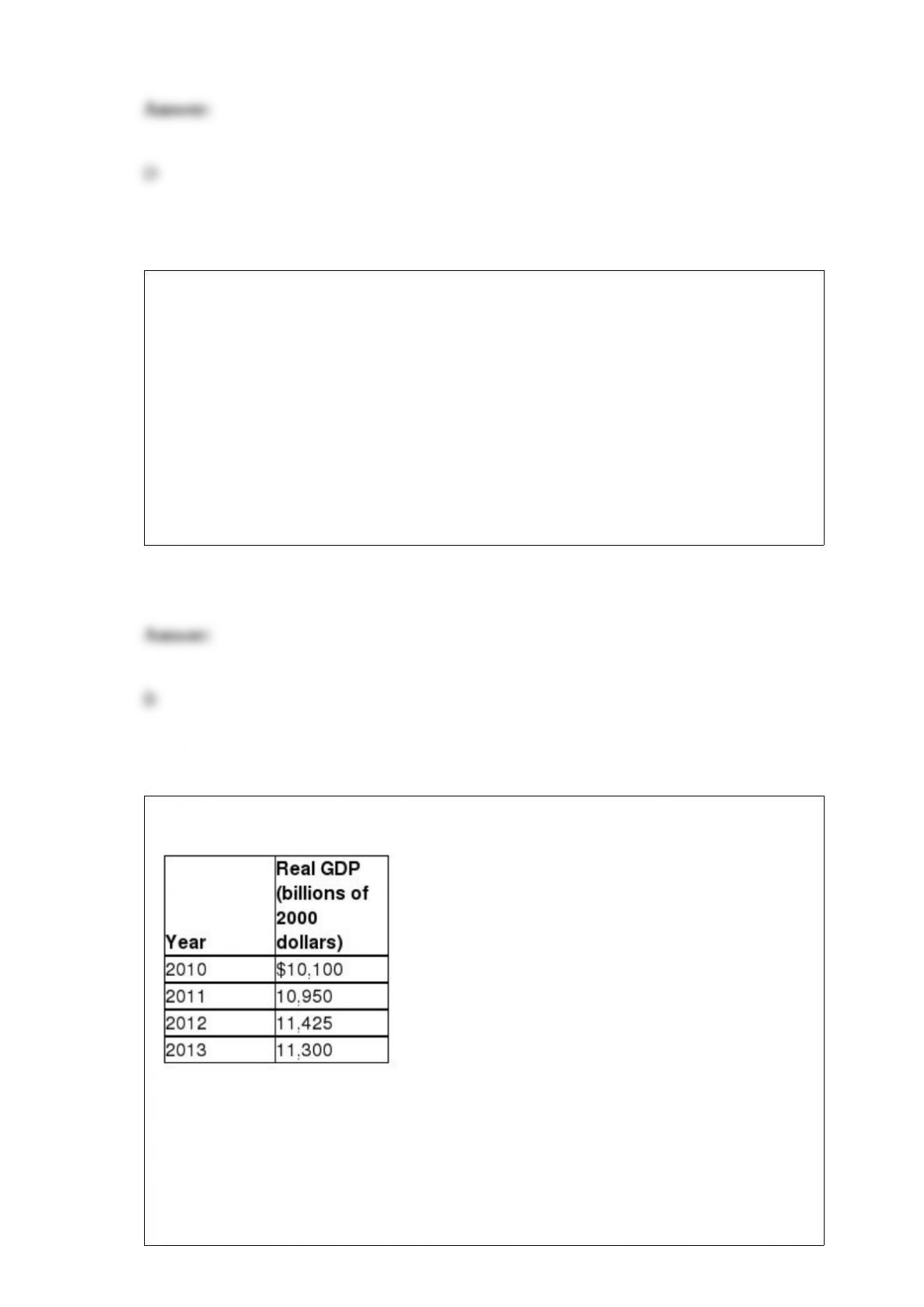
Table 10-2
Refer to Table 10-2. Using the table above, what is the approximate growth rate of real
GDP from 2011 to 2012?
A) 1%
B) 2%
C) 3%
D) 4%
From the beginning of 1973 until August 2013, the value of the dollar has ________
relative to the Canadian dollar and ________ relative to the Japanese yen.
A) appreciated; appreciated
B) appreciated; depreciated
C) depreciated; appreciated
D) depreciated; depreciated
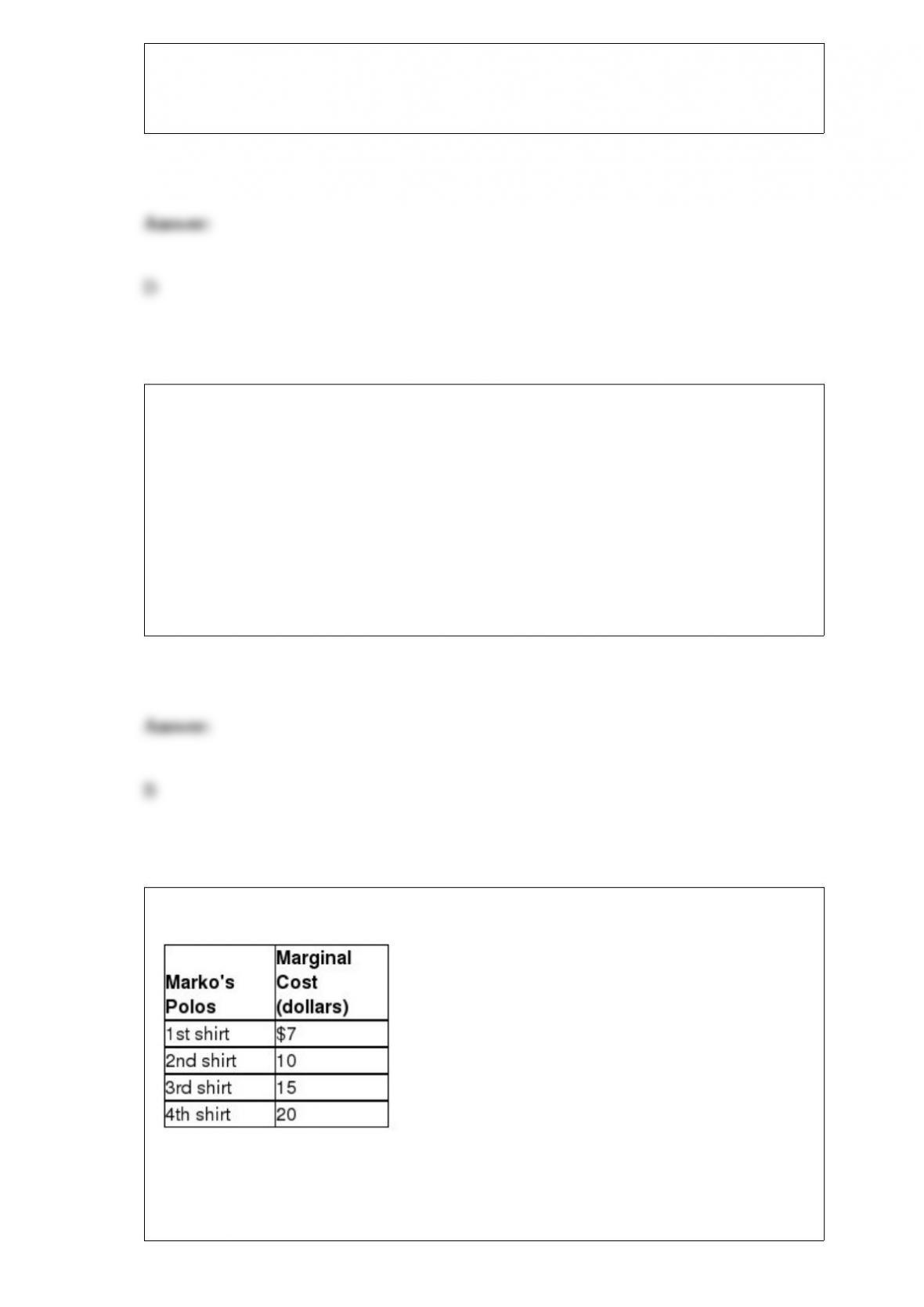
Table 4-3
Refer to Table 4-3. The table above lists the marginal cost of polo shirts by Marko’s, a
firm that specializes in producing men’s clothing. If the market price of Marko’s polo
shirts is $30, producer surplus is

A) $0.
B) $16.
C) $52.
D) $68.
The “Big Mac Theory of Exchange Rates” tests the accuracy of the purchasing power
parity theory. In July 2013, the Economist reported that the average price of a Big Mac
in the U.S. was $4.56. In Sweden, the average price of a Big Mac at that time was 41.6
kronor. What is the “implied exchange rate” between Swedish kronor and U.S. dollars?
A) 0.11 kronor per dollar
B) 1.90 kronor per dollar
C) 9.12 kronor per dollar
D) 46.2 kronor per dollar
How do firms raise external funds through indirect finance?
Why are music, television, and movie companies concerned about their products being
posted to Internet websites such as YouTube?
The federal budget was in deficit from 1931 to 1939, except in the year 1937. Given
this fact, how do you explain E. Cary Brown’s statement, “Fiscal policy, then, seems to
have been an unsuccessful recovery device in the ‘thirties-not because it did not work,
but because it was not tried.”
Explain why a centrally-planned economy might not grow as rapidly as a market
economy.
When Congress established the Federal Reserve in 1913, what was its main
responsibility? When did Congress broaden the Fed’s responsibilities?
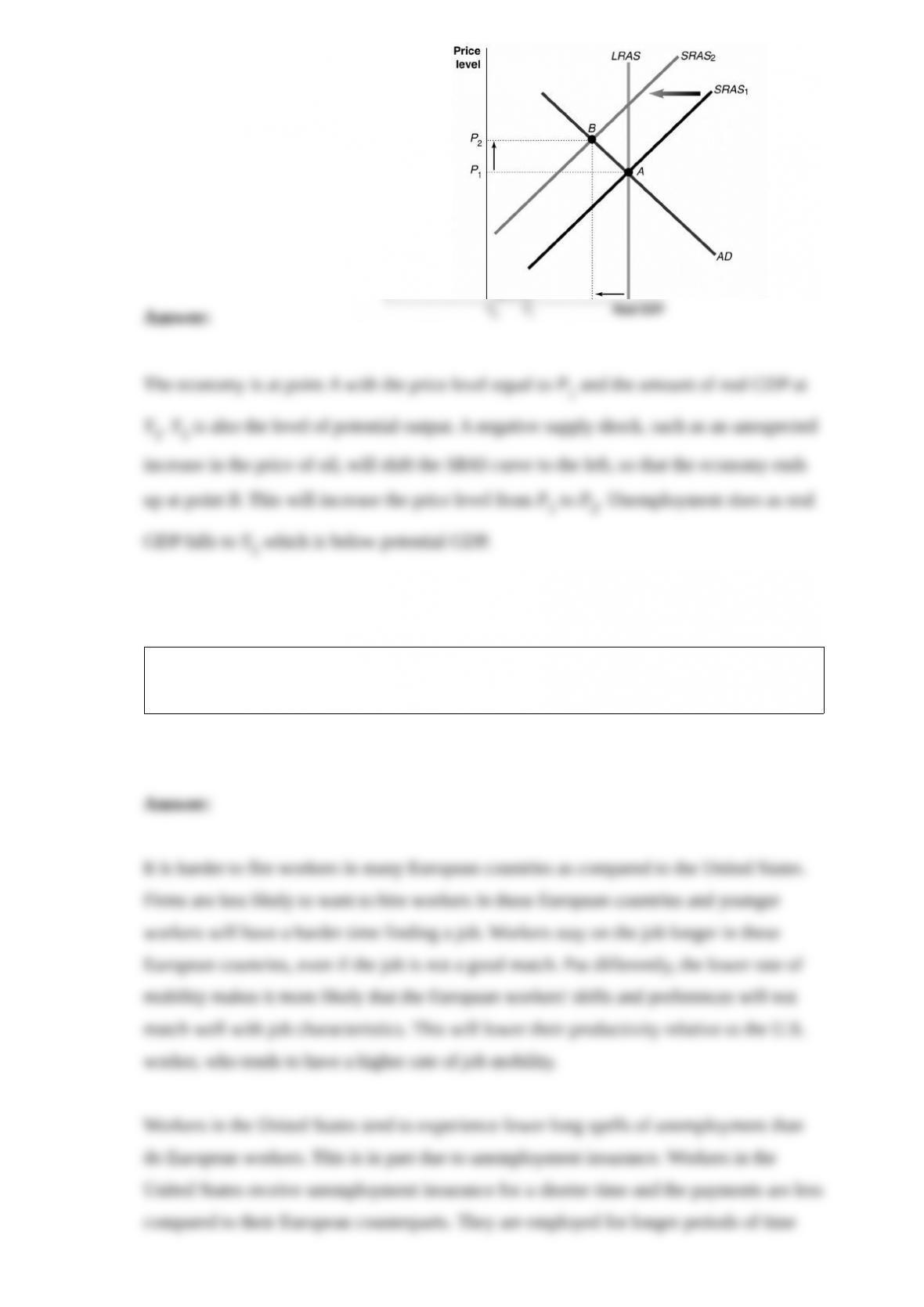
Beginning with long-run equilibrium, use the aggregate demand and aggregate supply
model to illustrate what happens in the short run when the economy suffers a negative
supply shock.
List two ways the labor force experience is different between workers in Europe and in
the United States. How do these differences influence productivity?
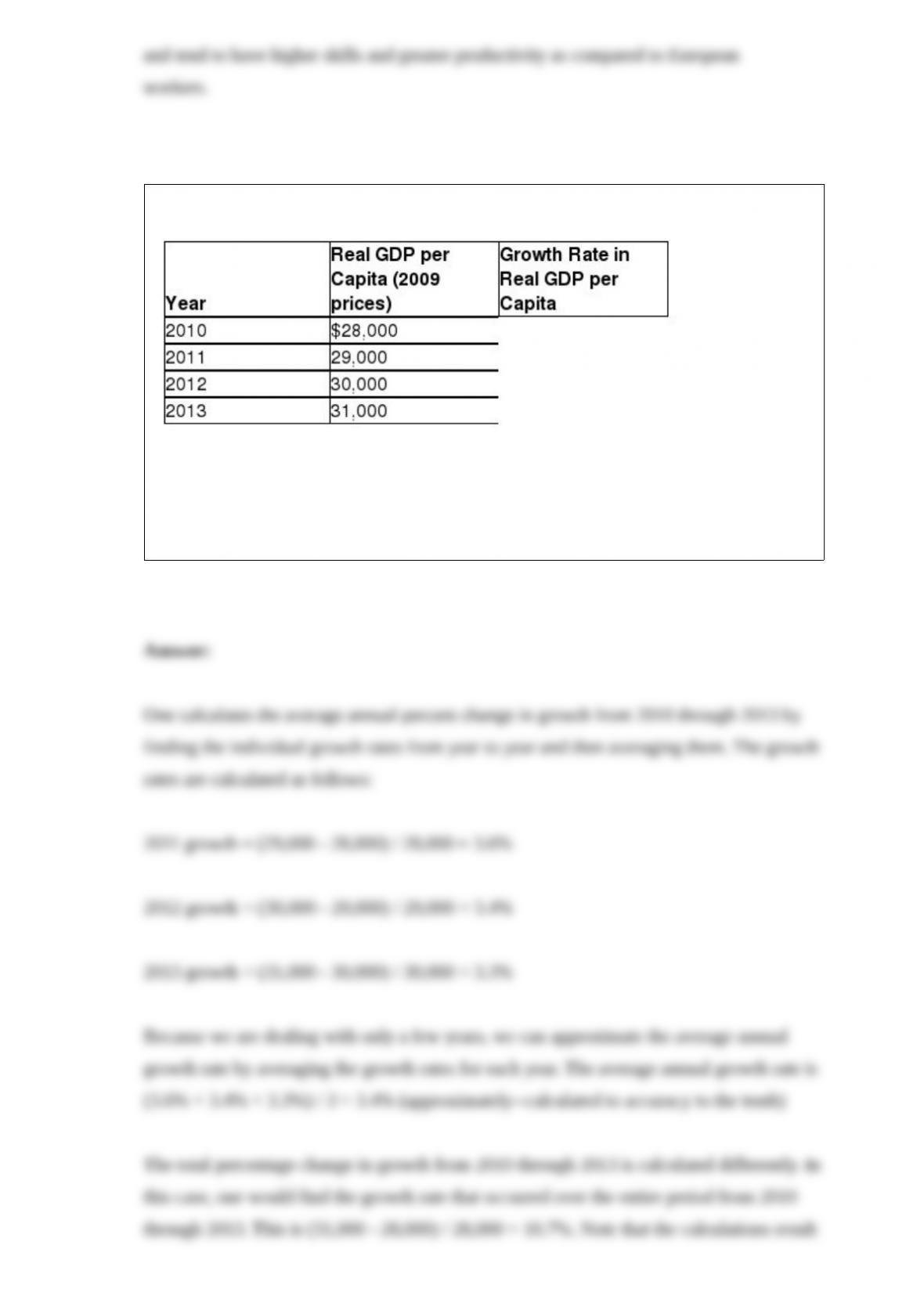
Table 11-3
Refer to Table 11-3. Use the table above to calculate the annual growth rate in GDP.
Also calculate the total percentage change in the growth from 2010 through 2013.
Explain the difference between the average annual growth rate in real per capita GDP
from 2010 through 2013 and the total percentage change in growth from 2010 and
2013.
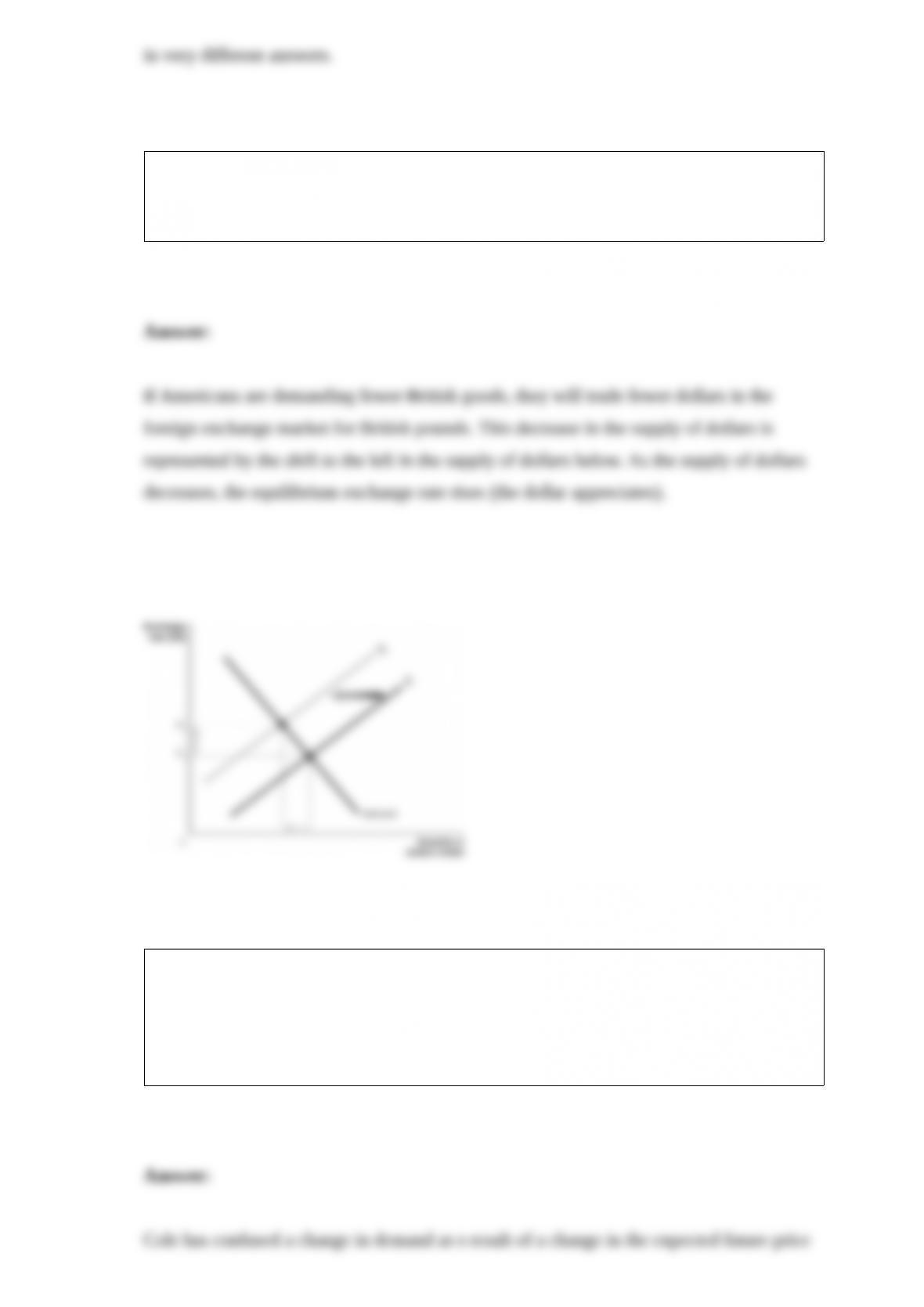
If American demand for purchases of British goods has decreased, how would you
expect the equilibrium exchange rate in the market for dollars to respond? Support your
answer graphically.
Cole was discussing the market for cocoa beans with his friend John Schmidt. Cole
said, “Ever since Venezuela announced that its cocoa harvest was its lowest ever in
fifteen years, the price of cocoa beans has been rising and rising and people are buying
more and more. I think the demand for cocoa beans must be upward sloping.” Is Cole
right? Briefly explain why or why not.