
1) developing countries have sometimes feared open immigration policies of developed
countries on the grounds that highly educated and skilled people may emigrate to the
developed countries, thus limiting the growth potential of the developing countries.
a.true
b.false
2) a sudden shift from import tariffs to free trade may induce short-term unemployment
in:
a.import-competing industries
b.industries that are only exporters
c.industries that sell domestically as well as export
d.industries that neither import nor export
3) although the law of one price predicts that identical goods should cost the same in all
nations, transportation costs and tariffs tend to prevent this prediction from actually
occurring.
a.true
b.false
4) trade creation and trade diversion refer to the short run (static) effects of economic
integration while economies of scale, stimulus to investment, and effects on
competition refer to the long run (dynamic) effects.
a.true
b.false
5) most economists contend that any reduction in the current account deficit is better
achieved through increased national saving than through reduced domestic investment.
a.true
b.false

6) trade analysis involving multinational enterprises differs from our conventional trade
analysis in that multinational enterprise analysis emphasizes:
a.absolute cost differentials rather than comparative cost differentials
b.the international movement of factor inputs rather than finished goods
c.purely competitive markets rather than imperfectly competitive markets
d.portfolio investments rather than direct foreign investments
7) those who argue in favor of import protection generally give the impression that such
restricted trade will:
a.decrease the level of national security
b.provide benefits to some particular industry
c.provide benefits to the entire nation
d.not yield welfare losses for the nation
8) the marshall-lerner condition suggests that depreciation of the franc leads to a
worsening of france’s trade account if the:
a.elasticity of demand for french exports is 0.4 while the french elasticity of demand for
imports is 0.2
b.elasticity of demand for french exports is 0.6 while the french elasticity of demand for
imports is 0.4
c.elasticity of demand for french exports is 0.5 while the french elasticity of demand for
imports is 0.7
d.elasticity of demand for french exports is 0.6 while the french elasticity of demand for
imports is 0.7
9) figure 3.1china – us trade possibilities
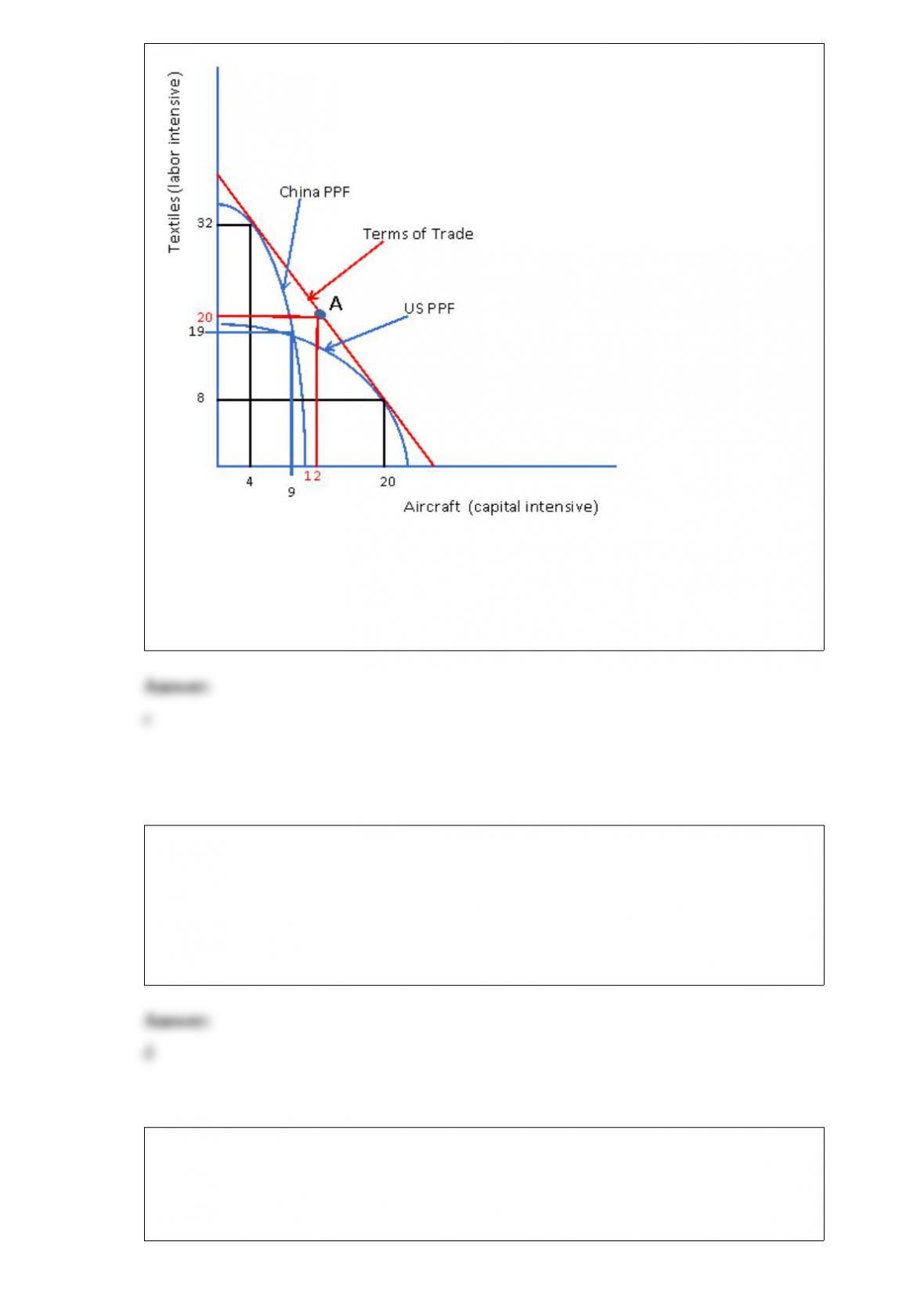
considering figure 3.1 which of the following would be true?
a.china has more of both labor and capital than the us.
b.the us has more of both labor and capital than china.
c.the us is relatively capital abundant and china is relatively labor abundant.
d.the us is relatively labor abundant and china id relatively capital abundant.
10) a firm’s ____, relative to that of other firms, is generally regarded as the most
important determinant of competitiveness.
a.income level
b.tastes and preferences
c.governmental regulation
d.productivity
11) day-to-day influences on foreign exchange rates always cause rates to move in the
same direction as changes in long-term market fundamentals.
a.true
b.false

12) both coca-cola co. and pepsi-cola co. are multinational firms in that their soft drinks
are bottled throughout the world. this practice illustrates:
a.backward vertical integration
b.forward vertical integration
c.horizontal integration
d.conglomerate integration
13) given a system of floating exchange rates, a contractionary monetary policy by the
federal reserve will cause
a.the dollar to appreciate and will decrease u.s. net exports
b.the dollar to appreciate and will increase u.s. net exports
c.the dollar to depreciate and will increase u.s. net exports
d.the dollar to depreciate and will decrease u.s. net exports
14) which theory of exchange-rate determination best views the foreign exchange
market as being similar to a stock exchange where future expectations are important
and prices are volatile?
a.balance-of-payments approach
b.purchasing-power-parity approach
c.asset-markets approach
d.monetary approach
15) the analysis of the effects of currency depreciation include all of the following
except the:
a.absorption approach
b.elasticity approach
c.fiscal approach
d.monetary approach

16) according to the cost-based definition of dumping, dumping begins to occur when a
firm sells a product at a price that is less than average variable cost.
a.true
b.false