
1) According to the Taylor rule, if real GDP falls by 1 percent below potential GDP, the
Fed should lower the Federal funds rate by one-half a percentage point.
2) Tax revenues automatically increase during economic expansions and decrease
during recessions.
3) The Fed reduces interest rates mainly by selling government securities.
4) an economic model is an ideal or utopian type of economy that society should strive
to obtain through economic policy.
5) Government transfer programs result in a U.S. Lorenz Curve that is closer to the
diagonal line than would be the case without the programs.
6) productivity growth was greater between 1973 and 1995 than between 1995 and
2007.
7) the marginal tax rate is the tax rate that applies to additional income.
8) The Economist’s Commodity Price Index reveals that the supply of productive
resources has increased faster than the demand for decades.
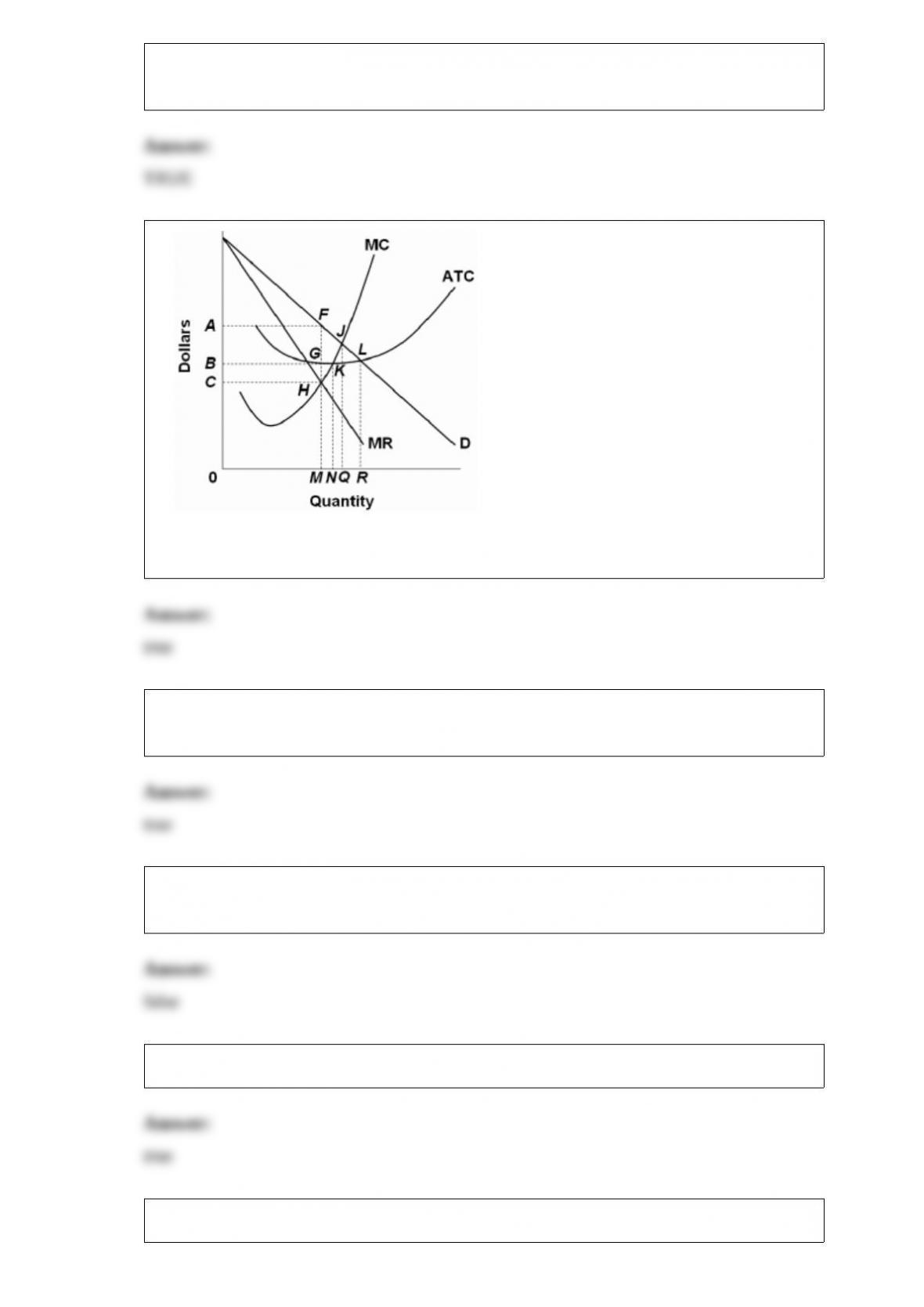
9)
refer to the above diagram for a nondiscriminating monopolist. from society’s point of
view it would be desirable to have the monopolist produce a larger output than m.
10) growth in well-being tends to be understated by growth in real gdp because of
increases in leisure time.
11) any migration that affects the economies of the countries involved is referred to as
“economic immigration.”
12) a government tax per unit of output reduces supply.
13) in drawing a particular budget line, money income and the prices of the two

products are fixed.
14) Since 1980, labor union membership in the United States has been:
A.increasing absolutely and as a percentage of the labor force.
B.increasing absolutely but declining as a percentage of the labor force.
C.decreasing absolutely and as a percentage of the labor force.
D.decreasing absolutely but increasing as a percentage of the labor force.
15) A firm is hiring resources X, Y, and Z in the profit-maximizing amounts when:
A.MRPx/Px equals MRPy/Py equals MRPz/Pz equals 1.
B.the sum of the MRPs of the three resources is at a minimum.
C.the marginal revenue productivity of all three resources is the same.
D.the marginal revenue product of the last dollar spent on each of the three resources is
the same.
16) innovation lagged in the centrally planned economies because:
a.there was too much domestic business competition.
b.there was too much competition from foreign firms.
c.enterprises resisted innovation in fear that their production targets would be raised.
17) approximately what percentage of u.s. income was received as wages and salaries in
2007?
a.14%
b.52%
c.71%
d.84%
18) Which of the following is considered a non-renewable natural resource?

A.solar power.
B.coal.
C.oceans.
D.aquifers.
19) Suppose the productivity of labor increases and at the same time the price of
capital, which is complementary to labor, increases. As a result, the demand for labor:
A.will increase.
B.will decrease.
C.may either increase or decrease.
D.will not change.
20) suppose total output (real gdp) is $10,000 and worker-hours are 20,000. we can
conclude that:
a.real gdp per capita must be $200,000.
b.the price-level index must be less than 100.
c.labor productivity must be $0.5.
d.nominal gdp must be between $10,000 and $20,000.
21) a lender need not be penalized by inflation if the:
a.long-term rate of inflation is less than the short-term rate of inflation.
b.short-term rate of inflation is less than the long-term rate of inflation.
c.lender correctly anticipates inflation and increases the nominal interest rate
accordingly.
d.inflation is unanticipated by both borrower and lender.
22) a recent study found that an increase in the federal tax on beer (and thus an increase
in the price of beer) would reduce the demand for marijuana. we can conclude that:
a.beer and marijuana are substitute goods.
b.beer and marijuana are complementary goods.
c.beer is an inferior good.
d.marijuana is an inferior good.
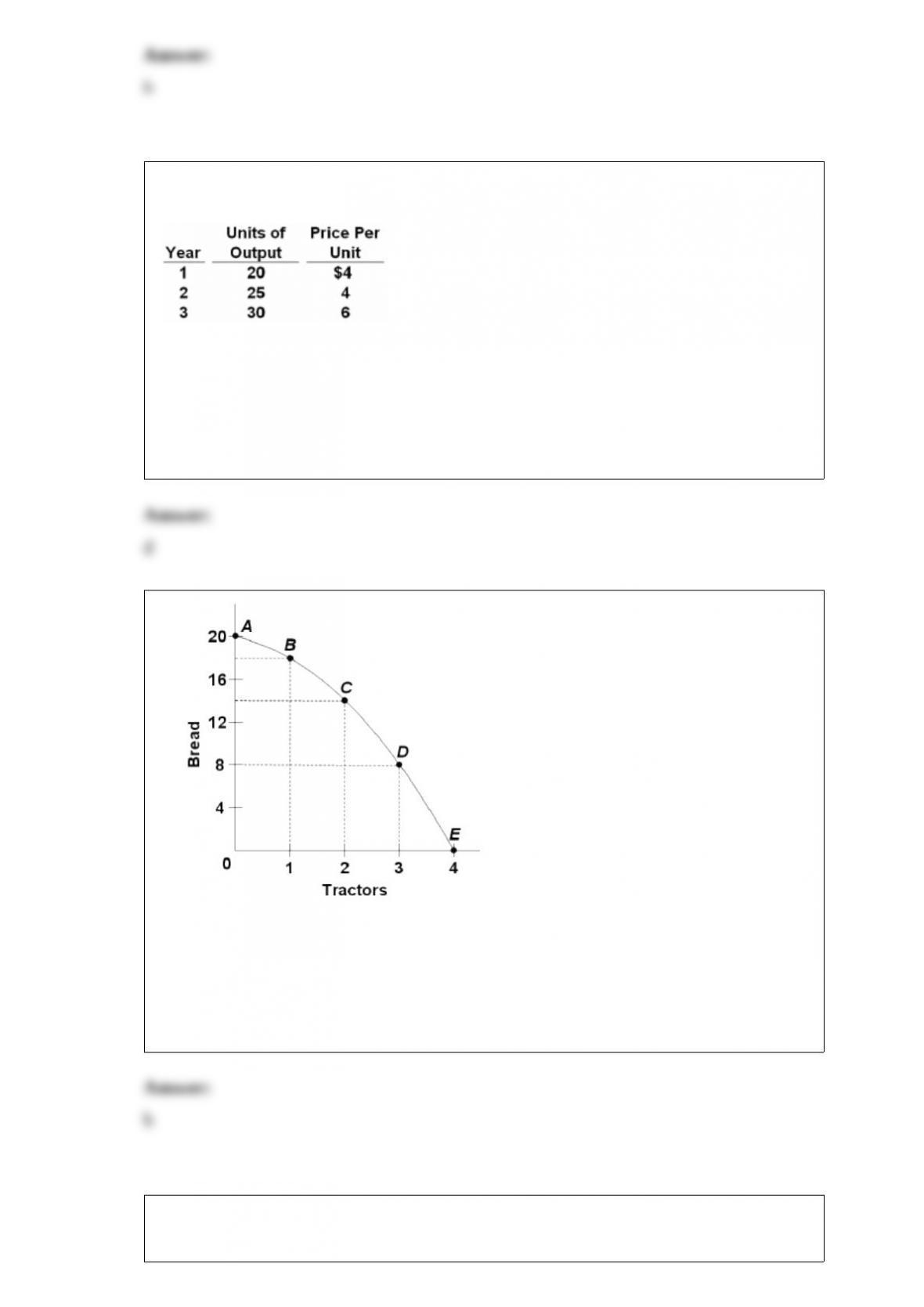
23) assume an economy that is producing only one product. output and price data for a
three-year period are as follows. answer the next question(s) on the basis of these data.
refer to the above data. if year 2 is chosen as the base year, in years 1 and 3 the price
index values, respectively, are:
a.4 and 6.
b.6 and 4.
c.120 and 100.
d.100 and 150.
24)
refer to the above diagram. starting at point a, the opportunity cost of producing each
successive unit of tractors is:
a.a constant 2 units of bread.
b.2, 4, 6, and 8 units of bread.
c.8, 6, 4, and 2 units of bread.
d.the reciprocal of the output of tractors.
25) the following cost data for a firm that is selling in a purely competitive market.
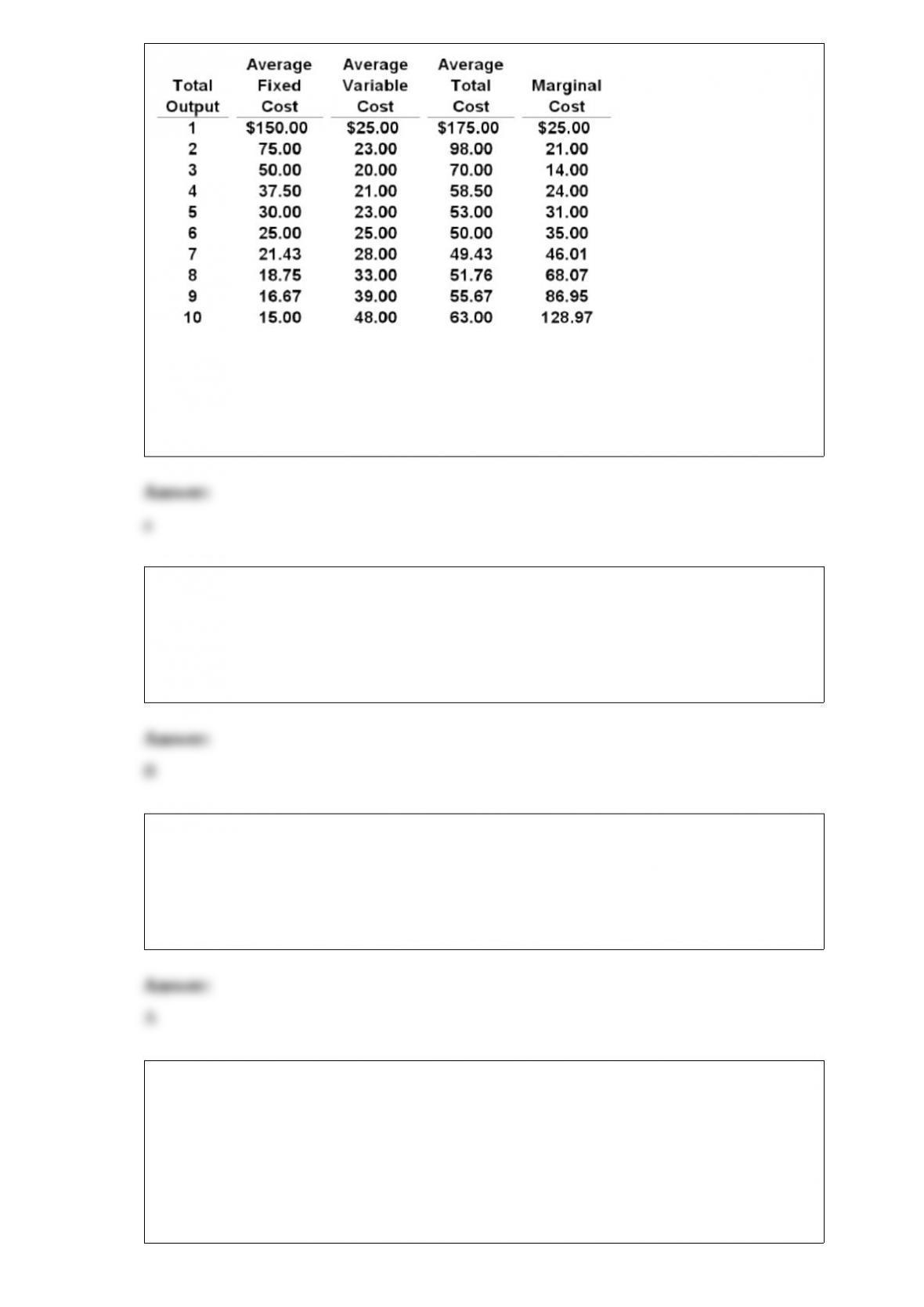
refer to the above data. the firm’s supply schedule is reflected in the:
a.marginal cost data for the fourth through tenth units of output.
b.marginal cost data for the first through tenth units of output.
c.average total cost data for the seventh through tenth units of output.
d.average variable cost data for fifth through tenth units of output.
26) Which one of the following is not prohibited by the original Clayton Act?
A.the purchase of the stocks of rival firms that lessens competition
B.the purchase of the assets of rival firms that lessens competition
C.an exclusive dealer or tying agreements that lessen competition
D.price discrimination that lessens competition
27) The misallocation of resources associated with price supports:
A.affects both domestic and foreign economies.
B.affects only foreign economies.
C.affects only the domestic economy.
D.is fully offset by reductions in food prices.
28) It is sometimes difficult to transfer the advanced technologies of the industrialized
nations to the DVCs because:
A.the technologies of the IACs are frequently based on relatively expensive labor and
relatively cheap capital.
B.the resource endowments of the IACs and the DVCs are highly similar.
C.international patent laws prohibit such transfers.
D.the technologies of the IACs are frequently based on relatively cheap labor and
relatively expensive capital.
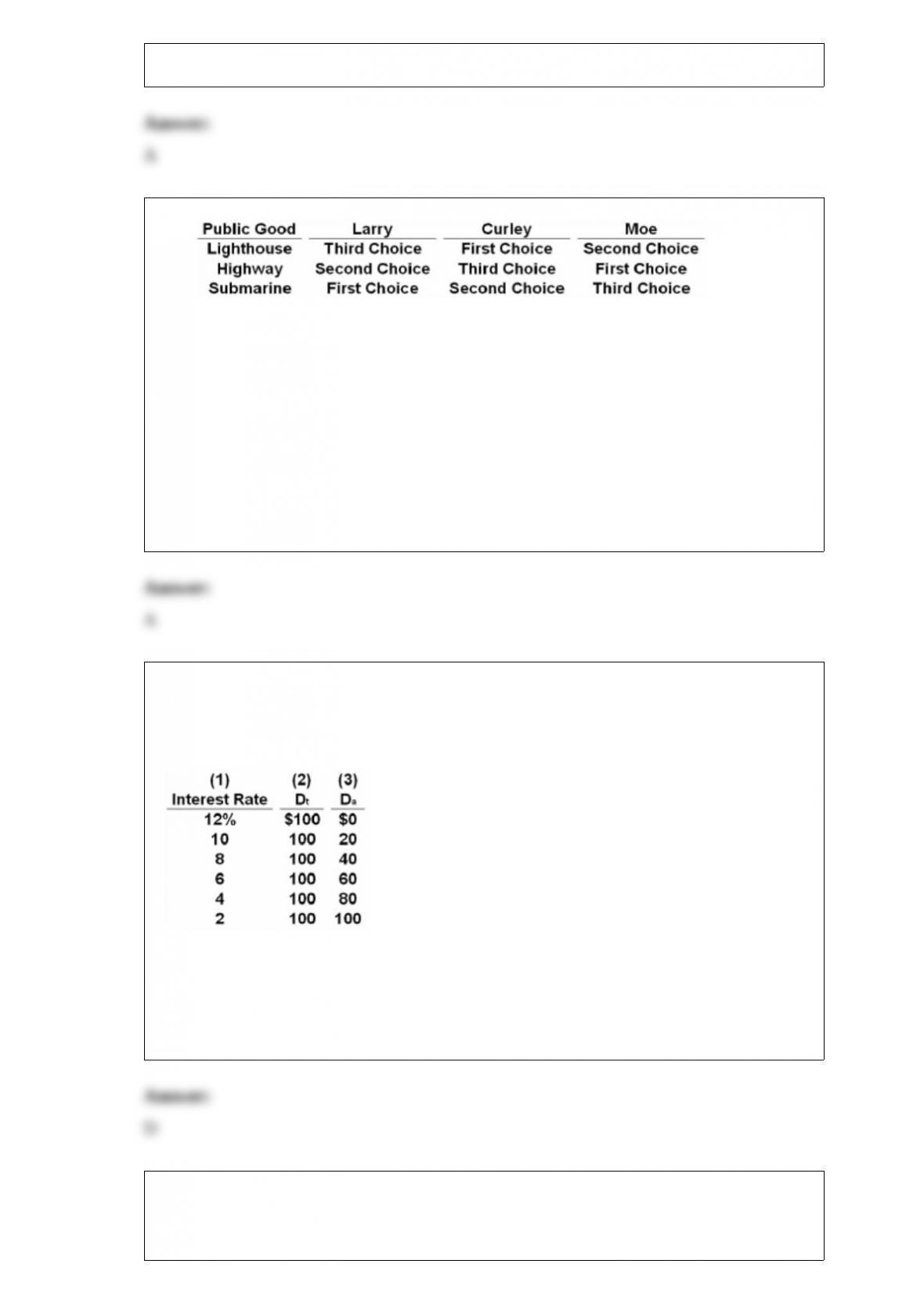
29)
Refer to the above table. The inconsistency illustrated by the table is that, while a
majority of voters prefer the:
A.highway to the lighthouse and the submarine to the highway, they also prefer the
lighthouse to the submarine.
B.lighthouse to the highway and the lighthouse to the submarine, they also prefer the
submarine to the highway.
C.highway to the lighthouse and the submarine to the lighthouse, they also prefer the
submarine to the highway.
D.lighthouse to the submarine and the highway to the submarine, they also prefer the
highway to the lighthouse.
30) The following table in which columns (1) and (2) indicate the transactions demand
(Dt) for money and columns (1) and (3) show the asset demand (Da) for money:
The above data suggest that the amount of money demanded for transactions:
A.varies directly with the interest rate.
B.varies inversely with the interest rate.
C.varies inversely with nominal GDP.
D.is independent of the interest rate.
31) Which of the following is a public assistance or welfare program as opposed to a
social insurance program?
A.Supplemental Security Income (SSI)
B.unemployment compensation
C.Medicare
D.Social Security
32) which of the following has been an outcome of the north american free trade
agreement (nafta)?
a.a lower standard of living in canada, mexico, and the united states
b.lower wages in the united states and canada
c.increased trade among canada, mexico, and the united states
d.lower wages and reduced employment in mexico
33) What information would be important for assessing the size of the public debt
beside the absolute amount of the public debt?
34) Evaluate the statement: There is no difference between the labor supply curve for
the single competitive firm and the supply curve in a competitive market for labor.
35) What is a monopsony and what are its basic characteristics?
36) Mainstream and new classical views are compatible perspectives on
macroeconomic issues and policies. Do you agree? Explain.
37) What is the World Trade Organization and what is it seeking to get adopted?