Suppose the government wants to maintain a balanced budget. To achieve this goal,
when the economy falls into recession government would need to ________ taxes,
which would cause aggregate demand to ________.
A) decrease; decrease
B) decrease; increase
C) increase; decrease
D) increase; increase
If net exports are equal to net foreign investment,
A) the balance of payments is zero.
B) the current account balance is equal to the negative of the financial account balance.
C) net capital inflows are equal to imports minus exports.
D) All of the above are true when net exports are equal to net foreign investment.
If foreign holdings of U.S. dollars increase, holding all else constant,
A) the balance on the U.S. financial account will increase.
B) the balance on the U.S. current account will increase.
C) the balance on the U.S. capital account will increase.
D) the U.S. balance of trade will increase.
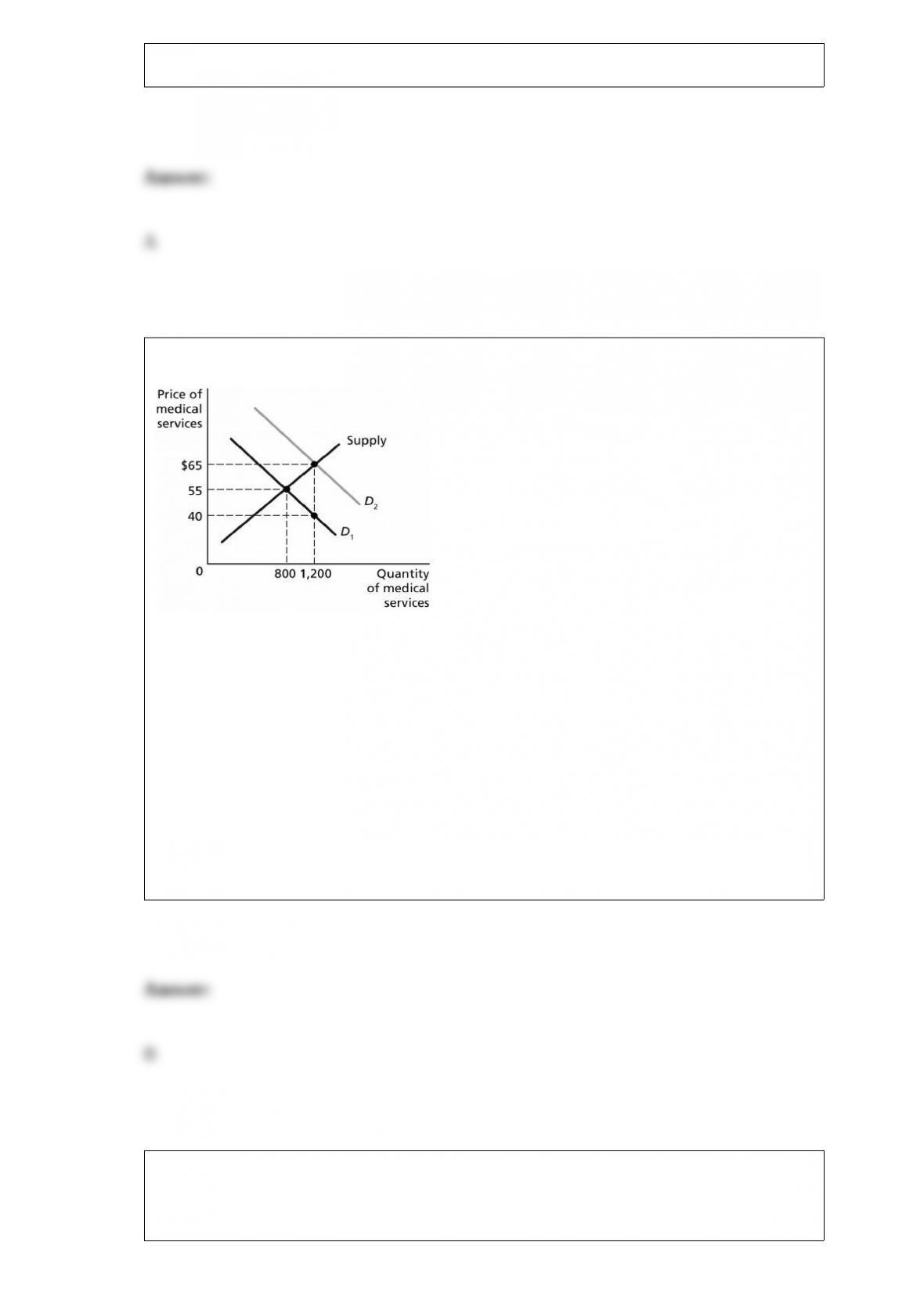
Figure 5-3
Figure 5-3 represents the market for medical services with and without insurance, and
the effect of a third-party payer system on the demand for medical services.
Refer to Figure 5-3. The efficient price of medical services is
A) $40.
B) $55.
C) $65.
D) >$65.
In the long run, the Phillips curve is a ________ at ________.
A) horizontal line; 0% inflation
B) negatively sloped line; the intersection of aggregate demand and short-run aggregate
supply
C) vertical line; the natural rate of unemployment
D) None of the above is correct.
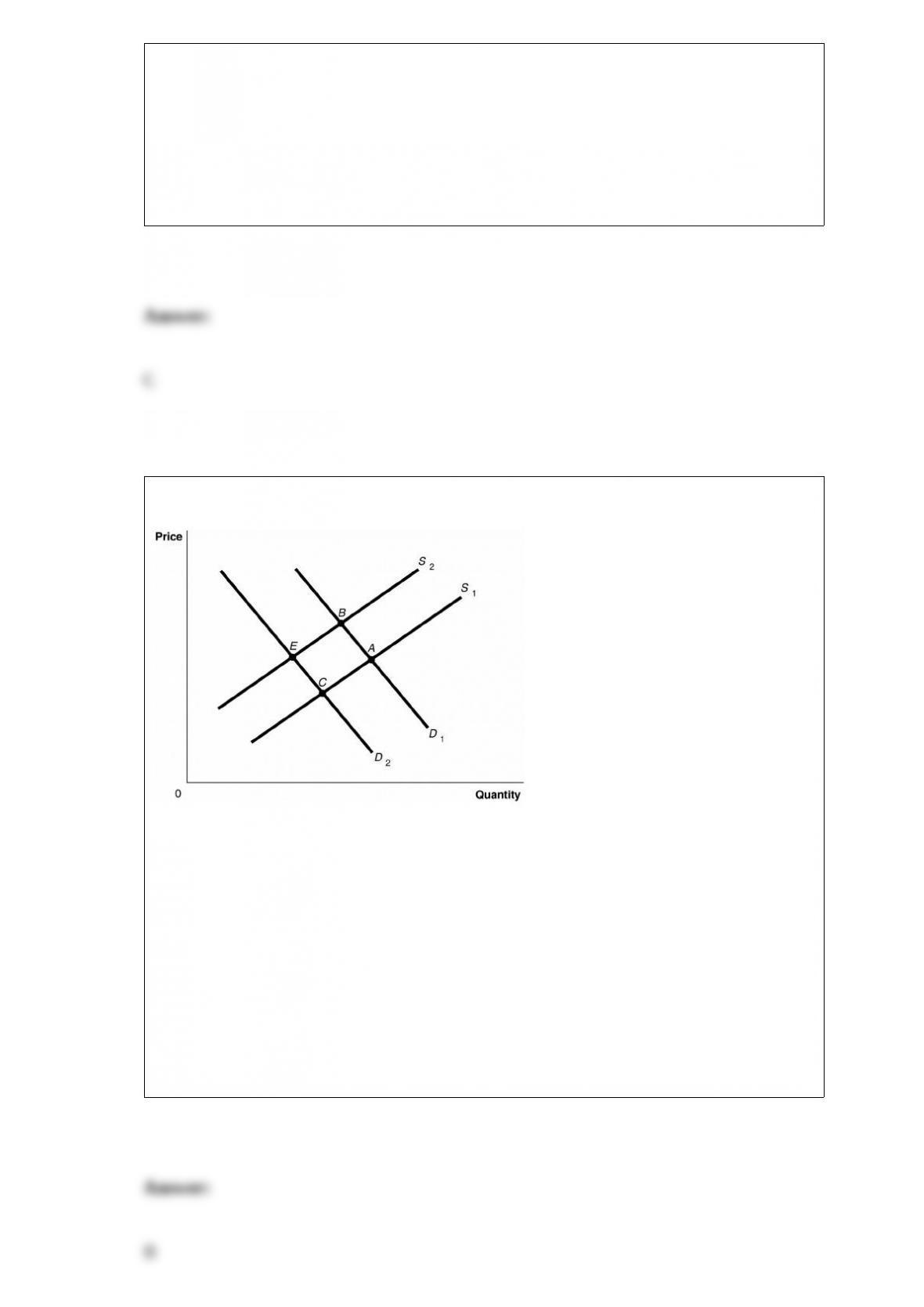
Figure 3-8
Refer to Figure 3-8. The graph in this figure illustrates an initial competitive
equilibrium in the market for motorcycles at the intersection of D1 and S1 (point A). If
the price of motorcycle engines increases, and the wages of motorcycle workers
increase, how will the equilibrium point change?
A) The equilibrium point will move from A to E.
B) The equilibrium point will move from A to B.
C) The equilibrium point will move from A to C.
D) The equilibrium will first move from A to B, then return to A.
A(n) ________ comes to an end with a business cycle ________.
A) recession; peak
B) recession; trough
C) expansion; trough
D) expansion; bubble
When the BEA calculates real GDP using the average of prices in the current year and
the year preceding it, and this average changes from year to year, this is called
calculating GDP using
A) chained-weighted prices.
B) fixed-weight prices.
C) current-year prices.
D) fixed base-year prices.
All of the following questions or statements regarding medical school are positive
except:
A) How do changes in expected future incomes affect the decisions of medical students
about which specialty to choose?
B) Medical students who enter specialized fields make a larger contribution to society
than do student who enter primary care.
C) What role does tuition play in a student’s decision about whether to attend medical
school?
D) Have tuition increases had a large effect or a small effect on the number of
applications to medical school?
In the circular flow diagram, ________ supply the factors of production, and ________
goods and services.
A) households; sell
B) households; buy
C) firms; sell
D) firms; buy
Article Summary
Administrative overhead costs resulting from insurance companies handling
reimbursement claims is in large part the reason that health care in the United States is
much more expensive than in other countries. An analysis on the administration costs of
health care in the United States found that roughly 30 percent of the costs of health care
are administrative and that more than 25 percent of health-sector employees work in
administration. Health insurance companies are often paid a fixed percentage of the
claims they administer, which gives them little to no impetus to increase efficiency and
keep costs down.
Source: Jeffrey Pfeffer, “The Reason Health Care Is So Expensive: Insurance
Companies,” Bloomberg Businessweek, April 10, 2013.
Refer to the Article Summary. Even if insurance companies were more efficient and
brought administrative costs down, consumers would ________ the full cost of medical
treatment. This would result in the market equilibrium price and quantity of medical
services being ________ than the efficient equilibrium price and quantity.
A) pay less than; less than
B) pay more than; less than
C) pay more than; more than
D) pay less than; more than