
Why do corporations want to keep the price of their stock high?
A) A higher stock price increases the funds the firm can raise when it sells a given
amount of stock.
B) Corporations can pay their managers lower salaries and avoid principal-agent
problems when stock prices are higher.
C) Higher stock prices are correlated with lower expected profitability.
D) All of the above provide incentive for corporations to keep the price of their stock
high.
In a closed economy, private saving is equal to which of the following? (Y = GDP, C =
Consumption, G = Government purchases, T = Taxes, and TR = Transfers)
A) Y – C – T
B) Y – G – T
C) Y – G – T + TR
D) Y + TR – C – T
When additions of input to a fixed quantity of another input lead to progressively
smaller increases in output, we say we are facing
A) diminishing returns.
B) negative returns.

C) accelerating returns.
D) decreasing production.
If the price of prime rib falls, the income effect due to the price change will cause
A) an increase in the demand for prime rib.
B) an increase in the demand for flank steak, a substitute for prime rib.
C) an increase in the quantity demanded of prime rib.
D) an increase in the quantity supplied of prime rib.
Figure 19-10

Refer to Figure 19-10. Under the Bretton Woods System of exchange rates, if the par
exchange rate was $2 per pound in the figure above, and equilibrium persisted at $3,
then this was evidence of ________ and the IMF would allow a ________ in the
exchange rate.
A) fundamental disequilibrium; revaluation
B) fundamental disequilibrium; devaluation
C) fundamental overvaluation; devaluation
D) fundamental overvaluation; revaluation
Limits on the flow of foreign exchange and financial investment across countries are
called
A) capital controls.
B) fixed exchange rates.
C) credit constraints.
D) currency restrictions.
Table 2-8

Table 2-8 shows the output per month of two people, Wilma and Betty. They can either
devote their time to making marble statues or making marble benches.
Refer to Table 2-8. What is Betty’s opportunity cost of making a statue?
A) 1/2 bench
B) 2 benches
C) 1/3 bench
D) 1.4 statues
One way investment banks differ from commercial banks is that investment banks
A) lend exclusively to households.
B) do not take in deposits.
C) only buy and sell mortgages.
D) trade only in foreign exchange markets.
Figure 16-1

Refer to Figure 16-1. Suppose the economy is in short-run equilibrium below potential
GDP and no fiscal or monetary policy is pursued. Using the static AD–AS model in the
figure above, this would be depicted as a movement from
A) A to B.
B) B to C.
C) C to B.
D) B to A.
E) A to E.
Since 1999, the capital account has recorded
A) transactions that affect net capital flows in the economy.
B) relatively minor transactions, such as migrants’ transfers, and sales and purchases of
nonproduced, nonfinancial assets.
C) transactions that affect the balance of trade or the balance of services.
D) statistical discrepancy between the current account and the financial account.
If in the market for apples the supply has decreased then
A) the supply curve for apples has shifted to the right.
B) there has been a movement upwards along the supply curve for apples.
C) the supply curve for apples has shifted to the left.
D) there has been a movement downwards along the supply curve for apples.
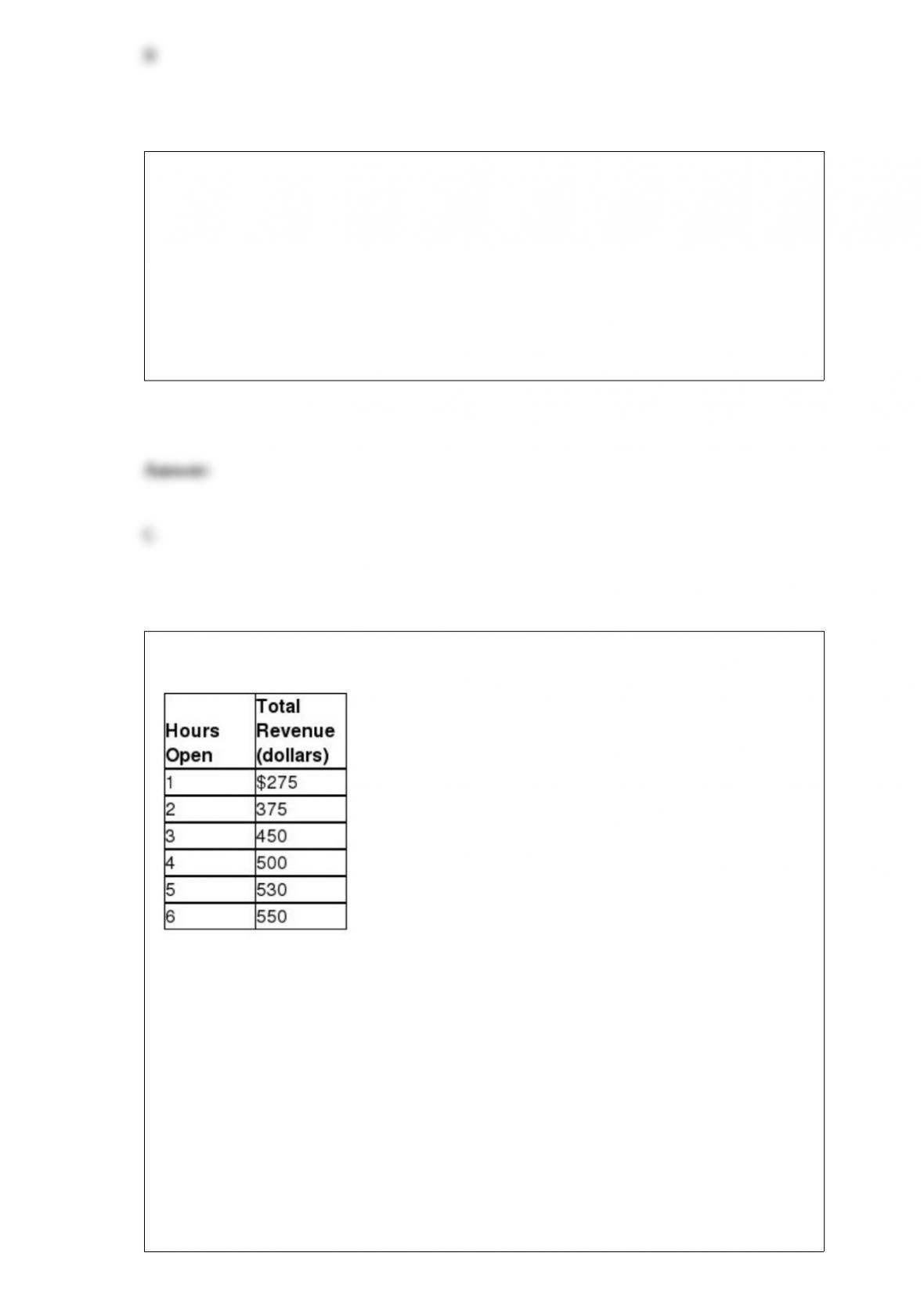
Table 1-3
Ivan runs a custom jewelry shop in Sparkle City. He is debating whether he should
extend his hours of operation. Ivan figures that his sales revenue will depend on the
number of hours the jewelry shop is open as shown in the table above. He would have
to hire a worker for those hours at a wage rate of $25 per hour.
Refer to Table 1-3. What is Ivan’s marginal benefit if he decides to stay open for six
hours instead of five hours?
A) $10
B) $20
C) $30

D) $91.67
If real GDP in the United States is growing at an annual rate of 3.2% per capita and
Bolivia’s real GDP per capita is growing at a rate of 1.3%, which of the following
would we expect in the long run? Assume real GDP per capita in the United States
begins at a level above that of real GDP per capita in Bolivia.
A) Real GDP per capita in the United States will always be 1.9% higher than real GDP
per capital in Bolivia.
B) The difference between the level of real GDP per capita in the United States and real
GDP per capita in Bolivia will shrink over time.
C) The difference between the level of real GDP per capita in the United States and real
GDP per capita in Bolivia will increase over time.
D) The difference between the level of real GDP per capita in the United States and real
GDP per capita in Bolivia will always be $1.9 trillion.
How are the fundamental economic decisions determined in Cuba?
A) Individuals, firms, and the government interact in a market to make these economic
decisions.
B) These decisions are made by the country’s elders who have had much experience in
answering these questions.
C) The government decides because Cuba is a centrally planned economy.

D) The United Nations decides because Cuba is a developing economy.
How are unemployment, inflation, and the business cycle related?
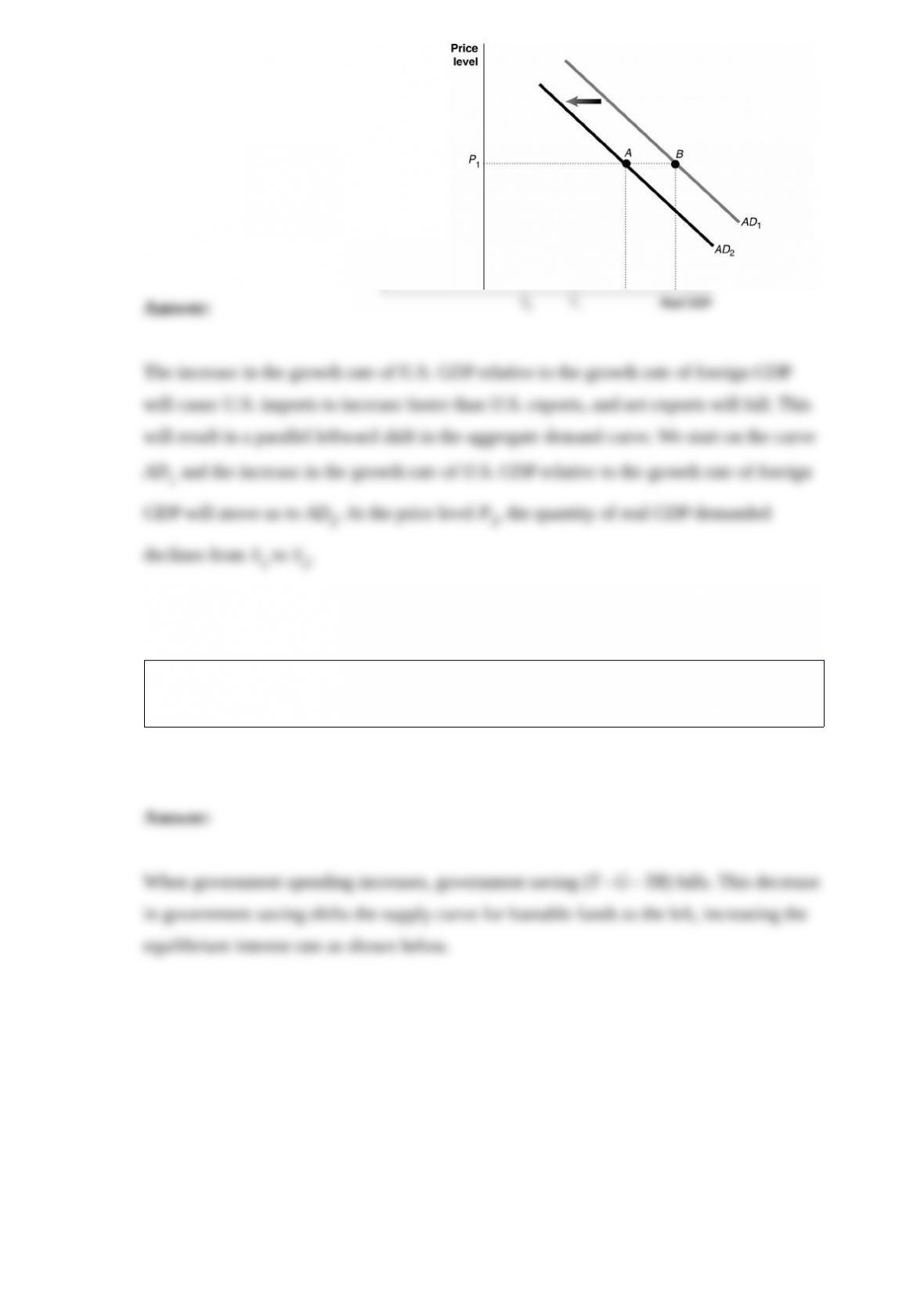
Using an aggregate demand graph, illustrate the impact of an increase in the growth rate
of U.S. GDP relative to the growth rate of foreign GDP.
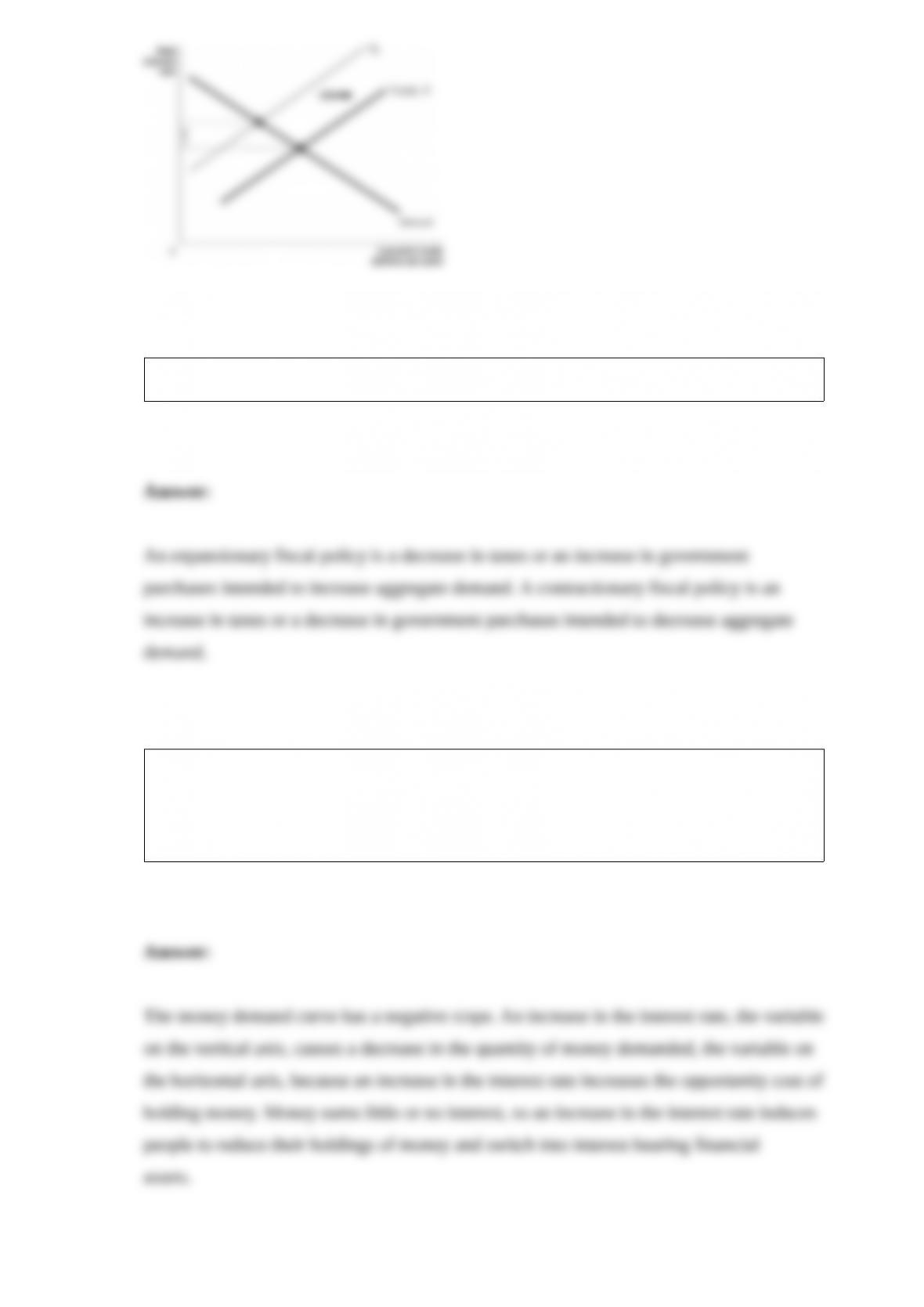
Explain and show graphically how an increase in government spending affects the
equilibrium interest rate in the market for loanable funds.
What is expansionary fiscal policy? What is contractionary fiscal policy?
Does the money demand curve have a positive slope or a negative slope? Why does it
have this slope? Explain why an increase in the variable on the vertical axis of the
money demand curve causes either an increase or a decrease in the variable on the
horizontal axis of the money demand curve.