
Suppose Orange Inc. sells MP3 players and initially has monopoly power because there
are only a few close substitutes available to consumers. As more types of MP3 players
are introduced into the market, the demand facing Orange becomes ________ elastic
and the Lerner index achieved by the firm in this market ________.
A) less, declines
B) less, increases
C) more, declines
D) more, increases
If a graph of a perfectly competitive firm shows that the MR = MC point occurs where
MR is above AVC but below ATC,
A) the firm is earning negative profit, and will shut down rather than produce that level
of output.
B) the firm is earning negative profit, but will continue to produce where MR = MC in
the short run.
C) the firm is still earning positive profit, as long as variable costs are covered.
D) the firm is covering explicit, but not implicit, costs.
E) the firm can cover all of fixed costs but only a portion of variable costs.

Some luxury product manufacturers will purposefully raise prices on their goods in
order to reduce sales volume. This strategy may successfully increase sales revenue if
the luxury goods are subject to the ________ effect and have relatively ________
demand.
A) bandwagon, elastic
B) bandwagon, inelastic
C) snob, elastic
D) snob, inelastic
Which of the following will result in a decrease in a consumer’s purchasing power?
A) A decrease in the consumer’s income
B) An increase in the price of the good on the vertical axis
C) An increase in the price of the good on the horizontal axis
D) all of the above
In what ways can economists help auto manufacturers estimate the marginal rate of
substitution between features such as vehicle interior size and acceleration?
A) Examining production cost data

B) Conducting consumer surveys about willingness to pay for auto features
C) Solving the standard consumer model
D) Statistically analyzing historical data on purchases of different types of autos
E) B and D only
Use the following two statements to answer this question:
I. The supply of newly mined copper is more elastic in the long run than in the short
run.
II. The supply of scrap copper is more elastic in the short run than in the long run.
A) Both I and II are true.
B) I is true, and II is false.
C) I is false, and II is true.
D) Both I and II are false.
Medical histories used by insurance firms allow them to
A) identify high-risk people, so they can be denied insurance and premiums kept down

for low risk people.
B) increase the number of policies issued, raising premiums as a result.
C) increase the number of policies issued, lowering premiums as a result.
D) lower the number of policies issued, raising premiums.
E) increase market power in the insurance industry, raising premiums.
What characteristic of monopolistic competition may help to offset the inefficiency of
this market structure?
A) Free entry and exit imply that firms produce at minimum long-run average cost.
B) Consumers may value the product diversity that allows them to choose from a wide
variety of differentiated products.
C) Consumers may feel better about the inefficiency if they know that firms earn zero
profits.
D) Consumers may prefer this outcome to monopoly or monopsony.
What is one difference between the Cournot and Stackelberg models?
A) In Cournot, both firms make output decisions simultaneously, and in Stackelberg,
one firm sets its output level first.

B) In Stackelberg, both firms make output decisions simultaneously, and in Cournot,
one firm sets its output level first.
C) In Cournot, a firm has the opportunity to react to its rival.
D) Profits are zero in Cournot and positive in Stackelberg.
Suppose your utility function for food (F) and clothing (C) is u(F,C) = F + 4C. If you
reduce your clothing consumption by 2 units, how much do you have to increase your
food consumption in order to maintain the same utility level?
A) 2 units
B) 4 units
C) 6 units
D) 8 units
Consider the following statements when answering this question
I. When a competitive industry’s supply curve is perfectly elastic, then the sole
beneficiaries of a reduction in input prices are consumers.
II. Even in competitive markets firms have no incentives to control costs, as they can
always pass on cost increases to consumers.

A) I and II are true.
B) I is true, and II is false.
C) I is false, and II is true.
D) I and II are false.
Use the following statements to answer this question:
I. If the extent of a market is broader, it is less likely that firms in the market can
influence the market price.
II. In determining whether two different products belong to the same market, it is
necessary to know whether the two products can be used as substitutes for each other.
A) I and II are both false.
B) I is false, and II is true.
C) I is true, and II is false.
D) I and II are both true.
Scenario 14.3:
Suppose that a firm’s demand curve for its product is as follows:
Output Price of the Good
25 9
40 8
54 7
67 6
79 5
90 4
Also suppose that labor is the only variable input of production, and that the total
product of labor is:
Amount of Total Output
Labor
2 25
3 40
4 54
5 67
6 79
7 90
Given the data in Scenario 14.3, how much labor should the firm employ if labor costs
$30 a unit?
A) 3 units of labor
B) 4 units of labor
C) 5 units of labor
D) 6 units of labor
E) 7 units of labor

Suppose the supply of non-OPEC oil increases due to new petroleum discoveries in
other countries. What happens to the price of oil on the world market?
A) Increases
B) Decreases
C) Remains the same
D) We do not have enough information to answer this question.
Assume that two investment opportunities have identical expected values of $100,000.
Investment A has a variance of 25,000, while investment B’s variance is 10,000. We
would expect most investors (who dislike risk) to prefer investment opportunity
A) A because it has less risk.
B) A because it provides higher potential earnings.
C) B because it has less risk.
D) B because of its higher potential earnings.
Your economics professor has decided that your class will not be graded on a curve but
on an absolute scale. Therefore, it is possible for every student in the class to get an
“A.” Your grade will not depend in any way on your classmates’ performance. Based on
this information, you decide that you should study economics three hours each day,
regardless of what your classmates do. In the language of game theory, your decision to
study three hours each day is:
A) a dominant strategy.
B) a minimax strategy.
C) a maximin strategy.
D) a Prisoner’s dilemma.
The snob effect corresponds best to a
A) negative network externality.
B) Giffen good.
C) positive network externality.
D) bandwagon effect.
Boeing Corporation and Airbus Industries are the only two producers of long-range
commercial aircraft. This market is not perfectly competitive because:
A) each company has annual sales over $10 billion.
B) each company can significantly affect prices.
C) Airbus receives subsidies from the European Union.
D) Airbus cannot sell aircraft to the United States government.
E) all of the above
Which of the following will NOT cause a shift in the supply of gasoline?
A) An increase in the wage rate of refinery workers
B) A decrease in the price of gasoline
C) An improvement in oil refining technology
D) A decrease in the price of crude oil
Scenario 3.1:
Andy derives utility from two goods, potato chips (Qp) and Cola (Qc). Andy receives
zero utility unless he consumes some of at least one good. The marginal utility that he
receives from the two goods is given as follows:
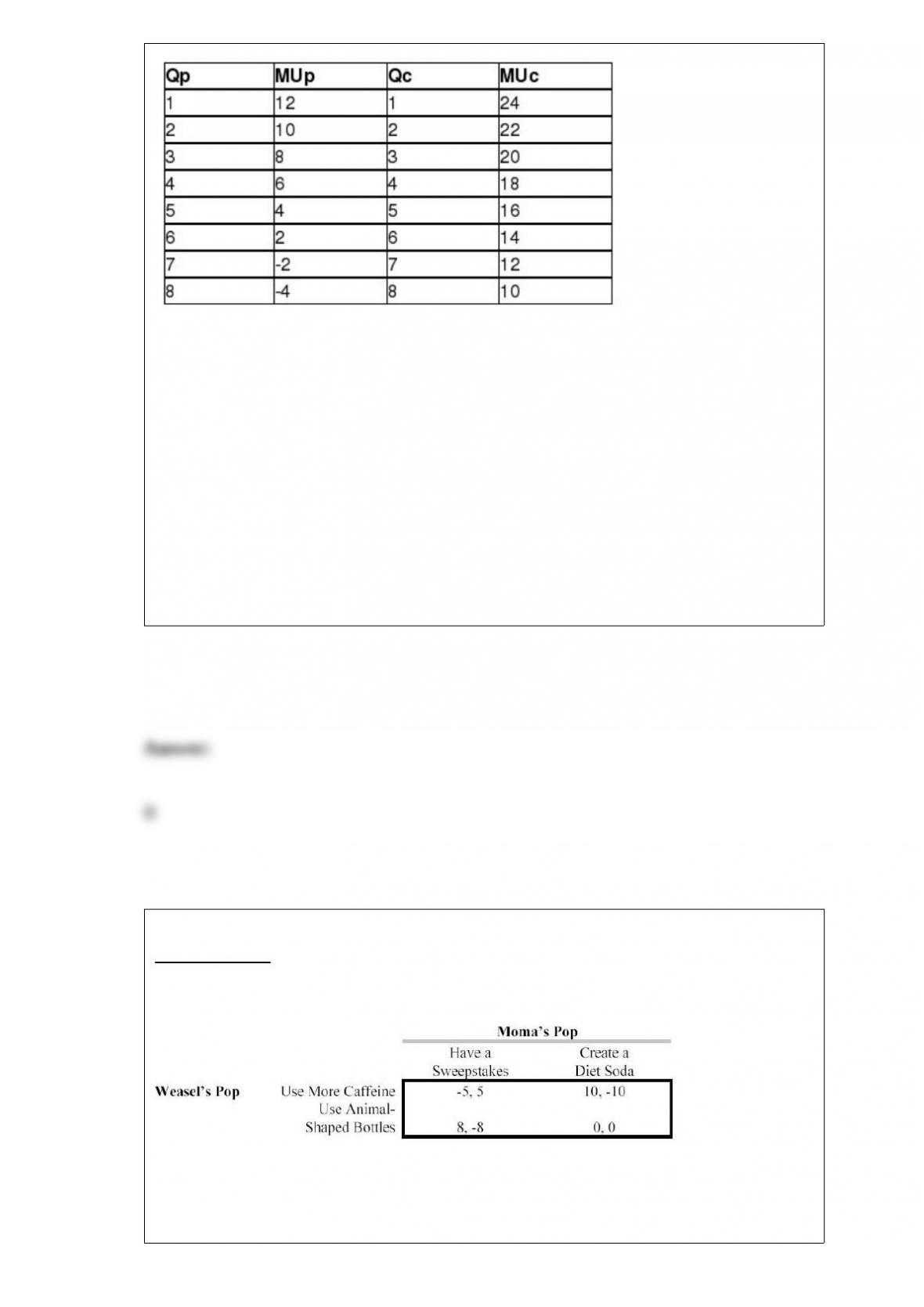
Refer to Scenario 3.1. If the price of potato chips is $0.50 and the price of Cola is $4.00,
and Andy has an unlimited income, how many units of potato chips will he consume?
A) 5
B) 6
C) 7
D) 8
E) none of the above
Scenario 13.10
Consider the game below:
What is true about dominant strategies in the game in Scenario 13.10?
A) “Use more caffeine” and “have a sweepstakes” are dominant strategies.

B) “Use more caffeine” and “create a diet soda” are dominant strategies.
C) “Make animal-shaped bottles” and “have a sweepstakes” are dominant strategies.
D) “Make animal-shaped bottles” and “create a diet soda” are dominant strategies.
E) There are no dominant strategies.
If two goods are substitutes, the cross-price elasticity of demand must be
A) negative.
B) positive.
C) zero.
D) infinite.
Use the following statements to answer this question:
I. Majority-voting always leads to an economically efficient outcome.
II. Majority-voting may generate too much or too little of a particular public good.
A) I and II are true

B) I is true and II is false
C) I is false and II is true
D) I and II are false
Suppose the major soft drink companies develop vending machines for canned and
bottled drinks that can determine your maximum willingness-to-pay for a drink, and the
machine charges you that price when you purchase a drink. If this were possible, the
consumer surplus in the vended soft drink market would be:
A) positive because consumer surplus equals consumer expenditures in this case.
B) positive because the market demand curve is perfectly inelastic in this case.
C) negative because people are not actually willing to pay their maximum value for the
product.
D) zero because all surplus value is captured by the seller.
In 1992, the Occupational Safety and Health Authority passed the Bloodborne
Pathogens Standard (BBP), which regulates dental office procedures. This regulation is
designed to minimize the transmission of infectious disease from patient to dental
worker. The effect of this regulation was both to increase the cost of providing dental
care and to ease the fear of going to the dentist as the risk of contracting an infectious
disease.

What is the effect of the BBP on the market for dental care?
A) Only the supply curve shifts.
B) Only the demand curve shifts.
C) Both the demand and supply curves shift.
D) Neither the demand nor supply curve shifts.
Ronny’s Pizza House is a profit maximizing firm in a perfectly competitive local
restaurant market, and their optimal output is 80 pizzas per day. The local government
imposes a new tax of $250 per year on all restaurants that operate in the city. How does
this affect Ronny’s profit maximizing decisions?
A) No impact on the restaurant’s decisions
B) Ronny’s will remain in business but will definitely produce less pizza
C) Ronny’s will definitely shut down
D) Ronny’s decision depends on the circumstances — if their profits are larger than $250
per year, then the tax does not impact output; otherwise, Ronny’s Pizza House will shut
down.
Scenario 4.3:

The demand for erasers (Q) is given as follows:
Q = 240 – 4Pe + 2I + Pb + A
where Pe is the price of erasers
I is the level of income
Pb is the price of another good
A is the level of advertising
Suppose that Q = 240, Pe = 10, Pb = 10, and A = 2.Given the information in Scenario
4.3, it would be correct to say that demand is:
A) infinitely elastic.
B) elastic, but not infinitely elastic.
C) unit elastic (Ep = -1).
D) inelastic, but not completely inelastic.
E) completely inelastic.
A demand curve of the form: Q = a – bP, where a and b are positive real numbers,:
A) is an upward sloping straight line.
B) has a constant price elasticity of demand.
C) is a downward sloping straight line.
D) is a parabolic curve.

Gary Franklin is a movie critic. He invented the Franklin Scale with which he rates
movies from 1 to 10 (10 being best). When asked about his scale, Mr. Franklin
explained “that it is a subjective measure of movie quality. A movie with a ranking of
10 is not necessarily 10 times better than a movie with a ranking of 1, but it is better. A
movie with a ranking of 5 is better than a movie with a ranking of 1, but is not as good
a movie with a ranking of 10. That’s all it really tells you.” Based on Mr. Franklin’s
description, his scale is:
A) ordinal but not cardinal.
B) cardinal but not ordinal.
C) an objective standard to judge movies.
D) neither cardinal nor ordinal.
Andre Agassi, a star tennis player, is playing the number one player in the world, Roger
Federer. Before the match, Agassi decided that he would serve 20 percent of his serves
to Federer’s backhand, 30 percent of his serves to Federer’s forehand, and 50 percent of
his serves straight at Federer. In the language of game theory, this is known as:
A) a pure strategy.
B) a dominant strategy.
C) a mixed strategy.
D) a maximin strategy.

A strategy A is “dominant” for a player X if
A) strategy A contains among its outcomes the highest possible payoff in the game.
B) irrespective of any of the possible strategies chosen by the other players, strategy A
generates a higher payoff than any other strategy available to player X.
C) strategy A is the best response to every strategy of the other player.
D) strategy A is the best response to the best strategy of the other player.
E) every outcome under strategy A generates positive payoffs.