
One reason why many low-income countries experience low rates of growth is because
of poor public education and health.
If banks receive a greater amount of reserves and do not hold all of these reserves as
excess reserves, the money supply expands.
The German central bank, the Bundesbank, faced the risk of increased inflation caused
by its actions to support an overvalued deutsche mark in the 1960s.
The United States has a closed economy.

Your checking account balance is included in your bank’s assets.
In the circular flow model, households demand resources such as labor services in the
product market.
The current account balance equals the value of net exports.
Despite saving Lehman Brothers from failing, the Fed and the Treasury decided to
allow Bear Stearns to go bankrupt, which it did in September, 2008.

On a balance sheet, short-term debts such as accounts payable are listed as
A) current assets.
B) current liabilities.
C) stockholder’s equity.
D) goodwill.
What impact does expansionary monetary policy have on the short-run Phillips curve if
consumers and firms expect the expansionary monetary policy to increase inflation?
A) The short-run Phillips curve shifts down.
B) The short-run Phillips curve shifts up.
C) The short-run Phillips curve becomes the long-run Phillips curve.
D) The short-run Phillips curve is not affected by expansionary monetary policy.
Which of the following is considered expansionary fiscal policy?
A) Congress decreases the income tax rate.
B) Congress increases defense spending.
C) Legislation increases a college tuition deduction from federal income taxes.
D) The Arizona legislature cuts highway spending to balance its budget.

Unemployment insurance is usually available to workers in ________ for a shorter
period of time than it is in ________.
A) the United States; Canada
B) Canada and some Western European countries; the United States
C) Canada; some Western European countries
D) some Western European countries; the United States
What can the Federal Reserve do to reduce the natural rate of unemployment?
A) nothing
B) follow expansionary monetary policy that will increase inflation
C) follow expansionary monetary policy that will reduce inflation
D) follow contractionary monetary policy that will increase inflation

If the quantity of tacos demanded is represented by the equation QD = 20 – 0.5P then
the corresponding price of tacos is represented by the equation
A) P = 0.5QD + 10.
B) P = 40 – 2QD.
C) P = 10 – 2QD.
D) P = QD + 40.
To calculate GDP by the expenditure method, one must add
A) wages, rents, interest, and profits.
B) consumption spending, investment spending, government spending and net exports.
C) consumption spending, investment spending, government spending and exports.
D) labor, natural resources, entrepreneurship, and capital.
Table 2-1
Production Choices for Dina’s Diner
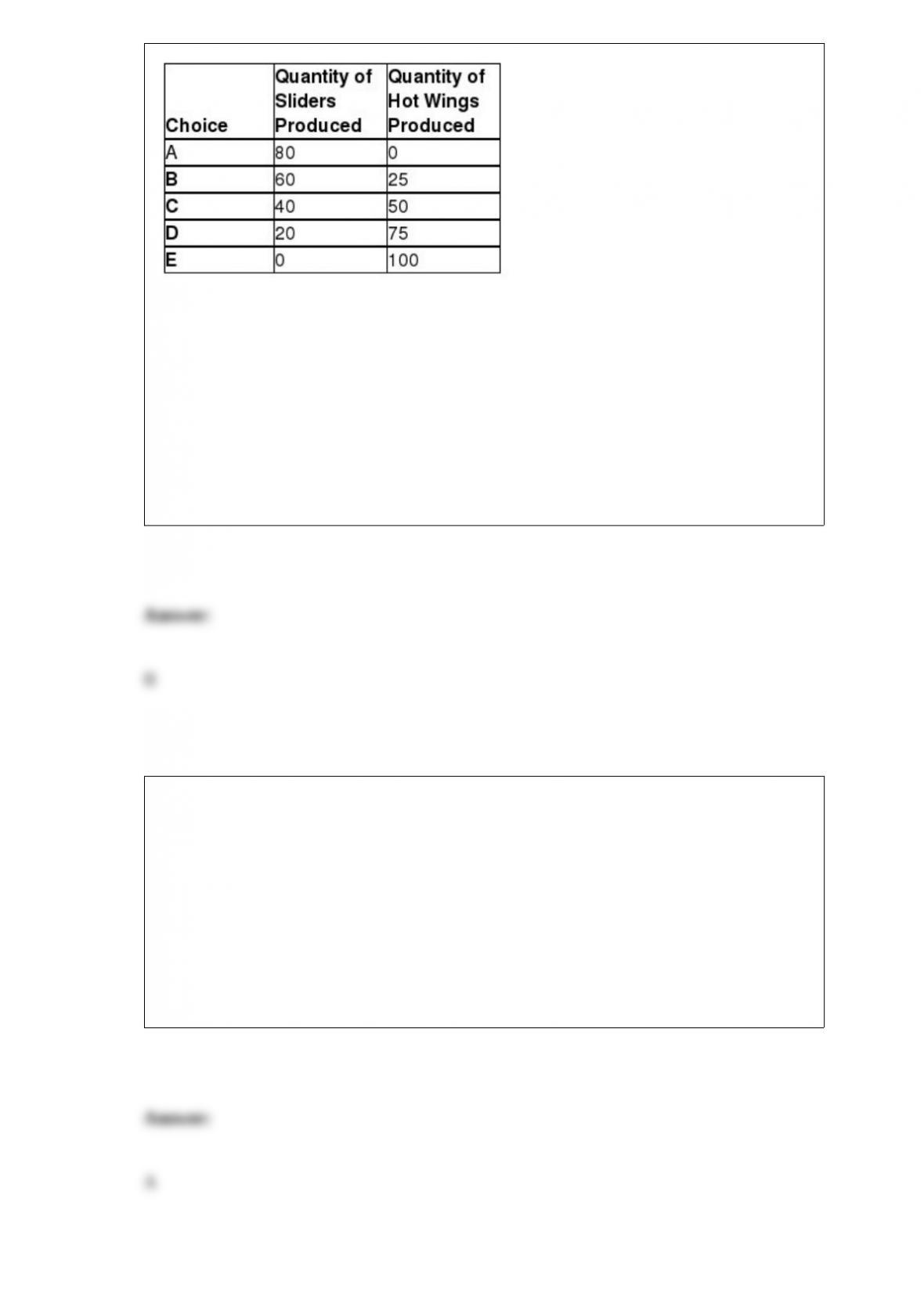
Refer to Table 2-1. Assume Dina’s Diner only produces sliders and hot wings. A
combination of 20 sliders and 60 hot wings would appear
A) along Dina’s production possibilities frontier.
B) inside Dina’s production possibilities frontier.
C) outside Dina’s production possibilities frontier.
D) at the vertical intercept of Dina’s production possibilities frontier.
During what period of time did the United States most consistently adhere to the gold
standard?
A) from the nineteenth century until the 1930s
B) from the eighteenth century until the nineteenth century
C) from 1914 until 1929
D) from 1944 until 1980
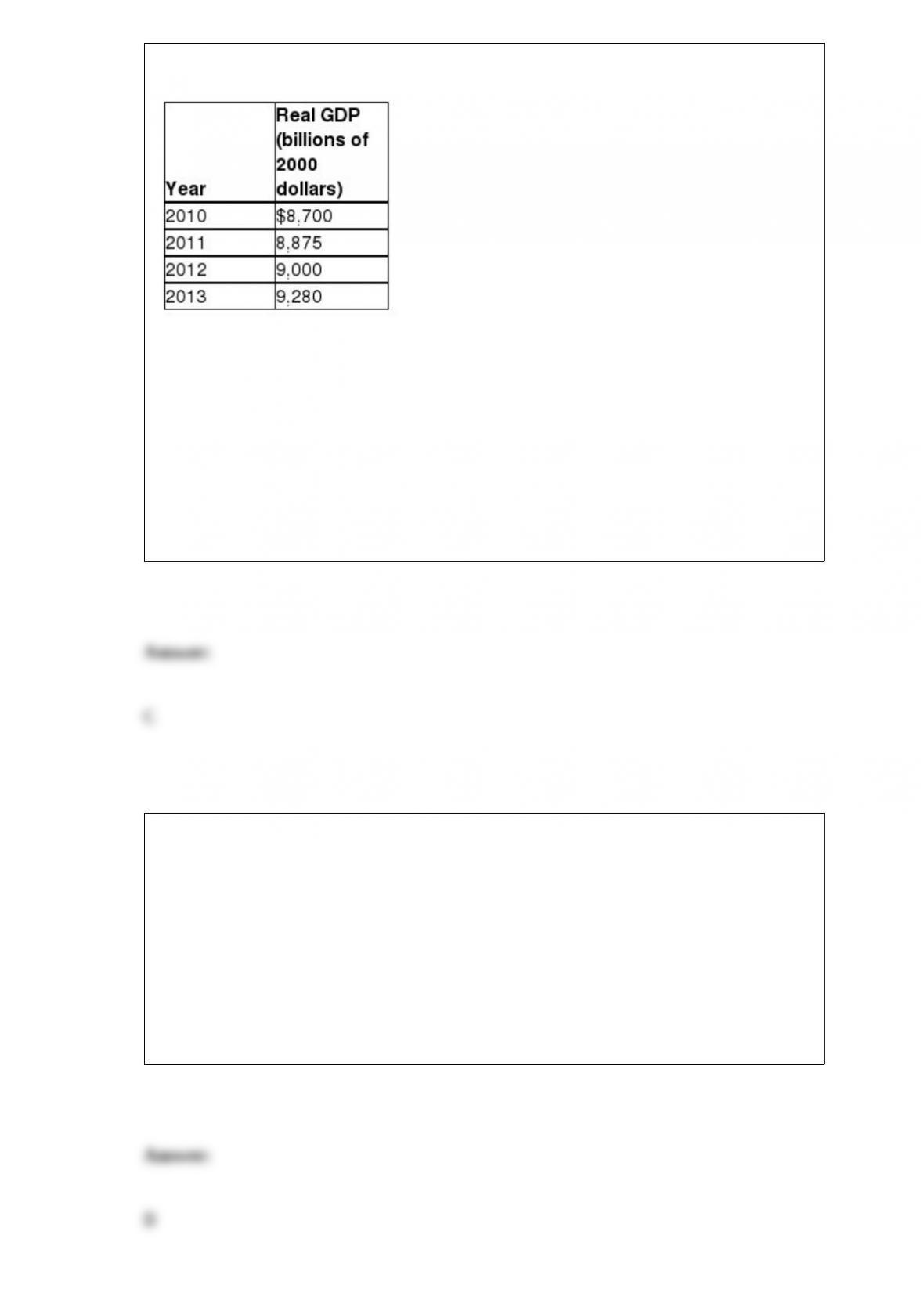
Table 10-1
Refer to Table 10-1. Using the table above, what is the approximate growth rate of real
GDP from 2012 to 2013?
A) 1%
B) 2%
C) 3%
D) 4%
You lend $5,000 to a friend for one year at a nominal interest rate of 10%. The CPI over
that year rises from 180 to 190. What is the real rate of interest you will earn?
A) 0%
B) 4.4%
C) 5.5%
D) 5.8%

Which of the following is a true statement regarding the economic growth model’s
predictions and how it actually affects the real world?
A) The growth model predicts that poor countries should catch up with rich countries,
but developing countries are not catching up to lower-income industrialized countries as
a group.
B) The growth model predicts that poor countries will never catch up with rich
countries, but lower-income industrialized countries are catching up to higher-income
industrialized countries as a group.
C) The growth model predicts that poor countries will catch up with rich countries, but
lower-income industrialized countries are not catching up to higher-income
industrialized countries as a group.
D) The growth model predicts that poor countries will catch up with rich countries, and
this is what we observe across all developmental categories of countries.
Assume a country is required by law to balance the budget every year. Suppose
aggregate demand falls, causing a recession and a budget deficit. To balance the budget,
what would the government need to do with the level of government spending and
taxes? How would these changes in government spending and taxes affect aggregate
demand and the economy?
Give three reasons why the U.S. economy is more stable since 1950.
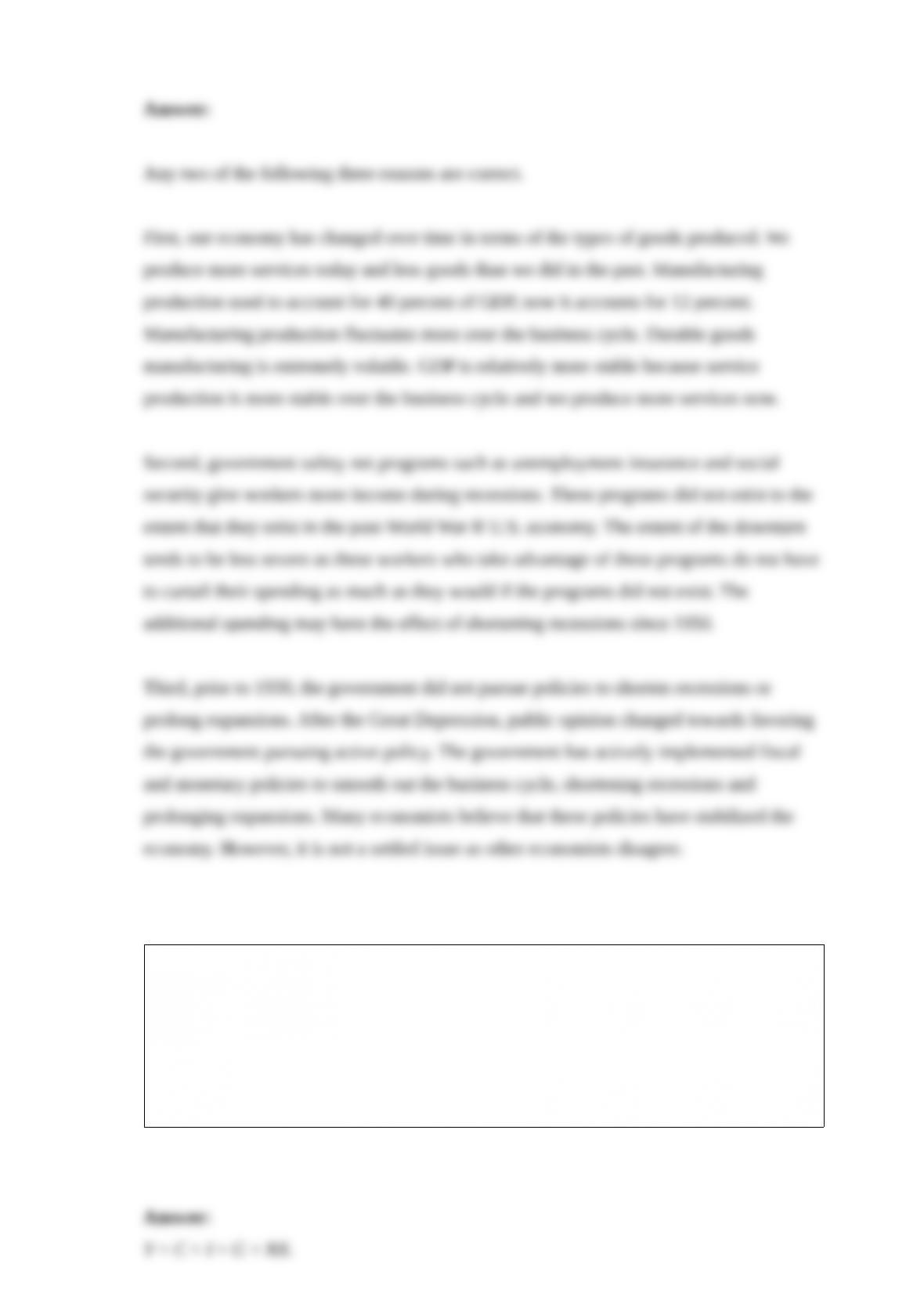
C = 2,550 + (MPC)Y
I = 800
G = 1,100
NX = 50
If the equilibrium level of GDP is $11,250, using the equations for C, I, G, and NX
shown above, find the value of the marginal propensity to consume.
If the exchange rate between the Mexican peso and the U.S. dollar expressed in terms
of pesos per dollar is 13.5 pesos = 1 dollar, what is the exchange rate when expresses in
terms of dollars per peso?
Use the rule of 70 to illustrate how small differences in growth rates can have a large
impact on how rapidly the standard of living in a country increases.