
Evidence seems to indicate that the demand for many agricultural products
a. has increased much more than supply over the years.
b. is relatively elastic.
c. is relatively inelastic.
d. is relatively income elastic.
e. b and d
Which of the following cost curves is never U-shaped?
a. the average total cost curve
b. the average fixed cost curve
c. the marginal cost curve
d. the average variable cost curve
Through war, many of the factories in country 1 are destroyed and many of its people
are killed. As a result, the country’s
a. production possibilities frontier (PPF) after the war has probably shifted to the right
compared to its PPF prior to the war.
b. PPF after the war has probably shifted to the left compared to its PPF prior to the
war.

c. PPF after the war is probably the same PPF as before the war.
d. ability to produce goods and services has increased.
e. b and d
In the supply-and-demand diagram of the market for peanut butter, the equilibrium
point has moved down and to the right. What could have caused this?
a. a fall in the price of peanuts
b. a rise in the price of peanuts
c. a rise in income, assuming that peanut butter is an inferior good
d. a shift in preferences toward peanut butter
A measure of the value that one unit of a factor adds to the firm’s output is value
__________ product.
a. average
b. marginal
c. variable
d. fixed
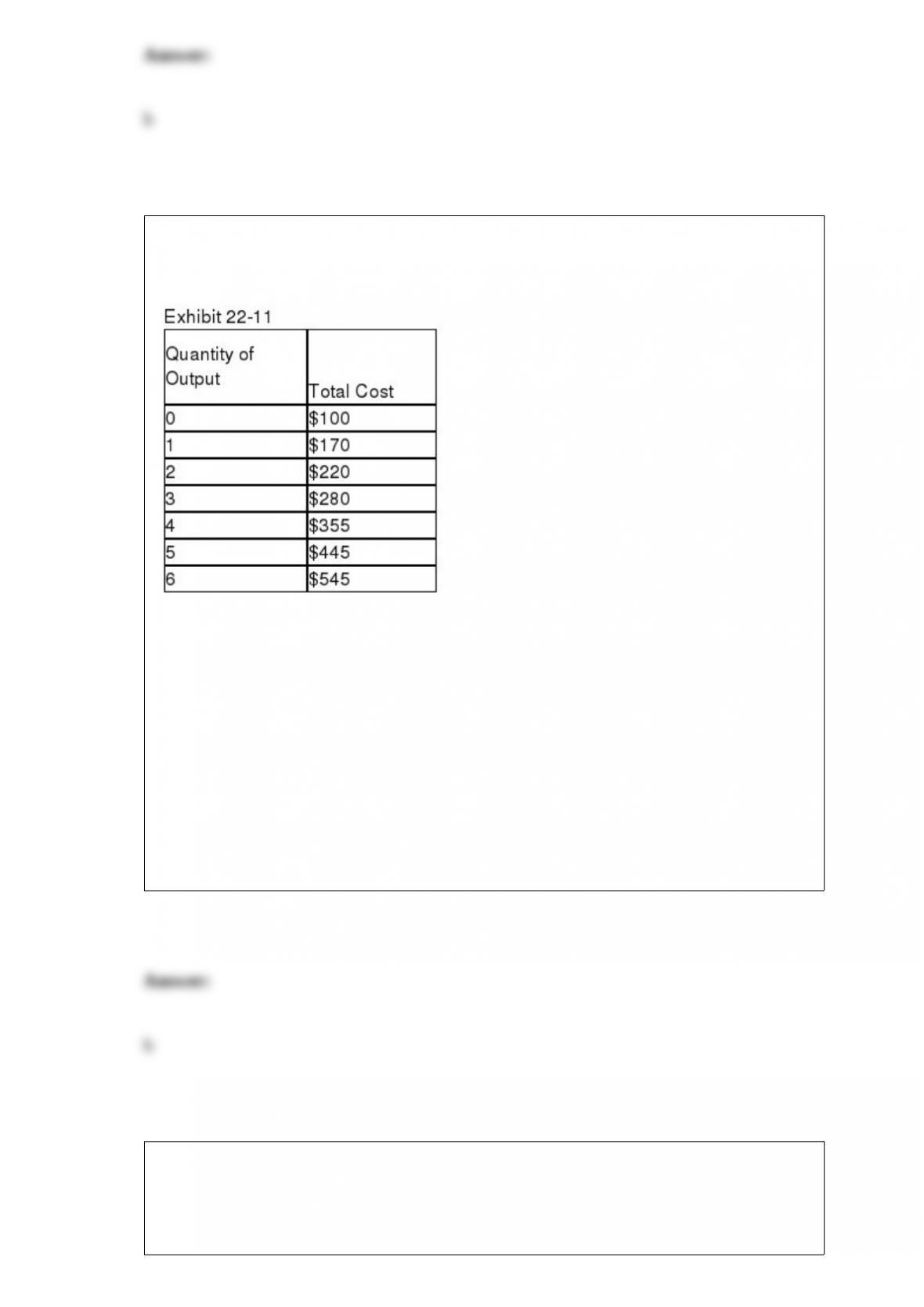
Average variable cost at three units of output is
a. $50.
b. $60.
c. $93.33.
d. $110.
e. There is not enough information provided to answer this question.
If X is the actual amount of income or receipts and i is the interest rate (in decimals)
that could be earned on alternative uses of money that face the same risk, the present
value of X one year from now is computed by

a. X/(1-i).
b. X/(1+i).
c. i/(1+X).
d. (X)(1 + i).
e. (i)(1 + X).
If goods A and B have a cross elasticity of demand that is positive, this is evidence that
goods A and B are __________ goods.
a. complementary
b. substitute
c. normal
d. inferior
If firms are earning zero economic profits, they must be producing at an output level at
which
a. price equals marginal cost.
b. price equals average total cost.
c. price equals average variable cost.

d. marginal revenue equals marginal cost.
e. none of the above
If the quantity demanded of medical care is higher at a zero price than at some positive
price, then it follows that the demand for those specific items that make up health care
will be higher (than it would be if the quantity demanded of health care were lower).
a. True
b. False
A significant difference between perfect competition and monopolistic competition is
that
a. a perfectly competitive firm is a price searcher, while a monopolistic competitive
firm is a price taker.
b. a perfectly competitive firm faces a downward-sloping demand curve, while a
monopolistic competitive firm faces a perfectly elastic demand curve.
c. a perfectly competitive firm sells a homogeneous product, while a monopolistic
competitive firm sells a differentiated product.
d. a perfectly competitive firm sets price above marginal cost, while a monopolistic
competitive firm sets price equal to marginal cost.
If a firm earns normal profit, then it has generated revenues
a. equal to the sum of implicit and explicit costs.
b. greater than total opportunity costs.
c. sufficient to cover explicit costs, but not implicit costs.
d. sufficient to cover implicit costs, but not explicit costs.
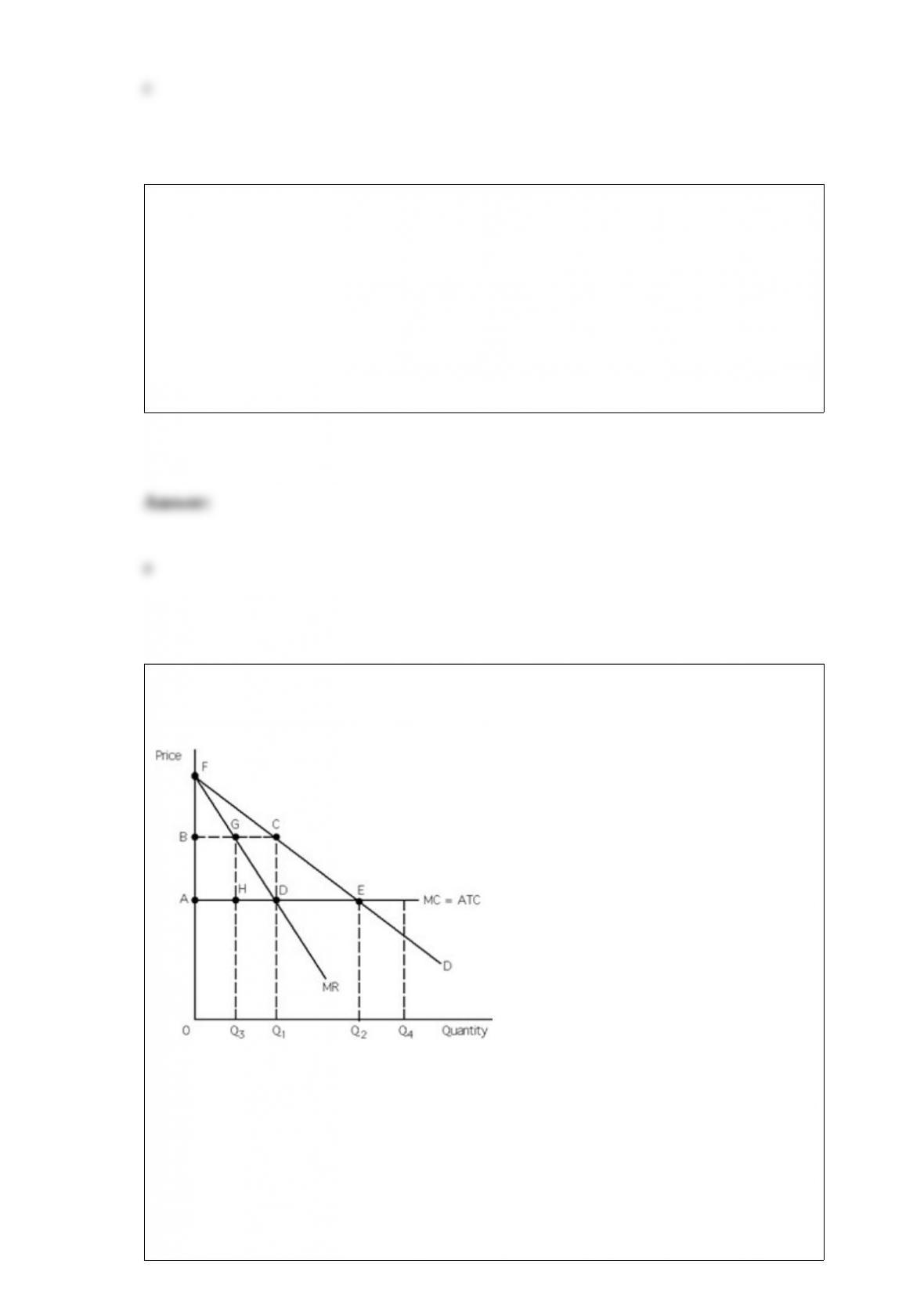
Exhibit 24-10
The deadweight loss triangle is what area?
a. GFC
b. HGD
c. GCD

d. DCE
e. BFG
Economies of scale are said to exist when
a. inputs are increased by some percentage and output increases by the same
percentage.
b. inputs are increased by some percentage and output increases by a lesser percentage.
c. inputs are increased by some percentage and output increases by a greater percentage.
d. the LRATC curve slopes upward.
e. none of the above
The coordinates of point A are 30 units of X and 70 units of Y. The coordinates of point
B are 28 units of X and 76 units of Y. With X on the horizontal axis and Y on the
vertical axis, the slope of the line between points A and B is
a. + 3.00
b. + 0.67
c. + 0.33
d. – 3.00
e. – 0.33
Research presented in the text shows that people are more concerned with their absolute
income position in a group than their relative income position in the group.
a. True
b. False
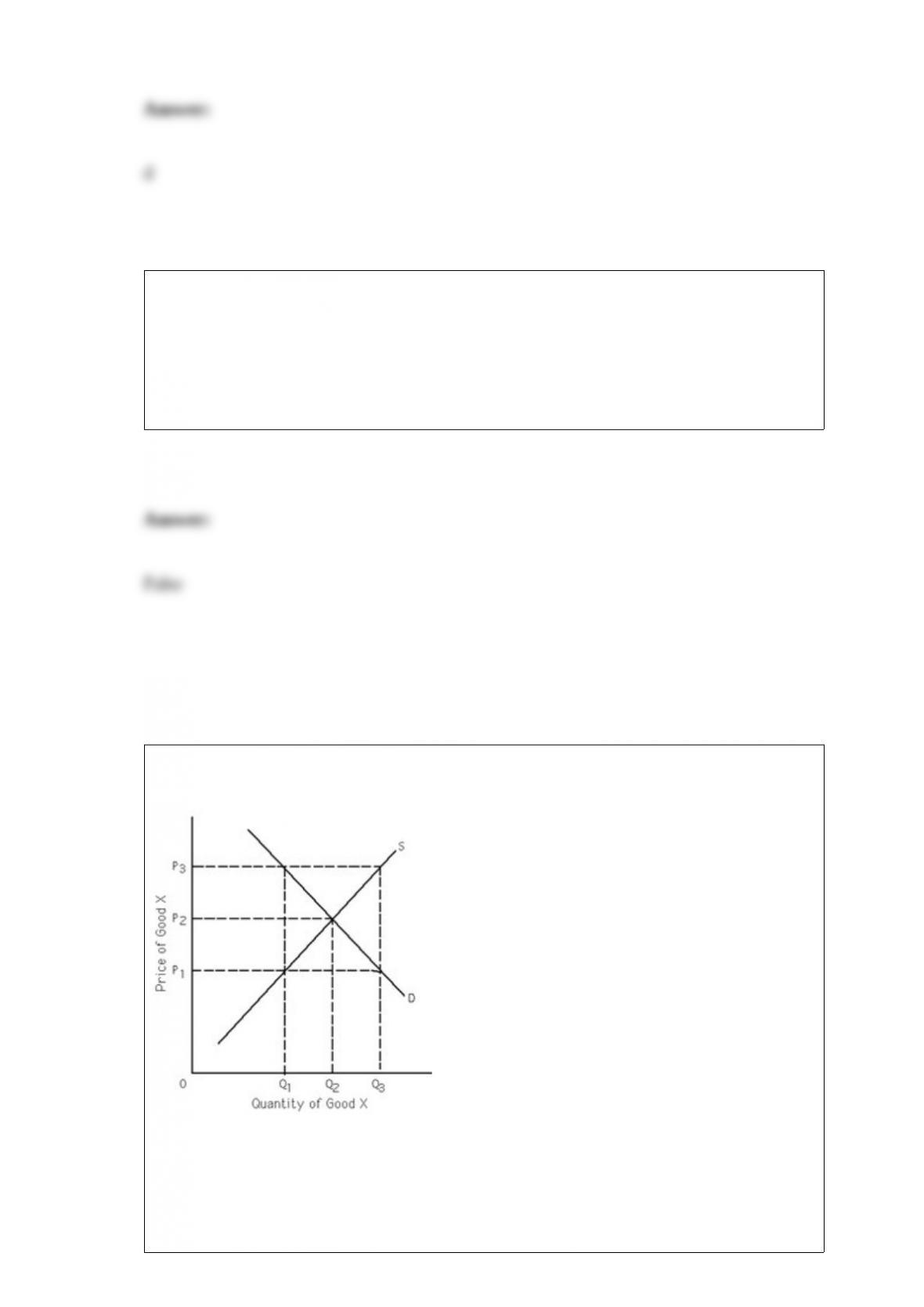
Exhibit 4-3
If price P1 is a price ceiling, then
a. the quantity exchanged is Q3.

b. there is a shortage in this market.
c. it is the highest price that can legally be charged in this market.
d. both b and c.
e. all of the above
The capture theory of regulation holds that
a. regardless of the motive for the initial regulation and the establishment of the
regulatory agency, eventually the special interests of the industry that is being regulated
will be “captured” (controlled) by the regulatory agency.
b. regardless of the motive for the initial regulation and the establishment of the
regulatory agency, eventually the regulatory agency will be “captured” (controlled) by
the special interests of the industry that is being regulated.
c. whether or not the special interests of the industry that is being regulated will be
“captured” (controlled) by the regulatory agency depends on the motive for the initial
regulation and the establishment of the regulatory agency.
d. whether or not the regulatory agency will be “captured” (controlled) by the special
interests of the industry depends on the motive for the initial regulation and the
establishment of the regulatory agency.
A gift-giver’s efficient number of gifts (to give to a gift-recipient) has fallen from 10 to
8.This could be because
a. the gift-giver’s marginal benefit curve for giving gifts shifted down and left.

b. the gift-giver’s marginal cost curve of giving gifts shifted up and left.
c. the gift-recipient “fell out” of the gift-giver’s utility function.
d. a and b
e. none of the above