1) Statistical discrimination refers to:
A.the crowding of women or minorities into low-paying occupations.
B.significant differences in average levels of earnings by gender, race, and ethnicity,
after accounting for nondiscriminatory factors.
C.making individual hiring decisions on the basis of the characteristics of the group to
which a person belongs, rather than on his or her personal characteristics and
productivity.
D.the 50-percent unexplained residual in studies that try to account for wage differences
by gender, race, and ethnic origin.
2) (Advanced analysis) Answer the next question(s) on the basis of the following
information for a private closed economy.
where S is saving, Ig is gross investment, i is the real interest rate, and Y is GDP.
Refer to the above information. In equilibrium the level of consumption will be:
A.$80.
B.$95.
C.$65.
D.$70.
3) if a technological advance reduces the amount of variable resources needed to
produce any level of output, then the:
a.avc curve will shift upward.
b.mc curve will shift downward.
c.atc curve will shift upward.
d.afc curve will shift downward.
4)
Refer to the above table representing Kara’s bank account. Assuming that $2000 was

deposited into her account at the beginning of year 1, the value for cell A is:
A.$10.
B.$20.
C.$100.
D.$200.
5) (Last Word) According to Yale University’s Environmental Performance Index (EPI):
A.countries with lower GDP per person tend to have healthier environments.
B.countries with higher GDP per person tend to have healthier environments.
C.there is no correlation between GDP per person and environmental quality.
D.growth in GDP per person initially improves environmental quality and then
gradually reduces it.
6) children are charged less than adults for admission to professional baseball games
but are charged the same prices as adults at the concession stands. this pricing system
occurs because:
a.children have an elastic demand for game ticket but an inelastic demand for
concession items.
b.children have an inelastic demand for game tickets but an elastic demand for
concession items.
c.the seller can prevent children from buying game tickets for adults but cannot prevent
children from buying concession items for adults.
d.children can personally “consume” only a single game ticket, but can personally
consume more than one concession item.
7) which of the following is associated with macroeconomics?
a.an examination of the incomes of harvard business school graduates
b.an empirical investigation of the general price level and unemployment rates since
1990
c.a study of the trend of pecan prices since the second world war
d.a case study of pricing and production in the textbook industry
8) In the past, Canada has agreed to set an upper limit on the total amount of softwood
lumber sold to the United States. This is an example of a(n):
A.import quota.
B.export subsidy.
C.voluntary export restriction.
D.protective tariff.
9) Resource X has many close substitutes whereas resource Y has no close substitutes.
Other things equal, we would expect:
A.the demand for resource Y to be more elastic than the demand for resource X.
B.resources X and Y to be close substitutes.
C.resource X to be more expensive than resource Y.
D.the demand for resource X to be more elastic than the demand for resource Y.
10) (Advanced analysis) Answer the next question(s) on the basis of the following
information for a private closed economy, where Ig is gross investment, S is saving, and
Y is gross domestic product (GDP).
Refer to the above information. The equilibrium GDP will be:
A.$160.
B.$400.
C.$360.
D.$480.
11) based on the concept of price elasticity of demand, which of the following cases is
most likely to occur?
a.golf courses charging higher prices for golf during the week than on weekends.
b.movie theatres charging higher prices for senior citizens.
c.colleges charging lower tuition for low-income students.
d.airlines charging lower fares for business travelers.
12) a purely competitive firm should produce in the short run if its total revenue is
sufficient to cover its:
a.total variable costs.
b.total costs.
c.total fixed costs.
d.marginal costs.
13) the simple circular flow model shows that:
a.households are on the buying side of both product and resource markets.
b.businesses are on the selling side of both product and resource markets.
c.households are on the selling side of the resource market and on the buying side of the
product market.
d.businesses are on the buying side of the product market and on the selling side of the
resource market.
14)
refer to the above supply and demand data for a certain elective surgical procedure. if
suppliers provide the quantity of health care demanded and insurance pays two-thirds of
the equilibrium price, the immediate price to the consumer and quantity of health care
consumed would be:
a.$4,000 and 10,000.
b.$3,000 and 7,000.
c.$2,000 and 11,000.
d.$1,000 and 16,000.
15) Suppose the United States sets a limit on the number of tons of sugar that can be
imported each year. This is an example of a(n):
A.protective tariff.
B.revenue tariff.
C.voluntary export restriction.
D.import quota.
16) other things equal, an increase in a consumer’s money income:
a.shifts her indifference curves rightward because she can now satisfy more of her
wants.
b.shifts her budget line rightward because she can now purchase more of both products.
c.will be subject to the substitution effect, but not the income effect.
d.will not alter the location of consumer equilibrium.
17) in deciding whether to study for an economics quiz or go to a movie, one is
confronted by the idea(s) of:
a.scarcity and opportunity costs.
b.money and real capital.
c.complementary economic goals.
d.full production.
18)
refer to the above diagram. if euro zone nations decide to import more agricultural
products from the united states, we would expect:
a.the demand for euros to increase, and the euro to appreciate.
b.the demand for euros to increase, and the dollar to appreciate.
c.the supply of euros to increase, and the euro to depreciate.
d.the supply of euros to decrease, and the dollar to depreciate.
19) (Advanced analysis) Answer the next question(s) on the basis of the following
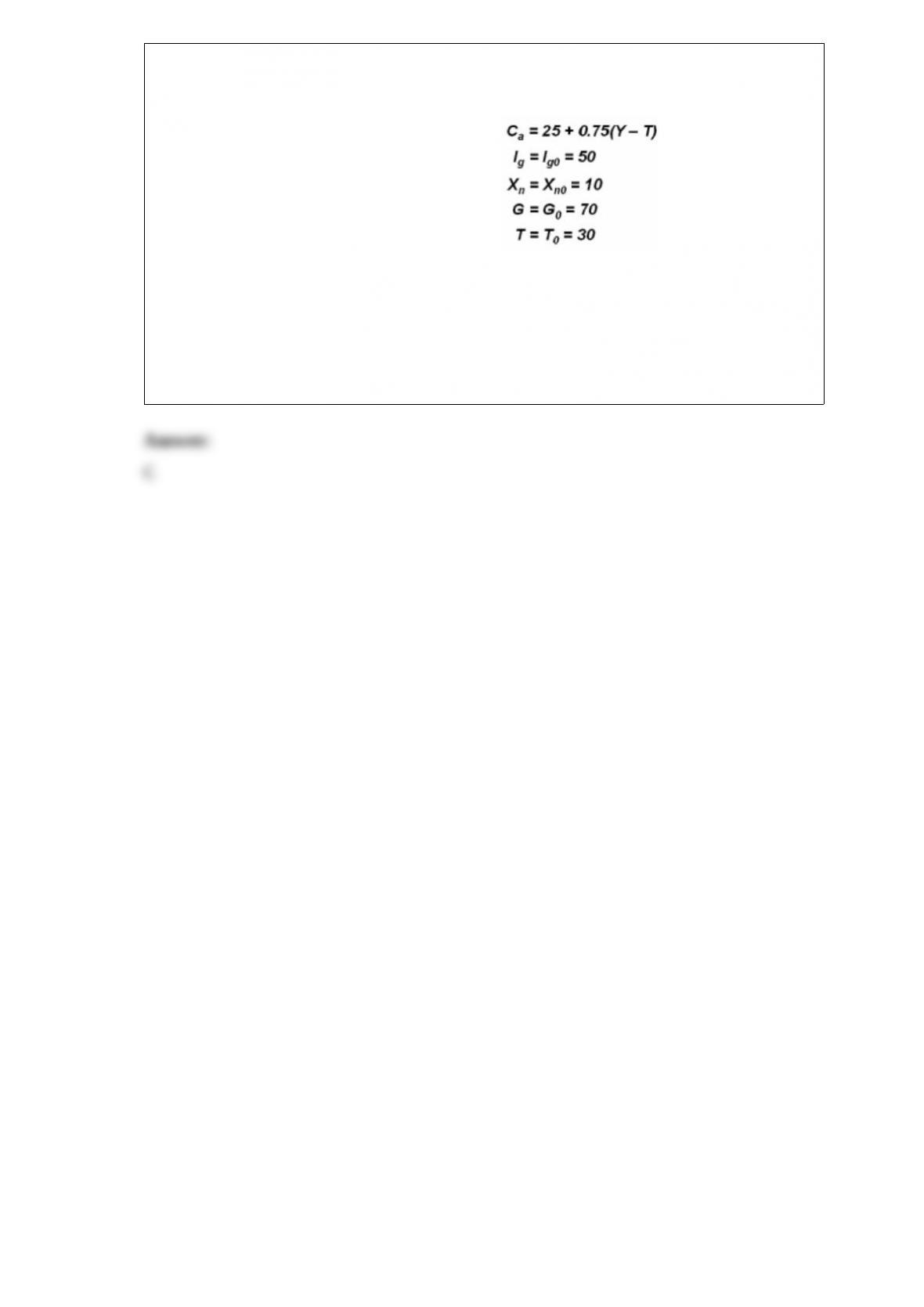
information for a mixed open economy. The letters Y, Ca, Ig, Xn, G, and T stand for
GDP, consumption, gross investment, net exports, government purchases, and net taxes
respectively. Figures are in billions of dollars.
Refer to the above information. If government desired to raise the equilibrium GDP to
$650, it could:
A.raise G by $45 and reduce T by $10.
B.raise G by $40 and reduce T by $30.
C.raise G by $30 or reduce T by $40.
D.raise both G and T by $40.