
The profit of a monopolist facing a downward-sloping demand curve typically
a. rises steadily as the monopolist increases the price.
b. rises steadily as the monopolist reduces the price.
c. first rises as the monopolist reduces the price, then falls.
d. first falls as the monopolist reduces the price, then rises.
e. rises regardless of the direction of the price change.
Under which of the following systems will an imbalance in trade be most likely to
cause changes in a country’s money supply and price levels, leading to a restoration of
trade equilibrium?
a. the gold standard
b. the multinational exchange standard
c. the stable exchange standard
d. flexible exchange rates
e. equation of exchange rates
The monopolist faces a demand curve that is

a. horizontal.
b. less elastic than the market demand curve for the product.
c. upward sloping to the right.
d. equal to its marginal revenue curve.
e. identical to the industry demand curve.
The purpose of an economic model is to
a. be a complex, exact replica of reality.
b. demonstrate which values and beliefs are best for the economy.
c. make predictions about the real world.
d. manage the economy like an automatic pilot.
e. set the prices in a price system.
The price of domestically produced wine in the United States is $15 per liter and the
price of the same wine produced in Italy is 12 euros per liter. If the exchange rate is
$.96 to the euro and no tariffs or quotas affect the good

a. the United States will export wine and the U.S. price of wine will rise.
b. the United States will import wine and the U.S. price of wine will rise.
c. Italy will export wine and the Italian price of wine will rise.
d. Italy will import wine and the Italian price of wine will rise.
e. both countries will produce their own wine and no trade will occur.
One adverse effect of unexpectedly high rates of inflation is that such inflation
a. redistributes income away from those with fixed money incomes.
b. redistributes income to lenders.
c. increases the value of savings.
d. encourages productive rather than speculative uses of saving.
e. causes real incomes to rise more rapidly than money incomes.
If a country is absolutely more efficient than any other country in producing everything,
then it would
a. simply export goods and services and import money.

b. not trade with others because there would be no benefit in doing so.
c. still benefit that nation to specialize and trade those goods in which it possesses a
comparative advantage.
d. make it unnecessary for other nations to produce anything for themselves.
e. represent a refutation of the concept of comparative advantage.
Interest rates and bond prices
a. have identical values most of the time.
b. are largely unaffected by monetary policy.
c. are unrelated in their behavior.
d. move in opposite directions.
e. rise and fall together.
The following questions are based on the following graph:
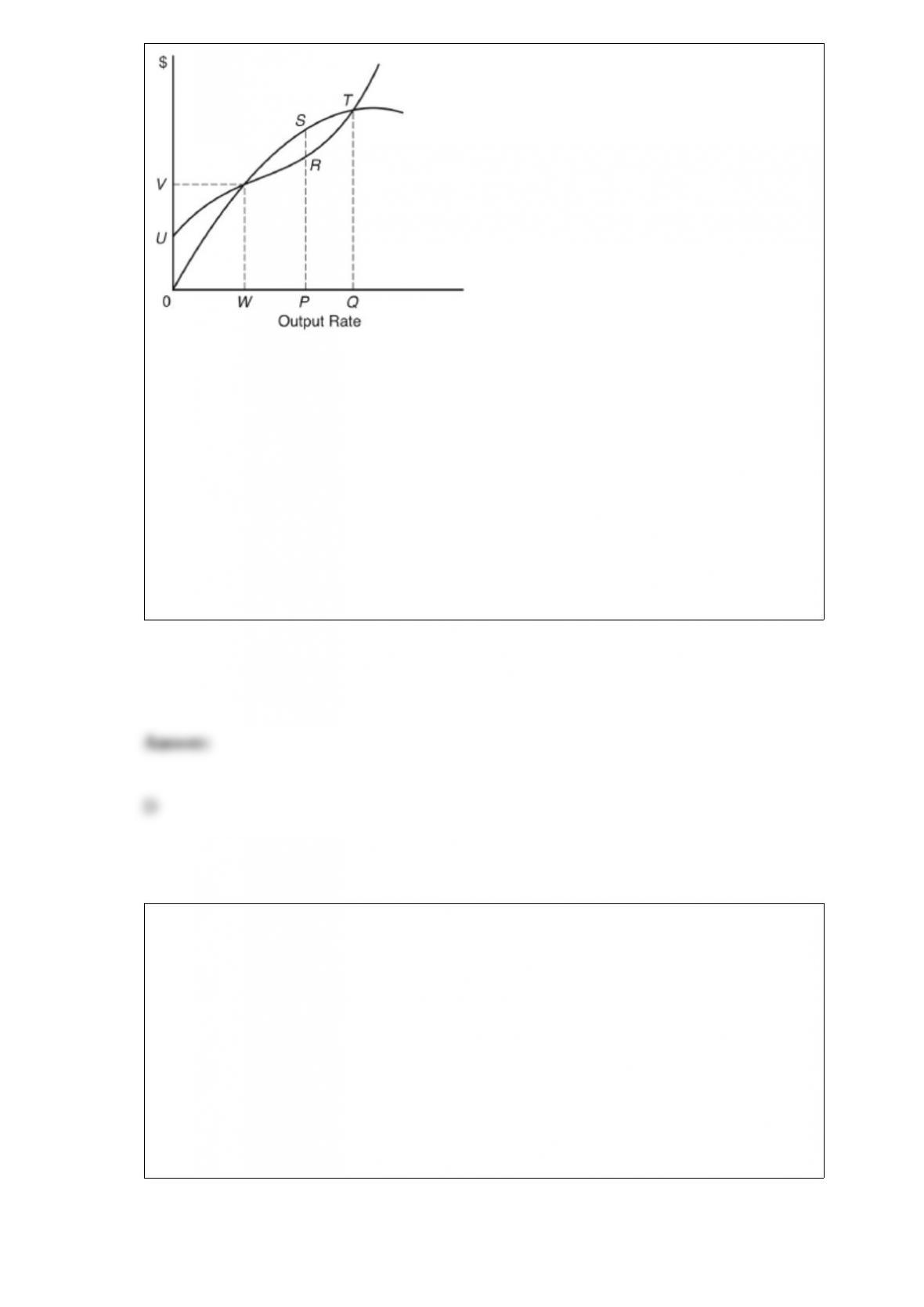
The total revenue curve is best represented by line
a. RS.
b. PR.
c. URT.
d. 0ST.
e. 0WPQ.
Game theory can most effectively be used to postulate behavior in ________ markets.
a. perfectly competitive
b. monopolistic
c. monopolistically competitive
d. oligopolistic
e. regulated
A reduction in personal consumption expenditures induced by a fall in disposable
income
a. will shift the consumption function downward.
b. will shift the saving function downward.
c. will produce an increase in intended investment.
d. will be offset by an increase in the amount saved.
e. represents a movement along a given consumption function.
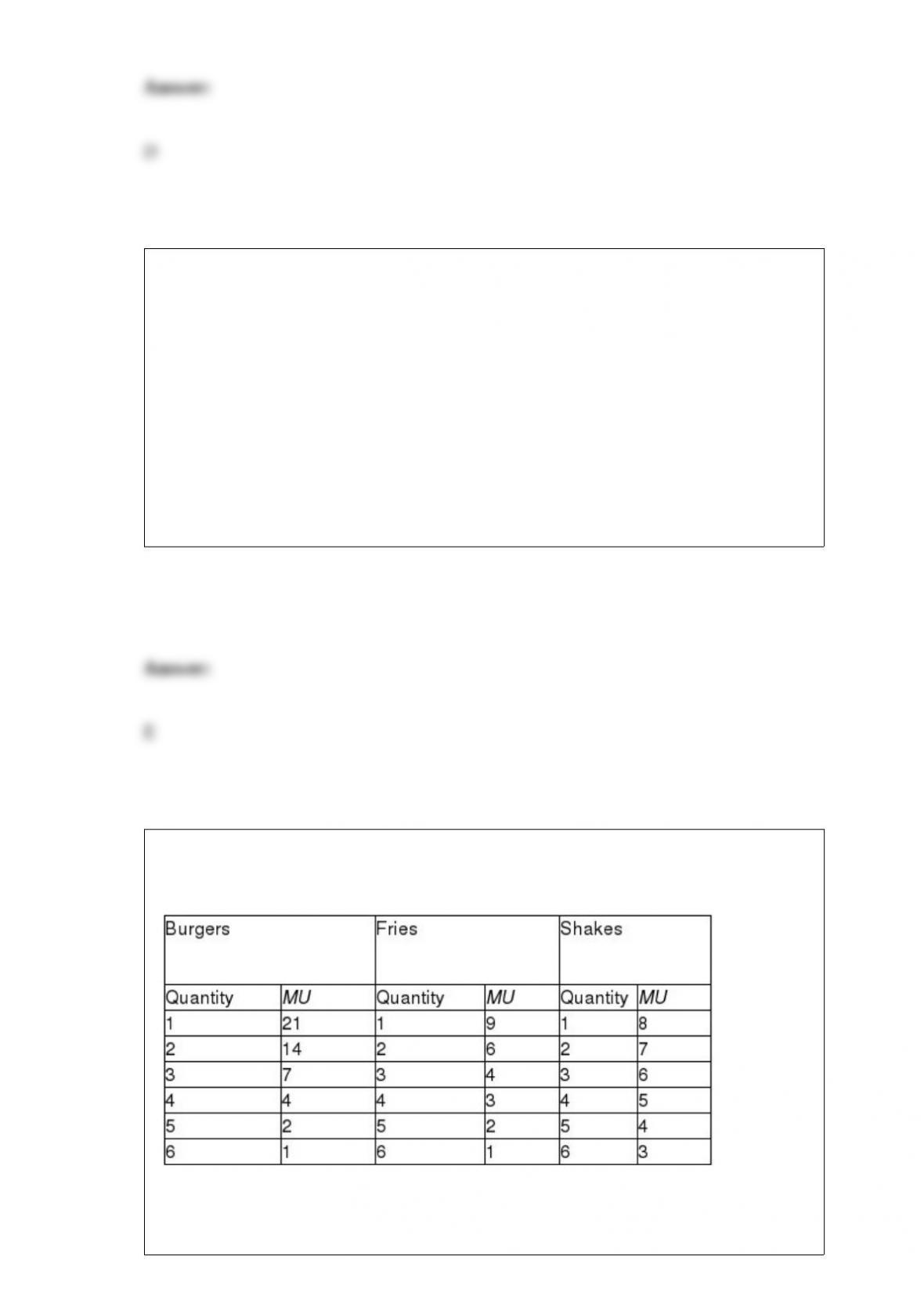
The next question is based on the typical teenager’s lunch preferences as depicted in the
table.
If the marginal utility of food divided by the price of food exceeds the marginal utility
of clothing divided by the price of clothing

a. the price of food is too high and less food should be purchased.
b. the total utility received from food exceeds the total utility received from clothing.
c. more should be spent on food and less on clothing.
d. more clothing should be purchased to raise the marginal utility of the last dollar
spent.
e. the price of clothing must exceed the price of food.
In 1965, President Johnson opposed a tax increase recommended by his economic
advisers because
a. the war in Vietnam was drawing to a close and additional tax revenue was no longer
needed.
b. he feared that a tax increase would bring the issue of the Vietnam War into sharp
political focus.
c. he feared a tax increase would aggravate already high interest rates.
d. the Fed saw no immediate threat from inflation and Johnson elected to trust its
judgment.
e. the United States had just had a significant increase in taxes to fund the Great
Society.

By 2009 U.S. expenditures on research and development
a. averaged about 10 percent of the GDP.
b. fell well below the levels of the 1960s.
c. were over 11 times what they were in 1953.
d. consistently led those of other developed nations in all fields.
e. have been directed primarily to making major advances in civilian technology.
Schumpeter argued that
a. rents should be taxed away.
b. profits result from exploitation of labor.
c. interest is the reward for bearing risk.
d. profits are derived from innovation.
e. interest is best explained by the liquidity preference theory.
The money supply multiplied by its velocity of circulation equals
a. the rate of inflation.

b. the amount of unemployment.
c. nominal GDP.
d. the Consumer Price Index.
e. government spending.
Adhering to a monetary rule, according to some economists, is superior to discretionary
attempts to “lean against the wind” because
a. it would virtually eliminate business fluctuations.
b. the success of monetary policy since World War II has demonstrated the effectiveness
of such a rule.
c. the Fed would be free to concentrate on manipulating interest rates.
d. the lag between policy actions and their economic impact is highly variable and
unpredictable.
e. it would allow for more successful fine-tuning of the economy.
If prices double, the value of a dollar would
a. double.

b. remain the same (be unaffected).
c. be halved.
d. decline by twice that amount.
e. fall to zero.
According to the Markets and Prices video, insufficient housing was a problem after
World War II because the
a. United States experienced excessive numbers of people immigrating from Europe
and Japan whose housing had been destroyed by the war.
b. depression and mobilization of resources to fight World War II resulted in little
housing construction for over 15 years.
c. supply of housing exceeded the demand for housing, pushing prices up.
d. unionization of construction workers shifted the supply curve of housing to the left,
resulting in higher prices.
e. availability of land in and around major U.S. cities was severely limited because of
past development.
Kuznets was honored for his contribution to economics with the Nobel Prize, largely on

the basis of his contributions to the GNP measure. In particular, Kuznets was cited for
a. quantifying a measure that had previously been largely impressionistic.
b. recognizing that products have a higher economic value than services.
c. revealing that the nation’s GNP was higher, even during the Depression, than anyone
had supposed.
d. finding a way to include child care and other domestic services in the measure of
GNP.
e. traffic violations, bootlegging, and tax evasion.
New methods of producing existing products and new designs that make it possible to
create new products are forms of
a. depreciation.
b. natural endowments.
c. compensation.
d. technological change.
e. price stability.

Critics of supply-side economic theory argue that the tax cut of 1981
a. shifted the aggregate supply curve to the left.
b. shifted the aggregate demand curve to the left.
c. caused the price level to rise with no change in real GDP.
d. led mainly to dramatic increases in the money supply.
e. did not increase the percent of total income devoted to saving.
The Sherman Act
a. outlawed conspiracy in restraint of trade.
b. outlawed the use of tying contracts.
c. established the rule of reason.
d. created the Federal Trade Commission.
e. allowed firms to meet to determine market prices.
One of the points made by economist Richard Gill in the video is that over the period
from 1950 to 1980, Keynesian stabilization policies

a. had little impact on nominal GDP but did contribute to systematic increases in the
price level.
b. increased the likelihood of severe recessions while keeping prices stable.
c. stabilized the fluctuations in real GDP but contributed to inflationary expectations.
d. encouraged people to save rather than to borrow for spending on things such as art,
land, and housing.
e. had little impact on the real economy because wages and prices were flexible and
markets cleared.
Monopolistically competitive markets tend to be characterized by
a. excessive economic profits in the long run.
b. interdependence among sellers.
c. overcrowding and excess capacity.
d. perfectly elastic demand curves.
e. homogeneous products.
Demand-side inflations indicate that the aggregate demand curve is shifting to the right
along the ________ portion of an aggregate supply curve.

a. horizontal
b. downward-sloping
c. upward-sloping
d. backward-bending
e. rightward-shifting
The chief spokesperson for U.S. monetary policy is the
a. president of the United States.
b. secretary of the Treasury.
c. chairperson of the Council of Economic Advisers.
d. chairperson of the Joint Economic Committee of Congress.
e. chairperson of the Federal Reserve Board.
Proposals to establish and maintain exchange rate target zones are intended to
a. facilitate the reestablishment of the gold exchange standard.

b. make it easier for individual countries to pursue domestic full-employment fiscal and
monetary policies without regard to their international consequences.
c. ensure that the international volume of exports will equal the international volume of
imports.
d. allow governments to independently choose whether to have fixed or flexible
exchange rates.
e. minimize the extent to which exchange rates can fluctuate.
In the mid-1980s buyers demanded 2.7 million bushels of wheat at $3 per bushel. In the
mid-1990s buyers demanded about 2.4 million bushels of wheat at $3 per bushel. From
this information it is clear that
a. demand decreased.
b. supply decreased.
c. demand was unchanged; only the quantity demanded fell.
d. the demand curve sloped upward.
e. the number of consumers in the market and their incomes rose.
A rightward shift in the demand curve for a commodity necessarily means that

a. consumers’ incomes have fallen.
b. supply conditions are more favorable.
c. equilibrium price decreases.
d. consumers are willing to buy more of the good at each price than previously.
e. the price of complementary goods increased.
Fiscal policy is the
a. policy that corporations follow to maintain their dividends when profit rises.
b. name given to Federal Reserve Banks’ efforts to control interest rates.
c. process by which prices are established in the stock market.
d. use of government spending and taxation for stabilization purposes.
e. international trade and commerce policy pursued by a nation.
Refer to the following graphs for the following questions.
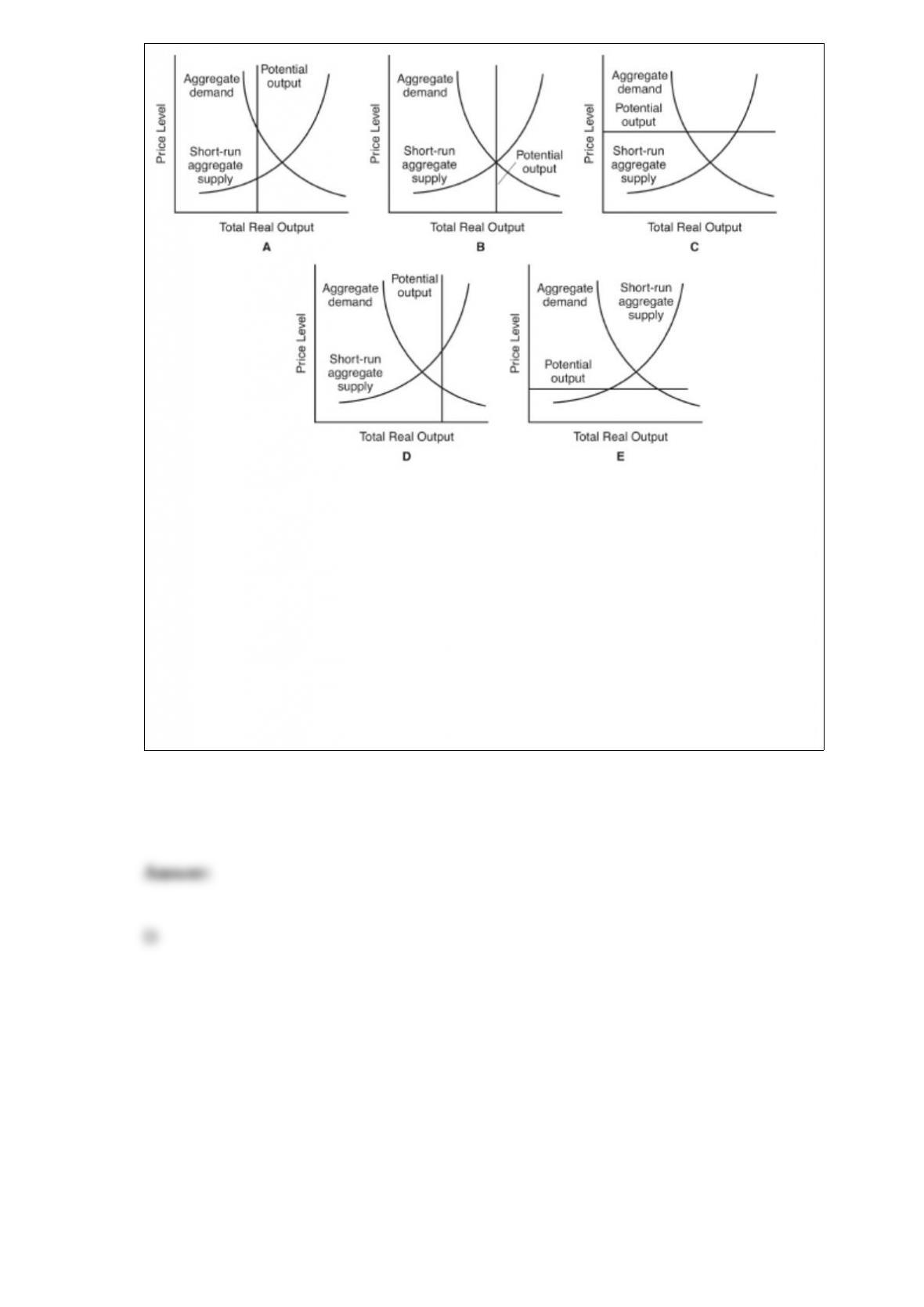
Which of the diagrams best reflects the existence of a recessionary gap?
a. A
b. B
c. C
d. D
e. E