
1) according to ricardian theory, comparative advantage depends on relative differences
in labor productivity.
a.true
b.false
2) in the post-world war ii era, nontariff trade barriers have decreased in importance
relative to tariff barriers.
a.true
b.false
3) the trading-triangle concept is used to indicate a nation’s:
a.exports, marginal rate of transformation, terms of trade
b.imports, terms of trade, marginal rate of transformation
c.marginal rate of transformation, imports, exports
d.terms of trade, exports, imports
4) figure 8.1 depicts the supply and demand schedules of calculators for greece, a
‘small” country that is unable to affect the world price. greece’s supply and demand
schedules of calculators are respectively depicted by sg and dg. assume that greece
imports calculators from either germany or france. suppose germany is the world’s
low-cost producer who can supply calculators to greece at $20 per unit, while france
can supply calculators at $30 per unit.
figure 8.1. effects of a customs union
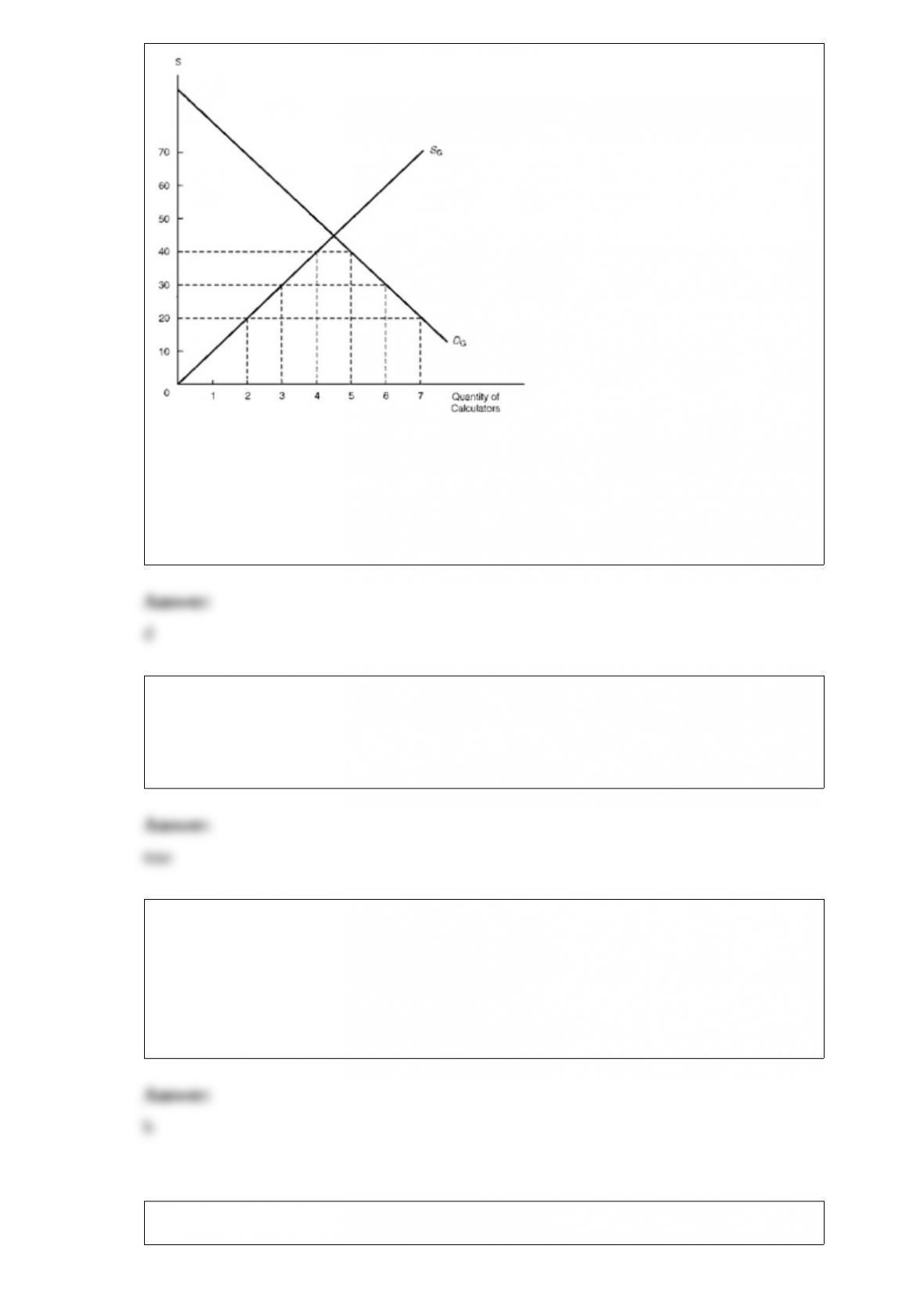
according to figure 8.1, the formation of a greece/germany customs union would result
in:
a.$20 of trade diversion
b.$40 of trade diversion
c.$20 of trade creation
d.$40 of trade creation
5) consider figure 5.5. assuming that the revenue effect of the export quota accrues to
japanese firms, the overall welfare loss to mexico equals $2100 as a result of the quota.
a.true
b.false
6) the movement to free international trade is most likely to generate short-term
unemployment in which industries?
a.industries in which there are neither imports nor exports
b.import-competing industries
c.industries that sell to domestic and foreign buyers
d.industries that sell to only foreign buyers
7) when material inputs enter a country at a very low duty while the final imported

product is protected by a high duty, the result tends to be a high rate of protection for
domestic producers of the final product.
a.true
b.false
8) the migration of workers from mexico to the united states tends to exert downward
pressure on the wages of native u.s. workers that compete against mexican workers for
jobs.
a.true
b.false
9) the classical theory of comparative advantage assumes that firms operate in
imperfectly competitive markets, while the theory of strategic trade policy assumes that
firms operate in perfectly competitive markets.
a.true
b.false
10) the asset-markets approach views exchange-rate determination as similar to the
stock market in which prices are volatile and expectations are important.
a.true
b.false
11) in industries where the final product is much less weighty or bulky than the
materials from which it is made, firms tend to locate production near resource supplies.
a.true
b.false

12) exhibit 4.2
in the absence of international trade, assume that the equilibrium price and quantity of
motorcycles in canada is $14,000 and 10 units respectively. assuming that canada is a
small country that is unable to affect the world price of motorcycles, suppose its market
is opened to international trade. as a result, the price of motorcycles falls to $12,000 and
the total quantity demanded rises to 14 units; out of this total, 6 units are produced in
canada while 8 units are imported. now assume that the canadian government levies an
import tariff of $1,000 on motorcycles.
refer to exhibit 4.2. the tariff’s revenue effect equals $6,000.
a.true
b.false
13) concerning international lending risk of commercial banks, ____ is closely related
to political developments in a borrowing country, especially the government’s views
concerning international investments and loans.
a.economic risk
b.credit risk
c.country risk
d.currency risk
14) the theory of reciprocal demand does not well apply when one country:
a.produces under constant cost conditions
b.produces along its production possibilities curve
c.is of minor economic importance in the world marketplace
d.partially specializes the production of its export good
15) the trade-weighted dollar is the weighted average of the exchange rates between the

dollar and the most important industrial-country trading partners of the united states.
a.true
b.false
16) to keep the pound’s exchange value from depreciating against the franc, the british
exchange stabilization fund would sell pounds for francs on the foreign exchange
market.
a.true
b.false