1) Two goods are complements when a decrease in the price of one good
a.decreases the quantity demanded of the other good.
b.decreases the demand for the other good.
c.increases the quantity demanded of the other good.
d.increases the demand for the other good.
2) Mrs. Smith operates a business in a competitive market. The current market price is
$8.50. At her profit- maximizing level of production, the average variable cost is $8.00,
and the average total cost is $8.25. Mrs. Smith should
a.shut down her business in the short run but continue to operate in the long run.
b.continue to operate in the short run but shut down in the long run.
c.continue to operate in both the short run and long run.
d.shut down in both the short run and long run.
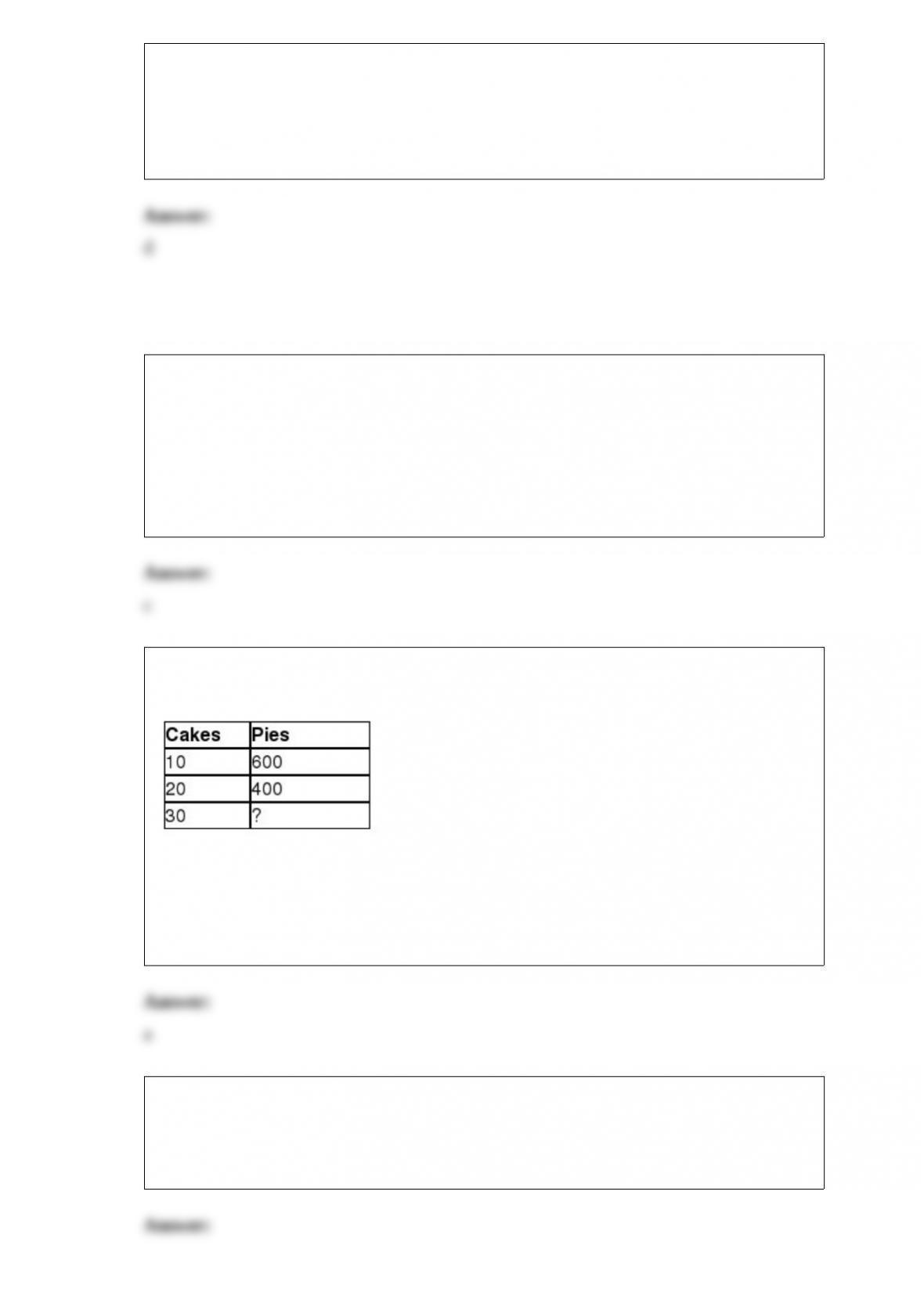
3) The following table contains some production possibilities for an economy for a
given year.
If the production possibilities frontier is bowed outward, then “?” could be
a.180
b.200
c.220
d.240
4) In a market characterized by externalities, the market equilibrium fails to maximize
the total benefit to society as a whole.
a.True
b.False
5) The Supplemental Security Income (SSI) program focuses on the poor who are sick
or disabled.
a.True
b.False
6) Refer to Figure 9-18. If Isoland allows international trade and the world price of
peaches is $5, then
a.producer surplus will be smaller than it would be if Isoland banned trade.
b.consumer surplus will be smaller than it would be if Isoland banned trade.
c.the domestic quantity of peaches demanded will exceed the domestic quantity of
peaches supplied.
d.Isoland will be an importer of peaches.
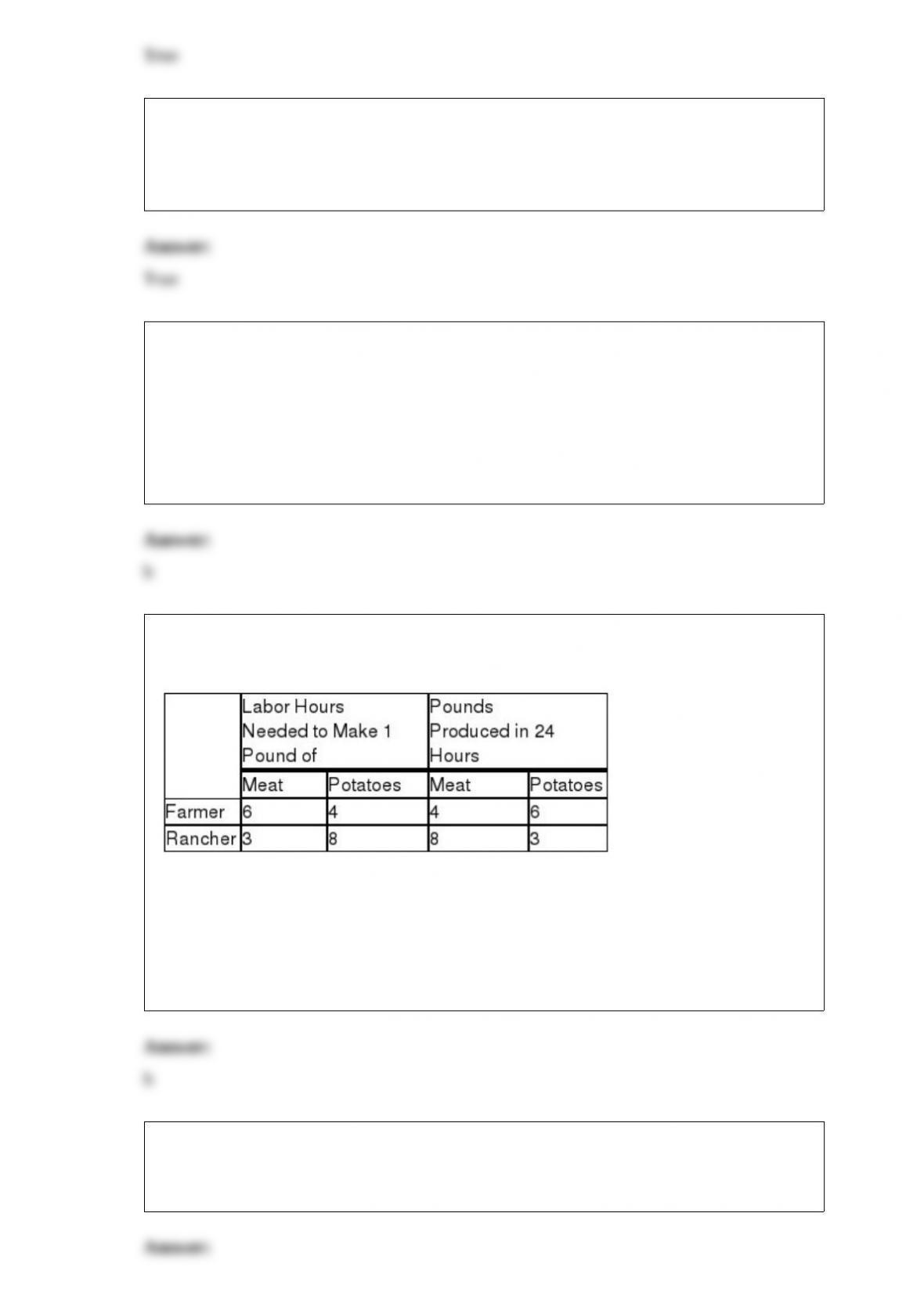
7) Assume that the farmer and the rancher can switch between producing meat and
producing potatoes at a constant rate.
Which of the following combinations of meat and potatoes could the farmer produce in
24 hours?
a.1 pound of meat and 8 pounds of potatoes.
b.2 pounds of meat and 2 pounds of potatoes.
c.1 pounds of meat and 5 pounds of potatoes.
d.3 pounds of meat and 2 pounds of potatoes.
8) The indifference curves for left shoes and right shoes are right angles.
a.True
b.False

9) Which of the following statements is correct?
a.The establishment of property rights sometimes gives rise to market failure.
b.The absence of property rights sometimes gives rise to market failure.
c.In the context of public goods, the Coase theorem implies that total surplus in some
markets can be improved by the elimination of property rights.
d.Government regulation of private behavior, in response to market failure, can never
improve social well-being.
10) Suppose that in a competitive market the equilibrium price is $2.50. What is
marginal revenue for the last unit sold by the typical firm in this market?
a.less than $2.50
b.more than $2.50
c.exactly $2.50
d.The marginal revenue cannot be determined without knowing the actual quantity sold
by the typical firm.
11) Betty’s Bakery bakes fresh bread every morning. Any bread not sold by the end of
the day is thrown away. A loaf of bread costs Betty $2.00 to produce, and she prices
loaves of bread at $3.50 per loaf. Suppose near the end of one day Betty still has 12
loaves of bread on hand. Which of the following is correct?
a.Betty should only sell the remaining bread for $3.50 per loaf since that is the regular
price.
b.Betty should only sell the remaining bread for $2.00 per loaf or more since that is
what the bread costs to make.
c.Betty should be willing to sell the remaining bread for any price above $0 per loaf
since she will have to throw it away if she does not sell it for something.
d.Betty should just throw the bread away and change the price of her bread starting
tomorrow to make sure she sells all of her bread each day.
12) Refer to Figure 9-20. From the figure it is apparent that
a.Vietnam will experience a shortage of rice if trade is not allowed.
b.Vietnam will experience a surplus of rice if trade is not allowed.
c.Vietnam has a comparative advantage in producing rice, relative to the rest of the
world.
d.foreign countries have a comparative advantage in producing rice, relative to

Vietnam.
13) The scientific method is the dispassionate development and testing of theories about
how the world works.
a.True
b.False
14) Winona‘s Fudge Shoppe is maximizing profits by producing 1,000 pounds of fudge
per day. If Winona‘s fixed costs unexpectedly increase and the market price remains
constant, then the short run profit-maximizing level of output
a.is less than 1,000 pounds.
b.is still 1,000 pounds.
c.is more than 1,000 pounds.
d.becomes zero.
15) Which of the following would a permanent increase in the growth rate of the money
supply change permanently?
a.inflation
b.unemployment
c.both inflation and unemployment
d.neither inflation nor unemployment
16) Table 12-9
United States Income Tax Rates for a Single Individual, 2012 and 2013.
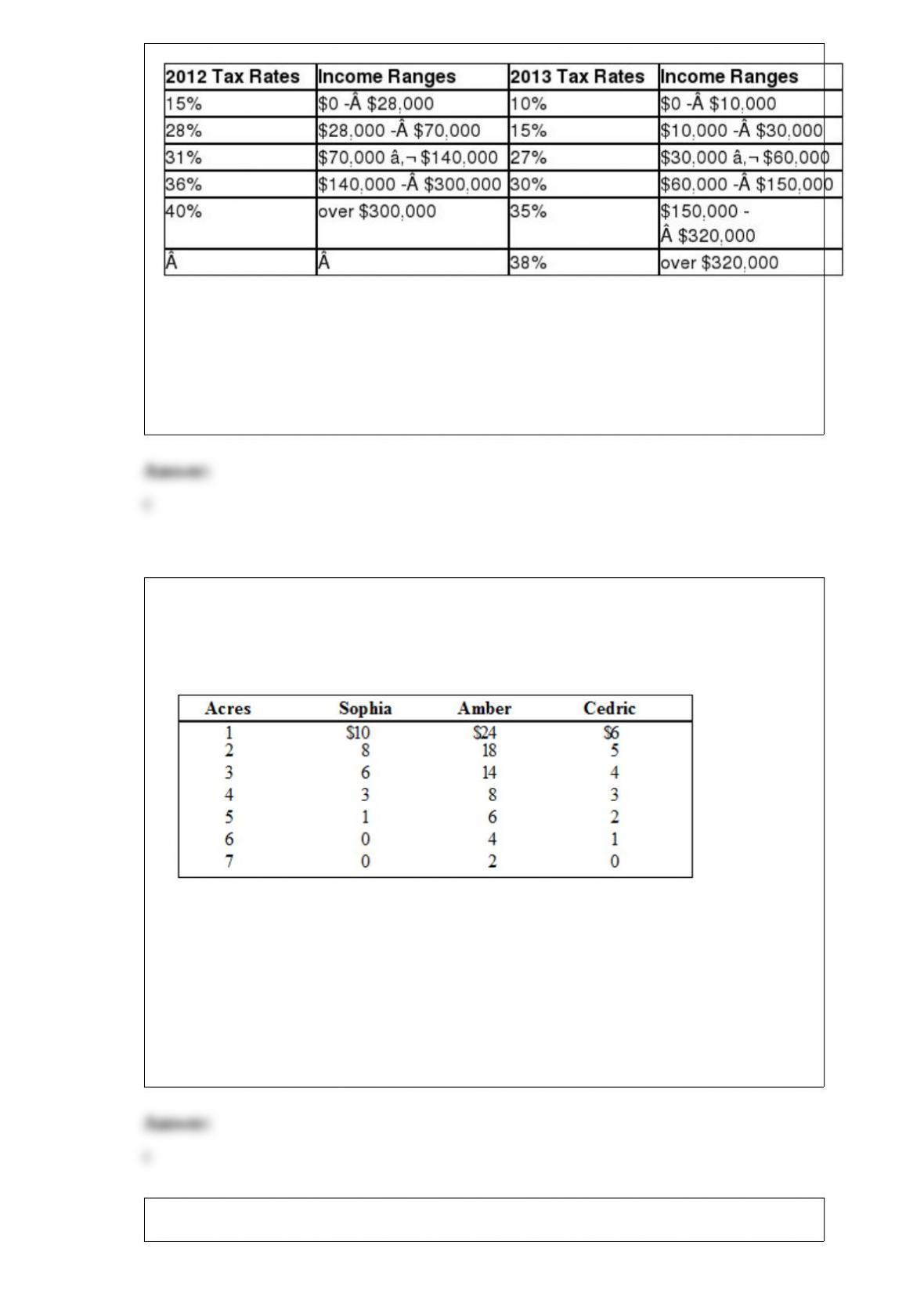
Jake is a single person whose taxable income is $20,000 a year. What is his average tax
rate in 2012?
a.10%
b. 12.5%
c.15%
d.28%
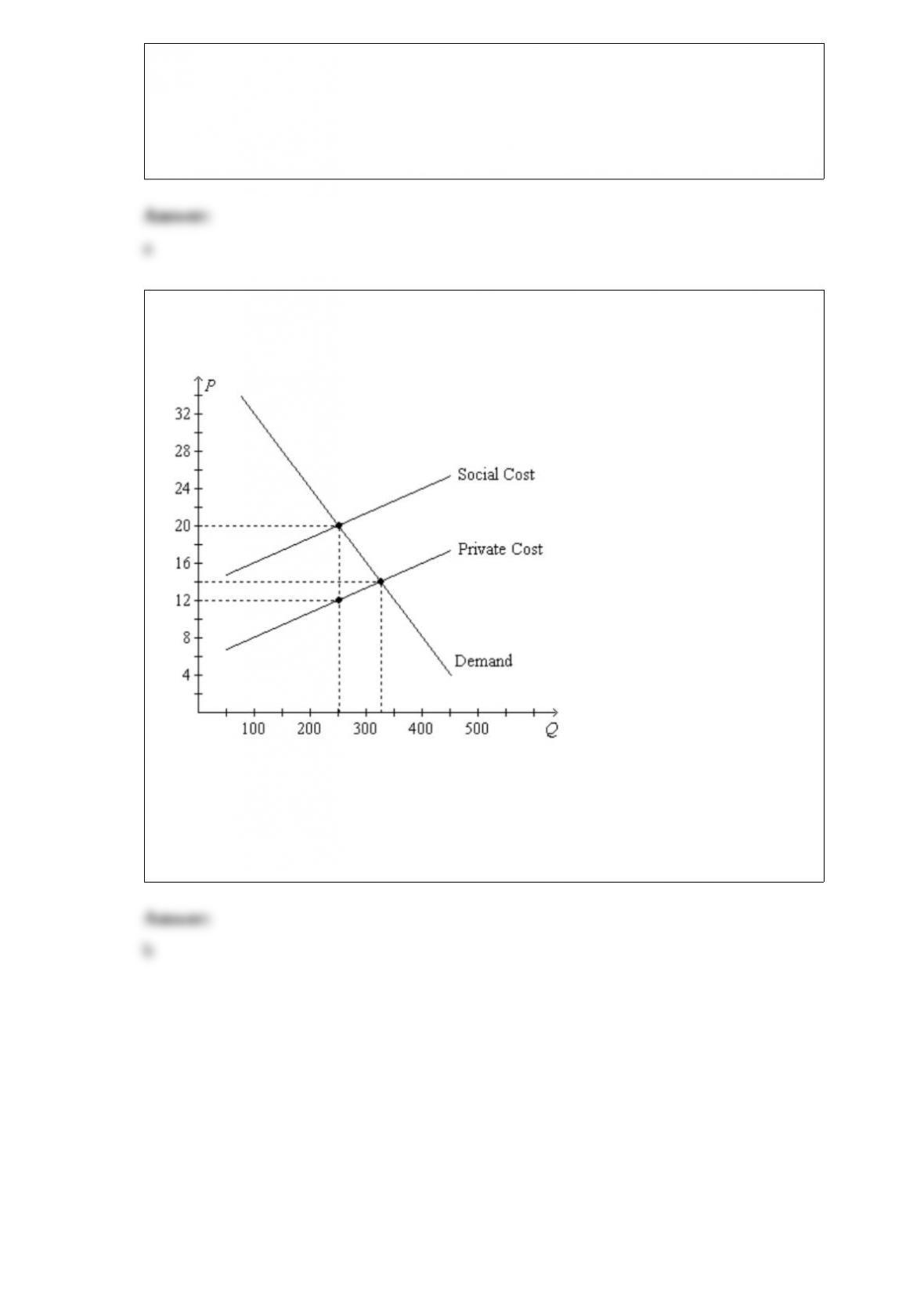
17) Consider the town of Springfield with only three residents, Sophia, Amber, and
Cedric. The three residents are trying to determine how large, in acres, they should
build the public park. The table below shows each resident’s willingness to pay for each
acre of the park.
Suppose the cost to build the park is $24 per acre and that the residents have agreed to
split the cost of building the park equally. If the residents decide to build a park with
size equal to the number of acres that maximizes total surplus from the park, how much
total surplus will Sophia receive?
a.-$5
b.-$2
c.$0
d.$2
18) Economists who study economic mobility have found that the income of a
grandfather and his grandson’s income are
a.not closely related.
b.negatively related.
c.directly related.
d.equal.
19) Figure 10-13. On the graph, Q represents the quantity of plastics and P represents
the price of plastics.
Each unit of plastics that is produced results in an external
a.cost of $6.
b.cost of $8.
c.benefit of $6.
d.benefit of $8.