
1) The aggregate supply curve (short-run):
A.slopes downward and to the right.
B.graphs as a vertical line.
C.slopes upward and to the right.
D.graphs as a horizontal line.
2) In an aggregate expenditures diagram equal increases in government spending and in
lump-sum taxes will:
A.shift the aggregate expenditures line downward.
B.shift the aggregate expenditures line upward.
C.not affect the aggregate expenditures line.
D.reduce the equilibrium GDP.
3) assume that in the short run a firm is producing 100 units of output, has average total
costs of $200, and average variable costs of $150. the firm’s total fixed costs are:
a.$5,000.
b.$500.
c.$.50.
d.$50.
4) Process innovation causes an upward shift in a firm’s total product curve and:
A.a decrease in its average product.
B.a downward shift in its average total cost curve.
C.an upward shift in its average total cost curve.
D.an upward shift in its marginal revenue curve.
5) The total global demand for resources is expected to:
A.increase for the coming decades, but eventually peak and decline.
B.increase indefinitely.
C.decrease for the coming decades, and eventually flatten out.
D.plateau for the coming decades and then increase exponentially.
6) The U.S. supply of Japanese yen is:
A.downsloping because a lower dollar price of yen means U.S. goods are cheaper to the
Japanese.
B.upsloping because a higher dollar price of yen means U.S. goods are cheaper to the
Japanese.
C.upsloping because a lower dollar price of yen means U.S. goods are cheaper to the
Japanese.
D.downsloping because a higher dollar price of yen means U.S. goods are cheaper to
the Japanese.
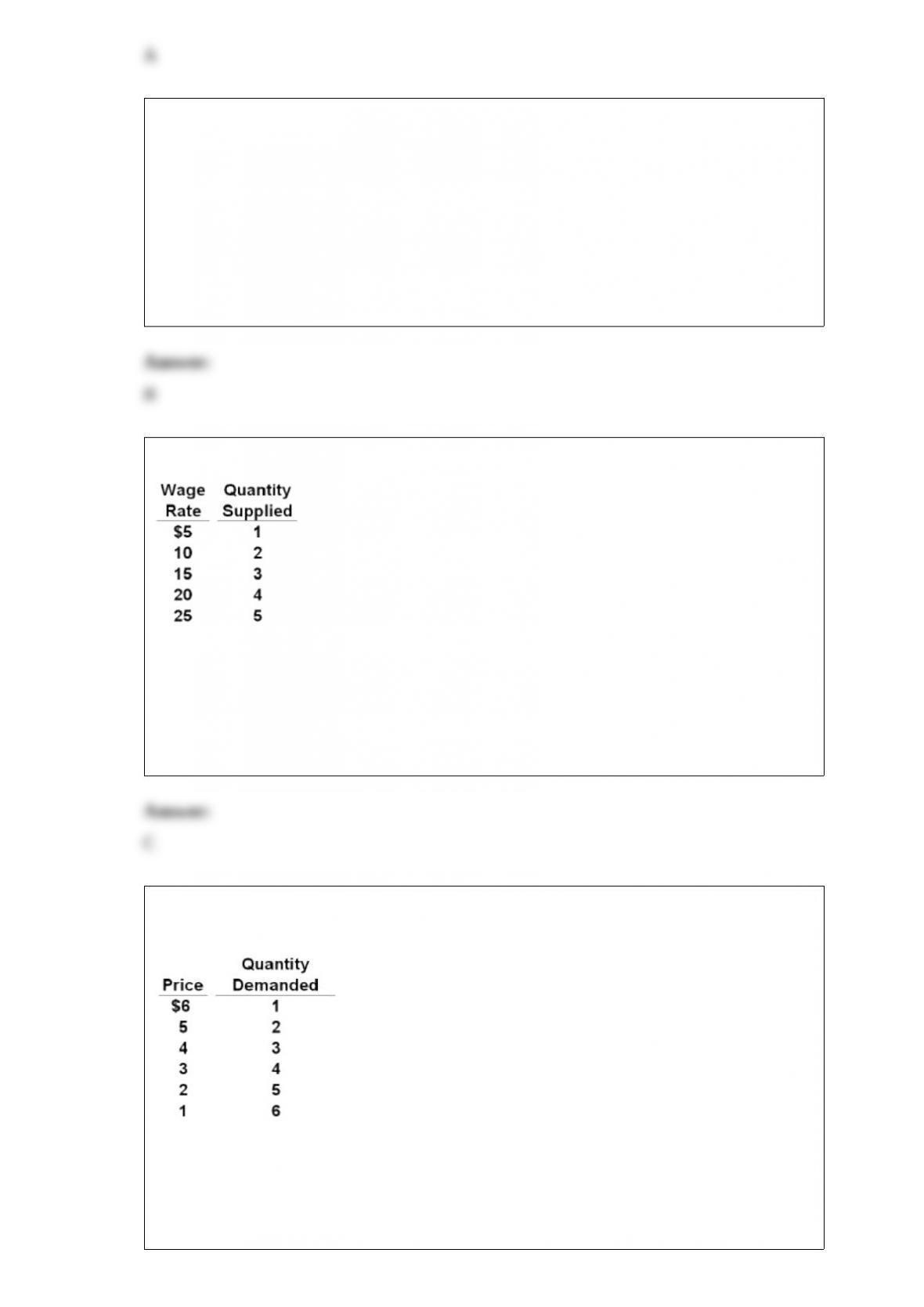
7)
Refer to the above information. This labor supply curve demonstrates that:
A.the firm is selling its output under imperfectly competitive conditions.
B.the firm is selling its output under purely competitive conditions.
C.higher wage rates must be paid to successive workers to overcome their higher
opportunity costs.
D.the firm is hiring labor under purely competitive conditions.
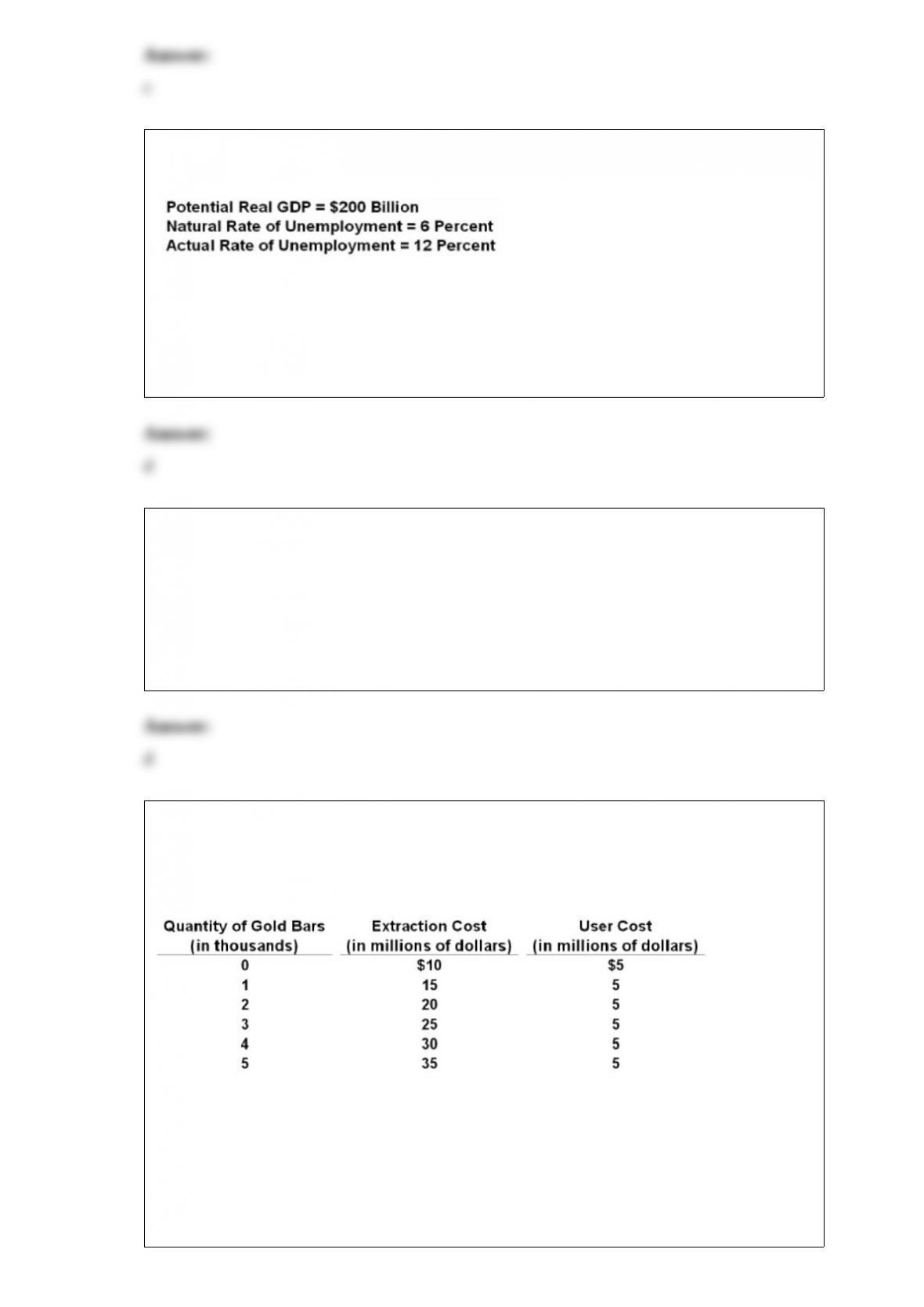
8) the following demand schedule:
refer to the above data. the price elasticity of demand is relatively inelastic:
a.in the $6-$4 price range.
b.over the entire $6-$1 price range.
c.in the $3-$1 price range.
d.in the $6-$5 price range only.
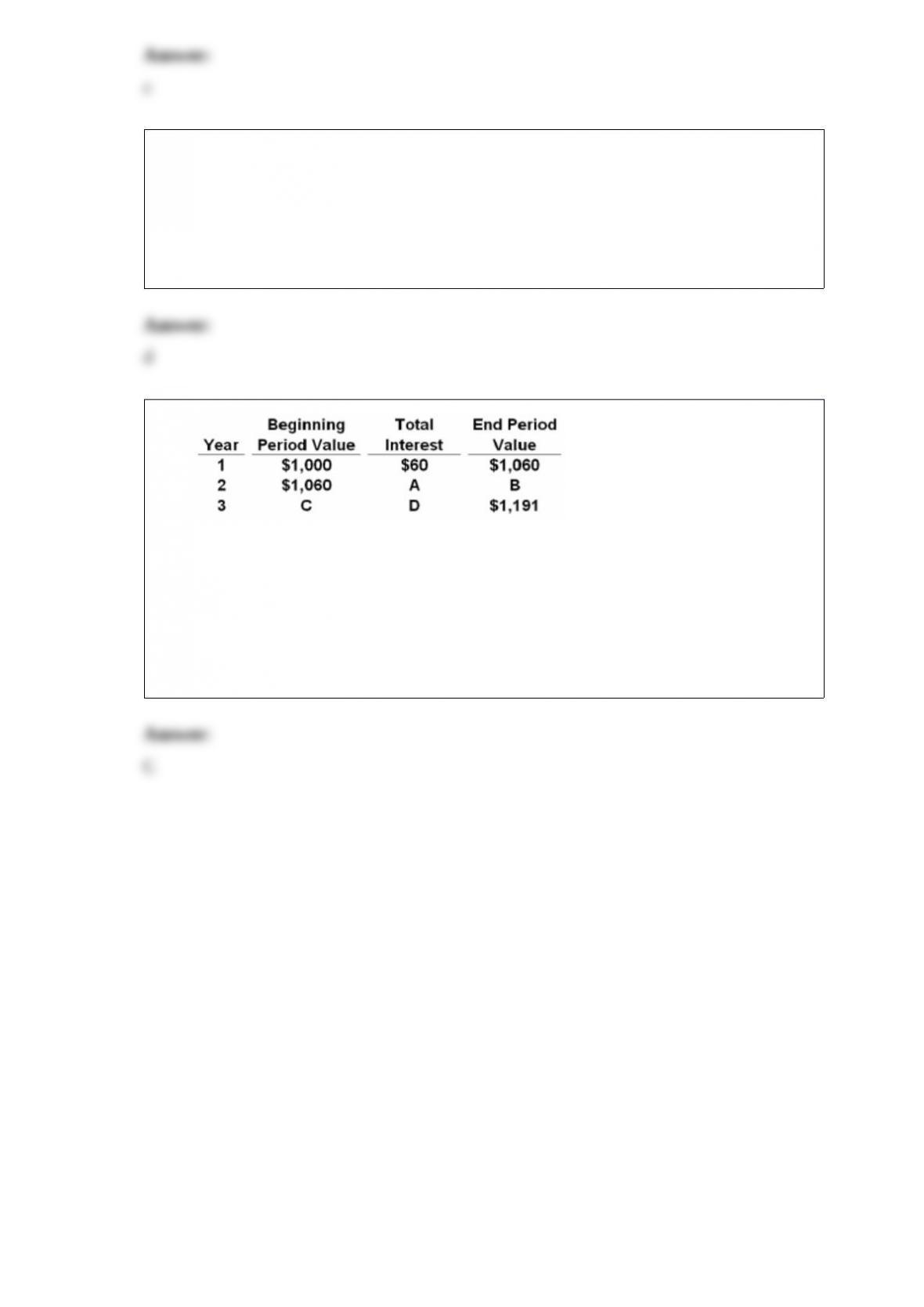
9) answer the next question(s) on the basis of the following information for a specific
year in a hypothetical economy for which okun’s law is applicable:
refer to the above data. the amount of output being forgone by the above economy is:
a.$12 billion.
b.$15 billion.
c.$18 billion.
d.$24 billion.
10) an indifference map implies that:
a.money income is constant, but the prices of the two products vary directly with the
quantities purchased.
b.the two products under consideration are perfectly substitutable for one another.
c.a consumer is better off to be at some point high on a given curve as opposed to a
point low on the same curve.
d.curves farther from the origin yield higher levels of total utility.
11) The table below shows the quantity of gold bars (Qb) in thousands, the extraction
cost for each thousand bars (in millions of dollars), and user cost of each thousand bars
(in millions of dollars) facing the OZ Mining Company this year.
Suppose that a new government regulation is going to shut down OZ’s mining operation
1 year from now. If the current price per bar of gold is $25,000, how many bars (in
thousands) should OZ extract and sell this year?
A.3
B.4
C.5
D.As many as possible

12) assume in a competitive market that price is initially above the equilibrium level.
we can predict that price will:
a.decrease, quantity demanded will decrease, and quantity supplied will increase.
b.decrease and quantity demanded and quantity supplied will both decrease.
c.decrease, quantity demanded will increase, and quantity supplied will decrease.
d.increase, quantity demanded will decrease, and quantity supplied will increase.
13) Suppose that the economy is in the midst of a recession. Which of the following
policies would most likely end the recession and stimulate output growth?
A.a Congressional proposal to incur a Federal surplus to be used for the retirement of
public debt
B.a reduction in agricultural subsidies and veterans’ benefits
C.a postponement of a highway construction program
D.a reduction in Federal tax rates on personal and corporate income
14) Consider the following payoff matrix in which the numbers indicate the profit in
millions of dollars for a duopoly based either on a high-price or a low-price strategy.
(a)What will be the result when each firm chooses a high-price strategy?
(b)What will be the result when Firm A chooses a low-price strategy while Firm B
maintains a high-price strategy?
(c)What will be the result when Firm B chooses a low-price strategy while Firm A
maintains a high-price strategy?
(d)What will be the result when each firm chooses a low-price strategy?
(e)What two conclusions can you draw about collusion?

15) voluntary migration of skilled craftworkers from low-paying to high-paying nations
is most likely to be opposed by:
a.business groups in the high-paying nations.
b.craft workers who stay in the low-paying nations.
c.industrial unions in the high-paying nations.
d.craft unions in the high-paying nations.
16) the advantages of the corporate form of business include:
a.the ability to raise financial capital by selling stocks and bonds.
b.the fact that owners are subject to unlimited liability.
c.the elimination of the principal-agent problem.
d.single taxation of corporate earnings.
17) children are charged less than adults for admission to professional baseball games
but are charged the same prices as adults at the concession stands. this pricing system
occurs because:
a.children have an elastic demand for game ticket but an inelastic demand for
concession items.
b.children have an inelastic demand for game tickets but an elastic demand for
concession items.
c.the seller can prevent children from buying game tickets for adults but cannot prevent
children from buying concession items for adults.
d.children can personally “consume” only a single game ticket, but can personally
consume more than one concession item.
18) which of the following is not characteristic of the demand for a commodity that is
elastic?
a.the relative change in quantity demanded is greater than the relative change in price.
b.buyers are relatively sensitive to price changes.
c.total revenue declines if price is increased.
d.the elasticity coefficient is less than one.
19)
Refer to the above table representing Darcy’s bank account. Assuming that $1000 was
deposited into her account at the beginning of year 1, and no further deposits or
withdrawals were made, what is the value for cell D?
A.$67.4
B.$180
C.$191
D.It cannot be determined.