1) Professional buyers of antiques often have more information about the value of
antique objects than do the sellers. This illustrates:
A.the Coase theorem.
B.the moral hazard problem.
C.the free-rider problem.
D.asymmetric information.
2)
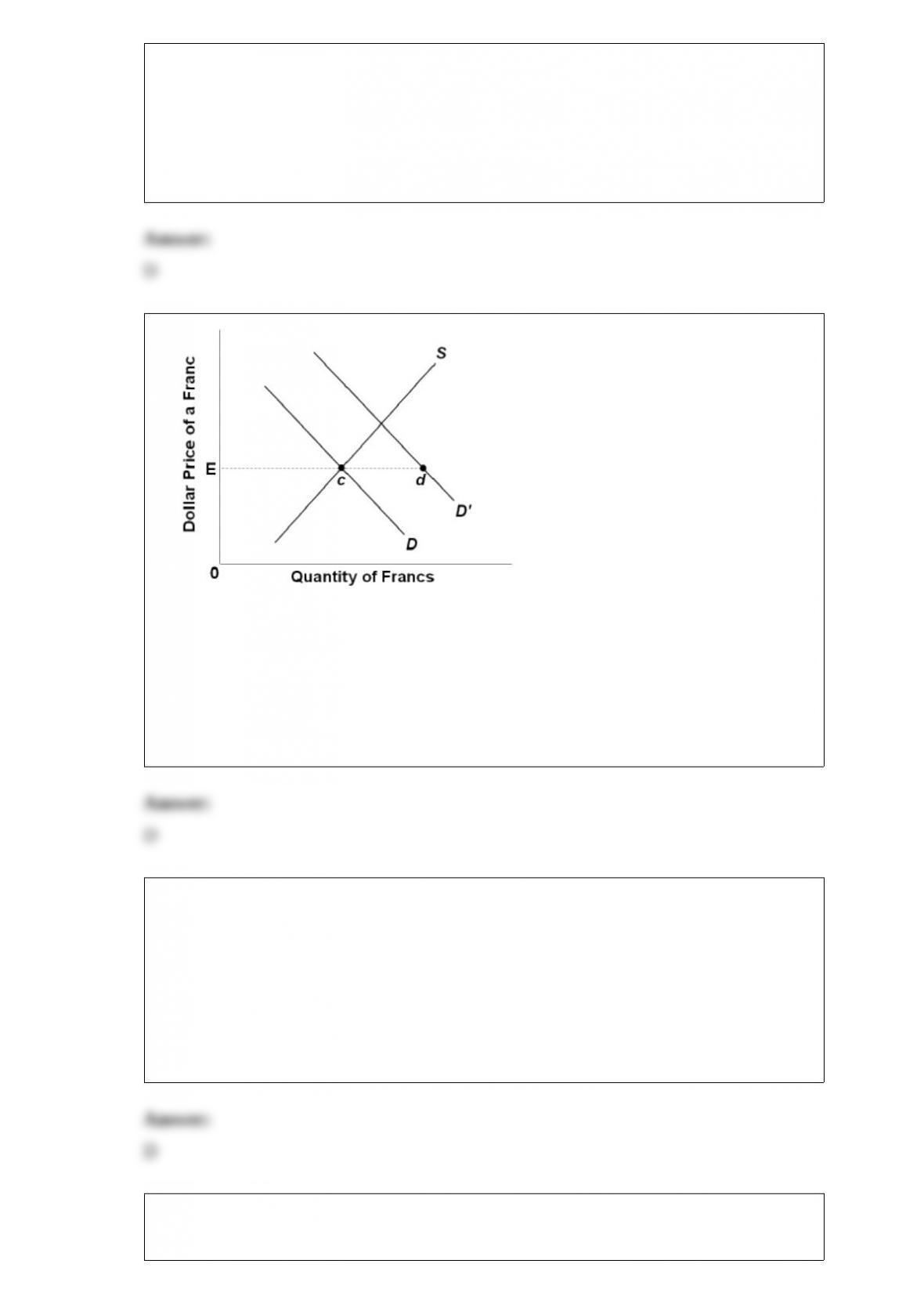
Refer to the above diagram where D and S are the United States’ demand for and supply
of Swiss francs. At the equilibrium exchange rate, E, the United States’ balance of
payments is in equilibrium. A shift of the demand curve to D’ might be the result of:
A.a relative decline in interest rates in Switzerland.
B.a reduction in the United States’ relative price level.
C.a recession in the United States which slows its rate of growth.
D.a relative decline in interest rates in the United States.
3) Suppose that two firms in an industry with a Herfindahl index of 5,000 announce a
merger. The U.S. Justice Department concludes the merger will boost the index to
5,500. The antitrust authorities will most likely:
A.ignore this merger because of the relatively small increase in the Herfindahl index.
B.allow the merger but watch the new firm carefully for future violations of the
antitrust laws.
C.allow the merger if foreign entry to the industry is possible.
D.prevent the merger, contending that it violates the Clayton Act.
4) the term allocative efficiency refers to:
a.the level of output that coincides with the intersection of the mc and avc curves.
b.minimization of the afc in the production of any good.
c.the production of the product-mix most desired by consumers.
d.the production of a good at the lowest average total cost.
5) what do economies of scale, the ownership of essential raw materials, and patents
have in common?
a.they must all be present before price discrimination can be practiced.
b.they are all barriers to entry.
c.they all help explain why a monopolist’s demand and marginal revenue curves
coincide.
d.they all help explain why the long-run average cost curve is u-shaped.
6) In 2005, the 20 percent of families with the lowest incomes paid an average Federal
tax rate (on all Federal taxes) of about ____ percent, whereas the 20 percent of families
with the highest incomes paid an average tax rate of about ____ percent.
A.5.5; 50.1
B.10.3; 30.9
C.8.4; 27.2
D.4.3; 25.5
7) If the marginal propensity to save in a closed economy is 0.25 and a lump-sum tax is
imposed, the slope of the economy’s aggregate expenditures schedule will be:
A..25.
B.less than the slope before the tax.
C.greater than the slope before the tax.
D..75.
8) The median-voter model implies that:
A.political voting will be as economically efficient as “dollar voting” in competitive
markets.
B.all voters have about the same preferences for various public goods and services.
C.many people will be dissatisfied with the size of government in the economy.
D.with majority voting there can never be a consistent ordering of public good

preferences.
9) (consider this) a direct cost of going to college is:
a.tuition, while an indirect cost (opportunity cost) is books and other supplies.
b.forgone income while in college, while an indirect cost (opportunity cost) is tuition.
c.tuition, while an indirect cost (opportunity cost) is forgone income while in college.
d.books and supplies, while an indirect cost (opportunity cost) is food and housing.
10) According to monetarists, an expansionary fiscal policy is a weak stabilization tool
because:
A.the asset demand for money varies inversely with the rate of interest.
B.government borrowing to finance a deficit will raise the interest rate and reduce
private investment.
C.government borrowing will reduce the supply of money in circulation and depress the
GDP.
D.government borrowing to finance a deficit will lower interest rates, increase money
balances, and lower velocity.
11) Refer to the above diagram. Assume that nominal wages initially are set on the basis
of the price level P2 and that the economy initially is operating at its full-employment
level of output Qf. In the short run, cost-push inflation could best be shown as:
A.a leftward shift of aggregate supply from AS2 to AS3.
B.a move from b to c on AS2.
C.a move from b to c to d.
D.a move from b to f to d.
12) In the real world, specialization is rarely complete because:
A.nations normally experience increasing opportunity costs in producing more of the
product in which they are specializing.
B.production possibilities curves are straight lines rather than curves bowed outward as
viewed from the origin.
C.one nation’s imports are necessarily another nation’s exports.
D.international law prohibits monopolies.
13) Though wages under bilateral monopoly are logically indeterminate, some wage
rate is actually established in such market situations. Explain those economic and
noneconomic factors that might be pertinent to the establishment of this wage.
14) What factors might cause the interest rates to differ? Explain.
15) What is the relevance of productive and allocative efficiency to the growth process?
16) Contrast the factors that underlie the downsloping resource demand curve with
those which underlie the downsloping product demand curve.
17) What are two criticisms of the unemployment rate? How do these criticisms relate
to the overstating or understating of the unemployment rate?
18) Since a public good is enjoyed by all members of society, willingness to pay for the
good will not diminish as the amount produced increases. Evaluate and use an example
to support your answer.
19) What are the major imports and exports of the United States?
20) Discrimination based on gender may cause a regrettable redistribution of income in
favor of males and at the expense of females, but it entails no loss to society as a whole.
Evaluate.