
1) because of health insurance, resources are underallocated to the health care industry.
2) noncash gift giving involves value loss when the marginal utility of the gift to the
receiver is less than the product price.
3) labor productivity = worker-hours/real gdp.
4) Non-renewable natural resources are fixed in supply.
5) only the bondholders of a corporation have the right to vote for a corporation’s
directors.
6) Economists prefer free trade to tariffs and prefer tariffs to import quotas.
7) the law of diminishing returns explains diseconomies of scale.
8) If the dollar depreciates, U.S. exports will eventually rise and U.S. imports will
eventually fall.

9) economic profit is found by subtracting accounting costs from total revenue.
10) the increasing wealth of the united states has reduced the relevance of economics.
11) The demand for productive resources has grown faster than the supply of productive
resources for the past 150 years.
12) In locating a particular aggregate demand curve it is assumed that the money supply
is fixed.
13) The total fertility rate is the average number of children that each person is expected
to have during his or her lifetime.
14) Sales taxes on consumer goods are regressive because poor people consume a larger
proportion of their incomes than do rich people.
15) hmo stands for holistic medical organization.
16) nominal gdp was $130 and $150 in years 1 and 2 respectively. real gdp was $100
and $110 in years 1 and 2 respectively. on the basis of this information we can conclude
that:
a.the price level increased between years 1 and 2.
b.more intermediate goods were produced in year 1 than in year 2.
c.the increase in nominal gdp between years 1 and 2 understated the increase in
production which occurred.
17) Assume that many households and businesses reduce their spending only because
they expect other households and consumers to reduce their spending. Also suppose that
all households and consumers would be better off if they did not reduce their spending.
This situation best describes the:
A.real-business-cycle theory.
B.rational expectations theory.
C.idea of coordination failures.
D.adaptive expectations theory.
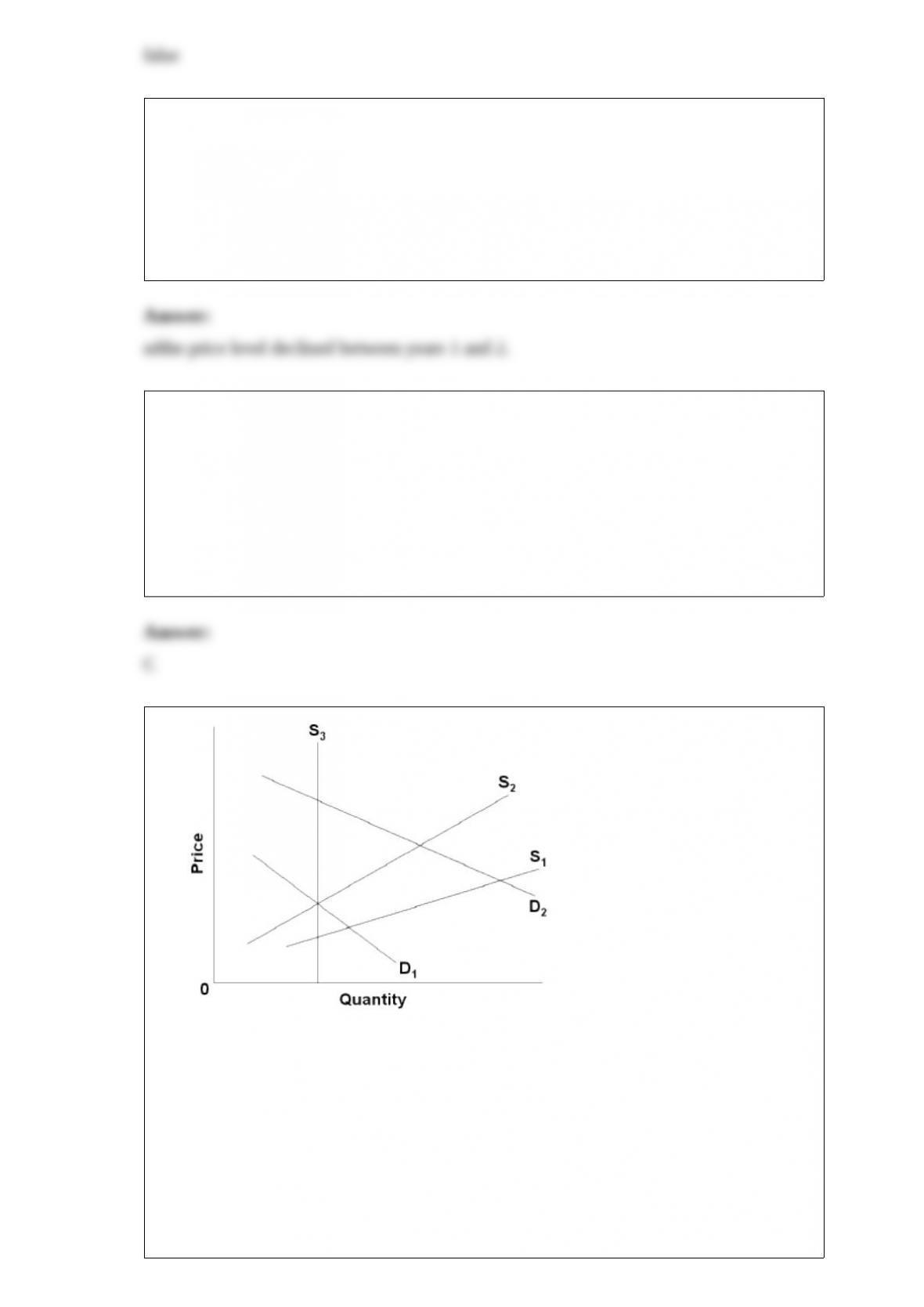
18)
the above diagram concerns supply adjustments to an increase in demand (d1to d2) in
the immediate market period, the short run, and the long run. on the basis of this
illustration we can conclude that:
a.short-run adjustments are more economically efficient than are long-run adjustments.
b.the amount of time producers have to adjust to a change in demand is not a
determinant of supply elasticity.
c.supply is more elastic the greater the amount of time producers have to adjust to a
change in demand.
d.supply is less elastic the greater the amount of time producers have to adjust to a
change in demand.
19) The asset demand for money is downsloping because:
A.the opportunity cost of holding money increases as the interest rate rises.
B.it is more attractive to hold money at high interest rates than at low interest rates.
C.bond prices rise as interest rates rise.
D.the opportunity cost of holding money declines as the interest rate rises.
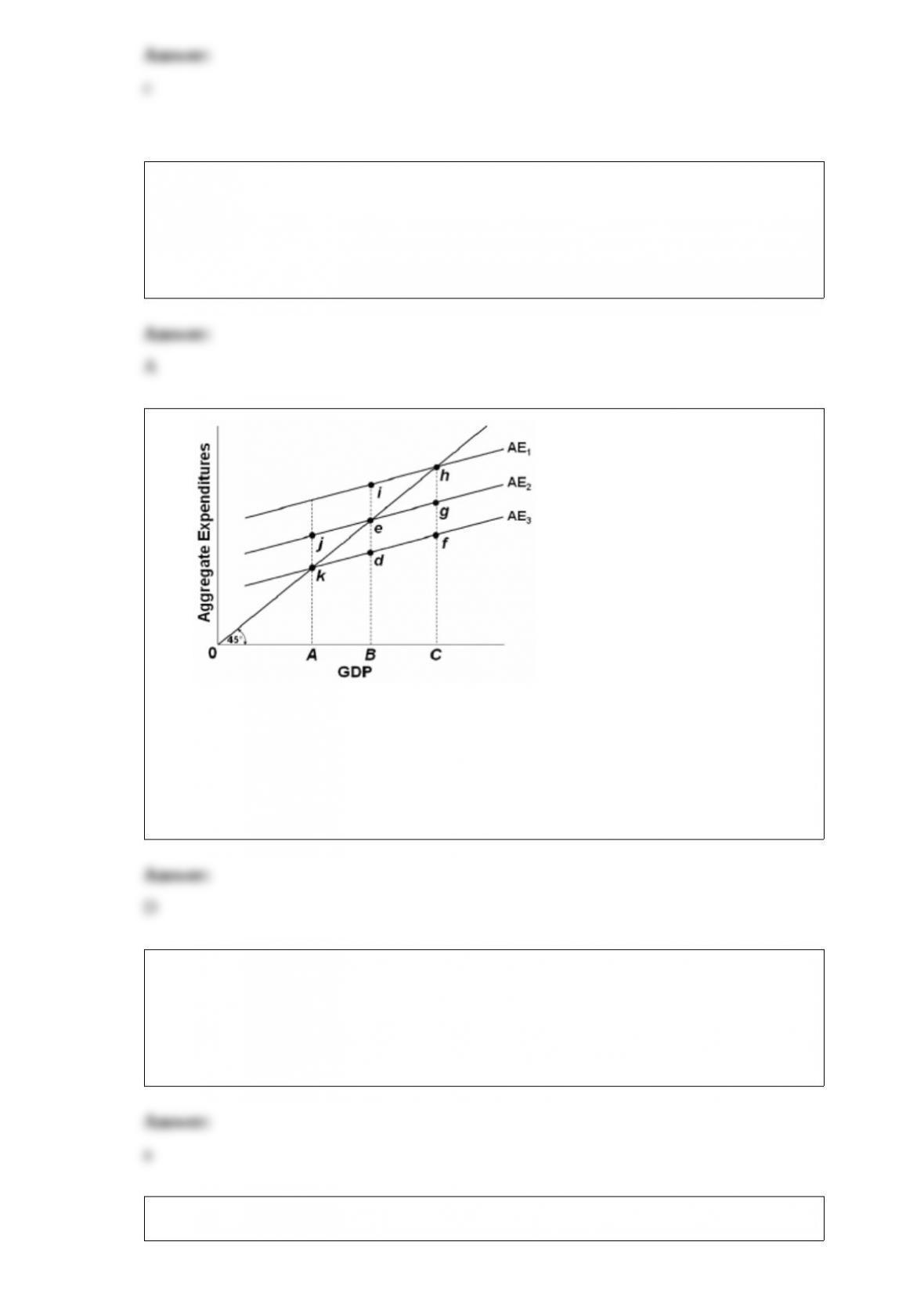
20)
Refer to the above diagram. If the full-employment level of GDP is B and aggregate
expenditures are at AE2, the:
A.inflationary expenditure gap is ed.
B.recessionary expenditure gap is BC.
C.inflationary expenditure gap is eg.
D.economy is in equilibrium, at full employment.
21) marginal cost:
a.equals both average variable cost and average total cost at their respective minimums.
b.is the difference between total cost and total variable cost.
c.rises for a time, but then begins to decline when diminishing returns set in.
d.declines continuously as output increases.
22) If farm state legislators support the food-stamp program to aid the urban poor and

urban state legislators in turn support farm subsidies, this is an example of:
A.the special-interest effect.
B.political logrolling.
C.the paradox of voting.
D.cost-benefit analysis.
23) consumer surplus:
a.is the difference between the maximum prices consumers are willing to pay for a
product and the lower equilibrium price.
b.the difference between the maximum prices consumers are willing to pay for a
product and the minimum prices producers are willing to accept.
c.the difference between the minimum prices producers are willing to accept for a
product and the higher equilibrium price.
d.rises as equilibrium price rises.
24) Harry owns a barber shop and charges $6 per haircut. By hiring one barber at $10
per hour the shop can provide 24 haircuts per 8-hour day. By hiring a second barber at
the same wage rate the shop can now provide a total of 42 haircuts per day.
Refer to the above information. The MP of the second barber is:
A.$240.
B.$108.
C.18 haircuts.
D.42 haircuts.
25) The marginal revenue product schedule is:
A.the same whether the firm is selling in a purely competitive or imperfectly
competitive market.
B.the firm’s resource demand schedule.
C.the firm’s resource supply schedule.
D.upsloping.
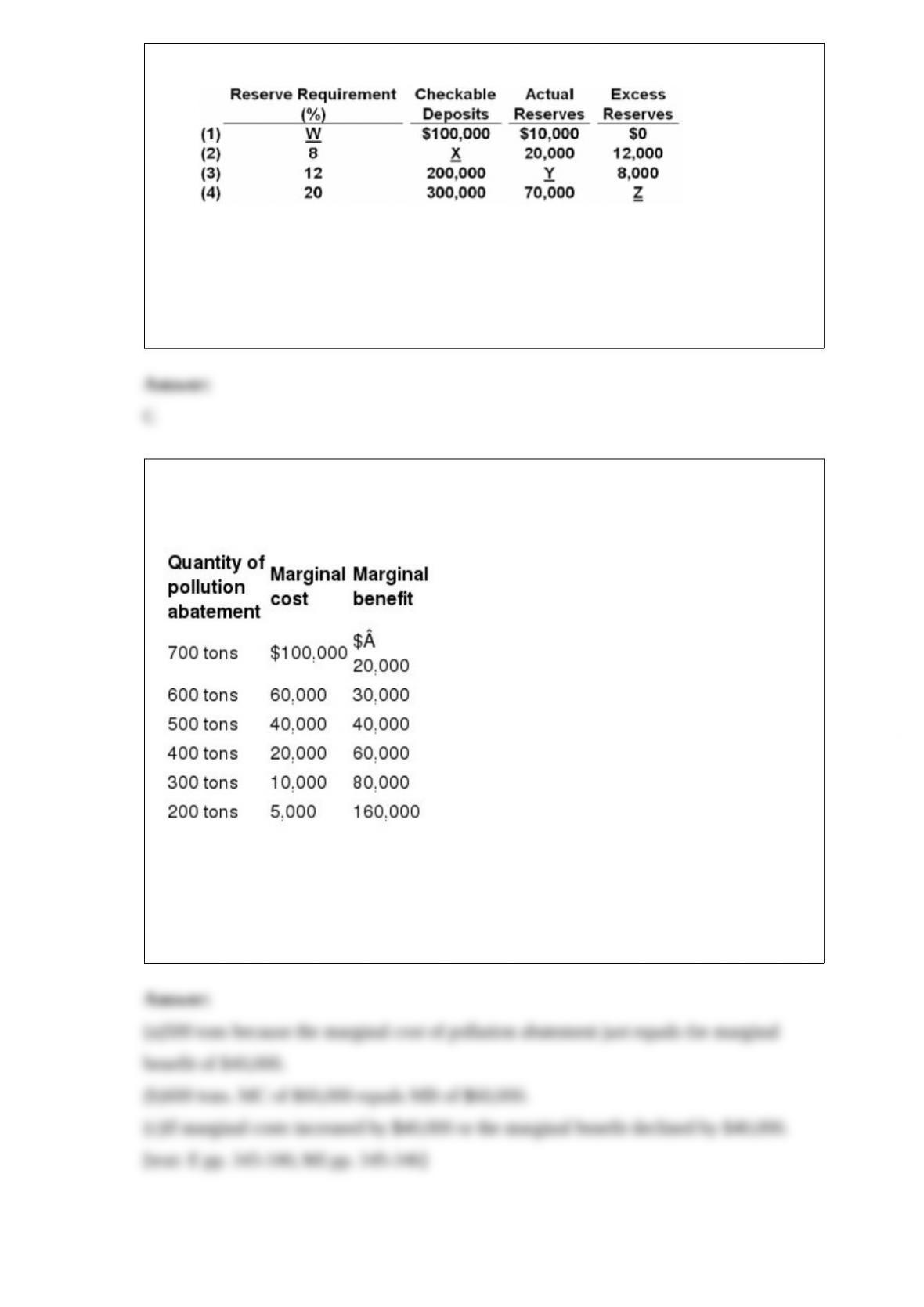
26)
Refer to row 1 in the above table. The number appropriate for space W is:
A.4
B.6
C.10
D.12
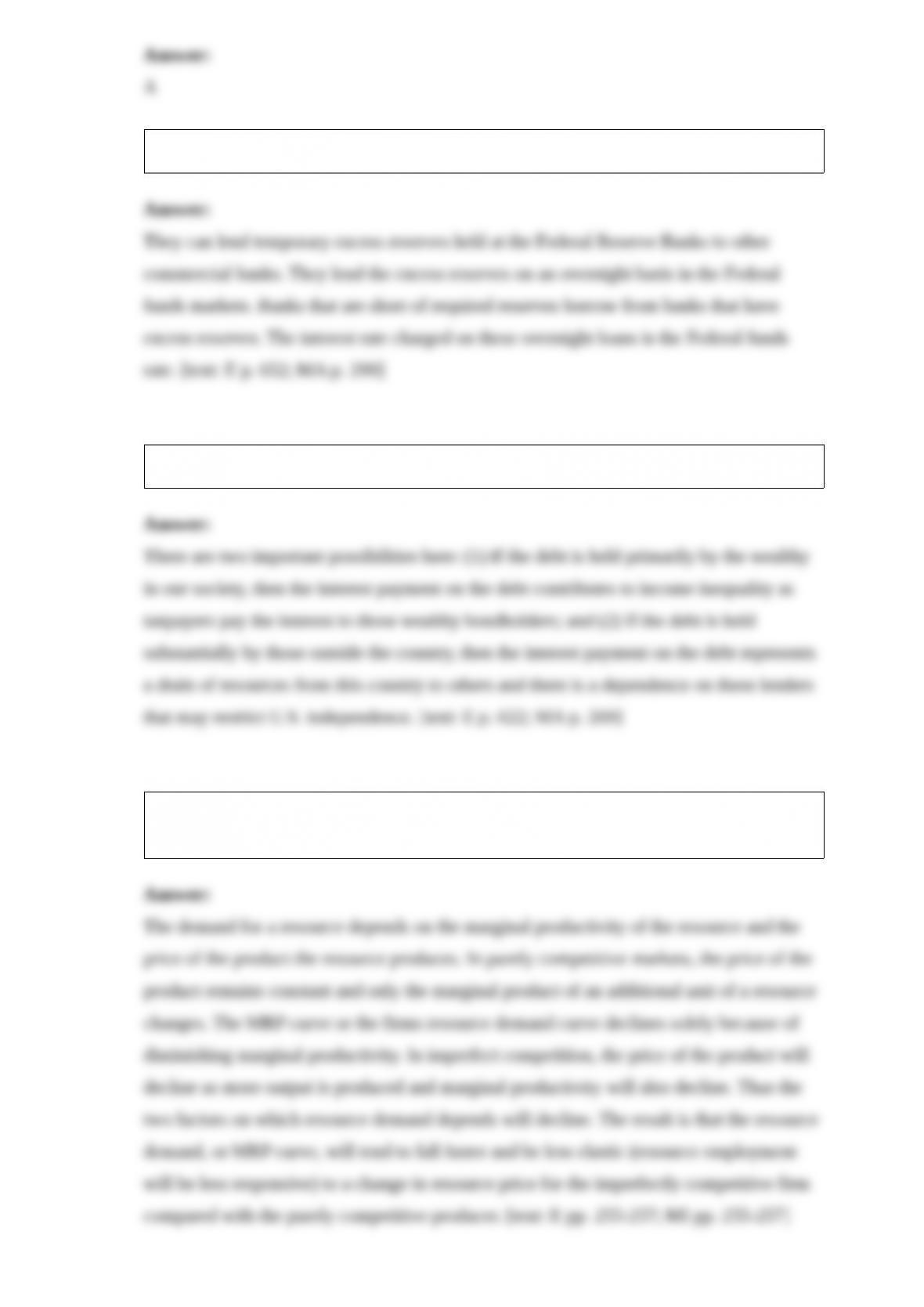
27) The following table shows marginal costs and benefits of the optimal quantity of
pollution abatement that will occur at a local factory.
(a)What is the optimal level of pollution abatement? Why?
(b)If the marginal benefit of pollution abatement were to increase by $30,000 at each
level because of the factorys desire to improve its image and environment, what would
the optimal level be? Why?
(c)What might cause the optimal level of pollution abatement to be 400 tons?

28) Suppose the demand for strawberries rises sharply, resulting in an increased price of
strawberries. As it relates to strawberry pickers, we could expect the:
A.MRP curve to shift to the right.
B.MRP curve to shift to the left.
C.MRC curve to shift downward.
29) a market is in equilibrium:
a.provided there is no surplus of the product.
b.at all prices above that shown by the intersection of the supply and demand curves.
c.if the amount producers want to sell is equal to the amount consumers want to buy.
d.whenever the demand curve is downsloping and the supply curve is upsloping.
30) “Near-monies” are included in:
A.both M1 and M2.
B.M2 only.
C.M1 only.
D.neither M1 nor M2.
31) The equations for the demand and supply curves for a particular product are P = 10
.4Q and P = 2 + .4Q, where P is price and Q is quantity expressed in units of 100.
After an excise tax is imposed on the product the supply equation is P = 3 + .4Q.
Refer to the above information. The excise tax on each unit of the product is:
A.$1.
B.$2.
C.$3.
D.$4.
32) Those who feel that unions positively affect productivity and efficiency argue that
unions are:
A.”voice mechanisms” which reduce labor turnover.
B.”exit mechanisms” which reduce labor turnover.
C.”voice mechanisms” which accelerate labor turnover.
D.”exit mechanisms” which accelerate labor turnover.
33) How do banks partly reconcile the goals of profits and liquidity?
34) Why is the ownership of the public debt an important issue?
35) What is the difference between the demand curve for a resource under pure
competition and under imperfect competition?
36) One of the advantages of monetary policy is its speed and flexibility, but there are
limitations. Explain.
37) Compare and contrast the views of new classical economists and mainstream
economists on the issue of policy rules versus the use of discretionary monetary and
fiscal policy.
38) Name at least four institutional structures that promote and sustain modern
economic growth. What other factors also influence a nations capacity for economic
growth?
39) Describe a recent violation of the Wheeler-Lea Act of 1938.
40) In what cases would the market share held by the dominant firm be or not be an
especially relevant or important factor in determining whether a firm has too much
market power?