
Use the following two statements to answer this question:
I. In order to answer normative questions, it is necessary to make value judgments.
II. In order to conduct positive economic analysis, it is always necessary to use
empirical evidence in addition to economic theories.
A) I and II are incorrect.
B) I is correct, II is incorrect.
C) I is incorrect, II is correct.
D) Both I and II are correct.
Which of the following statements about the composition of price indices is NOT true?
A) The Paasche index is calculated with current-year prices.
B) The Paasche index is calculated with base-year quantities for the bundle.
C) The Laspeyres index is calculated with current-year prices.
D) The Laspeyres index is calculated with base-year quantities for the bundle.
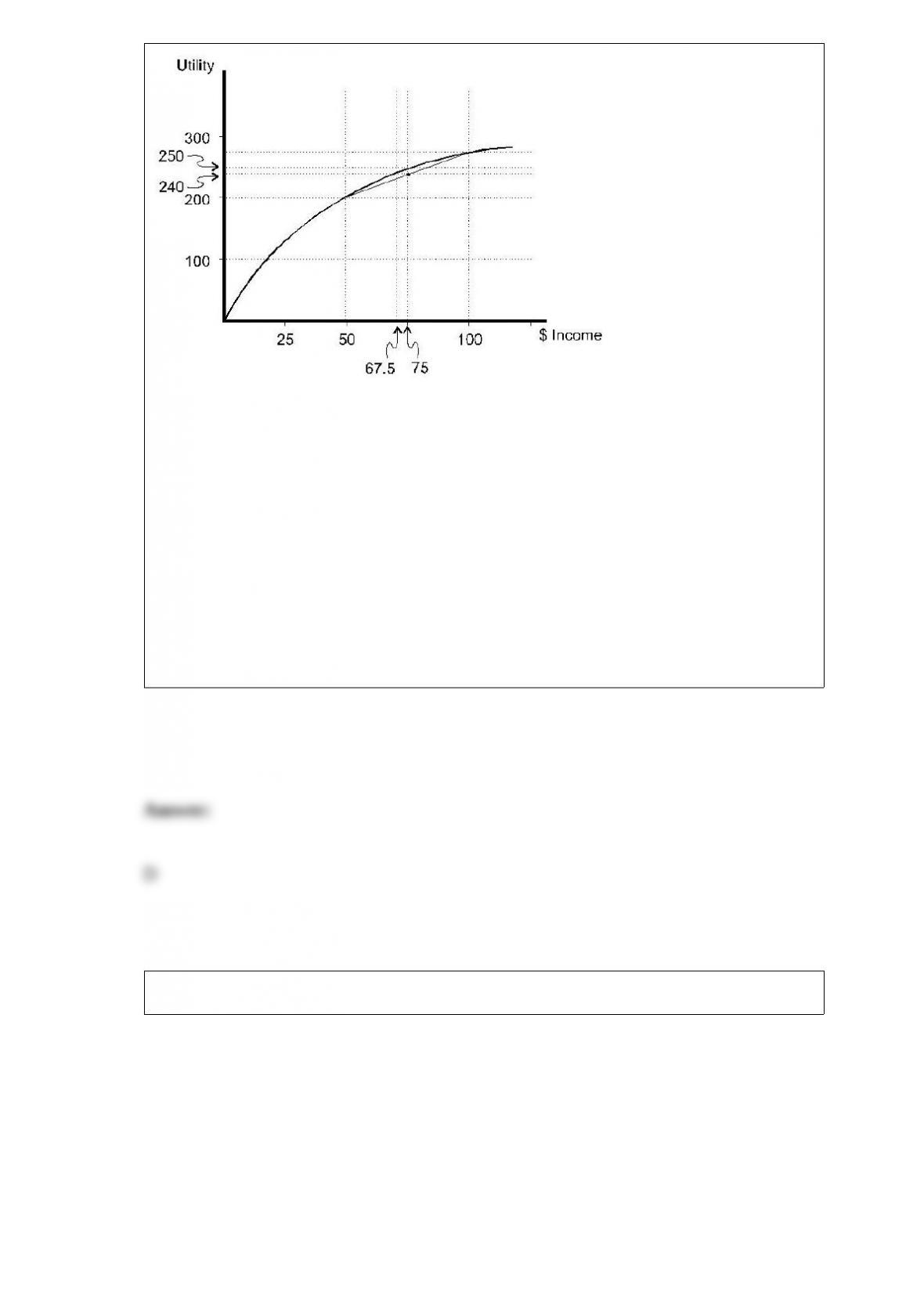
Figure 5.2
The individual pictured in Figure 5.2
A) prefers a 50% chance of $100 and a 50% chance of $50 to a sure $75.
B) would receive a utility of 300 from a 50% chance of $100 and a 50% chance of $50.
C) would receive a utility of 300 from a sure $75.
D) would receive a utility of 250 from a sure $75.
E) is one for whom income is a measure of well-being.
Consider the following diagram where a perfectly competitive firm faces a price of $40.
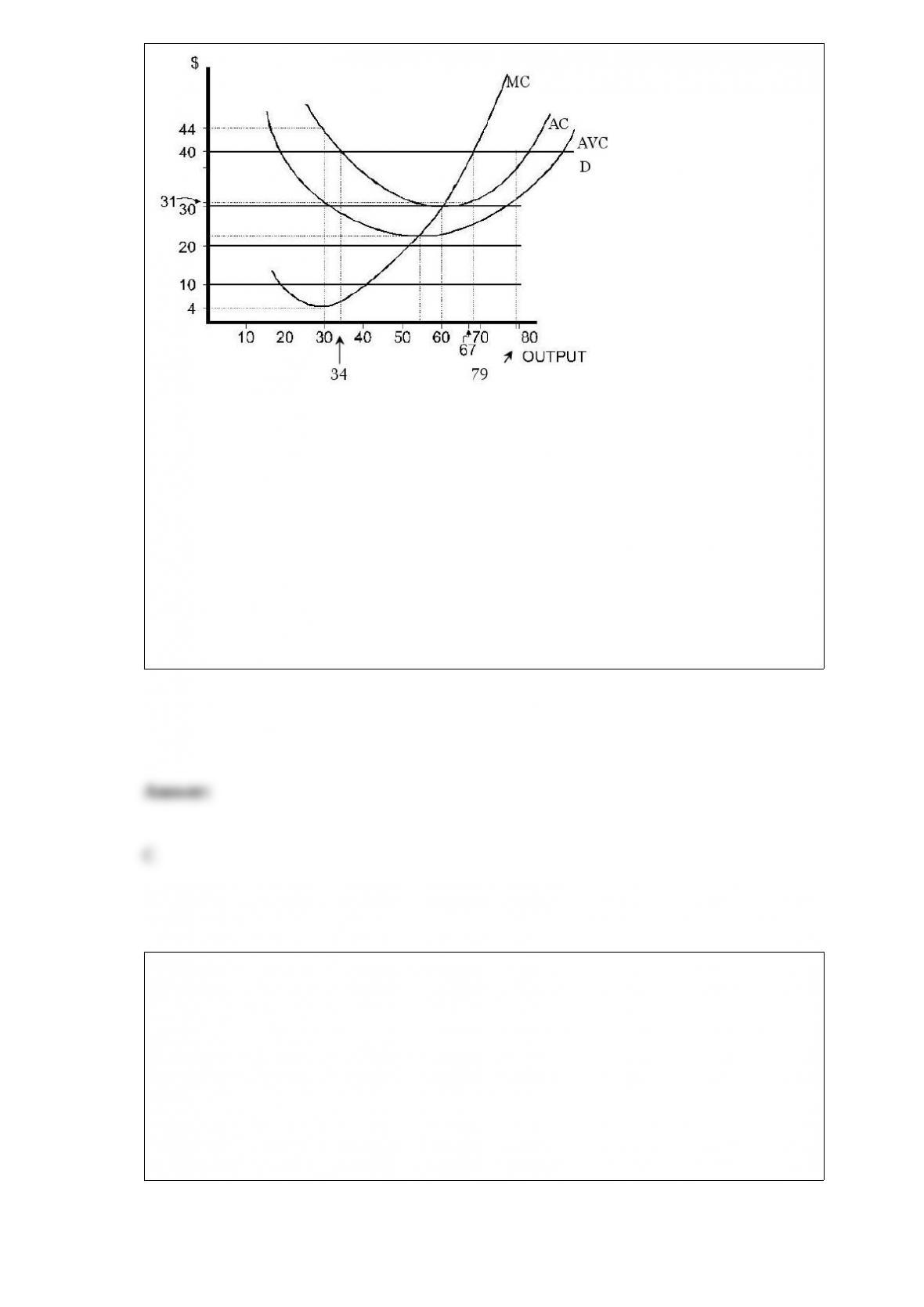
At 67 units of output, profit is
A) maximized and zero.
B) maximized and negative.
C) maximized and positive.
D) not maximized, and zero.
E) not maximized, and negative.
Efficient voting outcomes would assign weights to each vote that are:
A) equal.
B) egalitarian.
C) higher for the median voter and lower for other voters.
D) proportional to the voter’s strength of preference.
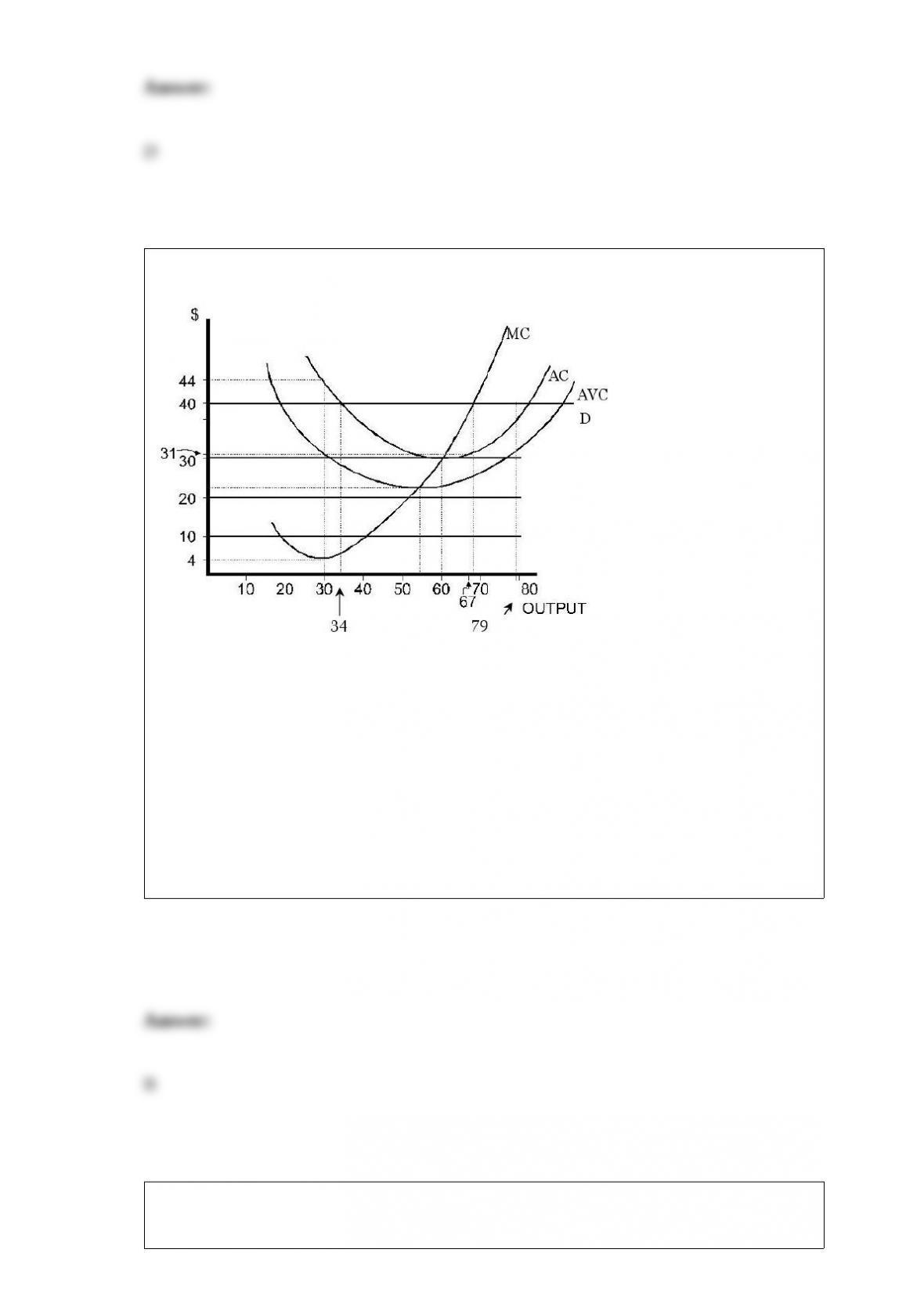
Consider the following diagram where a perfectly competitive firm faces a price of $40.
The firm earns zero profit at what output?
A) 0.
B) 34 and 79.
C) 54.
D) 60.
E) 67.
What does it mean to say that a game is in “extensive form”?

A) Strategies are described, rather than just numbered.
B) All payoffs are shown.
C) The game is presented as a matrix.
D) The game is presented as a decision tree.
E) The game is written out as often as the situation calls for it to be played.
The problem of asymmetric information in multi-plant firms involves
A) only the problem of how to get managers to produce as much as possible.
B) only the problem of how to get managers to produce the amount the larger firm
wants them to, whether it be a lot or a little.
C) both the problem of how to get managers to produce the appropriate amount and the
problem of how to get them to accurately report their capacity.
D) both the problem of how to get managers to produce the appropriate amount and the
problem of how to get them to not sell that output outside of the firm.
E) both the problems of vertical and horizontal integration with the rest of the firm.
Scenario 14.1:

You are the manager of a firm producing green chalk. The marginal product of labor is:
MPL = 24L-1/2
Suppose that the firm is a competitor in the green chalk market. The price of green
chalk is $1 per unit. Further suppose that the firm is a competitor in the labor market.
The wage rate is $12.00 per hour.
Given the information in Scenario 14.1, what is the marginal revenue product of labor?
A) 5L-1/2
B) 2L-1/2
C) 12L-1/2
D) 24L-1/2
The function which shows combinations of inputs that yield the same output is called
a(n)
A) isoquant curve.
B) isocost curve.
C) production function.
D) production possibilities frontier.

Suppose a firm has market power and faces a downward sloping demand curve for its
product, and its marginal cost curve is upward sloping. If the firm reduces its price,
then:
A) producer surplus increases due to new buyers, but the producer surplus from existing
customers declines due to the lower price.
B) the change in producer surplus is transferred to consumers.
C) the increase in consumer surplus is only due to the increase in quantity demanded.
D) the sum of producer and consumer surplus remains the same, but surplus value is
transferred from the producer to consumers.
Consider the following information:
The probability of a fire in a factory without a fire prevention program is 0.01. The
probability of a fire in a factory with a fire protection program is 0.001. If a fire
occurred, the value of the loss would be $300,000. A fire prevention program would
cost $80 to run.
If there is no insurance and a fire protection program in place, the expected loss from
fire for this company is
A) $0.
B) $300.
C) $3,000.
D) $6,000.
E) $300,000.

United Plastics Company produces large plastic cups in a variety of colors. United can
produce plain plastic cups that are sold in department stores in inexpensive ten cup
bundles. Alternatively, United can sell Novelty Cups which are imprinted with slogans
and designs. The printed cups cost more to produce, but they sell for a higher price. The
appropriate strategy for United depends upon the state of the economy. Plain cups do
better during a recession, while Novelty Cups earn higher profits during normal
economic conditions. During a recession, United will earn a $100,000 profit selling
plain cups and $40,000 with the Novelty line. Under normal economic conditions,
United will earn $120,000 with the plain cups and a $200,000 profit with Novelty Cups.
United currently does not use economic forecasts and simply assigns equal probabilities
to a recession and normal conditions.
a. Using the probabilities assumed by United, what is the expected value of each
alternative? Which alternative should the firm pursue? (Your recommendation should
include separate recommendations for alternative attitudes toward risk.)
b. Calculate and interpret the value to the firm of complete information.
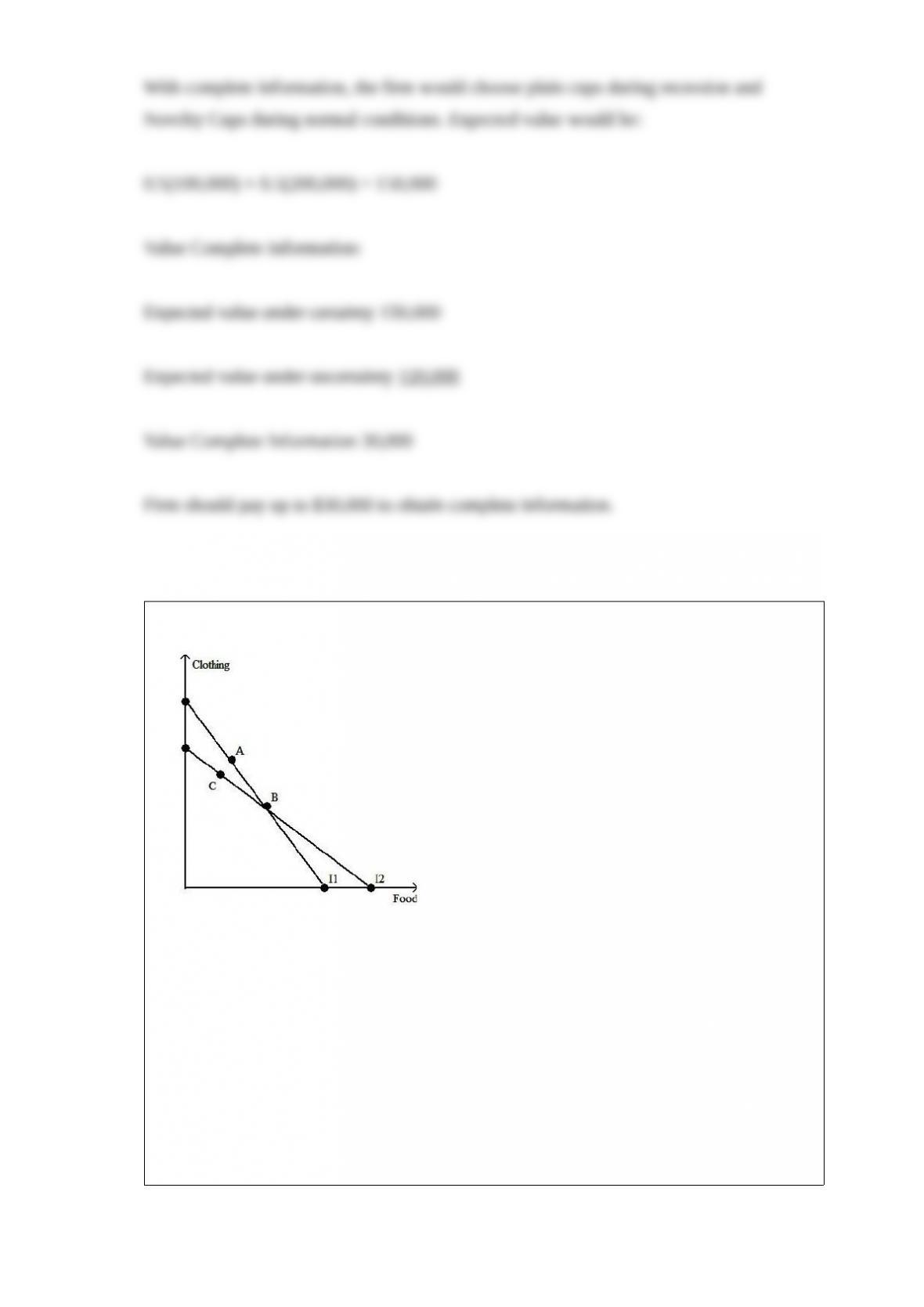
Please consider the following figure:
The consumer chooses A on budget line I1 and B on budget line I2. Which of the
following statements is NOT true?
A) B is preferred to C.
B) A is preferred to B.
C) C is preferred to A.
D) All of the statements are correct.

When contemplating the purchase of a resource, the pure monopsonist should do which
of the following to maximize profit?
A) Purchase enough to make the marginal expenditure equal to the marginal revenue
product.
B) Purchase enough to make the average expenditure equal to the marginal revenue
product.
C) Pay a wage equal to the value of MRP at the intersection of MRP and ME curves.
D) Pay a wage equal to the value of MRP at the intersection of AE and MRP curves.
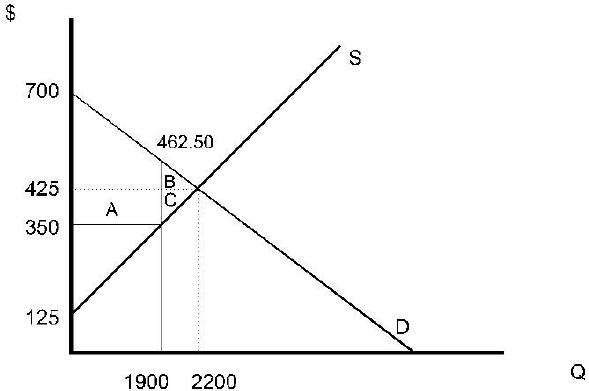
The elected officials in a west coast university town are concerned about the
“exploitative” rents being charged to college students. The town council is
contemplating the imposition of a $350 per month rent ceiling on apartments in the city.
An economist at the university estimates the demand and supply curves as:
QD = 5600 – 8P QS = 500 + 4P,
where P = monthly rent, and Q = number of apartments available for rent. For purposes
of this analysis, apartments can be treated as identical.
a. Calculate the equilibrium price and quantity that would prevail without the price
ceiling. Calculate producer and consumer surplus at this equilibrium (sketch a diagram
showing both).
b. What quantity will eventually be available if the rent ceiling is imposed? Calculate
any gains or losses in consumer and/or producer surplus.
c. Does the proposed rent ceiling result in net welfare gains? Would you advise the
town council to implement the policy?

Consider the following statements when answering this question;
I. Whenever the marginal product of labor curve is a downward sloping curve, the
average product of labor curve is also a downward sloping curve that lies above the
marginal product of labor curve.
II. If a firm uses only labor to produce, and the production function is given by a
straight line, then the marginal product of labor always equals the average product of
labor as labor employment expands.
A) I is true, and II is false.
B) I is false, and II is true.
C) Both I and II are true.
D) Both I and II are false.
Scenario 10.4:
The demand for tickets to the Katy Perry concert (Q) is given as follows:
Q = 120,000 – 2,000P

The marginal revenue is given as:
MR = 60 – .001Q
The stadium at which the concert is planned holds 60,000 people. The marginal cost of
each additional concert goer is essentially zero up to 60,000 fans, but becomes infinite
beyond that point.
Refer to Scenario 10.4. Suppose that the municipal stadium authority imposes a tax of
$10 per ticket on the concert promoters. Given the information above, the profit
maximizing ticket price would
A) increase by $10.
B) increase by $5.
C) not change.
D) decrease by $5.
E) decrease by $10.
Suppose the downward sloping labor demand curve shifts rightward in a labor market
with a single employer (monopsony). What happens to the equilibrium wage and level
of employment in the market?
A) Wage and level of employment increase.
B) Wage increases and level of employment declines.
C) Wage decreases and level of employment increases.
D) Wage and level of employment decline.
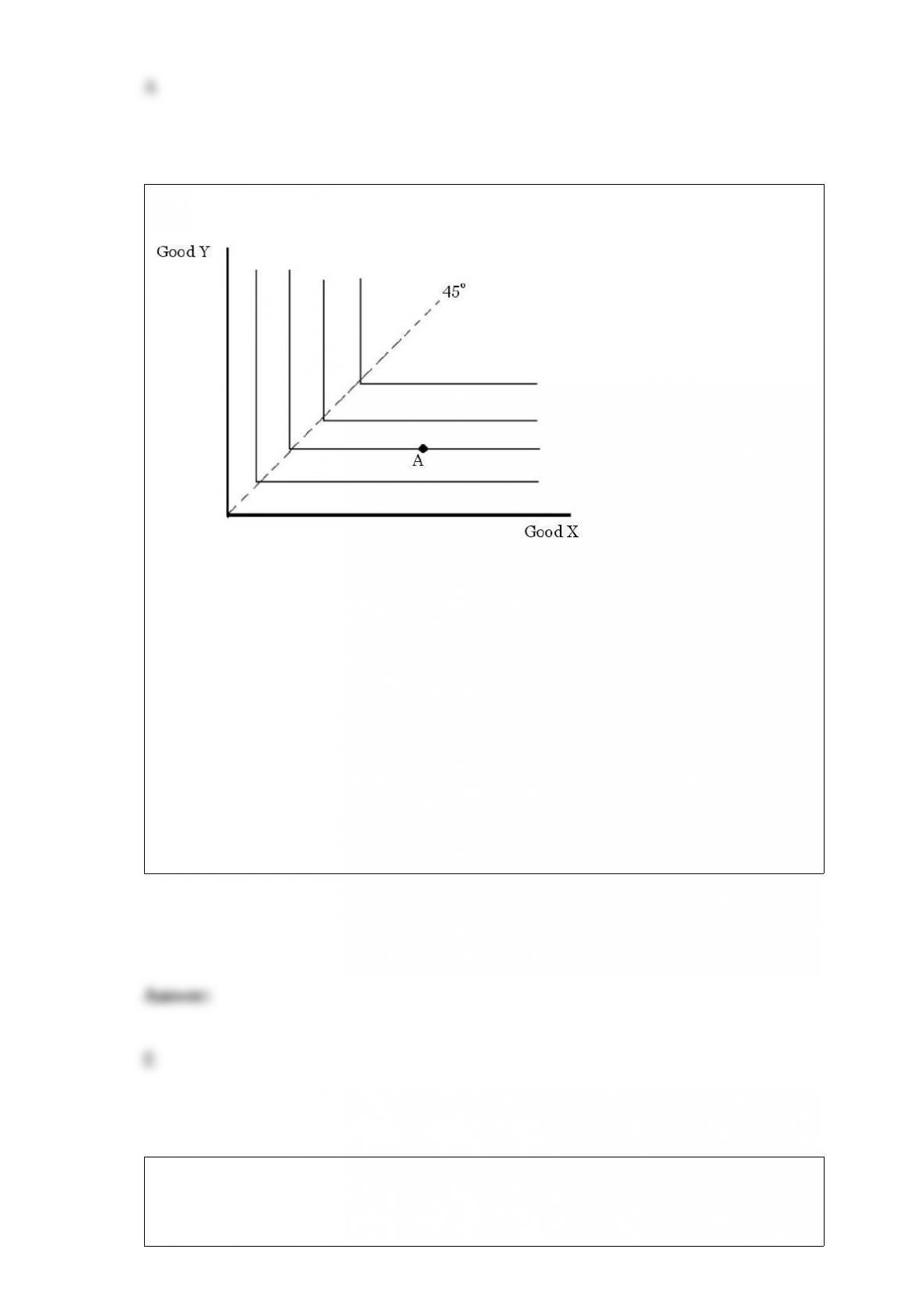
Alvin’s preferences for good X and good Y are shown in the diagram below.
Figure 3.2
Refer to Figure 3.2. Which assumption concerning preferences do Alvin’s indifference
curves violate?
A) Diminishing marginal rates of substitution
B) Transitivity of preferences
C) More is preferred to less
D) Completeness
E) both A and C
Assume that we have a demand curve of the form:
log(Q) = a – b log(P) + c log(I)

where Q = quantity, P = price, I = income, and a, b, and c are positive constants. The
income and price elasticities for the demand curve represented above are always
A) equal to one.
B) equal to zero.
C) equal (i.e., income elasticity always equals price elasticity).
D) constant but not necessarily equal to one another.
An investment opportunity is a sure thing; it will pay off $100 regardless of which of
the three possible outcomes comes to pass. The variance of this investment opportunity:
A) is 0.
B) is 1.
C) is 2.
D) is -1.
E) cannot be determined without knowing the probabilities of each of the outcomes.
Scenario 12.1:

Suppose mountain spring water can be produced at no cost and that the demand and
marginal revenue curves for mountain spring water are given as follows:
Q = 6000 – 5P MR = 1200 – 0.4Q
Refer to Scenario 12.1. What is the profit maximizing price of a monopolist?
A) $400
B) $600
C) $800
D) $900
E) none of the above
The expected value is a measure of
A) risk.
B) variability.
C) uncertainty.
D) central tendency.

Scenario 4.1:
Daniel derives utility from only two goods, cake (Qc) and donuts (Qd). The marginal
utility that Daniel receives from cake (MUc) and donuts (MUd) are given as follows:
MUc = Qd
MUd = Qc
Daniel has an income of $240 and the price of cake (Pc) and donuts (Pd) are both
$3.See Scenario 4.1. What is Daniel’s income-consumption curve?
A) Pc = Pd
B) Pc = Qc
C) Qd = I – 3Qc
D) Qc = Qd
E) all of the above
Third-degree price discrimination involves
A) charging each consumer the same two part tariff.
B) charging lower prices the greater the quantity purchased.
C) the use of increasing block rate pricing.
D) charging different prices to different groups based upon differences in elasticity of
demand.

Which of the following is a positive statement?
A) When the price of a good goes up, consumers buy less of it.
B) When the price of a good goes up, firms produce more of it.
C) When the Federal government sells bonds, interest rates rise and private business
investment is reduced.
D) all of the above
E) none of the above
Based on the example provided by the authors, what is the key factor that explains
much of the growing inequality in wages paid to different types of workers in the U.S.
since 1980?
A) Changes in the gender composition of the work force
B) Changes in the age distribution of the work force
C) Differences in computer and data analysis skills
D) Changes in the geographic concentration of workers

From 1970 to 2010, the real price of eggs decreased. Which of the following would
cause an unambiguous decrease in the real price of eggs?
A) A shift to the right in the supply curve for eggs and a shift to the right in the demand
curve for eggs.
B) A shift to the right in the supply curve for eggs and a shift to the left in the demand
curve for eggs.
C) A shift to the left in the supply curve for eggs and a shift to the right in the demand
curve for eggs.
D) A shift to the left in the supply curve for eggs and a shift to the left in the demand
curve for eggs.
Consider the information below:
For Group A the cost of attaining an educational level y is
CA(y) = $6,000y
and for Group B the cost of attaining that level is
CB (y) = $10,000y.
Employees will be offered $50,000 if they have y < y*, where y* is an education
threshold determined by the employer. They will be offered $130,000 if they have y >
y*.
An employer who only wants to hire individuals who find learning less costly can do so
by choosing y* to be anywhere between
A) 7 and 14.
B) 8 and 13 1/3.
C) 10 and 16.

D) 13 1/3 and 20.
E) 14 and 20.
For infinitely repeated games in which the players follow a tit-for-tat strategy, which
one of the following outcomes is NOT possible?
A) The players cooperate with one another until someone decides to not cooperate, and
then the other players will not cooperate for some period of time.
B) There can be dominant strategies.
C) If the information about another player’s action is limited, then some cooperative
actions may be incorrectly interpretted as “not cooperate.”
D) All of the above are possible outcomes.