
One of the Ten Principles of Economics in Chapter 1 is that people face tradeoffs. The
growth that arises from capital accumulation is not a free lunch. It requires that society
a. conserve resources for future generations.
b. sacrifice consumption goods and services now in order to enjoy more consumption in
the future.
c. recycle resources so that future generations can produce goods and services with the
accumulated capital.
d. None of the above is correct.
Purchasing-power parity describes the forces that determine
a. prices in the short run.
b. prices in the long run.
c. exchange rates in the short run.
d. exchange rates in the long run.
In the equation for the production function Y/Lrepresents
a. productivity.

b. output.
c. the availability of natural resources.
d. the amount of human capital.
Which of the following two effects of a decrease in the tax rate on saving would raise
savings?
a. the income effect and the substitution effect
b. the income effect but not the substitution effect
c. the substitution effect but not the income effect
d. neither the substitution effect nor the income effect
Which of the following statements is notcorrect?
a. The catch-up effect is based on the assumption of diminishing returns to capital.
b. Investment in poor countries by citizens of rich countries is one way poor countries
can learn new technologies.
c. Malthus argued that charity and government aid was an effective way to reduce
poverty.
d. Peace and justice are keys to growth.

Stagflation exists when prices
a. rise and unemployment falls.
b. rise and unemployment falls.
c. fall and unemployment rises.
d. fall and unemployment rises.
In the open-economy macroeconomic model, if the supply of loanable funds shifts right
a. the interest rate rises and the demand for dollars in the market for foreign currency
exchange shifts right.
b. the interest rate rises and the demand for dollars in the market for foreign currency
exchange shifts left.
c. the interest rate falls and the supply of dollars in the market for foreign-currency
exchange shifts right.
d. the interest rate falls and the supply of dollars in the market for foreign currency
exchange shifts left.

The unemployment rate never falls to zero.
a. True
b. False
If money demand shifts right, the price level falls.
a. True
b. False
In the circular-flow diagram, payments for labor, land, and capital flow from firms to
households through the markets for the factors of production.
a. True
b. False

The government builds a new water-treatment plant. The owner of the company that
builds the plant pays her workers. The workers increase their spending. Firms from
which the workers buy goods increase their output. This type of effect on spending
illustrates
a. the multiplier effect.
b. the crowding-out effect.
c. the Fisher effect.
d. the wealth effect.
When the money market is drawn with the value of money on the vertical axis, as the
price level increases, the value of money
a. increases, so the quantity of money demanded increases.
b. increases, so the quantity of money demanded decreases.
c. decreases, so the quantity of money demanded decreases.
d. decreases, so the quantity of money demanded increases.

A company that formerly produced music CDs went out of business because too many
potential customers bought illegally-produced copies of the CDs instead of buying the
product directly from the company. This instance serves as an example of
a. market power.
b. inefficient trade.
c. inadequate enforcement of property rights.
d. the invisible hand at work.
If a good has become more scarce, then we know fosurethat
a. the demand for it increased.
b. the supply of it decreased.
c. either the demand for it increased or the supply of it decreased.
d. both the supply of it and the demand for it decreased.

Felix deposited $500 into an account two years ago. The first year he earned 3 percent
interest and the second year he earned 5 percent interest. How much money does Felix
have in his account now?
a. $540.75
b. $540.80
c. $540.85
d. None of the above are correct to the nearest cent.
Monetary policy and fiscal policy are the only factors that influence aggregate demand.
a. True
b. False
Table 28-4
2010 Labor Data for Adults (ages 16 and older) in Meditor

RefetoTable28-4. What is the adult female labor-force participation rate in Meditor?
a. 38.1%
b. 61.9%
c. 66.7%
d. 95.2%
If Prepresents the price of goods and services measured in money, then 1/Pis the value
of money measured in terms of goods and services.
a. True
b. False
The Patersons bought a home that was newly constructed in 2007 for $275,000. They
sold the home in 2015 for $255,000. Which of the following statements is correct
regarding the sale of the house?
a. The 2015 sale increased 2015 GDP by $255,000 and had no effect on 2007 GDP.
b. The 2015 sale reduced 2015 GDP by $20,000 and had no effect on 2007 GDP.
c. The 2015 sale increased 2015 GDP by $255,000; and caused 2007 GDP to be revised
downward by $20,000.
d. The 2015 sale affected neither 2007 GDP nor 2015 GDP.
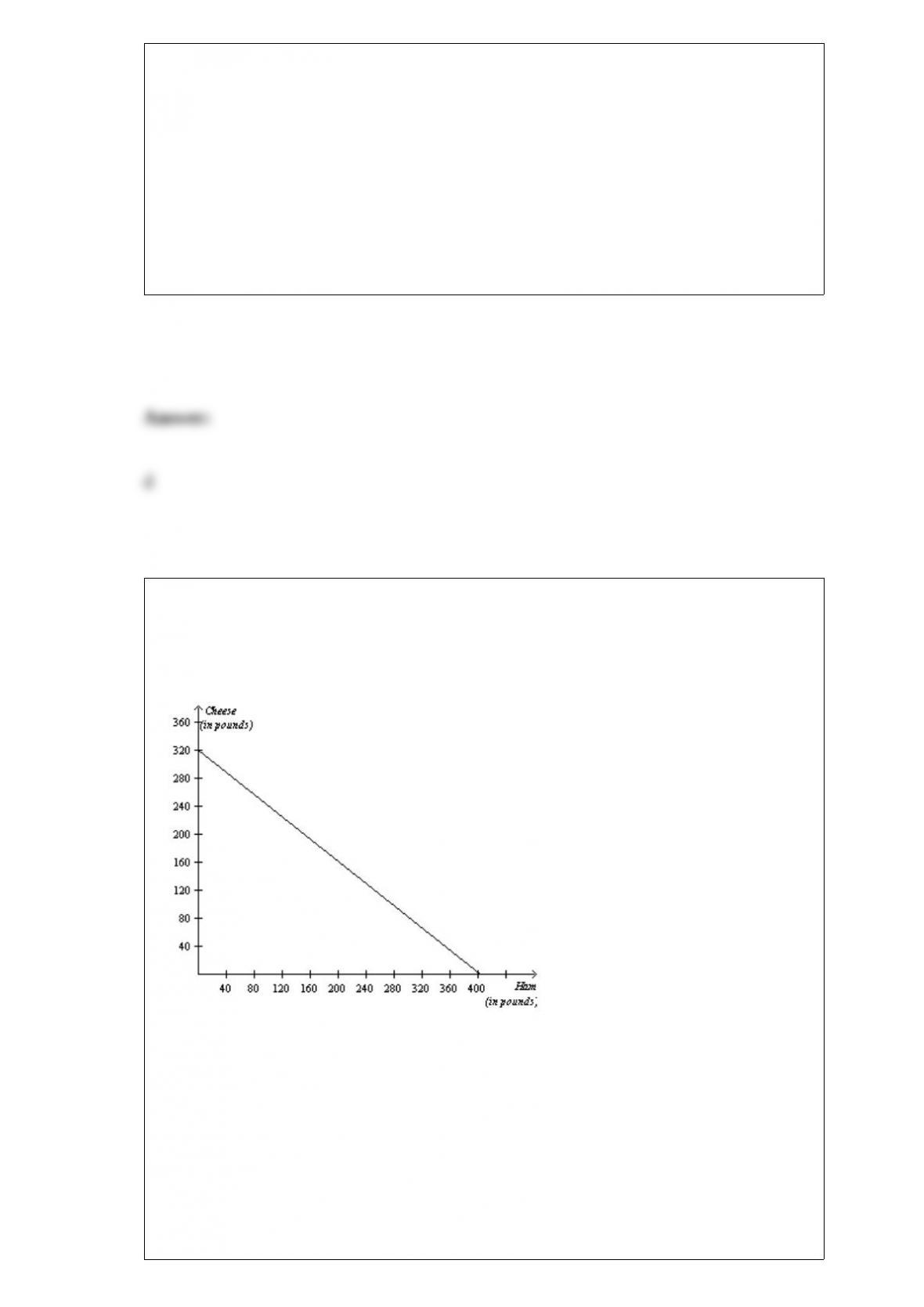
Figure 3-23
The graph below represents the various combinations of ham and cheese (in pounds)
that the nation of Bonovia could produce in a given month.
Refer to Figure3-23. In the nation of Cropitia, the opportunity cost of a pound of ham
is 0.3 pounds of cheese. Bonovia and Cropitia both can gain from trading with one
another if one pound of ham trades for
a. 0.40 pounds of cheese.
b. 0.55 pounds of cheese.
c. 0.75 pounds of cheese.

d. All of the above are correct.
A decrease in the price level makes consumers feel wealthier, so they purchase more.
This logic helps explain why the aggregate demand curve slopes downward.
a. True
b. False
Which of the following agencies calculates the CPI?
a. Bureau of Labor Statistics
b. Congressional Budget Office
c. Federal Reserve
d. Bureau of National Price Standards and Records

Evidence indicates that seat belt laws have led to
a. fewer pedestrian deaths.
b. fewer automobile accidents.
c. fewer deaths per automobile accident.
d. All of the above are correct.
The interest rate would fall and the quantity of money demanded would
a. increase if there were a surplus in the money market.
b. increase if there were a shortage in the money market.
c. decrease if there were a surplus in the money market.
d. decrease if there were a shortage in the money market.
Which of the following would shift the demand for dollars in the market for foreign
currency exchange to the right?
a. foreign citizens want to buy more U.S. goods and services at a given exchange rate

b. foreign citizens want to buy fewer U.S. goods and services at a given exchange rate
c. foreign citizens want to buy more U.S. bonds
d. foreign citizens want to by fewer U.S. bonds
A U.S. publisher purchases new computers that were manufactured in the U.S. This
purchase by itself makes
a. a positive contribution both to investment and to GDP.
b. a positive contribution both to consumption and to GDP.
c. a positive contribution to GDP, but it does not affect investment or consumption.
d. a positive contribution to investment, but it does not affect GDP.
Suppose the real exchange rate is such that the market for foreign-currency exchange
has a surplus. This surplus will lead to
a. an appreciation of the dollar, an increase in U.S. net exports, and so an increase in the
quantity of dollars demanded in the foreign exchange market.
b. an appreciation of the dollar, a decrease in U.S. net exports, and so a decrease in the
quantity of dollars demanded in the foreign exchange market.
c. a depreciation of the dollar, an increase in U.S. net exports, and so an increase in the

quantity of dollars demanded in the foreign exchange market.
d. a depreciation of the dollar, a decrease in U.S. net exports, and so a decrease in the
quantity of dollars demanded in the foreign exchange market.
Which of the following is true concerning IRA’s, 401(k) and 403(b) plans?
a. There are no limits on the amount of funds people can hold in them.
b. Some people are not eligible to hold them.
c. There are never penalties for withdrawals.
d. All of the above are correct.
Figure 3-21
RefertoFigure3-21.Azerbaijan’s opportunity cost of one nail is
a. 1/4 bolt and Uzbekistan’s opportunity cost of one nail is 1/2 bolt.
b. 1/4 bolt and Uzbekistan’s opportunity cost of one nail is 2 bolts.
c. 4 bolts and Uzbekistan’s opportunity cost of one nail is 1/2 bolt.
d. 4 bolts and Uzbekistan’s opportunity cost of one nail is 2 bolts.

When quantity demanded has increased at every price, it might be because
a. the number of buyers in the market has decreased.
b. income has increased, and the good is an inferior good.
c. the costs incurred by sellers producing the good have decreased.
d. the price of a complementary good has decreased.
Suppose an economy produces two goods, food and machines. This economy always
operates on its production possibilities frontier. Last year, it produced 1000 units of
food and 47 machines. This year it experienced a technological advance in its
machine-making industry. As a result, this year the society wants to produce 1050 units
of food and 47 machines. Which of the following statements is correct?
a. Because the technological advance occurred in the machine-making industry, it will
not be possible to increase food production without reducing machine production below
47.
b. Because the technological advance occurred in the machine-making industry,
increases in output can only occur in the machine industry.
c. In order to increase food production in these circumstances without reducing machine
production, the economy must reduce inefficiencies.
d. The technological advance reduced the amount of resources needed to produce 47
machines, so these resources could be used to produce more food.

Which of the following does purchasing-power parity imply?
a. The purchasing power of the dollar is the same in the U.S. as in foreign countries.
b. The price of domestic goods relative to foreign goods cannot change.
c. The nominal exchange rate is the ratio of U.S. prices to foreign prices.
d. All of the above are correct.
The very low inflation that the U.S. experienced in 2009 and 2010
a. appears to have reduced expected inflation, and the short-run Phillips curve shifted
downward as a result.
b. appears to have reduced expected inflation, and the short-run Phillips curve shifted
upward as a result.
c. does not appear to have reduced expected inflation, and the short-run Phillips curve
remained relatively stable as a result.
d. does not appear to have reduced expected inflation, but the short-run Phillips curve
shifted dramatically nevertheless.