The closed shop was prohibited by the
a. Norris-LaGuardia Act.
b. Clayton Act.
c. Wagner Act.
d. Taft-Hartley Act.
e. none of the above
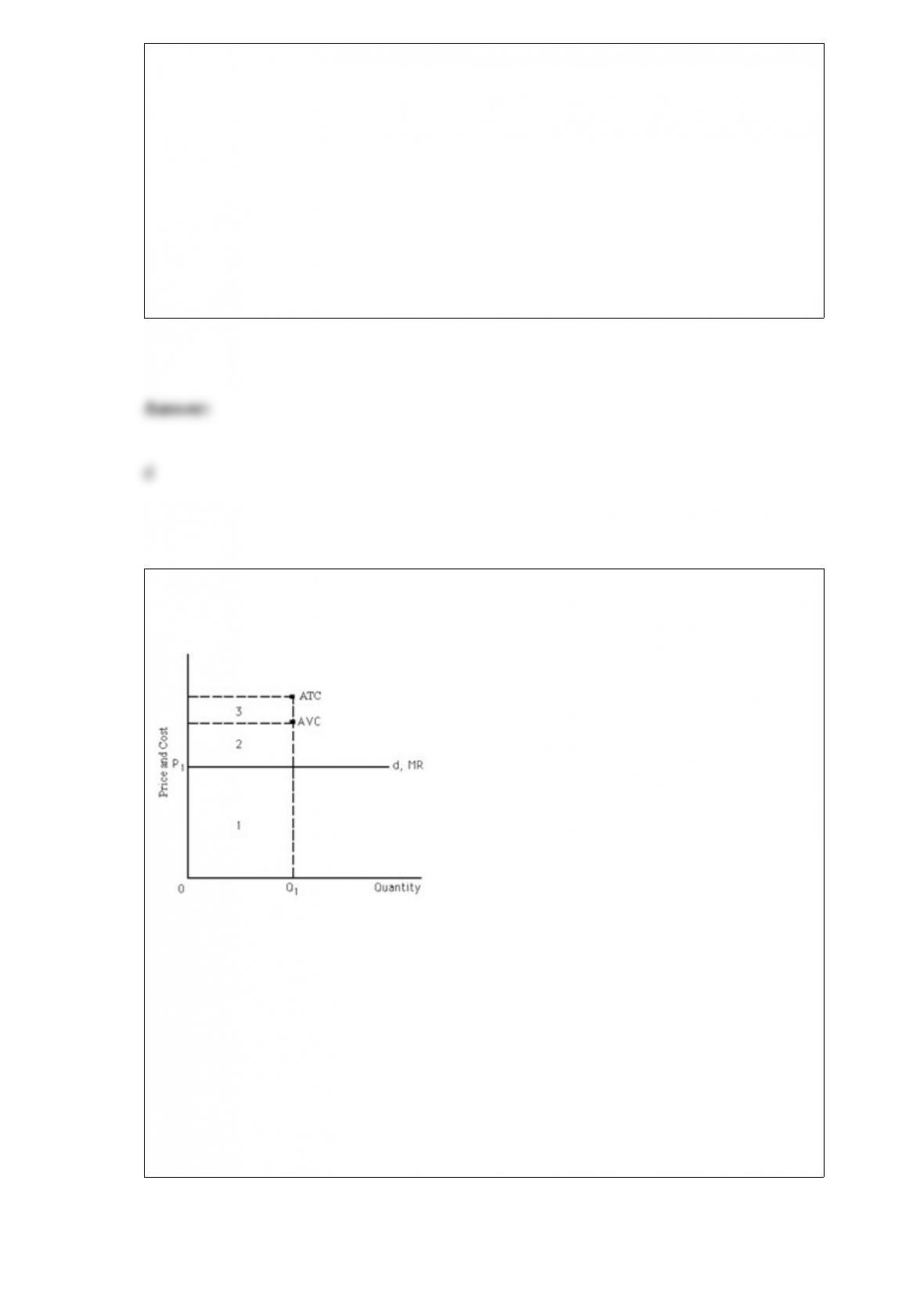
Exhibit 23-4
Where can you find the lowest price that will motivate the firm to produce Q1 in the
short run?
a. at the horizontal line running to “ATC”
b. at the horizontal line running to “AVC”
c. P1
d. $0

Special interest groups are subsets of __________ that hold (usually) intense
preferences for or against a particular government service, activity, or policy.
a. the general population
b. bureaucrats
c. elected officials
d. candidates for political office
e. all of the above
Theory B predicts that everything that happens, happens for a reason – although we may
not know what the reason is.This theory
a. can be refuted.
b. probably cannot be refuted.
c. is a good explanation for what happens.
d. is the kind of theory that scientists like to build because it can explain so much.

Situation 33-1Suppose that the equation that represents the expected benefits of
burglary for a given prospective criminal is as follows:
EB = Ps x Loot
The criminal’s cost equation is as follows:
EC = [Pp x (I + F)] +AC
Where:
EB is the expected benefits of burglary
Ps is the probability of successfully burglarizing a house
Loot is the dollar take from the burglary
EC is the expected costs of burglary
Pp is the probability of imprisonment
I is the income the criminal gives up if caught and imprisoned
F is the dollar value the criminal puts on freedom
AC is the anguish cost of committing a burglary
If the prospective criminal sets the following values:
Ps = 50 percent
Loot = $30,000
Pp = 10 percent
I = $10,000
F = $25,000
AC = $5,000
The prospective criminal’s expected benefit from committing the burglary is
______________ and his expected cost of committing the burglary is
_______________.Economic theory tells us that under these circumstances, the
prospective criminal ______________ commit the burglary.
a. $15,000; $8,500; will
b. $15,000; $8,500; will not
c. $15,000; $40,000; will not

d. $17,500; $12,000; will
Which of the following statements is false?
a. The Dow Jones Industrial Average went down by 40 percent during the decade of the
1930s.
b. Based on data from the period between 1926 and 2004, the probability of having a
positive return on an investment in the stocks contained in the Dow Jones Industrial
Average would have been 97.1 percent if the stocks had been held for 10 years.
c. When reading the stock market page of a newspaper, if the column marked “Div.” is
blank, it means that the company does not currently pay out dividends.
d. A stock that yields 4 percent is better than a stock that yields 5 percent, all else being
the same.
Suppose the marginal utility (MU) of a paperback books is 40 utils and each costs $5
while the MU of a hamburger is 20 utils and each costs $4. If you consume one movie
and buy one hamburger per week, are you attaining consumer equilibrium?
a. Yes, so there is no need to change.
b. No. You need to buy more books and fewer hamburgers.
c. No. You need to buy more hamburgers and fewer books.
d. There is not enough information to answer the question.

Land can earn economic rent, and so can
a. labor and capital.
b. labor.
c. capital.
d. none of the above
Price elasticity of demand is the ratio of the
a. absolute change in quantity demanded to the absolute change in price.
b. absolute change in price to the absolute change in quantity demanded.
c. percentage change in quantity demanded to the percentage change in price.
d. percentage change in price to the percentage change in quantity demanded.

Jose has one evening in which to prepare for two exams and can employ one of two
possible strategies:
The opportunity cost of receiving a 90 on the statistics exam is ___________ points on
the economics exam.
a. 79
b. 17
c. 11
d. 90
If the minimum wage law sets a price floor that is below the equilibrium wage in the
unskilled labor market, the minimum wage will create a shortage of unskilled labor.
a. True
b. False
The terms scarcity and shortage are synonyms.
a. True
b. False

Which of the following statements best represents the law of supply?
a. Price and quantity supplied are inversely related.
b. Price and quantity supplied are directly related.
c. Price and quantity supplied are inversely related, ceteris paribus.
d. Price and quantity supplied are directly related, ceteris paribus.
e. Price and supply are directly related, ceteris paribus.
The effect of a decrease in interest rates upon economic growth is an example of
positive economics.
a. True
b. False
If the percentage change in quantity demanded of a good is equal to the percentage

change in buyer’s income, then the good is said to be
a. income elastic.
b. income inelastic.
c. income unit elastic.
d. price unit elastic.
e. price inelastic.