An economy that grows too slowly fails to raise living standards.
In the United States, the typical person who has lost his or her job finds another one in a
few months except during severe recessions.
The developing countries have been catching up to the lower-income industrial
countries in terms of economic growth.
If a country produces only two goods, then it is not possible to have a comparative
advantage in the production of both those goods.

A surplus occurs when the market price is lower than the equilibrium price.
At the end of an expansion, wages of workers are usually rising faster than prices.
Contractionary monetary policy should increase foreign financial investment in the
United States.
The costs to firms of changing prices are called menu costs.

Transfer payments are subtracted from national income to get to personal income.
There is a shortage of every good that is scarce.
The unemployment rate is higher with a minimum wage law than it would be without a
minimum wage law.
Figure 3-8
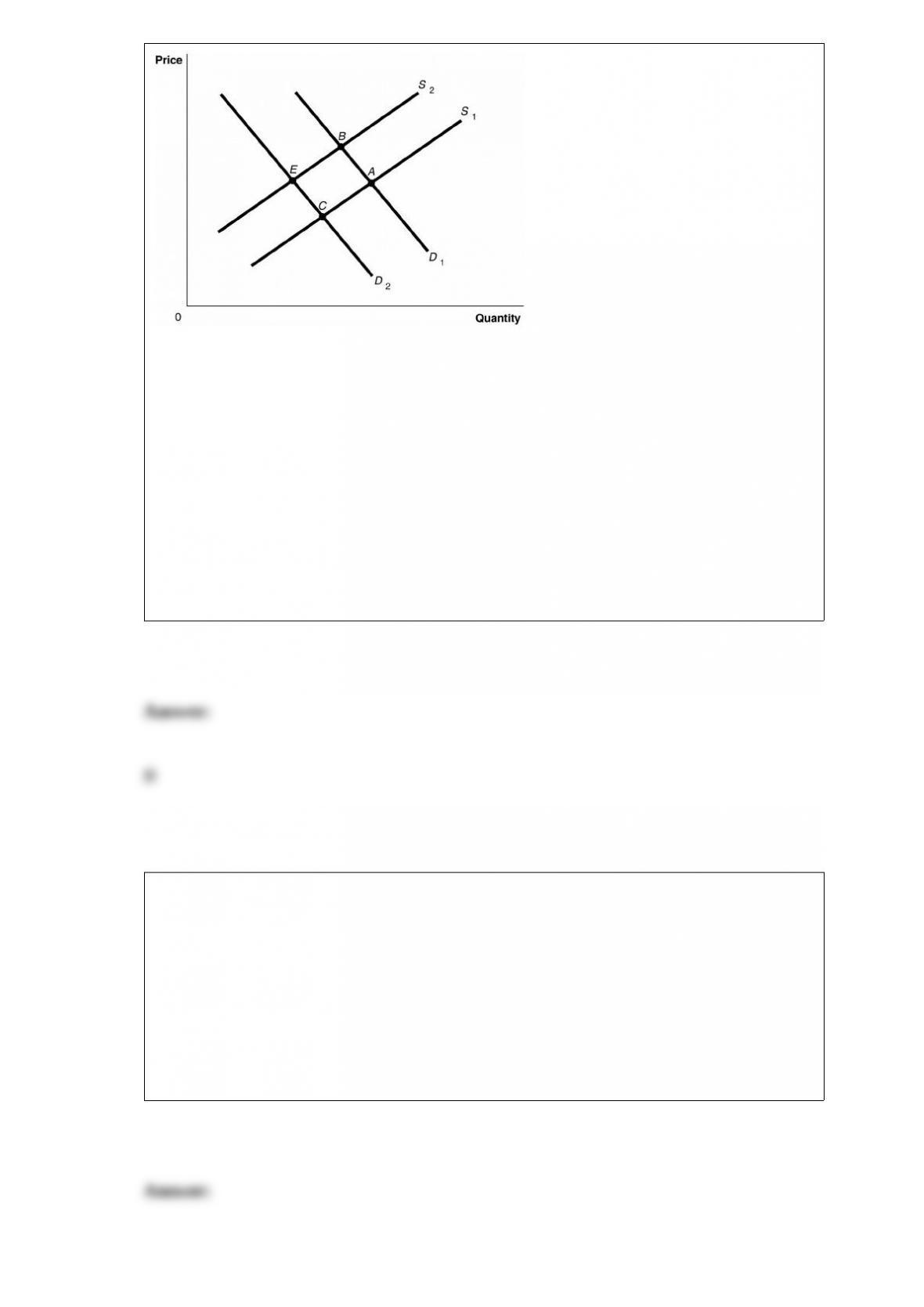
Refer to Figure 3-8. The graph in this figure illustrates an initial competitive
equilibrium in the market for motorcycles at the intersection of D2 and S1 (point C). If
the price of motorcycle side cars (a complement to motorcycles) decreases, and the
wages of motorcycle workers increase, how will the equilibrium point change?
A) The equilibrium point will move from C to E.
B) The equilibrium point will move from C to B.
C) The equilibrium point will move from C to A.
D) The equilibrium will first move from C to A, then return to C.
The real business cycle model focuses on how
A) wage and price stickiness explains fluctuations in real GDP.
B) the labor theory of value is the best measure of value of a good or service.
C) the Federal Reserve should adopt a monetary growth rule.
D) productivity shocks explain fluctuations in real GDP.
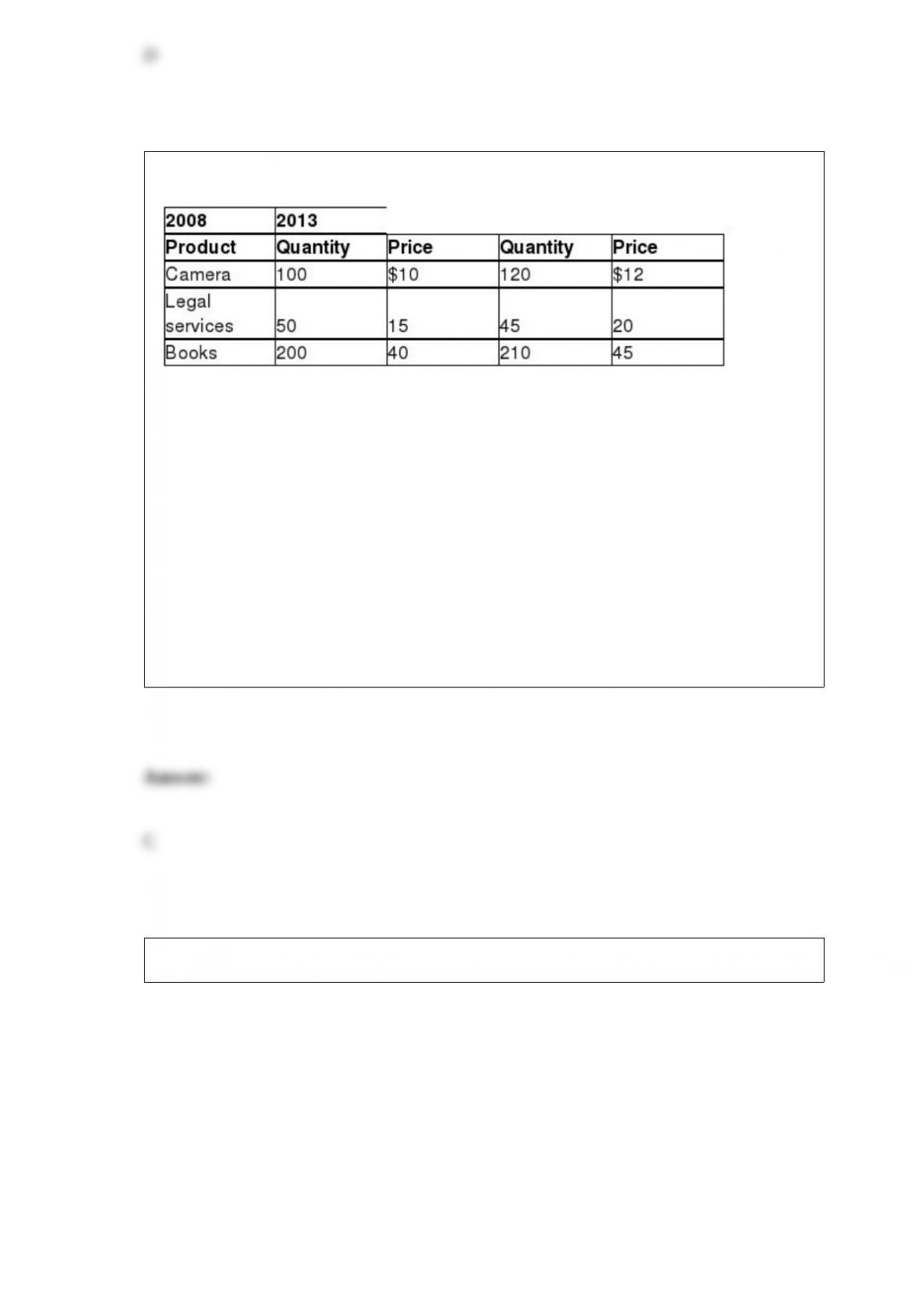
Table 8-18
A very simple economy produces three goods: cameras, legal services, and books. The
quantities produced and their corresponding prices for 2008 and 2013 are shown in the
table above.
Refer to Table 8-18. What is the GDP deflator in 2013 if 2013 is the base year?
A) 120
B) 118
C) 100
D) 87
Figure 16-1
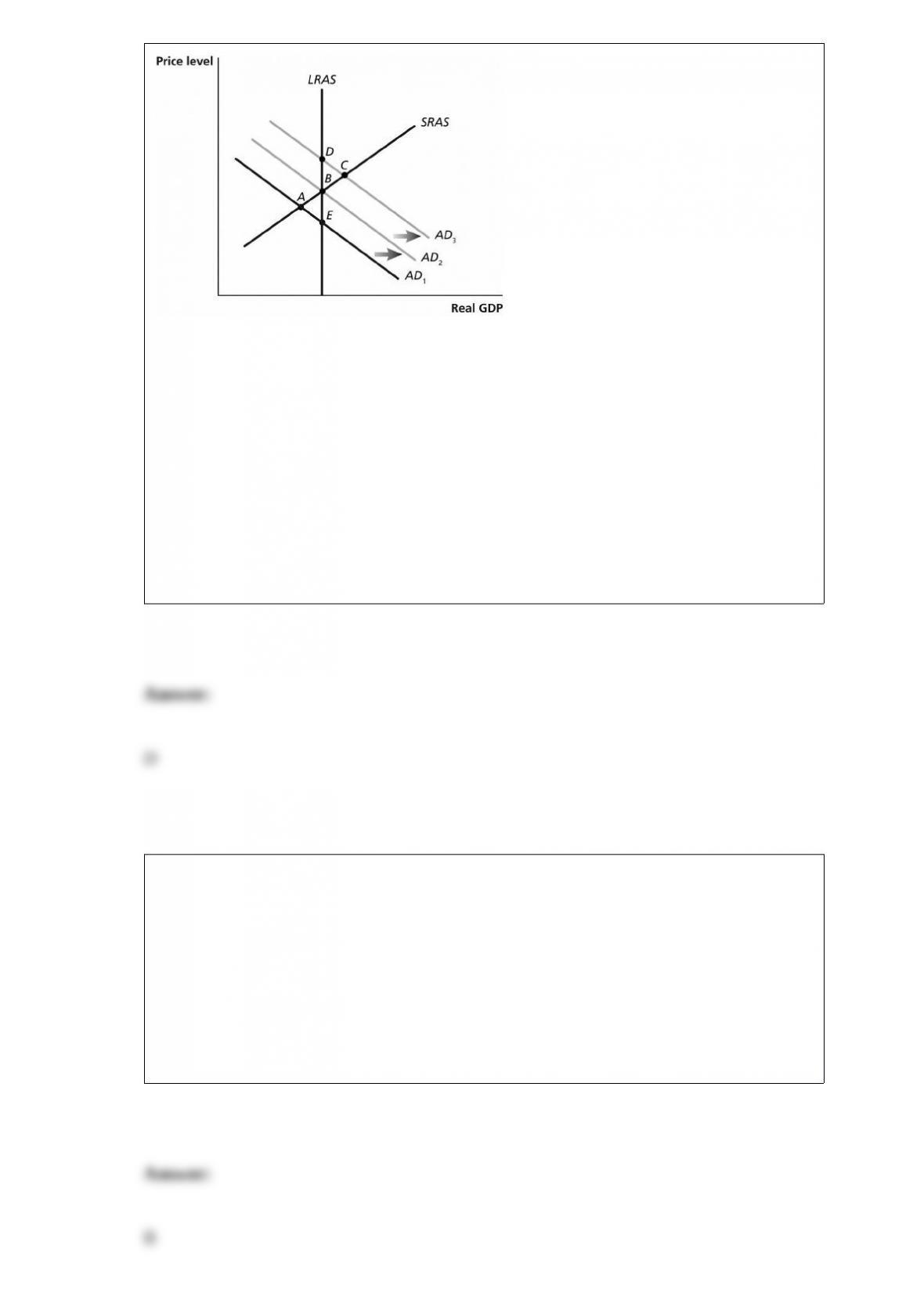
Refer to Figure 16-1. An increase in taxes would be depicted as a movement from
________, using the static AD–AS model in the figure above.
A) E to B
B) B to C
C) A to B
D) B to A
E) C to D
A change in which variable will change the market demand for a product?
A) the price of the product
B) expected future prices
C) the number of firms in the market
D) the quantity supplied of the product
Which of the following leads to an increase in real GDP?
A) a decrease in government spending
B) a decrease in the inflation rate in other countries, relative to the inflation in the
United States
C) a decrease in interest rates
D) Households have increasingly pessimistic expectations about future income.
Table 2-5
Table 2-5 shows the number of labor hours required to produce a cell phone and a board
foot of lumber in Estonia and Finland.
Refer to Table 2-5. What is Estonia’s opportunity cost of producing one cell phone?
A) 0.2 board feet of lumber
B) 5 board feet of lumber
C) 8 board feet of lumber
D) 32 board feet of lumber

When every good or service is produced up to the point where the last unit provides a
marginal benefit to society equal to the marginal cost of producing it, ________ occurs.
A) allocative efficiency
B) productive efficiency
C) equity
D) efficient central planning
Foreign direct investment in the United States declined 42 percent in the first quarter of
2009. This means that
A) people or firms in other countries reduced their purchases of stocks and bonds in the
United States by 42 percent in the first quarter of 2009.
B) people or firms in the United States reduced their purchases of stocks and bonds in
foreign countries by 42 percent in the first quarter of 2009.
C) people or firms in other countries reduced their building of facilities of purchases of
facilities in the United States by 42 percent in the first quarter of 2009.
D) people or firms in the United States reduced their building of facilities or purchases
of facilities in foreign countries by 42 percent in the first quarter of 2009.
Table 4-4
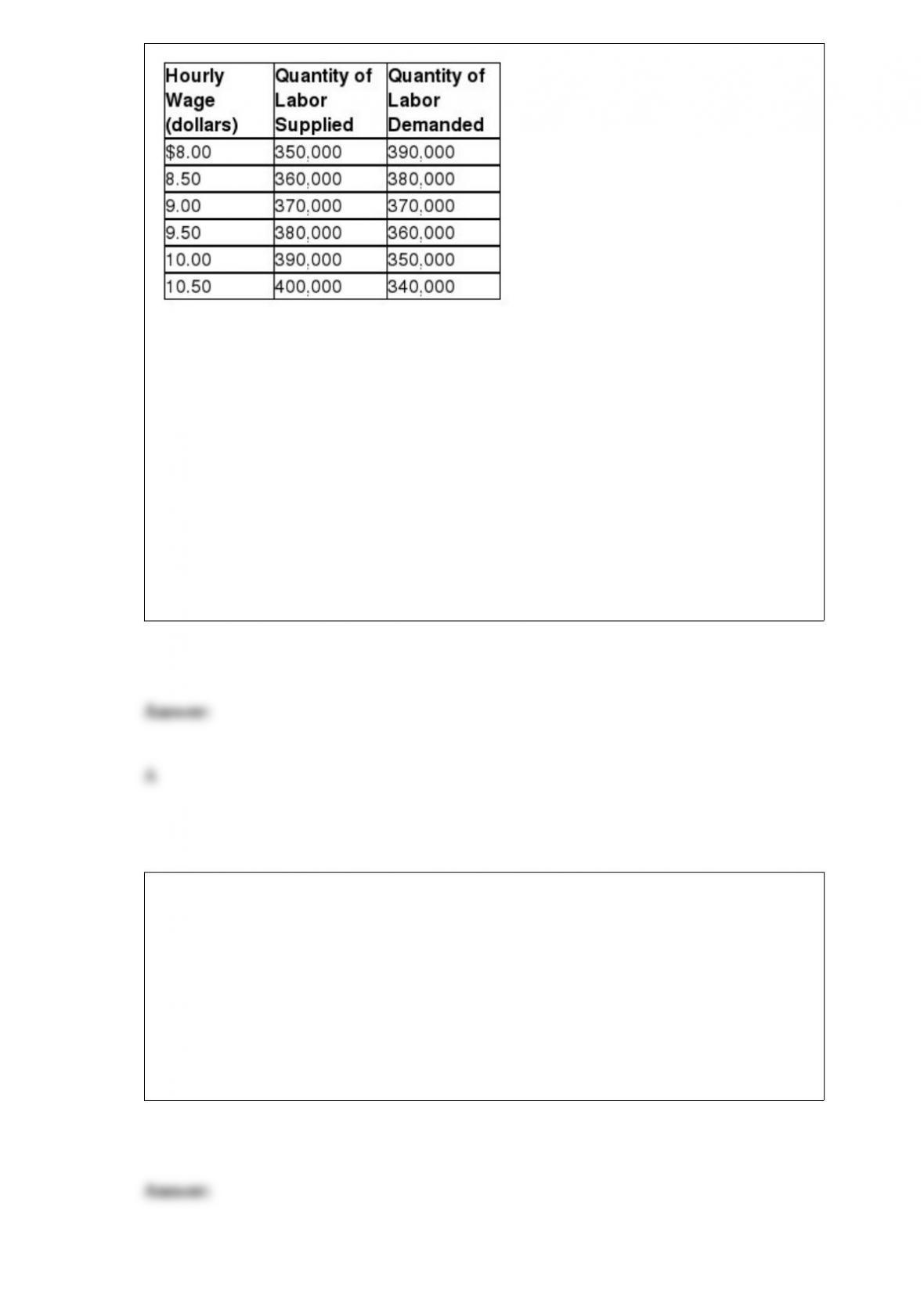
Table 4-4 shows the demand and supply schedules for the low-skilled labor market in
the city of Westover.
Refer to Table 4-4. If a minimum wage of $10.50 an hour is mandated, what is the
quantity of labor supplied?
A) 400,000
B) 370,000
C) 340,000
D) 60,000
As a form of business, a partnership
A) has limited liability.
B) has only one owner.
C) cannot issue stock.
D) has the most government rules and regulations affecting it.

China has developed a comparative advantage in the production of children’s toys. The
source of this comparative advantage is
A) superior process technology.
B) a large supply of unskilled workers and relatively little capital.
C) investment in capital used to produce toys.
D) a large supply of natural resources.
Is the value of U.S. exports is typically larger or smaller than the value of U.S. imports.
Suppose that Federal Reserve policy leads to higher interest rates in the United States.
How will this policy affect real GDP in the short run if the United States is a closed
economy, and how will it affect real GDP in the short run if the United States is an open
economy?
What is the difference between economic efficiency and equity?
What does the phrase “Keynesian revolution” refer to?
What are the advantages of setting up a corporation as opposed to a proprietorship or
partnership?
South Korea, Indonesia, Malaysia, and Thailand all pegged their currencies to the dollar
at one point in time. Because some of these currencies were overvalued at the pegged
rate, speculators anticipated these countries would abandon the peg and speculators
began selling those currencies. Explain how this speculation would affect the ability of
a country to maintain a pegged exchange rate.
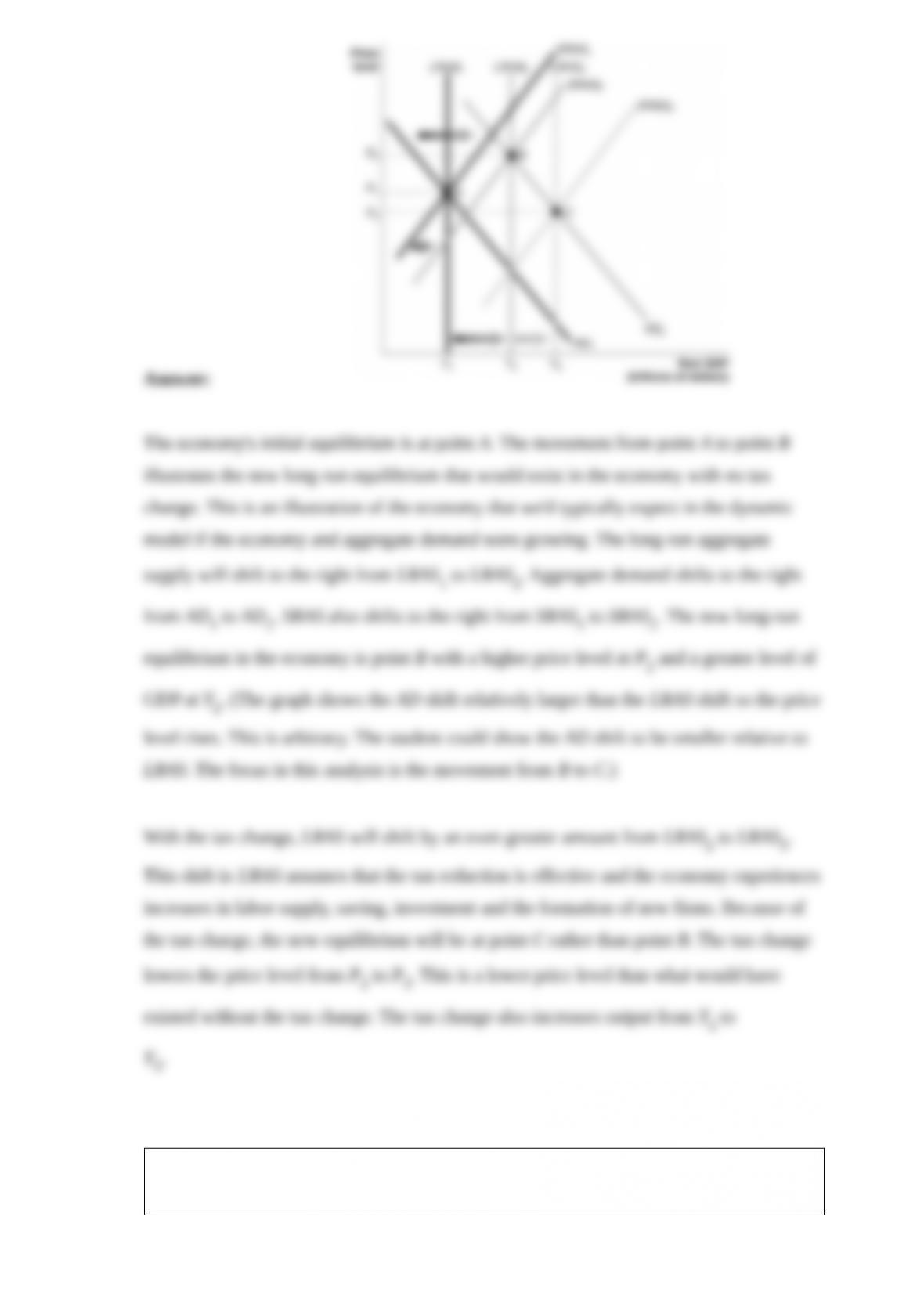
Show the impact of tax reduction and simplification using the dynamic aggregate
demand and aggregate supply model. Clearly show and identify the impact of the tax
change. Assume that aggregate demand and short-run aggregate supply shift as they
typically do in the dynamic model. Show what happens to the price level and real GDP
because of the tax change.
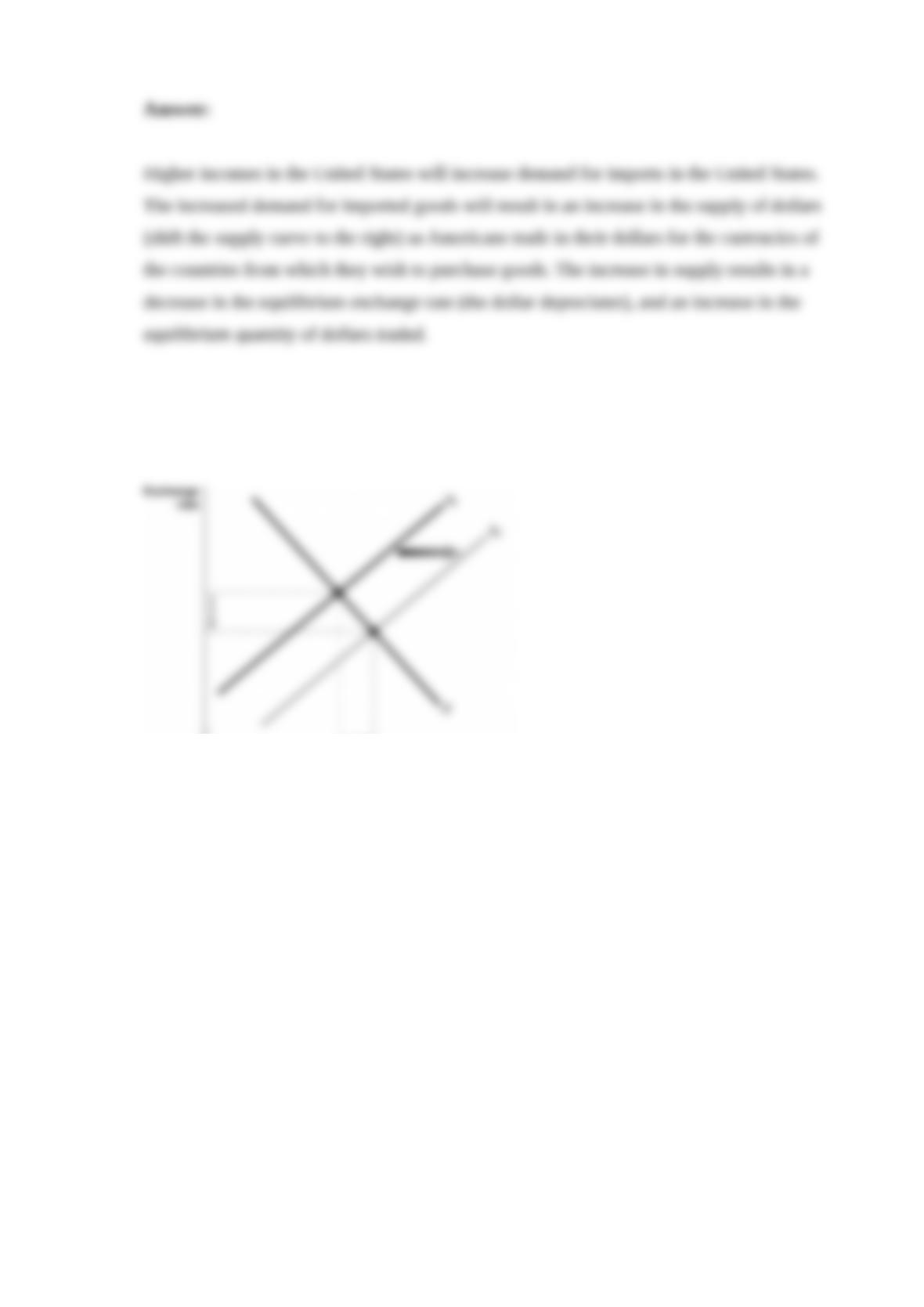
Explain and show graphically how an increase in incomes in the United States will
affect equilibrium in the foreign exchange market?