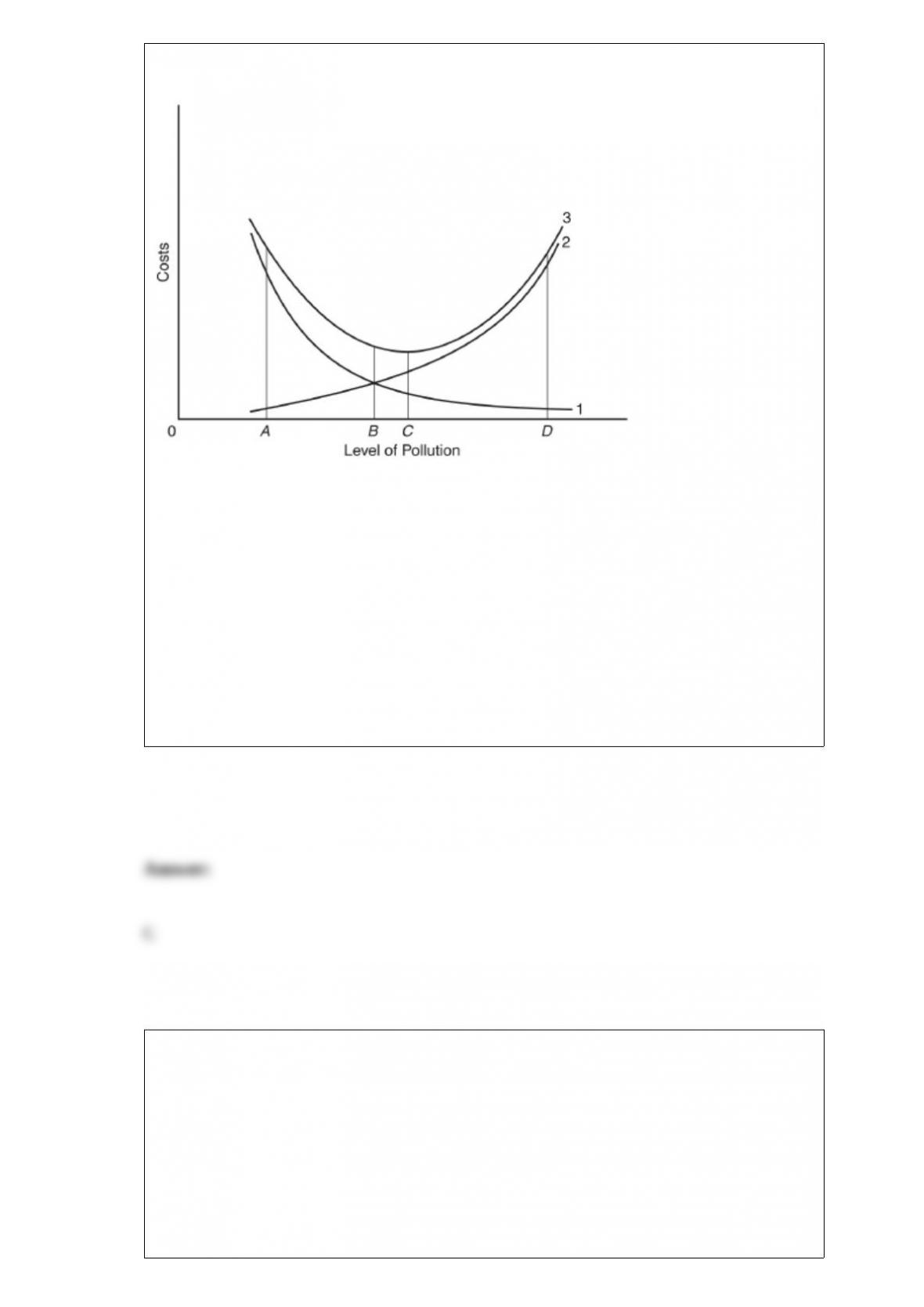
The following questions are based on the following diagram:
Point C represents the
a. highest cost of pollution.
b. average cost of pollution.
c. optimal level of pollution
d. absence of pollution.
e. point where the costs of pollution equal the costs of pollution control.
Supply-side inflation
a. generally occurs during periods of full employment of both human and capital
resources.
b. shifts the aggregate supply curve downward to the right.
c. causes the prices of important inputs to fall.
d. is caused by large decreases in the money supply.
e. reflects, in part, the market power of labor unions and large corporations.
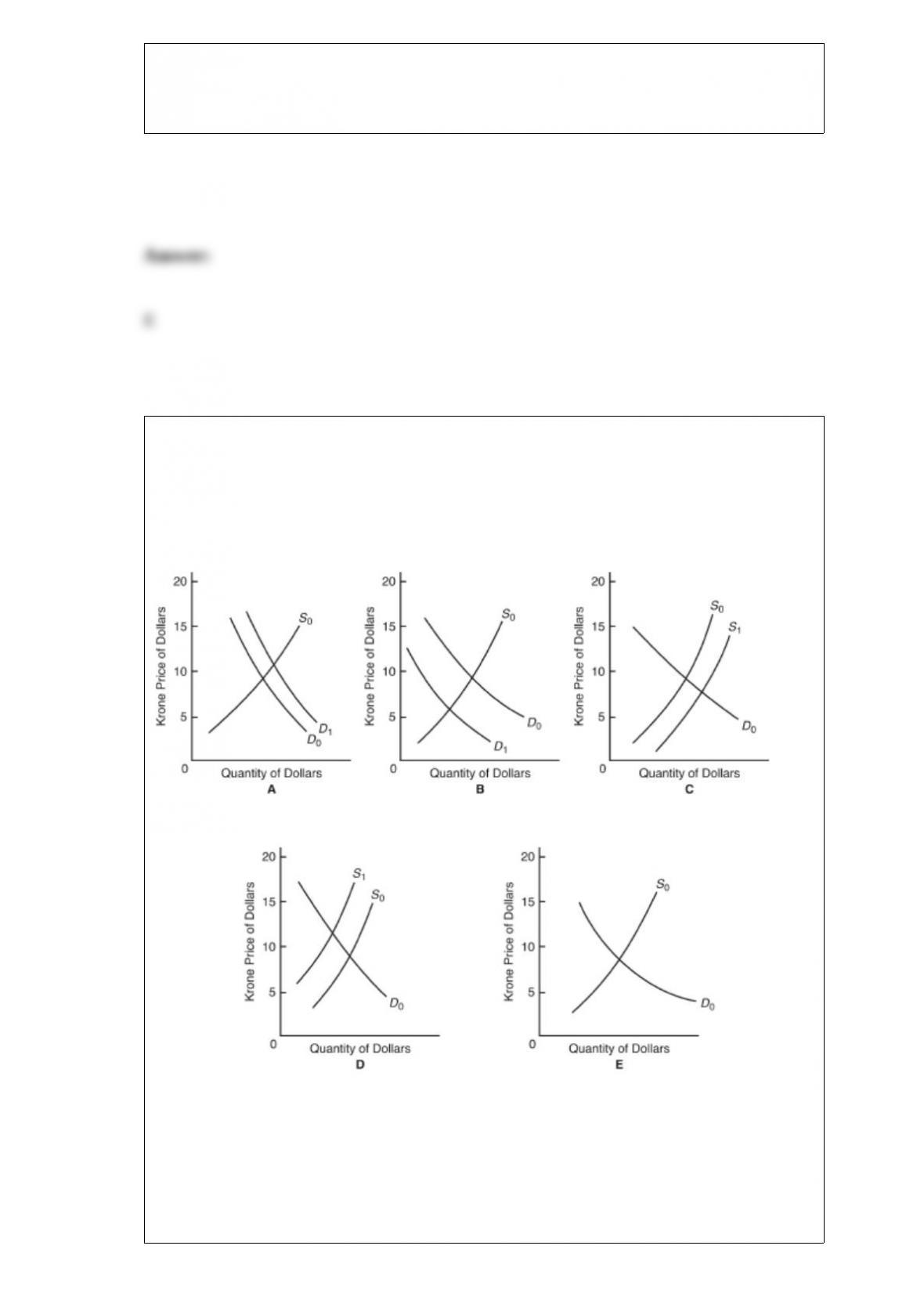
The following questions are based on the following diagrams, showing the demand and
supply of U.S. dollars in terms of Danish krone. For all cases D0 and S0 are initial
demand and supply and D1 and S1 are new demand and supply. Assume an initial
exchange rate of 9 krone to $1.
Which diagram best reflects the effect of a decrease in U.S. tourism in Denmark?
a. A
b. B

c. C
d. D
e. E
The sensitivity of the quantity demanded to the total money income of consumers in a
market is measured by the ________ elasticity of demand.
a. income
b. price
c. cross
d. equilibrium
e. arc
The size of the structural deficit tells us
a. what increase to expect in the actual deficit over the next fiscal period.
b. what relative impact current fiscal policy is having on the economy.
c. what size tax increase is needed to balance the budget.

d. the best way to finance the current deficit.
e. how much of the budget should be financed by borrowing and how much by raising
taxes.
Which of the following is the best example of capital?
a. mineral deposits
b. human effort
c. buildings and equipment that contribute to production
d. accounts receivable
e. goods and services purchased by households for their enjoyment
The following questions are based on the following information: The country has a
fractional-reserve banking system, required reserves are 12.5 percent of demand
deposits, each bank initially has reserves exactly equal to the required amount, each
wants to maintain this equality, and no person withdraws cash from the banking system.
After this process has worked its way through the banking system, the initial excess
reserves in bank A will have led to an additional increase in the money supply of
a. $8,750.
b. $10,000.
c. $17,500.
d. $70,000.
e. $80,000.
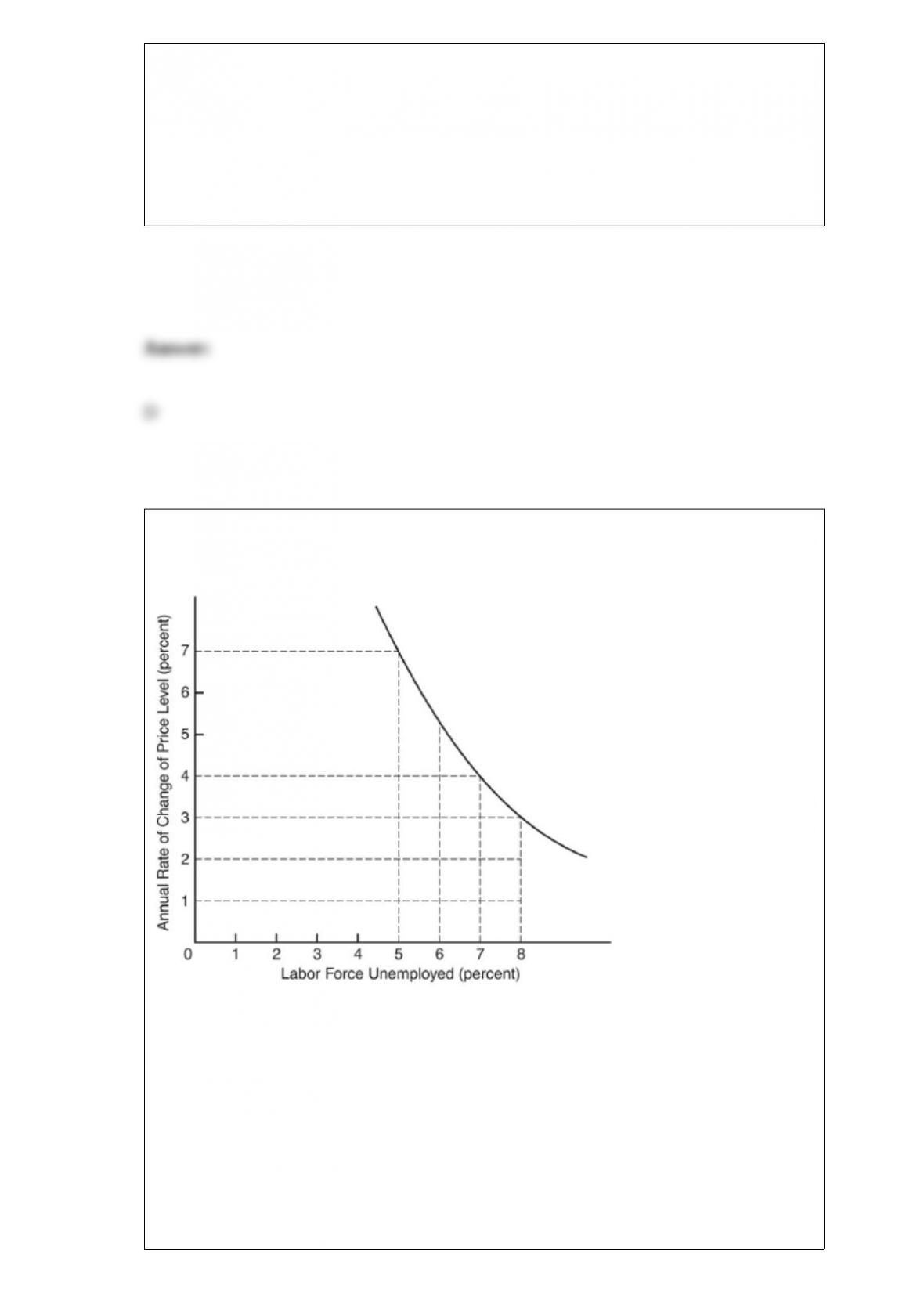
The following questions are based on the following graph, which shows the relationship
between price levels and unemployment:
If the rate of unemployment is 5 percent, the annual rate of change in prices is
________ percent.
a. 7
b. 4
c. 3
d. 2

e. 1
If the permanent annual rate of return on an asset that costs $20,000 is 8 percent, then
each year the owner of the asset will earn
a. $20,000.
b. $16,000.
c. $4,000.
d. $1,600.
e. $800.
The Fed’s freedom to control the supply of money and interest rates unhampered by
constraints of the U.S. Treasury was the principle result of the
a. Federal Reserve Act of 1913.
b. Full Employment Act of 1946.
c. Taft-Hartley Act of 1947.
d. Accord of 1951.

e. Humphrey-Hawkins Act of 1978.
When evaluating the usefulness of an economic model, one should check to see
whether the model
a. is consistent with models in other social sciences.
b. is based on assumptions that are all close replicas of reality.
c. is intelligible to the average layperson.
d. predicts more accurately than any other model.
e. can be tested under carefully controlled conditions.
Determination of the price of labor under perfect competition is based on the
assumption that
a. labor is the sole input in the production process.
b. buyers of labor are output maximizers.
c. prices of inputs and outputs are taken by firms as given.
d. the supply curve of labor slopes upward.
e. all occupations are equally desirable.

Changes in the legal reserve requirements
a. change the amount of Federal Deposit Insurance Corporation insurance.
b. must be approved by Congress.
c. change the amount of demand deposits the banking system can support.
d. change the discount rate.
e. usually have no effect on the money supply.
Comparisons of year-to-year changes in the current dollar value of output can be
misleading because
a. nonmarket transactions are included.
b. intermediate goods are excluded.
c. nonproductive transactions are added to changes in production costs.
d. secondhand goods are excluded.
e. they reflect changes in both prices and output.

One strategy consistent with the new classical macroeconomists’ theories would have
a. fiscal policy focus on maintaining full employment regardless of the size of the
resulting budget deficit.
b. monetary policy stick to an announced policy to keep the rate of inflation to some
specified low figure.
c. the government emphasize policies of wage and price controls to achieve a targeted
full-employment rate with stable prices.
d. monetary authorities impose a structure of variable tax rates that automatically
adjusts to changes in the unemployment rate.
e. both fiscal and monetary policy coordinated in a way that ensures that both the
Phillips curve and long-run aggregate supply curves are vertical.
If the demand for cigarettes is price inelastic
a. people will pay any price to smoke.
b. an increase in the price of cigarettes would have no effect on the quantity demanded
of cigarettes.
c. a fall in cigarette prices would reduce people’s expenditures for cigarettes.
d. a decrease in the price of cigarettes would decrease the demand for cigarettes.
e. as the price is reduced, the percentage increase in quantity demanded must be greater
than the percentage decrease in price.

A monopolist seeking to maximize total profits will
a. maximize profit per unit.
b. minimize cost per unit.
c. charge the highest possible price.
d. set price equal to average total cost.
e. set marginal cost equal to marginal revenue.
Low or negative income elasticities of demand indicate that the items are
a. luxuries.
b. necessities.
c. unrelated.
d. substitutes.
e. complements.
The 12 Federal Reserve banks
a. hold the deposits of member banks and make loans to them.
b. are all located in Washington, DC, but serve different districts throughout the
country.
c. are all headed by members of the Federal Open Market Committee.
d. carry out policies dictated by the Treasury Department.
e. hold about 73 percent of the nation’s demand deposits.
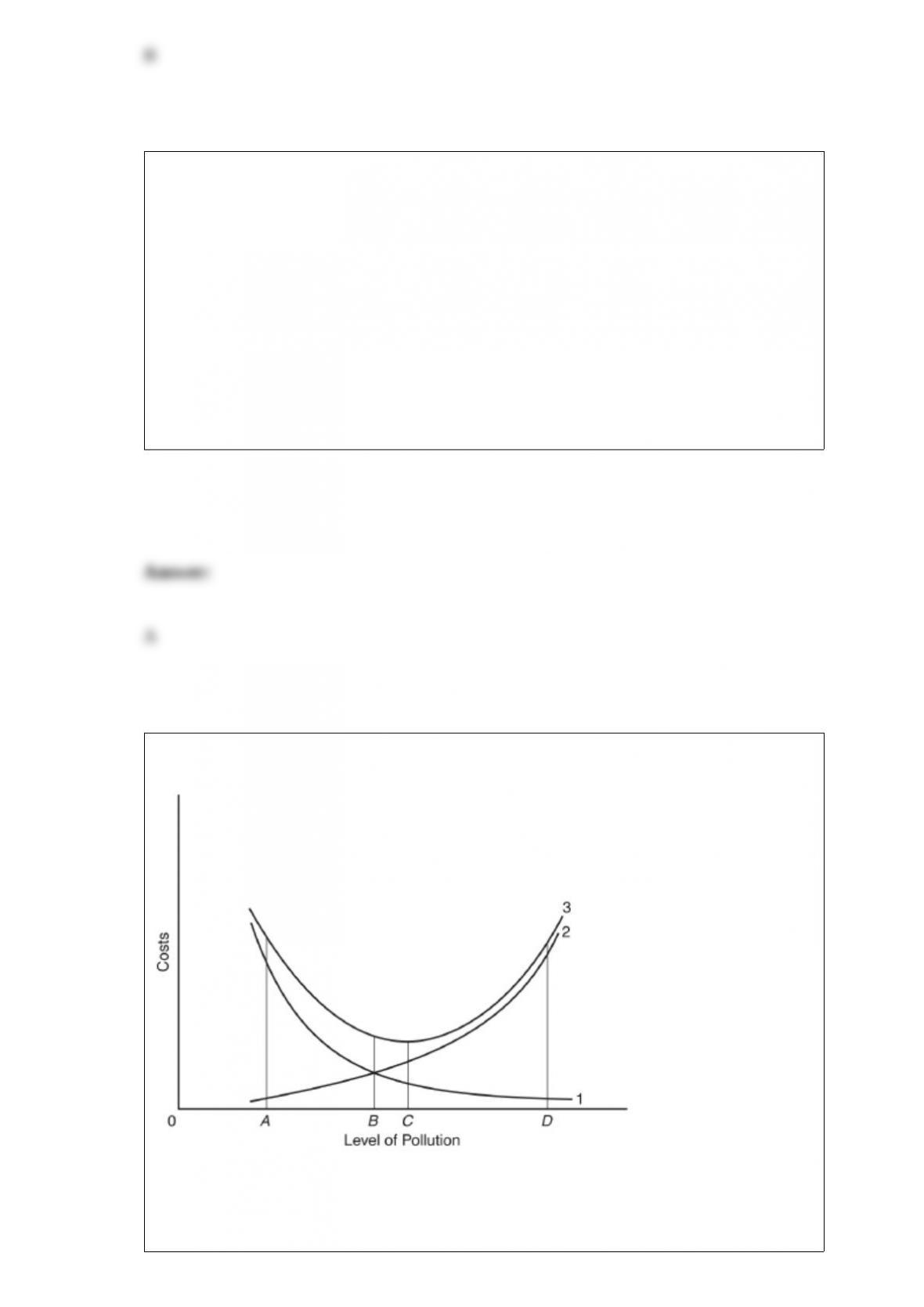
The following questions are based on the following diagram:
It costs society more to allow pollution to take place than it does to reduce pollution in
the range

a. 0A.
b. AB.
c. AC.
d. BC.
e. CD.
Which of the following most likely leads to an increase in the quantity demanded?
a. an increase in price
b. a decrease in the price of a substitute good
c. a decrease in income
d. an increase in supply
e. an increase in the cost of production
If the capital-output ratio is three, the full-employment GDP is $5,100 billion, and
intended investment is $750 billion, then a $60 billion increase in intended investment
will increase full-employment GDP by ________ billion.
a. $250

b. $180
c. $60
d. $50
e. $20
If output determines income and income determines spending
a. an equilibrium is impossible in the economy.
b. intended spending and actual spending are always equal.
c. the C + I line is the same as the 45-degree line.
d. the levels of both national output and prices rise indefinitely.
e. the level of GDP changes unless intended spending equals GDP.
The value of an asset such as a bond will rise when
a. interest rates rise.
b. interest rates fall.

c. the price of bonds falls.
d. the supply of loanable funds decreases.
e. the demand for loanable funds increases.
Which set of characteristics best identifies an oligopoly market?
a. many firms, homogeneous product, significant barriers to entry, significant nonprice
competition, and considerable power over price
b. few firms, differentiated product, no barriers to entry, the absence of nonprice
competition, and considerable advertising
c. one firm producing a product with no close substitutes, significant barriers to entry,
and considerable power over price
d. many firms, differentiated product, few barriers to entry, and nonprice competition
e. few firms, differentiated product, significant barriers to entry, and significant
amounts of nonprice competition
The process of accommodation by the Fed typically means it is following a(n)
________ money policy.
a. tight

b. easy
c. selective
d. fiscal
e. open
When the total amount spent on a commodity remains unchanged as price is raised or
lowered, demand is said to be
a. of absolute elasticity.
b. income inelastic.
c. of unitary elasticity.
d. price inelastic.
e. price elastic.
The following questions are based on the following diagrams, showing the demand and
supply of U.S. dollars in terms of Danish krone. For all cases D0 and S0 are initial
demand and supply and D1 and S1 are new demand and supply. Assume an initial
exchange rate of 9 krone to $1.
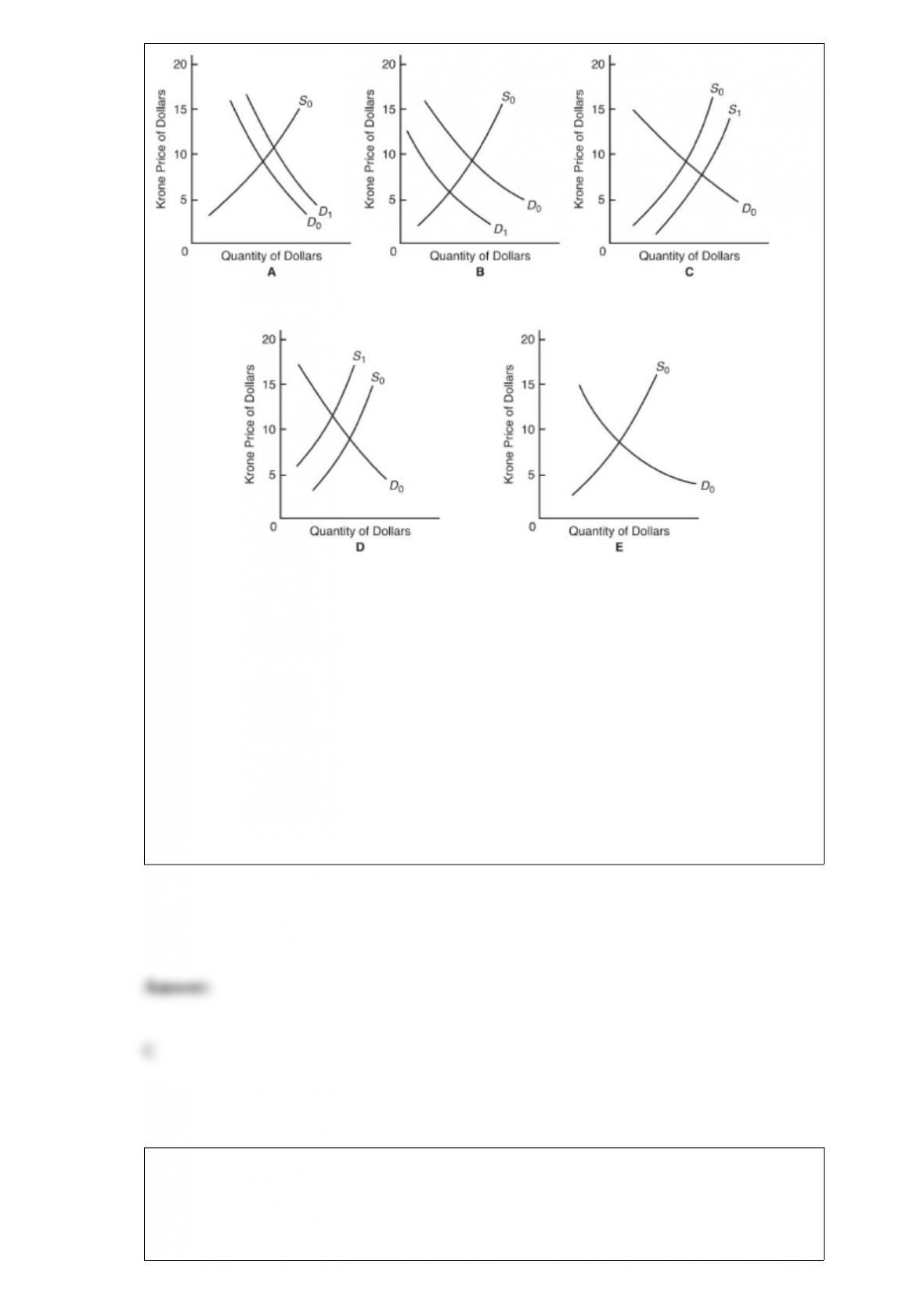
Which diagram best illustrates the effect of an increase in the U.S. demand for Danish
cheese and cookware?
a. A
b. B
c. C
d. D
e. E
When computing GDP, services performed by the government are
a. excluded.

b. considered nonproductive transactions.
c. valued at their cost to the taxpayer.
d. given values estimated from similar activities in the private sector.
e. added to government transfer payments.
The existence of noncompeting groups and other occupational differences in labor
markets means that
a. homogeneous, competitive labor markets are possible in the short run.
b. the government must step in to ensure that enough people enter unskilled
occupations.
c. the market demand curves for all labor groups are highly price inelastic.
d. wage differentials will tend to persist over time.
e. wages have little or no effect on the supply curves of labor.
The intersection of the horizontal and vertical axes of a graph is called the
a. equilibrium.
b. origin.

c. elbow.
d. solution.
e. nib.
When measuring GDP, we double count if we include the value of
a. government expenditures. d. nonproductive transactions.
b. intermediate goods. e. net exports.
c. nonmarket transactions.
The Industrial Revolution was characterized by
a. significant declines in society’s saving rates.
b. rapid increases in the growth rate of population relative to output.
c. falling standards of living for the majority of society.
d. considerable increases in capital.
e. a decline in technology.