
1) Noncompeting groups of workers are the result of:
A.differences in the age-earnings profiles of workers.
B.differences in the “job tastes” of workers.
C.differences in the innate and acquired abilities of workers.
D.geographic immobilities.
2) net exports are:
a.that portion of consumption and investment goods sent to other countries.
b.exports plus imports.
c.exports less imports.
d.imports less exports.
3) The foreign purchases effect suggests that an increase in the U.S. price level relative
to other countries will:
A.increase the amount of U.S. real output purchased.
B.increase U.S. imports and decrease U.S. exports.
C.increase both U.S. imports and U.S. exports.
D.decrease both U.S. imports and U.S. exports.
4) we would expect:
a.the demand for coca-cola to be less elastic than the demand for soft drinks in general.
b.the demand for coca-cola to be more elastic than the demand for soft drinks in
general.
c.no relationship between the elasticity of demand for coca-cola and the elasticity of
demand for soft drinks in general.
d.none of these to hold true.
5) The equality-efficiency tradeoff best describes the:
A.tradeoff between a lower benefit-reduction rate and a higher break-even level of
income maintenance plans.
B.failure to include noncash benefits in calculating the poverty rate.
C.inequities in Temporary Assistance for Needy Households benefits among the various
states.
D.the choice between “more equality and less output” and “less equality and more
output.”
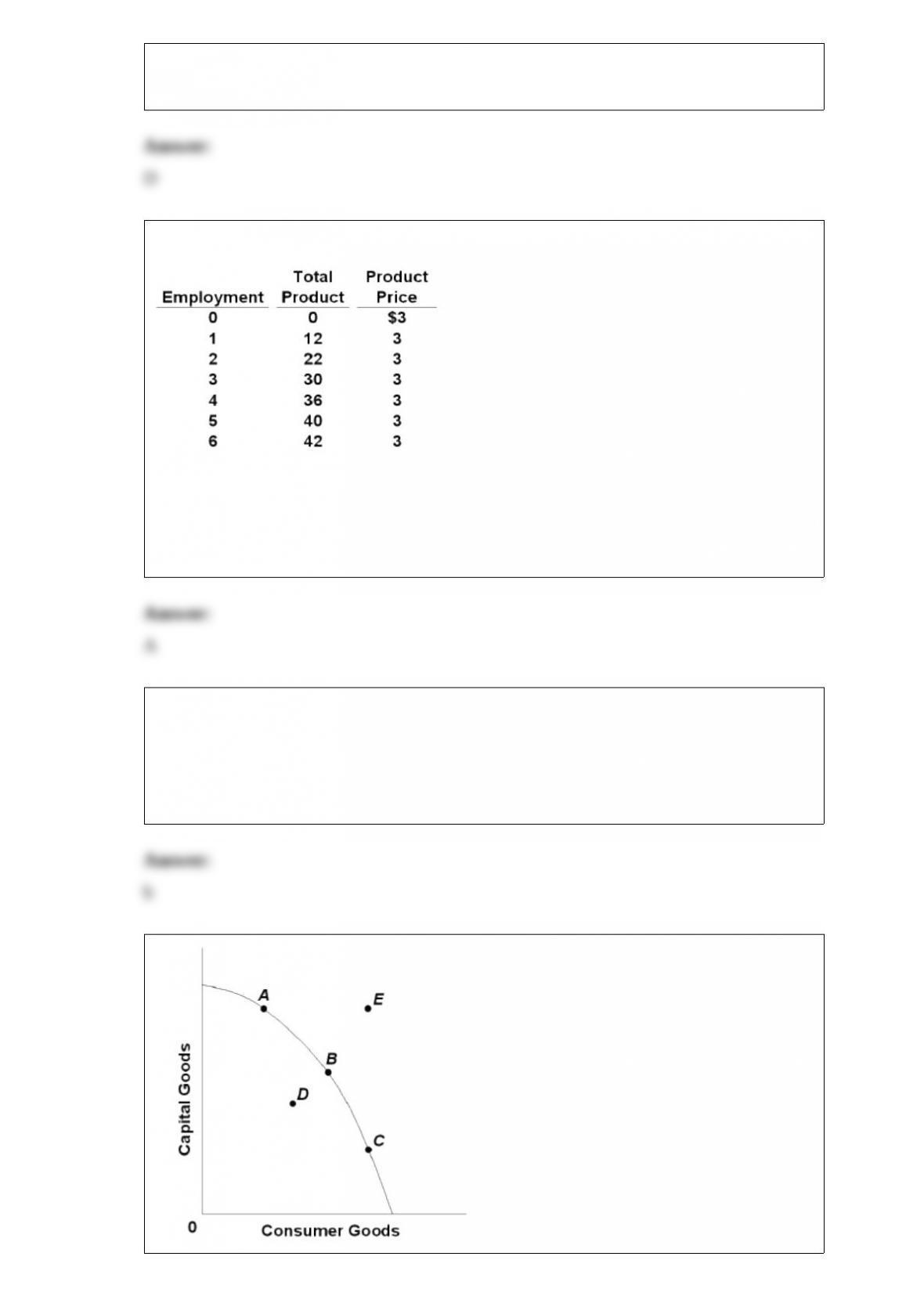
6)
Refer to the above data. This firm is:
A.selling its product in a purely competitive market.
B.selling its product in an imperfectly competitive market.
C.hiring workers in a purely competitive market.
D.hiring workers in an imperfectly competitive market.
7) the production possibilities curve has:
a.a positive slope that increases as we move along it from left to right.
b.a negative slope that increases as we move along it from left to right.
c.a negative slope that decreases as we move along it from left to right.
d.a negative slope that is constant as we move along it from left to right.
8)
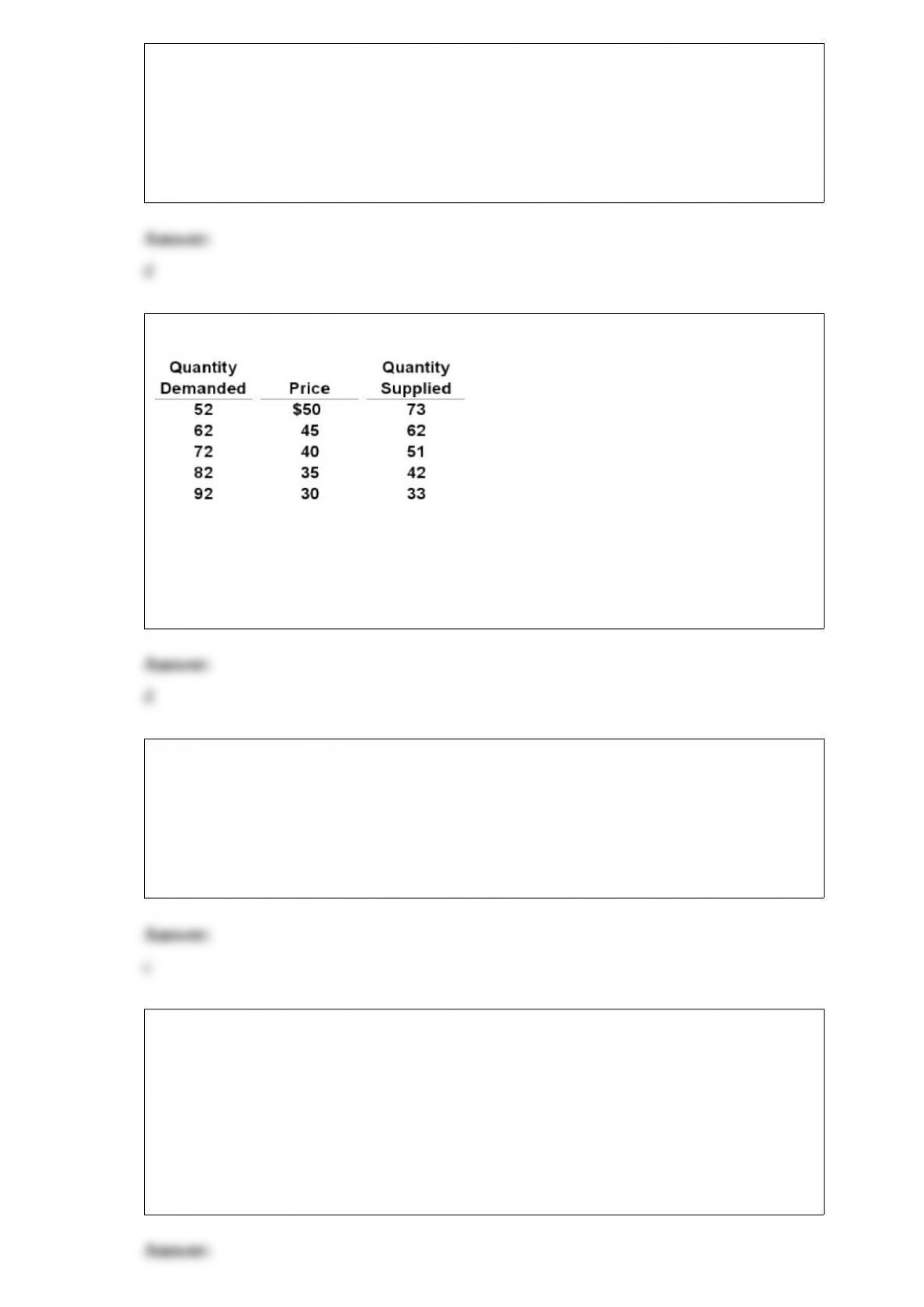
refer to the above diagram. other things equal, this economy will achieve the most rapid
rate of growth if:
a.the ratio of capital to consumer goods is minimized.
b.it chooses point c.
c.it chooses point b.
d.it chooses point a.
9) government-set prices
if government set a maximum price of $45 in the above market:
a.a shortage of 21 units would arise.
b.a surplus of 21 units would arise.
c.a surplus of 40 units would arise.
d.it would create neither a shortage nor a surplus.
10) all else equal, depreciation of the mexican peso relative to the u.s. dollar would
make a trip by:
a.an american to mexico more expensive.
b.a mexican to the united states less expensive.
c.an american to mexico less expensive.
d.an australian to the united states more expensive.
11) noncash gifts:
a.increase the utility of recipients by introducing them to products they have not
consumed before.
b.reduce recipient utility relative to a cash gift because noncash gifts often fail to match
recipient preferences.
c.entail as much utility as do cash gifts.
d.increase the utility of recipients because many people are uncertain of their own
preferences.

12) suppose that a fully-employed economy produces only two goods, hamburgers and
flat-panel tvs. if the economy is currently producing more than the optimal quantity of
hamburgers, then to attain the optimal allocation of resources it should:
a.produce more hamburgers and fewer tvs.
b.produce more tvs and fewer hamburgers.
c.produce more of both goods.
d.produce fewer of both goods.