
If MPPX/PX > MPPY/PY, the firm should buy
a. more of factor X and less of factor Y.
b. less of factor X and more of factor Y.
c. more of factor Y and the same amount of factor X.
d. less of factor X and factor Y.
e. more of factor X and factor Y.
A single-price monopolist
a. must lower price on all previous units to sell an additional unit of output.
b. is a price taker.
c. finds that its marginal revenue and price are the same for the first unit of the good it
sells.
d. necessarily faces a perfectly inelastic demand curve.
e. a and c
In the market for a given product, when a price floor is set above the equilibrium price
the result will be
a. more exchanges made in the market.
b. an increase in the supply of the product.
c. a decrease in the demand for the product.
d. a deadweight loss.
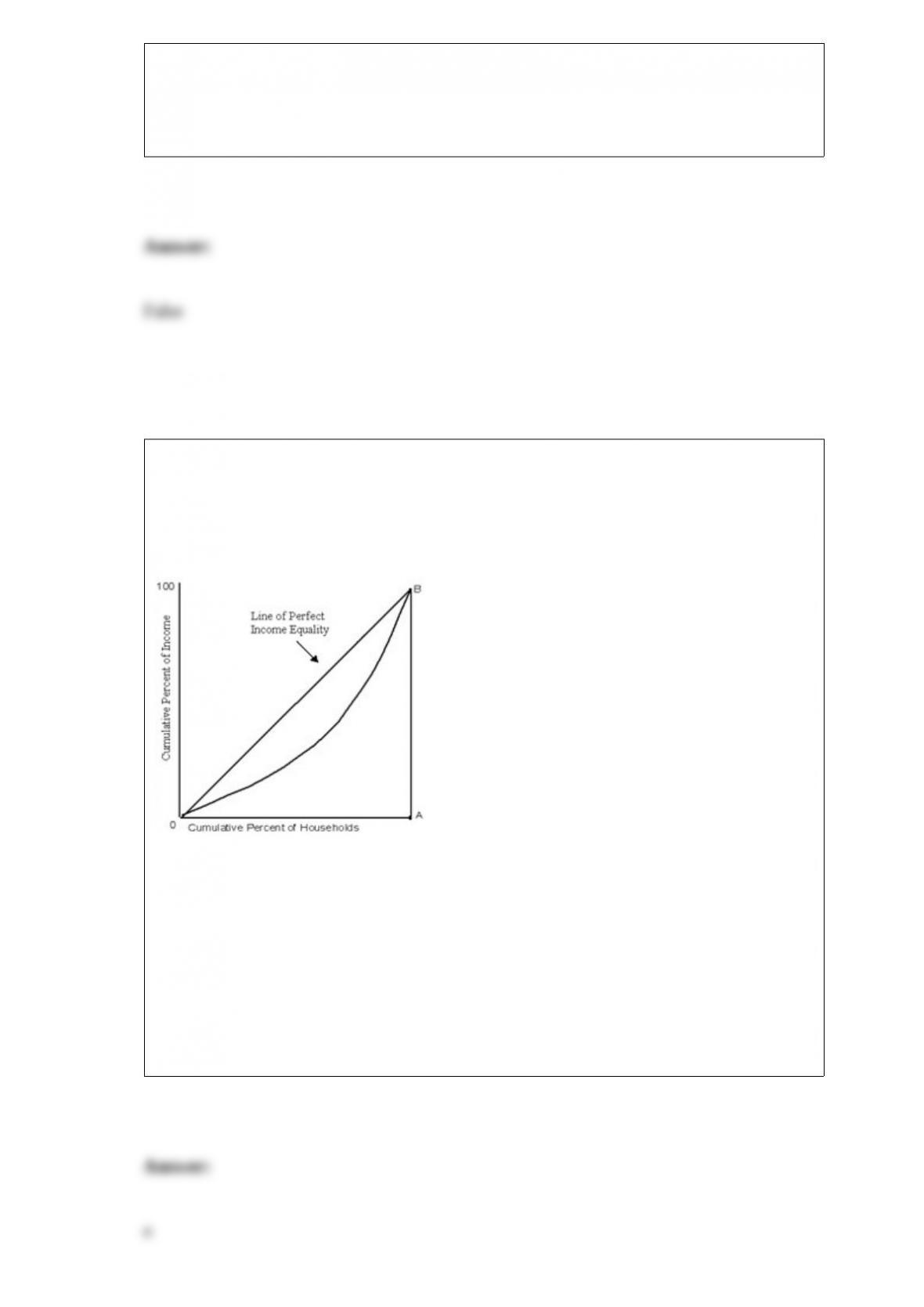
Refer to Exhibit 3-2. Suppose equilibrium is at point A. Something then changes and
equilibrium becomes point C. Which of the following is consistent with the change in
equilibrium from point A to C (assuming that good X is a normal good)?
Exhibit 3-2
Good X a. There was a decrease in the number of buyers and business taxes increased.
b. There was an increase in the number of buyers and business taxes decreased.
c. There was an increase in the number of buyers and business taxes increased.
d. There was a decrease in the number of buyers and business taxes decreased.

According to public choice theorists, the behavior of people employed in the public
sector is likely to differ from the behavior of people employed in the private sector
because
a. the two sectors are likely to attract people of different psychological profiles.
b. government employees are likely to exhibit more civic responsibility than
private-sector employees.
c. the same objective to maximize one’s net benefit will produce different behavior in
different institutional settings.
d. all of the above
e. a and b
The price elasticity of demand for many agricultural products is (absolute value) less
than 1, meaning that these products are inelastic in demand.
a. True
b. False
If Dan’s marginal utility from eating one apple is 100 utils and Jorge’s marginal utility
from eating one apple is 200 utils, it follows that Jorge likes apples more than Dan,
assuming that Dan and Jorge measure the marginal utility of apples in exactly the same
way.
a. True
b. False
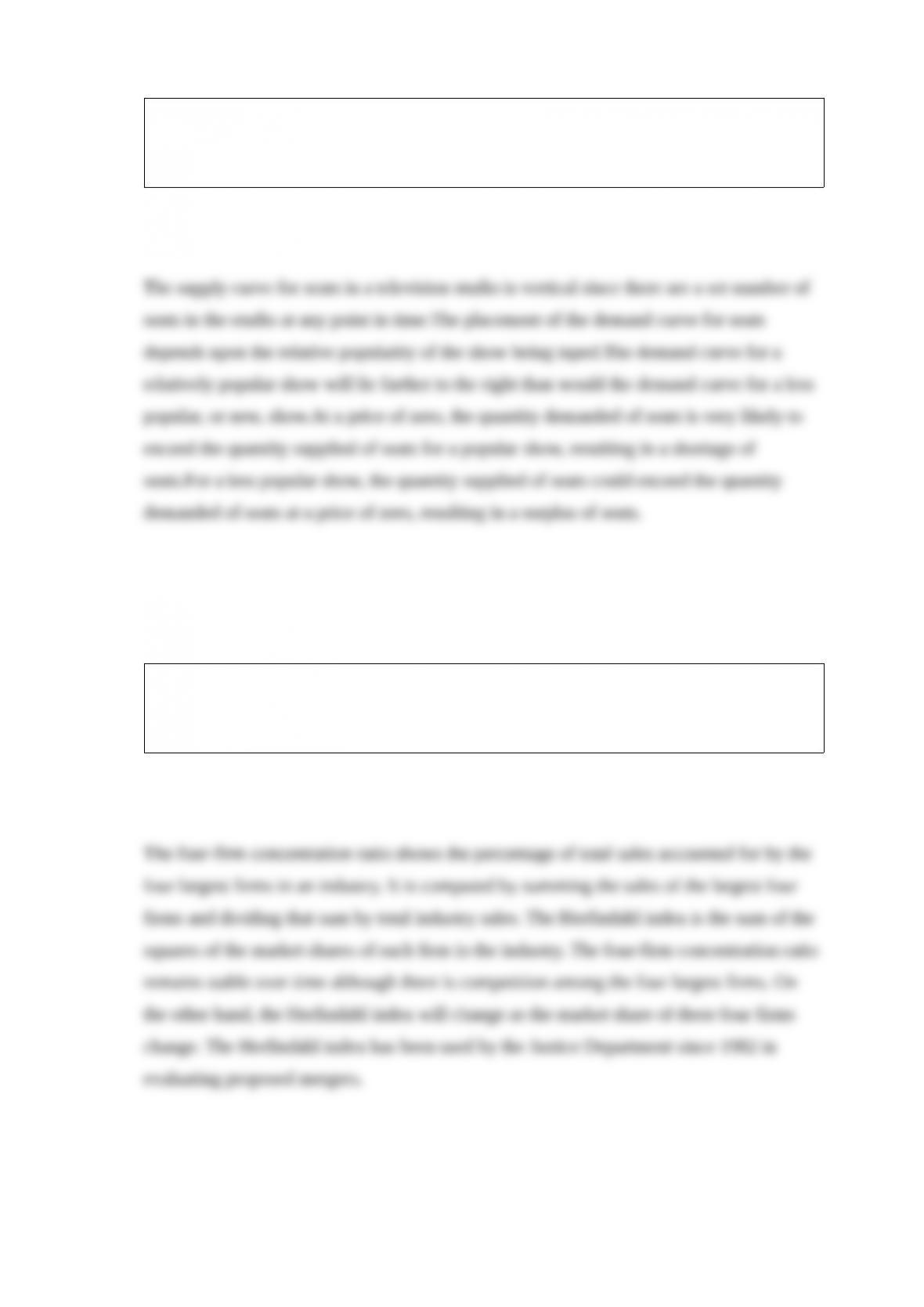
Refer to Exhibit 29-1. If the Gini coefficient equals 1, then the Lorenz curve is
Exhibit 29-1
a. point B.
b. line OB.
c. the horizontal axis from 0 to A.
d. line AB.
e. the horizontal axis from 0 to A and the line AB.

Marginal social costs are equal to
a. marginal private costs + external costs.
b. marginal private costs – external costs.
c. marginal private costs + internal costs.
d. marginal private costs – internal costs.
The vertical distance between the AVC and ATC curves is equal to
a. marginal cost.
b. average fixed cost.
c. accounting profit.
d. economic profit.
e. none of the above

Supply-restricting policies are intended to __________ prices and __________ farmers’
revenues.
a. lower; increase
b. lower; reduce
c. raise; increase
d. raise; reduce
If there is an increase in the amount of good B foregone as every additional unit of good
A is produced, the PPF between goods A and B would
a. be a straight line.
b. be a bowed-outward curve.
c. be a bowed-inward curve.
d. not exist.
If the demand curve for agricultural products is inelastic and farmers as a group become
more productive, then prices of agricultural goods will __________ and total revenue
earned by farmers will __________.
a. decrease; increase
b. decrease; decrease

c. increase; increase
d. increase; decrease
e. We cannot answer this question without knowing how inelastic the demand curve is.
The primary intent of antitrust legislation is to
a. ensure that product safety standards are met.
b. eliminate positive economic profits.
c. eliminate price discrimination.
d. control monopoly power and preserve and promote competition.
e. all of the above
Asymmetric information can exist before, but not after, a transaction.
a. True
b. False

A perfectly competitive firm will continue to hire more factor units as long as
a. MRP > MFC.
b. VMP > MFC.
c. MRP > VMP.
d. VMP = MFC.
e. a and b
Describe the difference between positive and normative economics. Cite an example of
each.
Using supply and demand analysis, explain why there is sometimes a surplus of seats to
watch a television show being taped and other times there is a shortage of such
seats.Assume that tickets to view the taping of a television show are free of charge.
How does the four-firm concentration ratio differ from the Herfindahl index?Which one
does the Justice Department currently rely on when evaluating whether or not a
proposed merger should be permitted?
Describe at least three of the key concepts in economics introduced in Chapter 1 of the
textbook that define how an economist views the world.
Identify and describe each step of thefive-step process outlined in the textbook for
building and testing theories.