
A firm’s labor demand curve is derived from the supply of the goods and services it
produces.
If the Federal Reserve sells a $2,000 bond to a bond dealer who pays with a check
written on an account at Second National Bank, what changes will occur on the bank’s
balance sheet after the check clears?
a. Reserves and total assets will increase by $2,000; demand deposits and total
liabilities will decrease by $2,000.
b. Reserves, demand deposits, total assets, and total liabilities will all increase by
$2,000.
c. Reserves and total assets will decrease by $2,000; demand deposits and total
liabilities will increase by $2,000.
d. Reserves, demand deposits, total assets, and total liabilities will all decrease by
$2,000.
e. Reserves will decrease by $2,000; demand deposits, total assets, and total liabilities
will all increase by $2,000.
What is creeping inflation?
a. Inflation that continues to rise but slowly.
b. Inflation that suddenly appears without warning.
c. Price levels that suddenly rise without warning.
d. Price levels that continue to rise but slowly.
e. Inflation that suddenly appears and creates panic.

Suppose you observed that at the same time employment increased, wages fell. Which
of the following is a possible explanation for this observation?
a. An increase in labor demand
b. A decrease in labor demand
c. An increase in labor demand that was outpaced by an increase in labor supply
d. A decrease in labor supply
e. Cannot be determined from the available information
At present, what is the approximate natural rate of unemployment in the United States?
a. 4.5 percent
b. 5.5 percent
c. 7 percent
d. 8.5 percent
e. 2.5 percent
Refer to Figure 9-6. Starting from a balanced budget, the government runs a budget
deficit of $200 billion. Investment spending will
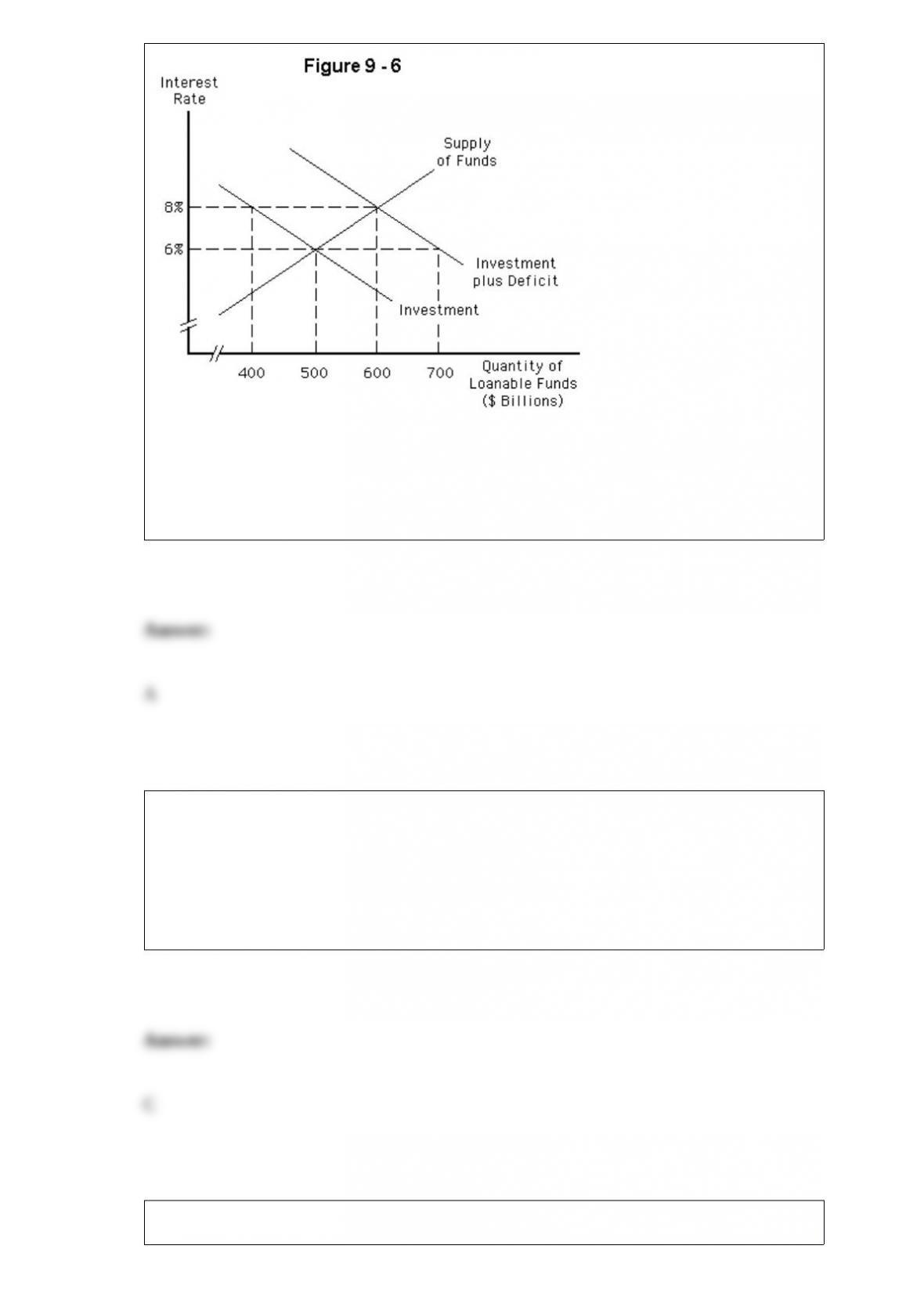
a. decrease by $100 billion
b. decrease by $200 billion
c. increase by $100 billion
d. increase by $200 billion
e. not be affected by government budget deficit
If there is an excess demand for money in the economy,
a. there is also an excess supply of money.
b. there is also an excess demand for bonds.
c. there is also an excess supply of bonds.
d. the interest rate will fall.
e. there is also an excess supply of housing.
A local store noticed that when it increased the price of milk from $2.50 to $3.50 per
gallon, it sold 33% less milk. Since everything else remained the same, we would say
the
If autonomous consumption decreases, which of the following would occur in the short
run?
a. a decrease in GDP, a decrease in the price level, a decrease in money demand and a
decrease in the interest rate.
b. an increase in GDP, an increase in the price level, an increase in money demand and
an increase in the interest rate.
c. a decrease in GDP, an increase in the price level, an increase in money demand and
an increase in the interest rate.
d. an increase in GDP, a decrease in the price level, a decrease in money demand and an
increase in the interest rate.
e. a decrease in GDP, a decrease in the price level, an increase in money demand and an
increase in the interest rate.
In monopolistic competition, product differentiation causes

Of the four major market structures, perfect competition is the best at achieving
economic efficiency.
If the Fed sells bonds, we should expect to see the money supply
a. decrease, the interest rate increase, autonomous consumption decrease, business
investment decrease, and real GDP decrease
b. increase, the interest rate decrease, autonomous consumption decrease, business
investment decrease, and real GDP decrease
c. increase, the interest rate decrease, autonomous consumption increase, business
investment increase, and real GDP increase
d. decrease, the interest rate decrease, autonomous consumption increase, business
investment increase, and real GDP decrease
e. decrease, the interest rate increase, autonomous consumption increase, business
investment increase, and real GDP increase
Production involving a positive externality is inefficient.
Which of the following statements about quotas is correct?
a. They benefit domestic consumers through lower prices.
b. They benefit domestic producers through higher prices.
c. They raise world output.
d. They cause outward shifts in the domestic and foreign production possibilities
frontiers.
e. They benefit domestic producers through increased competition that stimulates
innovation.
One macroeconomic goal is to achieve an unemployment rate of zero.