
Mortgages issued to borrowers whose credit histories include failures to make payments
on bills are known as ________ mortgages.
A) catastrophic
B) variable rate
C) subprime
D) Alt-A
If the price of train tickets decreases, what will be the impact in the market for bus
travel ?
A) The demand curve for bus travel shifts to the right.
B) The quantity of bus travel demanded increases.
C) The demand curve for bus travel shifts to the left.
D) The quantity of bus travel demanded decreases.
The revenue received from the sale of an additional unit of a product
A) is a marginal benefit to the firm.
B) is called profit.
C) is called gross sales.

D) is called a net gain.
Which of the following statements about an entrepreneur is false?
A) organizes the other factors of production into a working unit
B) develops the vision for the firm and funds the producing unit
C) sells his entrepreneurial services in the output market
D) risks the personal funds provided
The additional cost to a firm of producing one more unit of a good or service is the
A) minimum cost.
B) total cost.
C) opportunity cost.
D) marginal cost.
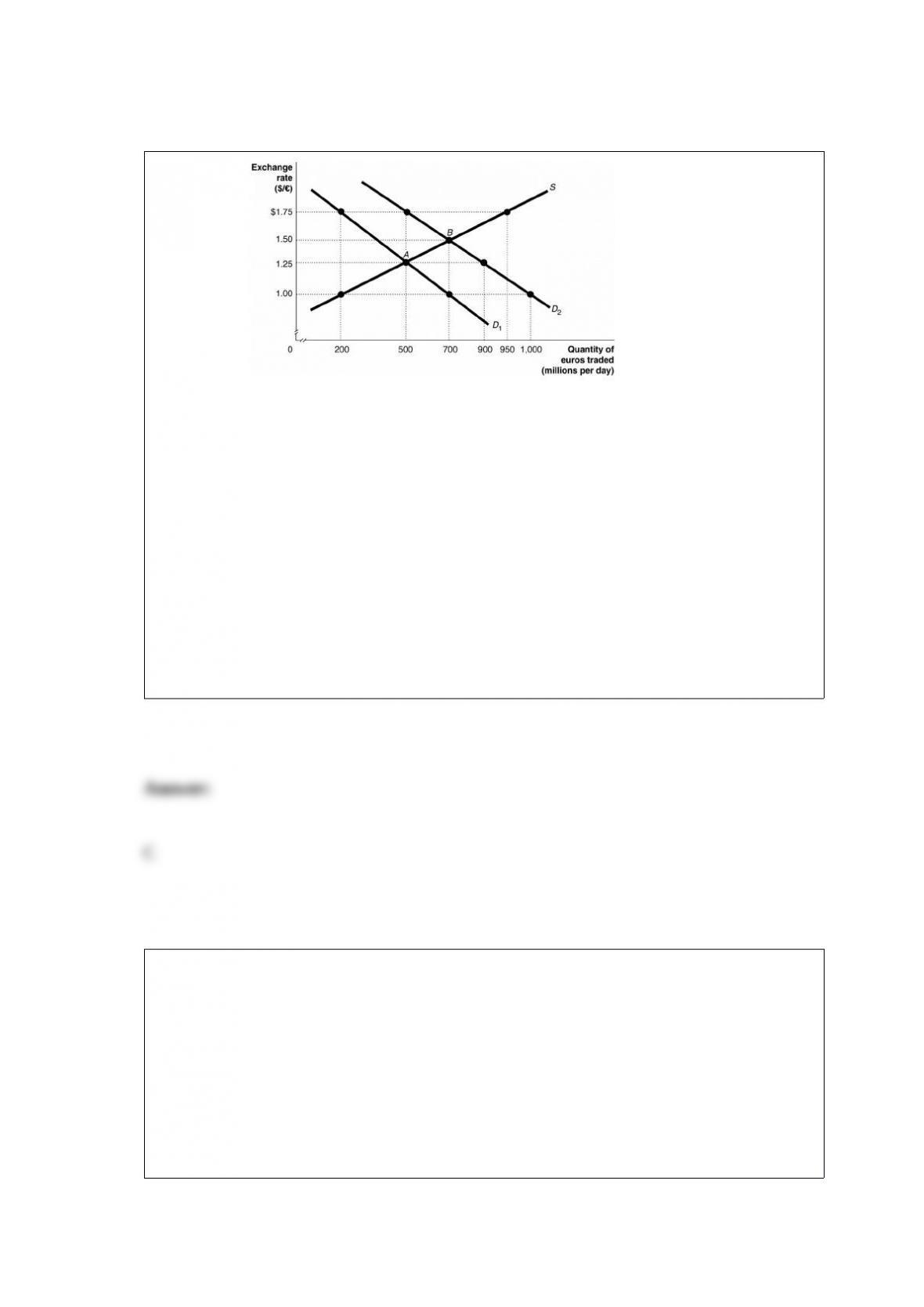
Figure 30-8
The equilibrium exchange rate is originally at A, $1.25/euro. Suppose the European
Central Bank pegs its currency at $1.00/euro. Speculators expect that the value of the
euro will rise and this shifts the demand curve for euro to D2. If the European Central
Bank abandons the peg, the equilibrium exchange rate would be
A) $1.00/euro.
B) $1.25/euro.
C) $1.50/euro.
D) $1.75/euro.
Equilibrium GDP is equal to
A) autonomous expenditure times the marginal propensity to consume.
B) autonomous expenditure times the marginal propensity to save.
C) autonomous expenditure times the multiplier.
D) autonomous expenditure.
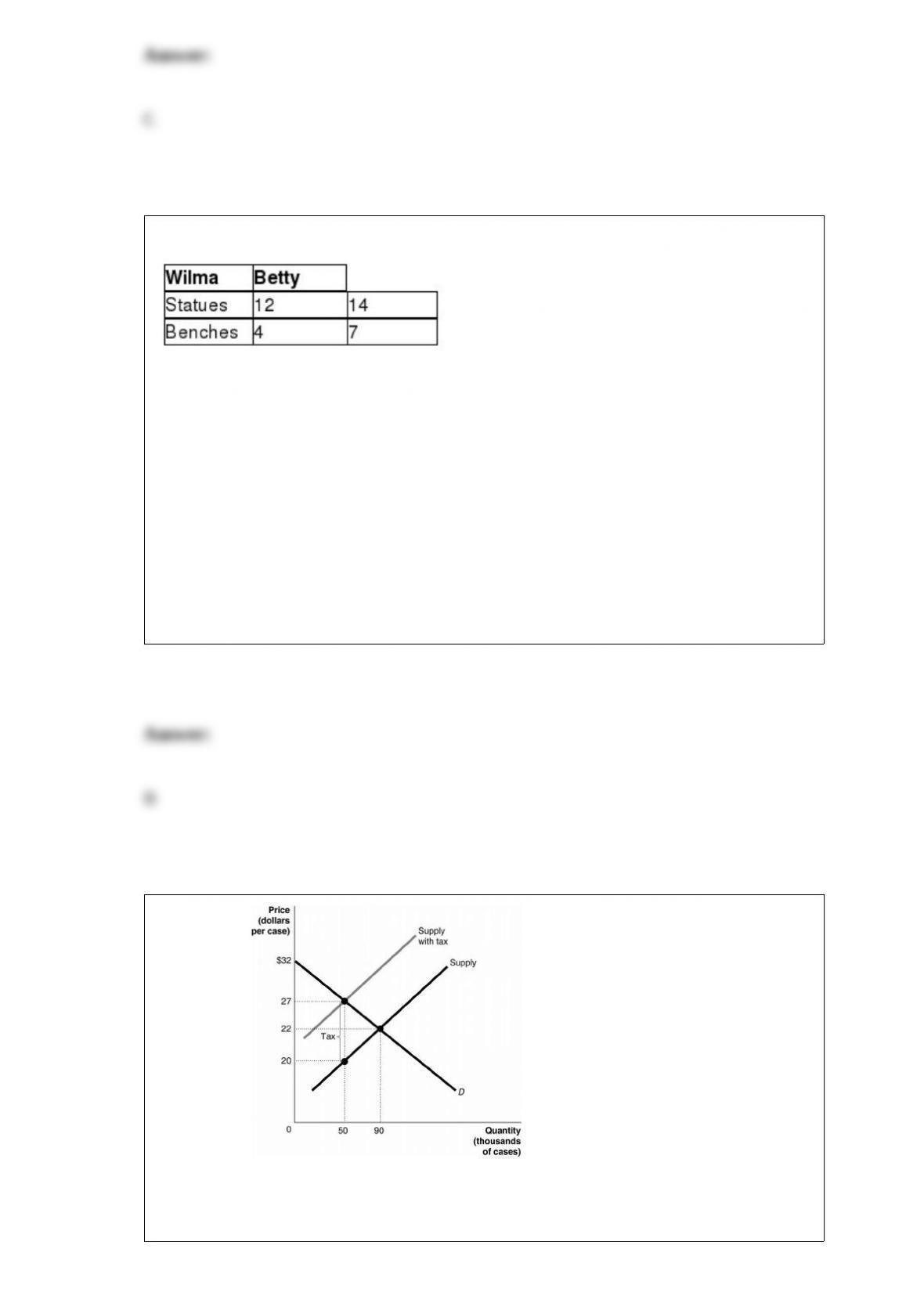
Table 2-8
Table 2-8 shows the output per month of two people, Wilma and Betty. They can either
devote their time to making marble statues or making marble benches.
What is Betty’s opportunity cost of making a bench?
A) 1/2 statue
B) 2 statues
C) 1.75 benches
D) 2.8 statues
Figure 4-15 Figure 4-15 shows the market for
beer. The government plans to impose a unit tax in this market.
As a result of the tax, is there a loss in consumer surplus?

A) Yes, because consumers paying a price above the economically efficient price.
B) No, because the producer pays the tax.
C) No, because the market reaches a new equilibrium
D) No, because consumers are charged a lower price to cover their tax burden.
What does the marginal rate of substitution measure?
A) It measures the rate at which a consumer must give up one good to purchase another
good.
B) It measures the rate at which a consumer will substitute one good for another when
the price of one good changes.
C) It measures the change in utility from consuming one additional unit of a good.
D) It measures the rate at which a consumer is willing to trade off one product for
another while keeping utility constant.
During a(n) ________ many firms experience increased profits, which increases
________ and investment spending.
A) expansion; government spending
B) recession; cash flow
C) expansion; cash flow
D) recession; business confidence
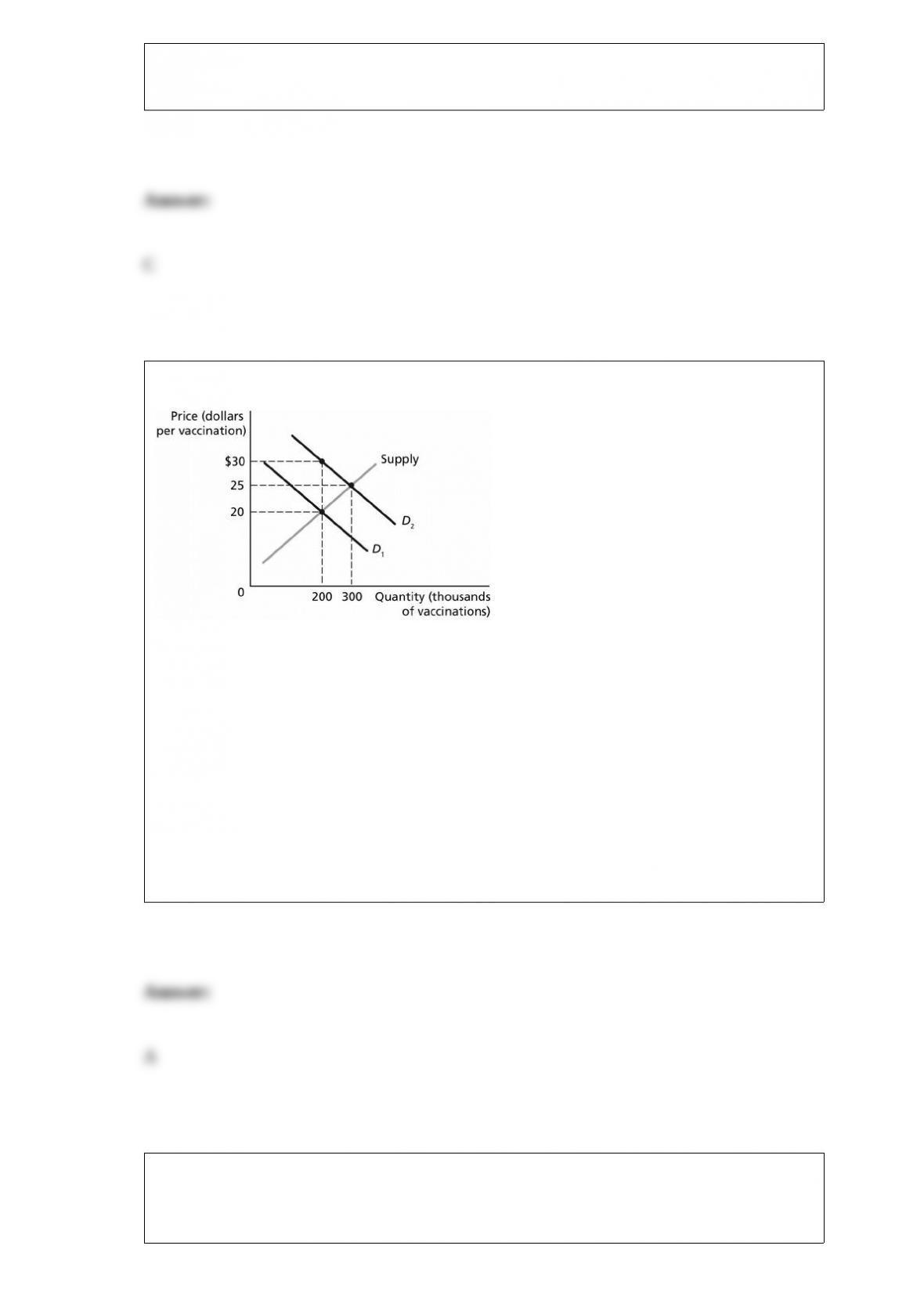
Figure 7-1
Figure 7-1 represents the market for
vaccinations. Vaccinations are considered a benefit to society, and the figure shows both
the marginal private benefit and the marginal social benefit from vaccinations. Marginal
private benefit is represented by which curve?
A) D1
B) D2
C) Supply
D) All of the above represent marginal private benefit.
The Smoot-Hawley Tariff
A) lowered U.S. tariffs by 50 percent following World War II.

B) was passed by the U.S. Congress following the Civil War as a means of increasing
government revenue.
C) was passed by the U.S. Congress upon a recommendation made by the General
Agreement on Tariffs and Trade (GATT) in 1948.
D) raised average tariff rates by over 50 percent in the United States in 1930.
The economic analysis of minimum wage involves both normative and positive
analysis. Consider the following consequences of a minimum wage:
a. The minimum wage law causes unemployment.
b. Unemployment would be lower without a minimum wage law.
c. Minimum wage laws benefit some workers and harm others.
d. The minimum wage should be more than $7.25 per hour. Which of the consequences
above are positive statements and which are normative statements?
A) a, b, and c are positive statements and d is a normative statement.
B) a and b are positive statements, c and d are normative statement.
C) Only a is a positive statement, b, c and d are normative statements.
D) a and c are positive statements, b and d are normative statements.
Table 2-11

Table 2-11 shows the number of labor hours required to produce a digital camera and a
pound of wheat in China and South Korea.
If the two countries specialize and trade, who should export wheat?
A) There is no basis for trade between the two countries.
B) China
C) South Korea
D) They should both be exporting wheat.
If net foreign investment is positive, which of the following must be true? (Assume that
the capital account is zero and net transfers are zero.)
A) Capital outflows are less than capital inflows.
B) Domestic investment must be less than national saving.
C) Net exports are negative.
D) None of the above are true when net foreign investment is positive.

Which of the following would decrease net exports in the United States?
A) An American party planner purchases 350 pi±atas from Mexico.
B) The government of Mexico purchases 2,000 Dell laptop computers from the United
States.
C) A Mexican citizen purchases 100 shares of stock in IBM.
D) The U.S. government donates $25 million to Mexico to help victims of a hurricane
in Mexico.
If the Fed buys Treasury bills, this will shift the
A) money supply curve to the right.
B) money supply curve to the left.
C) money demand curve to the right.
D) money demand curve to the left.
One goal a firm tries to achieve when it advertises a product is to
A) make the demand curve for the product more elastic.
B) shift the demand curve for the product to the left.
C) make the demand curve for the product unitary elastic.

D) make the demand curve for the product more inelastic.