
Over the last fifty years both real GDP and prices have trended upward in most
countries. Continuing real GDP growth and inflation can be explained by
a. continuing technological progress alone.
b. continuing increases in the money supply alone.
c. continued technological progress and continuing increases in the money supply.
d. None of the above can explain continuing real GDP growth and inflation.
The price index was 136 in one year and 142 in the next year. What was the inflation
rate between the two years?
a. 1.04 percent
b. 4.41 percent
c. 6.00 percent
d. 42.00 percent
An opponent of monetary policy decisions by rule would point to which of the
following as support of his case?
a. time inconsistency of policy

b. flexibility to confront unforeseen circumstances
c. political business cycle
d. the ability to craft rules that account for all possible contingencies in advance
When an American doctor opens a practice in Bermuda, his production there is part of
U.S. GDP.
a. True
b. False
If the real exchange rate for coal is 1.5, the price of coal in the U.S. is $50 per ton, and
the price of coal in Britain is 20 British pounds per ton, what is the nominal exchange
rate?
a. 15/4
b. 5/3
c. 3/5
d. 4/15

The logic behind the catch-up effect is that
a. workers in countries with low incomes will work more hours than workers in
countries with high incomes.
b. the capital stock in rich countries deteriorates at a higher rate because it already has a
lot of capital.
c. new capital adds more to production in a country that doesn’t have much capital than
in a country that already has much capital.
d. None of the above is correct.
Within the U.S. population, teenagers (ages 16-19) have higher rates of unemployment
than adults of prime working age (ages 25-54), regardless of race or gender.
a. True
b. False

In an economy that relies on barter, trade requires a double-coincidence of wants.
a. True
b. False
Suppose investment spending falls. To offset the change in output the Federal Reserve
could
a. increase the money supply. This increase would also move the price level closer to its
value before the decline in investment spending.
b. increase the money supply. However, this increase would move the price level farther
from its value before the decline in investment spending.
c. decrease the money supply. This decrease would also move the price level closer to
its value before the decline in investment spending.
d. decrease the money supply. However, this increase would move the price level
farther from its value before the decline in investment spending.
Table 4-8

RefertoTable4-8.If these are the only three sellers in the market, then the market
quantity supplied at a price of $6 is
a. 6 units.
b. 12 units.
c. 18 units.
d. 24 units.
Other things the same, a government budget deficit
a. reduces public saving, but not national saving.
b. reduces national saving, but not public saving.
c. reduces both public and national saving.
d. reduces neither public saving nor national saving.

A decrease in the price of baseball bats will decrease the demand for baseballs.
a. True
b. False
What is the present value of a payment of $150 one year from today if the interest rate
is 6 percent?
a. $141.11
b. $141.36
c. $141.75
d. None of the above are correct to the nearest cent.
Figure 35-4. The left-hand graph shows a short-run aggregate-supply (SRAS) curve
and two aggregate-demand (AD) curves. On the left-hand diagram, the price level is
measured on the vertical axis; on the right-hand diagram, the inflation rate is measured
on the vertical axis.
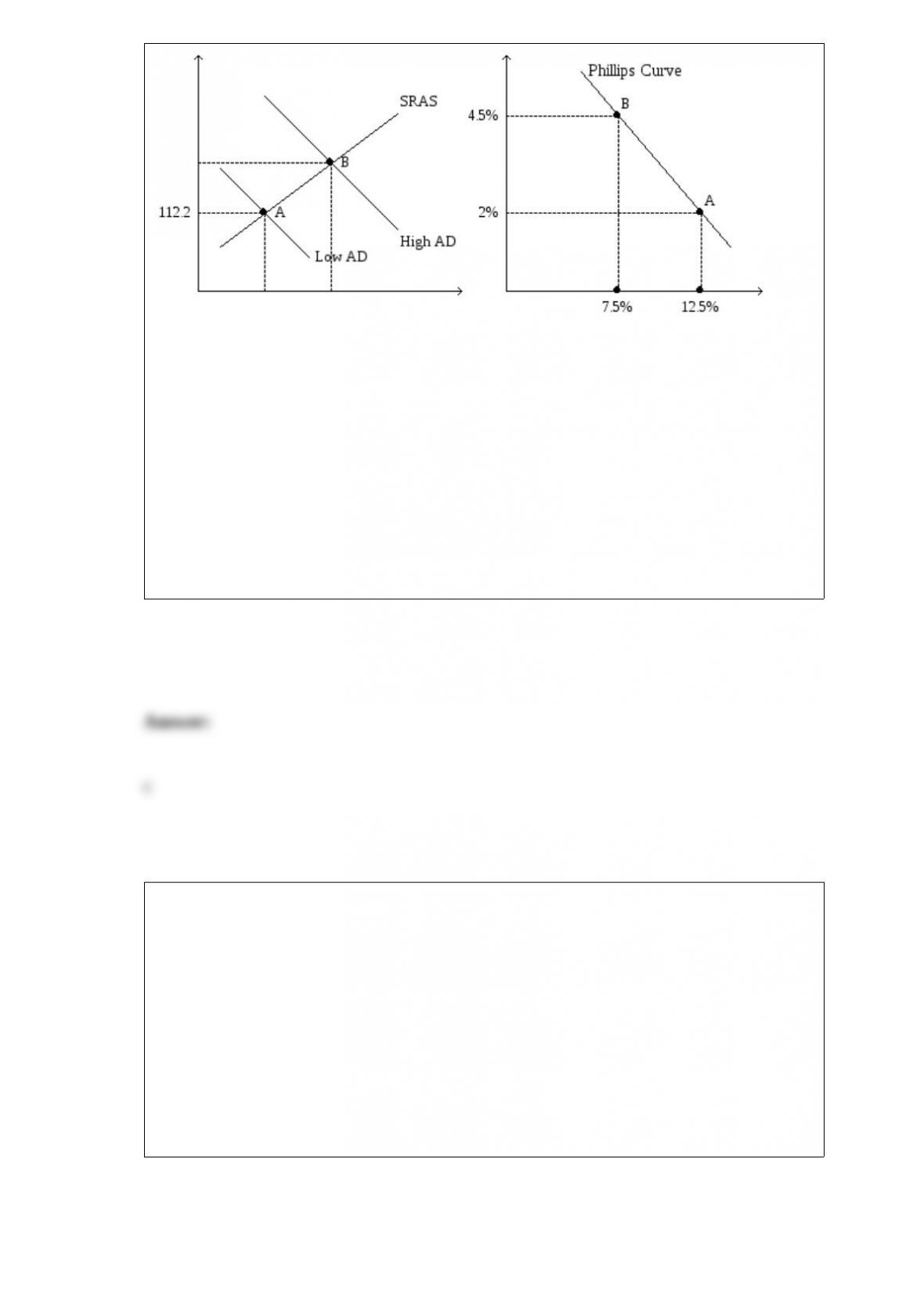
RefertoFigure35-4.Assume the figure depicts possible outcomes for the year 2018. In
2018, the economy is at point A on the left-hand graph, which corresponds to point A on
the right-hand graph. The price level in the year 2017 was
a. 106.
b. 108.
c. 110.
d. 112.
Workers at a bicycle assembly plant currently earn the mandatory minimum wage. If
the federal government increases the minimum wage by $1.00 per hour, then it is likely
that the
a. demand for bicycle assembly workers will increase.
b. supply of bicycles will shift to the right.
c. supply of bicycles will shift to the left.
d. firm must increase output to maintain profit levels.
In recent years, the Federal Reserve has conducted policy by setting a target for the
a. size of the money supply.
b. growth rate of the money supply.
c. federal funds rate.
d. discount rate.
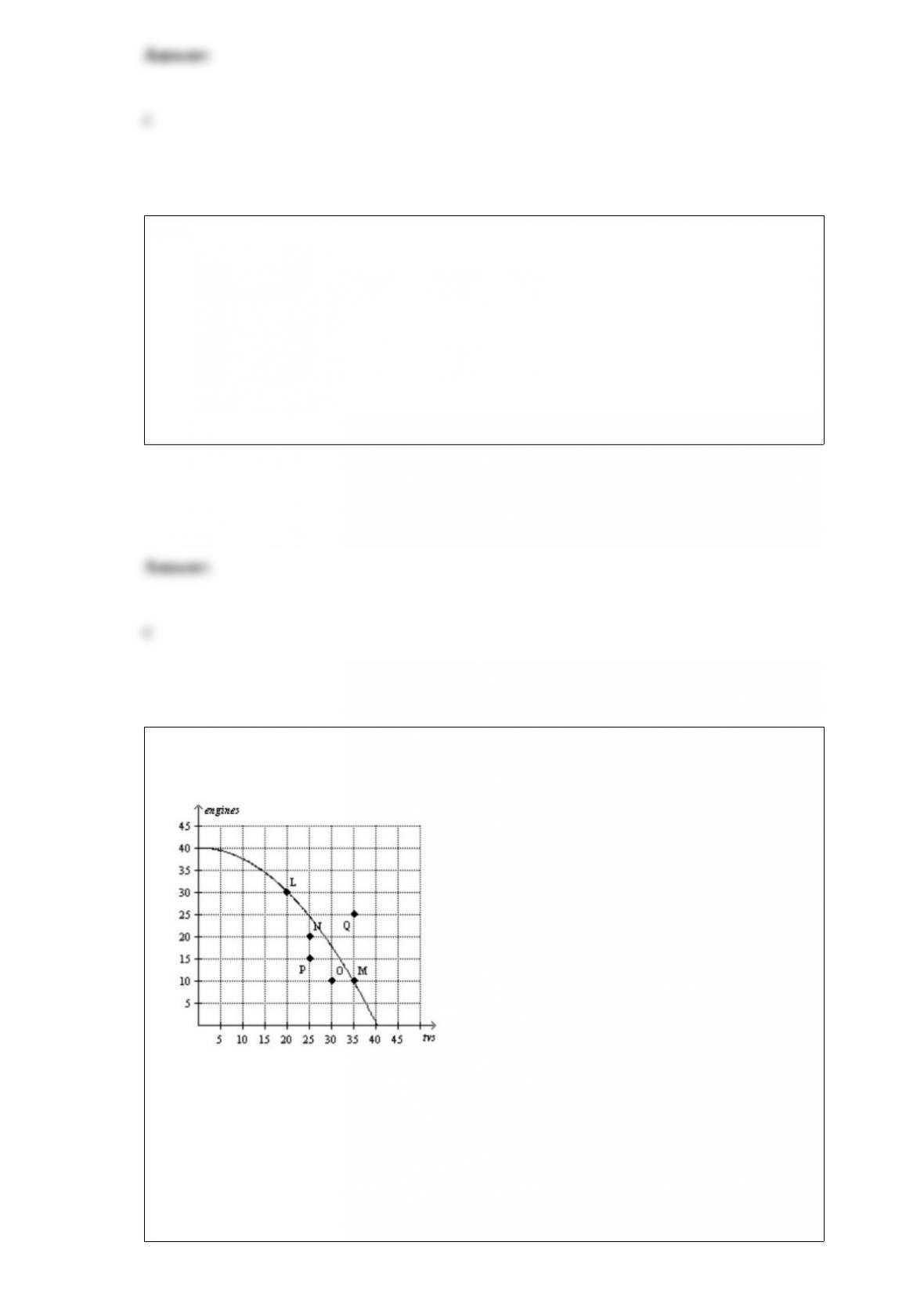
Figure 2-7
RefertoFigure2-7. This economy cannotproduce at which point(s)?
a. L, M
b. N, O, P, Q
c. N, O, P

d. Q
People had been expecting the price level to be 140 but it turns out to be 138. Johnson
Family Restaurants increases the number of workers it employs. What could explain
this?
a. both sticky price theory and sticky wage theory
b. sticky price theory but not sticky wage theory
c. sticky wage theory but not sticky price theory
d. neither sticky wage theory nor sticky price theory
Most economists believe that an increase in the quantity of money results in
a. an increase in the demand for goods and services.
b. lower unemployment in the short run.
c. higher inflation in the long run.
d. All of the above are correct.

If U.S. net exports are positive, then net capital outflow is
a. positive, so foreign assets bought by Americans are greater than American assets
bought by foreigners.
b. positive, so American assets bought by foreigners are greater than foreign assets
bought by Americans.
c. negative, so foreign assets bought by Americans are greater than American assets
bought by foreigners.
d. negative, so American assets bought by foreigners are greater than foreign assets
bought by Americans.
The Economic Development Minister of a country has a list of things she thinks may
explain her country’s low growth of real GDP per person relative to other countries. She
asks you to pick the one you think most likely explains her country’s low growth.
Which of the following contributes to low growth?
a. poorly enforced property rights
b. outward-oriented trade policies
c. policies that permit foreign investment
d. All of the above are correct.
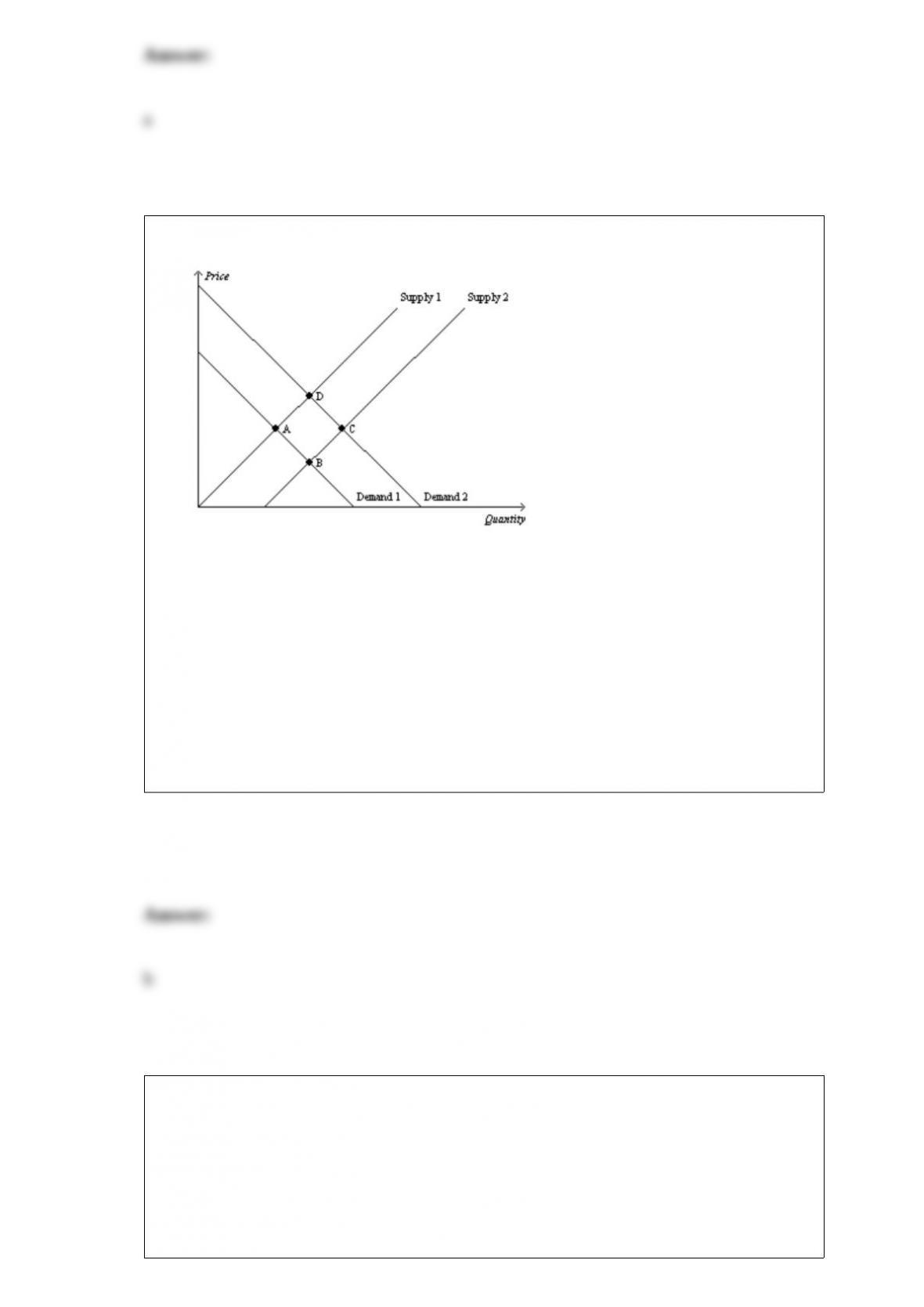
Figure 4-26
RefertoFigure4-26.Which of the following movements would illustrate the effect in the
market for golf balls of an increase in green fees?
a. Point A to Point B
b. Point C to Point B
c. Point C to Point D
d. Point A to Point D
The business cycle is the
a. relationship between unemployment and inflation.
b. irregular fluctuations in economic activity.
c. positive relationship between the quantity of money in an economy and inflation.

d. predictable changes in economic activity due to changes in government spending and
taxes.
The Fed increases reserves if it conducts open market
a. purchases or auctions term credit.
b. purchases but not if it auctions term credit
c. sales or auctions term credit
d. sales but not if it auctions term credit
Changes in the interest rate
a. shift aggregate demand whether they are caused by changes in the price level or by
changes in fiscal or monetary policy.
b. shift aggregate demand if they are caused by changes in the price level, but not if
they are caused by changes in fiscal or monetary policy.
c. shift aggregate demand if they are caused by fiscal or monetary policy, but not if they
are caused by changes in the price level.
d. do not shift aggregate demand.

Suppose that a worker in Boatland can produce either 5 units of wheat or 25 units of
fish per year, and a worker in Farmland can produce either 25 units of wheat or 5 units
of fish per year. There are 10 workers in each country. Political pressure from the fish
lobby in Farmland and from the wheat lobby in Boatland has prevented trade between
the two countries on the grounds that cheap imports would kill the fish industry in
Farmland and the wheat industry in Boatland. As a result, Boatland produces and
consumes 25 units of wheat and 125 units of fish per year while Farmland produces and
consumes 125 units of wheat and 25 units of fish per year. If the political pressure were
overcome and trade were to occur, each country would completely specialize in the
product in which it has a comparative advantage. If trade were to occur, the combined
output of the two countries would increase by
a. 25 units of wheat and 25 units of fish.
b. 50 units of wheat and 50 units of fish.
c. 75 units of wheat and 75 units of fish.
d. 100 units of wheat and 100 units of fish.
At which interest rate is the present value of $95.40 one year from today equal to $90
today?
a. 4 percent
b. 5 percent
c. 6 percent

d. 7 percent
If the U.S. government increased its deficit, then
a. U.S. bonds would pay higher interest but a dollar would purchase fewer foreign
goods.
b. U.S. bonds would pay higher interest and a dollar would purchase more foreign
goods.
c. U.S. bonds would pay lower interest and a dollar would purchase fewer foreign
goods.
d. U.S. bonds would pay lower interest but a dollar would purchase more foreign goods.
A government budget deficit affects the supply of loanable funds, rather than the
demand for loanable funds, because
a. in our model of the loanable funds market, we define “loanable funds” as the flow of
resources available to fund private investment.
b. in our model of the loanable funds market, we define “loanable funds” as the flow of
resources available from private saving.
c. markets for government debt are fundamentally different from markets for private
debt.

d. of our assumption that the economy is closed.
If there is a political business cycle and the Federal Reserve supports the incumbent,
then we should expect that prior to elections
a. interest rates and output would rise.
b. interest rates would rise and output would fall.
c. interest rates would fall and output would rise.
d. interest rates and output would fall.
The long-run Phillips curve would shift left if
a. the money supply increased or if the minimum wage was reduced.
b. the money supply increased but not if the minimum wage was reduced.
c. the minimum wage was reduced but not if the money supply increased.
d. None of the above is correct.

When we are calculating the consumer price index and the inflation rate for a certain
year,
a. the value of the consumer price index may depend on the choice of a base year, but
the inflation rate does not depend on the choice of a base year.
b. the inflation rate may depend on the choice of a base year, but the value of the
consumer price index does not depend on the choice of a base year.
c. both the value of the consumer price index and the inflation rate may depend on the
choice of a base year.
d. neither the value of the consumer price index nor the inflation rate depends on the
choice of a base year.