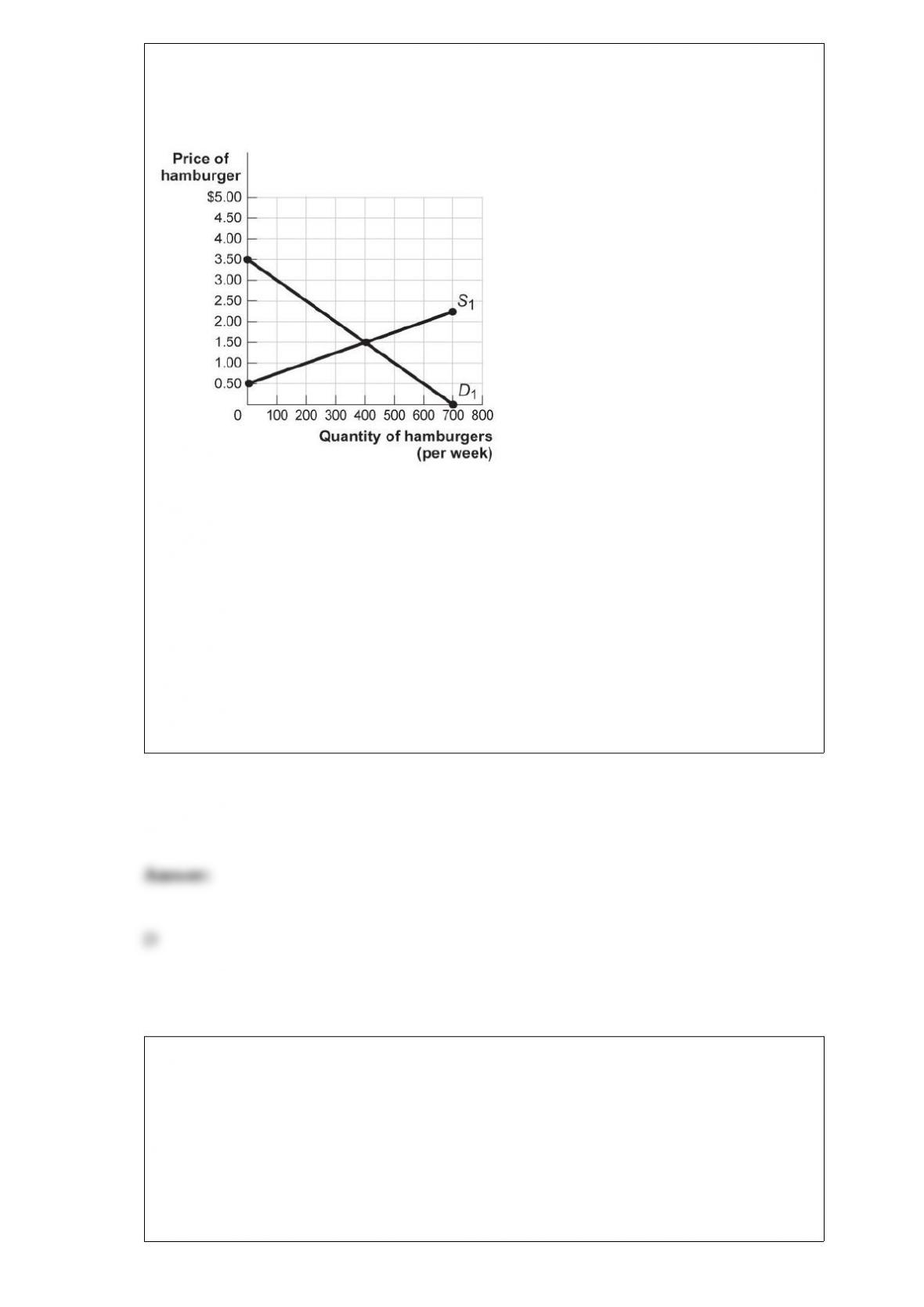
Figure: Market for Hamburgers
(Figure: The Market for Hamburgers) The figure The Market for Hamburgers shows the
weekly market for hamburgers in Irvine, Kentucky. If 400 hamburgers are sold,
producer surplus will equal:
A) $650.
B) $400.
C) $510.
D) $200.
An increase in supply is caused by:
A) an increase in input prices.
B) suppliers’ expectations of higher prices in the future.
C) an increase in the price of the good.
D) a decrease in the price of resources used in production.
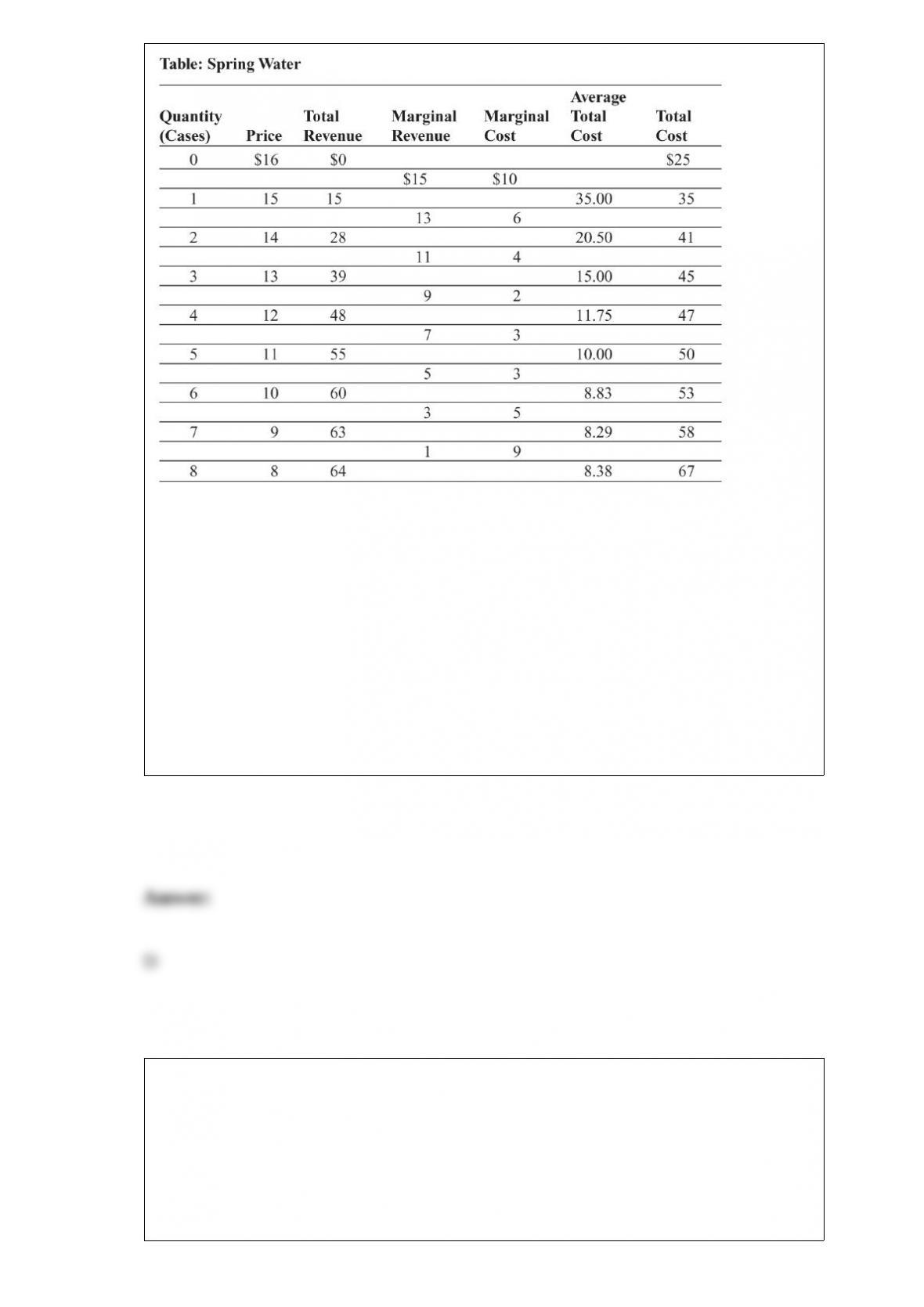
(Table: Spring Water) The table Spring Water shows the demand and cost data for a
firm in a monopolistically competitive industry producing drinking water from
underground springs. At the profit-maximizing output, profit is:
A) $9.00.
B) $10.00.
C) $60.00.
D) $7.00.
Constant marginal costs occur when production of each individual unit costs:
A) less than the previous one.
B) more than the previous one.
C) the same as the previous one.

D) more than the next one.
Goods that are subject to network externalities tend to be ones:
A) for which the value of the good to an individual is lower when more people use it.
B) that are land-intensive.
C) for which the value of the good to an individual is higher when more people use it.
D) for which one person owning the good enhances its value because it’s the only one.
A cost that does not depend on the quantity of output produced is:
A) marginal.
B) fixed.
C) variable.
D) average.

Some nations, including Canada, have adopted a health care system in which the
government pays the medical bills. This is known as a(n) _____ system.
A) employment-based
B) private health insurance
C) means-tested
D) single-payer
During the Great Depression, consumers and producers in the United States
dramatically reduced their spending as compared to the quantity of goods and services
available at the time. This statement best represents this economic concept:
A) Resources are scarce.
B) When markets don’t achieve efficiency, government intervention can improve
society’s welfare.
C) Overall spending sometimes gets out of line with the economy’s productive capacity.
D) Government policies can change spending.

Which of the following is FALSE about the circular-flow diagram?
A) Households are the primary demanders of goods and services.
B) Firms are the primary suppliers of goods and services.
C) Money flows from households to firms as households offer factors of production for
sale.
D) Money flows in the direction opposite to goods and services and factors of
production.
Scenario: Choosing Insurance
The Ramirez family owns three cars and is considering buying insurance to cover the
cost of repairs. They face two possible states: in state 1 their cars need no repairs and
their income available for purchasing other goods and services is $50,000; in state 2
their cars need $10,000 worth of repairs and their income available for purchasing other
goods and services is reduced to $40,000. The probability of repairs is 10%, while the
probability of no repairs is 90%.
(Scenario: Choosing Insurance) Refer to the information in the scenario Choosing
Insurance. For $900 the Ramirez family can buy insurance that will cover the full cost
of repairs. If family members are risk-averse and maximize their expected utility:
A) they will buy the insurance.
B) they will be indifferent between buying and not buying the insurance, since their
expected income for purchasing other goods and services is $49,100, regardless of what
they do.
C) they will not buy the insurance, since buying it does not increase their expected
income for purchasing other goods and services.
D) they will self-insure.
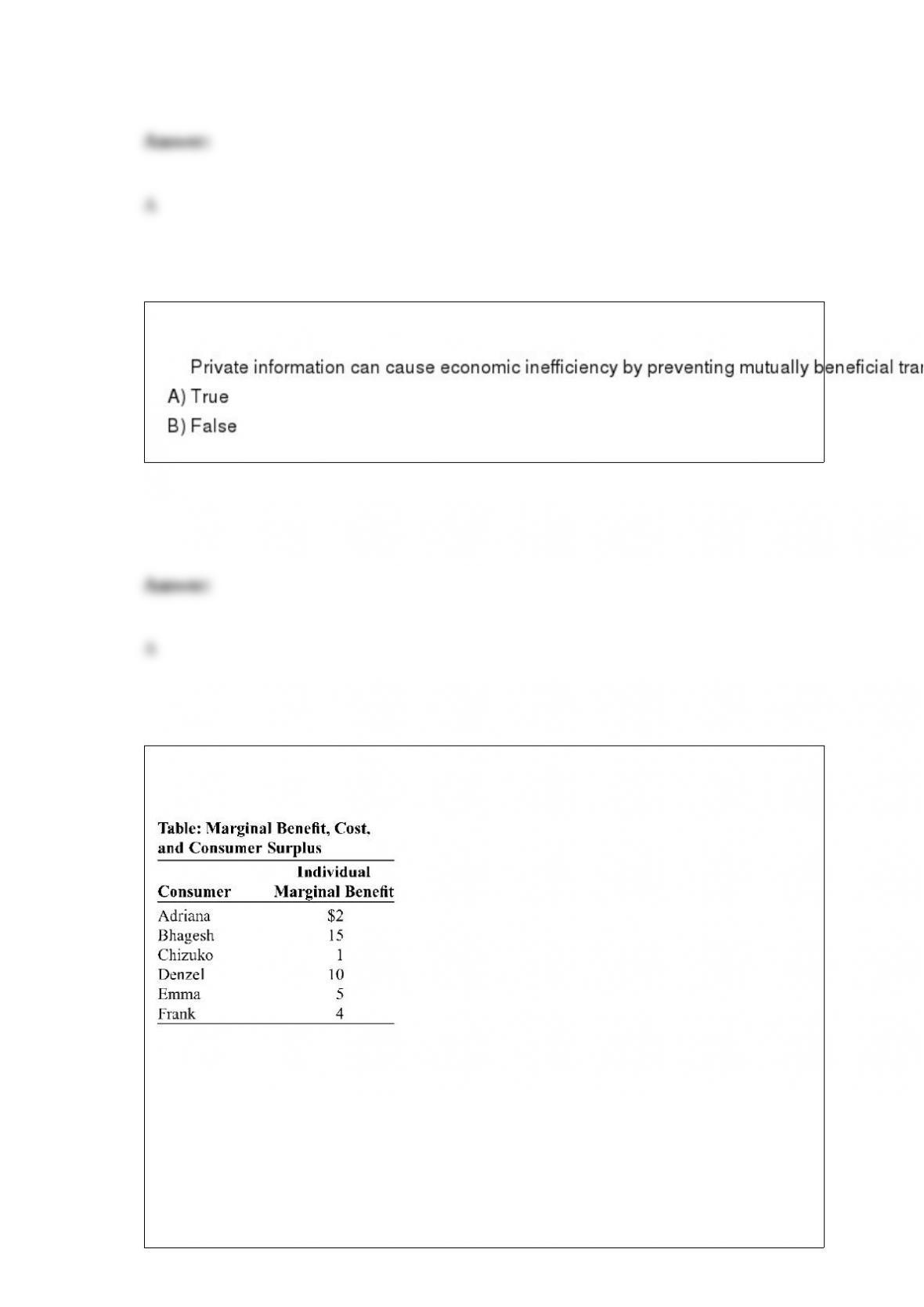
(Table: Marginal Benefit, Cost, and Consumer Surplus) The table Marginal Benefit,
Cost, and Consumer Surplus shows six consumers’ willingness to pay for one iTunes
download. If the marginal social cost is constant at $0, then the efficient price is _____
and consumer surplus is _____.
A) $0; $37
B) $1; $36

C) $4; $33
D) $5; $32
Along a straight-line downward-sloping demand curve, a decrease in the market price
of a good:
A) will cause no change in consumer surplus.
B) will increase consumer surplus.
C) will decrease consumer surplus.
D) may either decrease or increase consumer surplus.
On a sparsely populated island, high-speed Internet service would have a _____
marginal utility than in New York City, while in New York City quiet evenings would
carry a _____ marginal utility than on a deserted island.
A) lower; higher
B) higher; lower
C) lower; lower
D) higher; higher
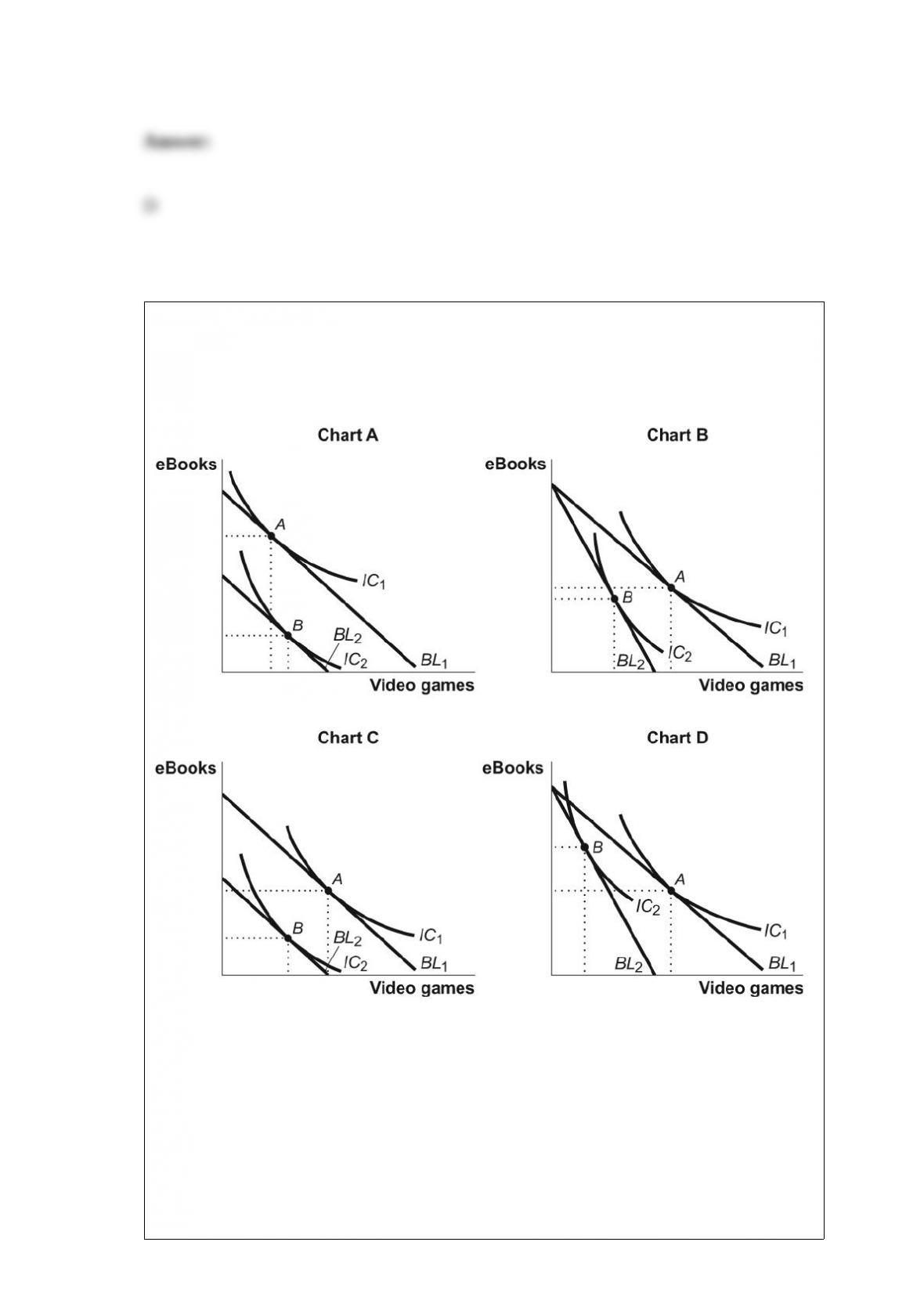
Figure: The Consumption of Video Games and E-Books
(Figure: The Consumption of Video Games and E-Books) Look at the figure The
Consumption of Video Games and E-Books. Which chart shows the effects of a
decrease in income when video games are an inferior good and e-books are a normal
good?
A) A
B) B

C) C
D) D
A public good is a good:
A) whose consumption is nonexcludable and nonrival.
B) for which the marginal cost of adding another consumer is high.
C) that the market will usually provide efficiently.
D) whose consumption is rival.
Excess capacity is a problem in monopolistic competition because if there were fewer
firms in the industry:
A) there would be more choices for consumers.
B) average total costs would be higher and profits would be lower.
C) average total costs would be lower and the prices paid by consumers could be lower.
D) there would be less need for government regulation.
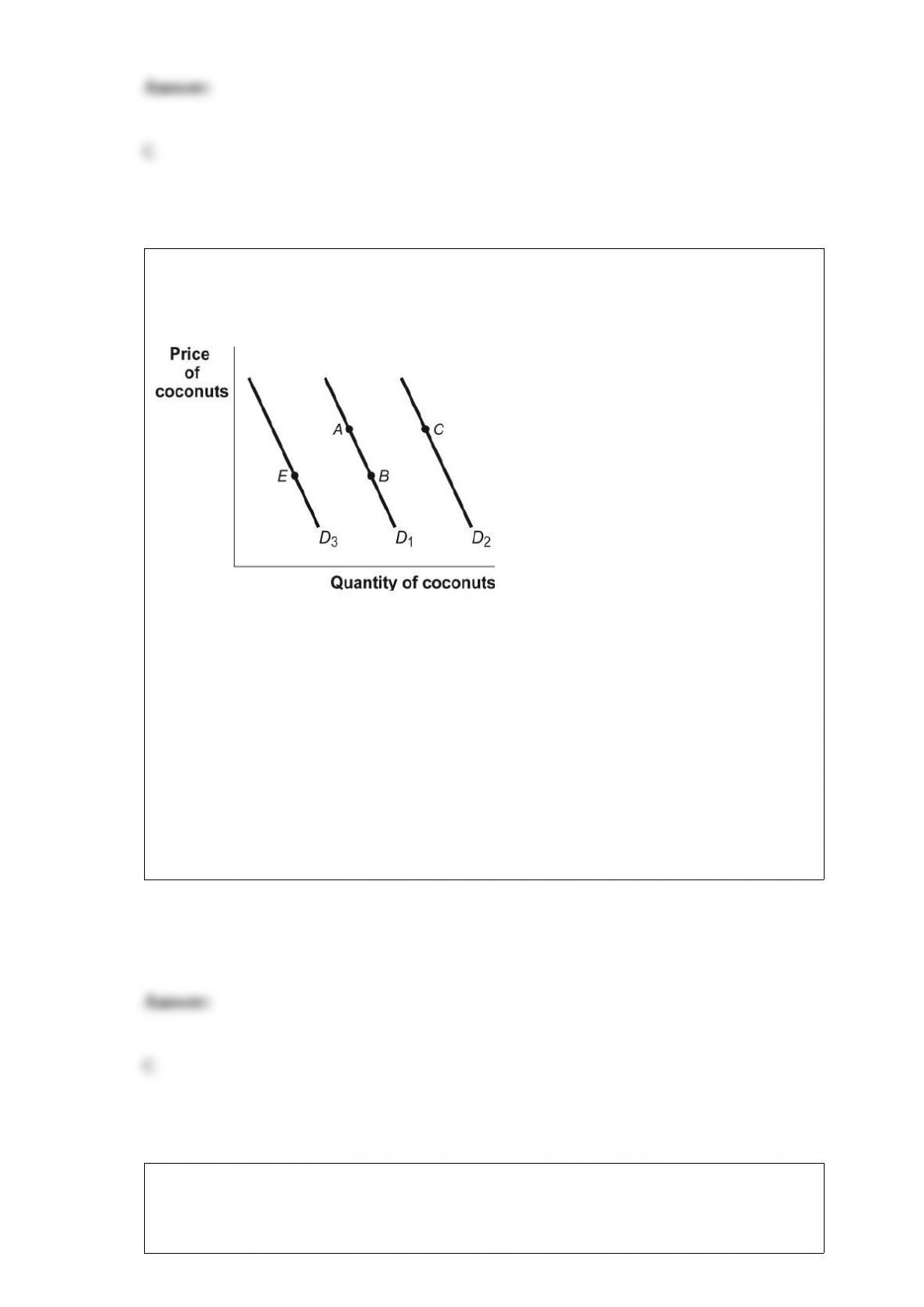
Figure: Demand for Coconuts
(Figure: Demand for Coconuts) Look at the figure Demand for Coconuts. If coconuts
are a normal good and the income level of consumers falls, it will be represented in the
figure as a movement from:
A) A to C.
B) B to A.
C) C to A.
D) E to B.
Figure: Risk Aversion
(Figure: Risk Aversion) Look at the figure Risk Aversion. Bob and Nancy have the
same income and total utility. Nancy will be willing to pay a ____ insurance premium
than Bob because she is _____ risk-averse.
A) higher; more
B) lower; more
C) lower; less
D) higher; less
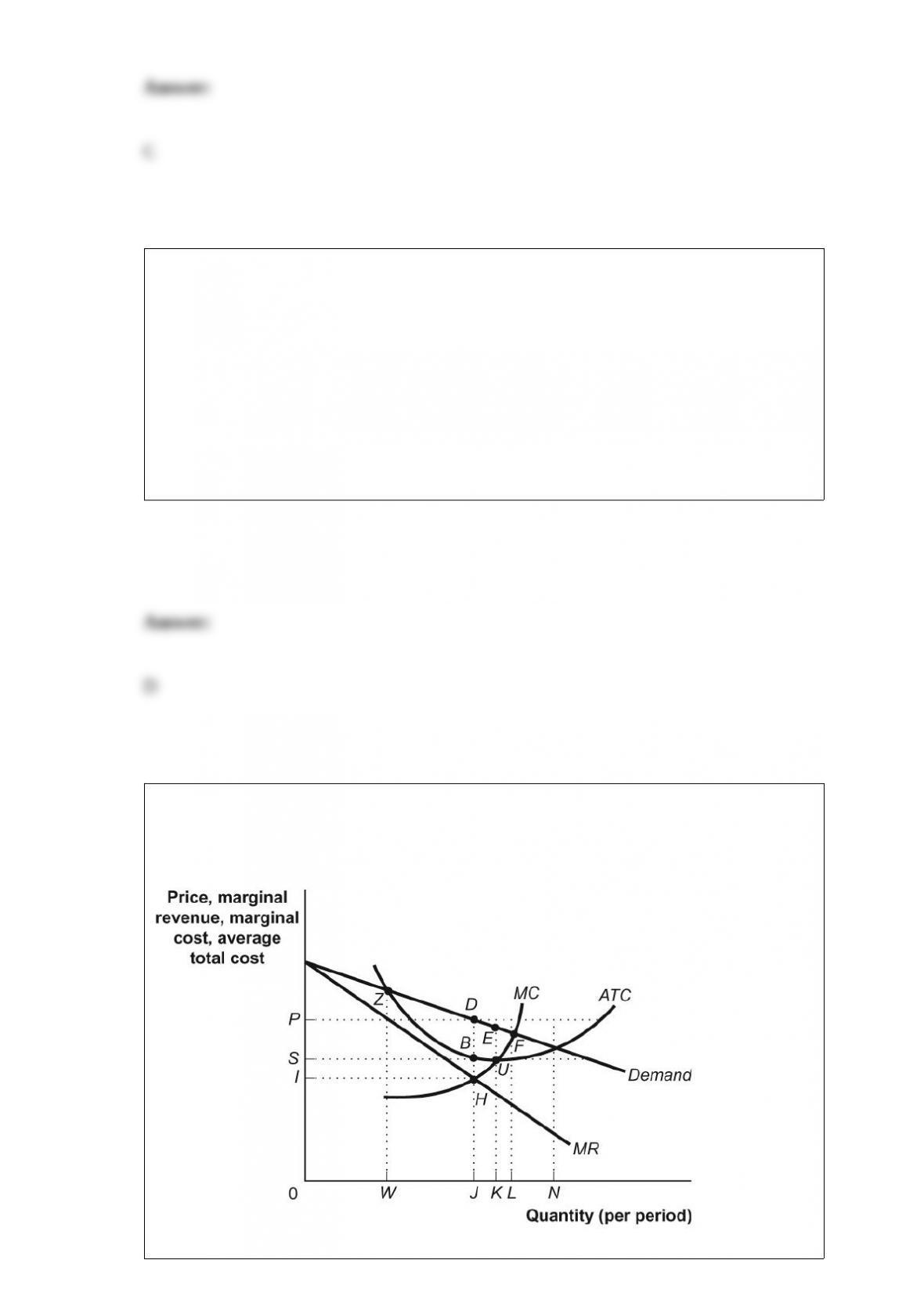
(Table: Taxes, Spending, and Income) Suppose Governor Meridias initiates a tax of
10% on all income up to $50,000. Income above $50,000 is not taxed. An individual
earning $75,000 will have an average tax rate of:
A) 10%.
B) 0%.
C) 6.67%.
D) 5%.
Suppose the equilibrium price of good Y is $5 and the equilibrium quantity is 150 units.
If the price of good Y is $12:
A) the quantity demanded will be greater than 150 units.
B) the quantity supplied will be less than 150 units.
C) there will be an excess demand for good Y.
D) there will be an excess supply of good Y.
Figure: Monopoly Model

(Figure: Monopoly Model) Look at the figure Monopoly Model. When the firm is in
equilibrium (that is, maximizing its economic profit), its profit is the area of rectangle:
A) SPDB.
B) IPDH.
C) ISBH.
D) 0PDJ.
Your community requires the sewage treatment plant to process raw sewage so that it is
safe to return the water to the environment. This is:
A) an emissions tax.
B) the Coase theorem.
C) a tradable emissions permit.
D) an environmental standard.
Table: Long-Run Total Cost Quantity of Soybeans (bushels) Long-Run Total Cost
1 $ 50 2 80 3 90 4 120 5 200 6 300

(Table: Long-Run Total Cost) Look at the table Long-Run Total Cost. This soybean
grower receives constant returns to scale over the _____ and _____ bushels.
Quantity of Soybeans (bushels) Long-Run Total Cost
1 $ 50
2 80
3 90
4 120
5 200
6 300
A) first; second
B) third; fourth
C) fourth; fifth
D) fifth; sixth
If people demand more of product A when the price of B falls, then A and B are:
A) not related.
B) substitutes.
C) complements.
D) inferior goods.

In the rental housing market with price controls, the quantity of rental houses demanded
exceeds the quantity of rental housing supplied. This price control must be a:
A) price ceiling.
B) price floor.
C) quota.
D) quantity control.
If the combination of two goods occurs at a point of tangency between the budget line
and an indifference curve:
A) consumer equilibrium has not been achieved.
B) all available income has been spent and total utility is maximized.
C) total utility can be increased by consuming less of both goods.
D) total utility can be decreased by consuming more of both goods.
Comparative advantage arises from:
A) differences in climate, factor endowments, and technology.
B) absolute advantage.
C) countries engaging in autarkic behavior.
D) an emphasis on export production.
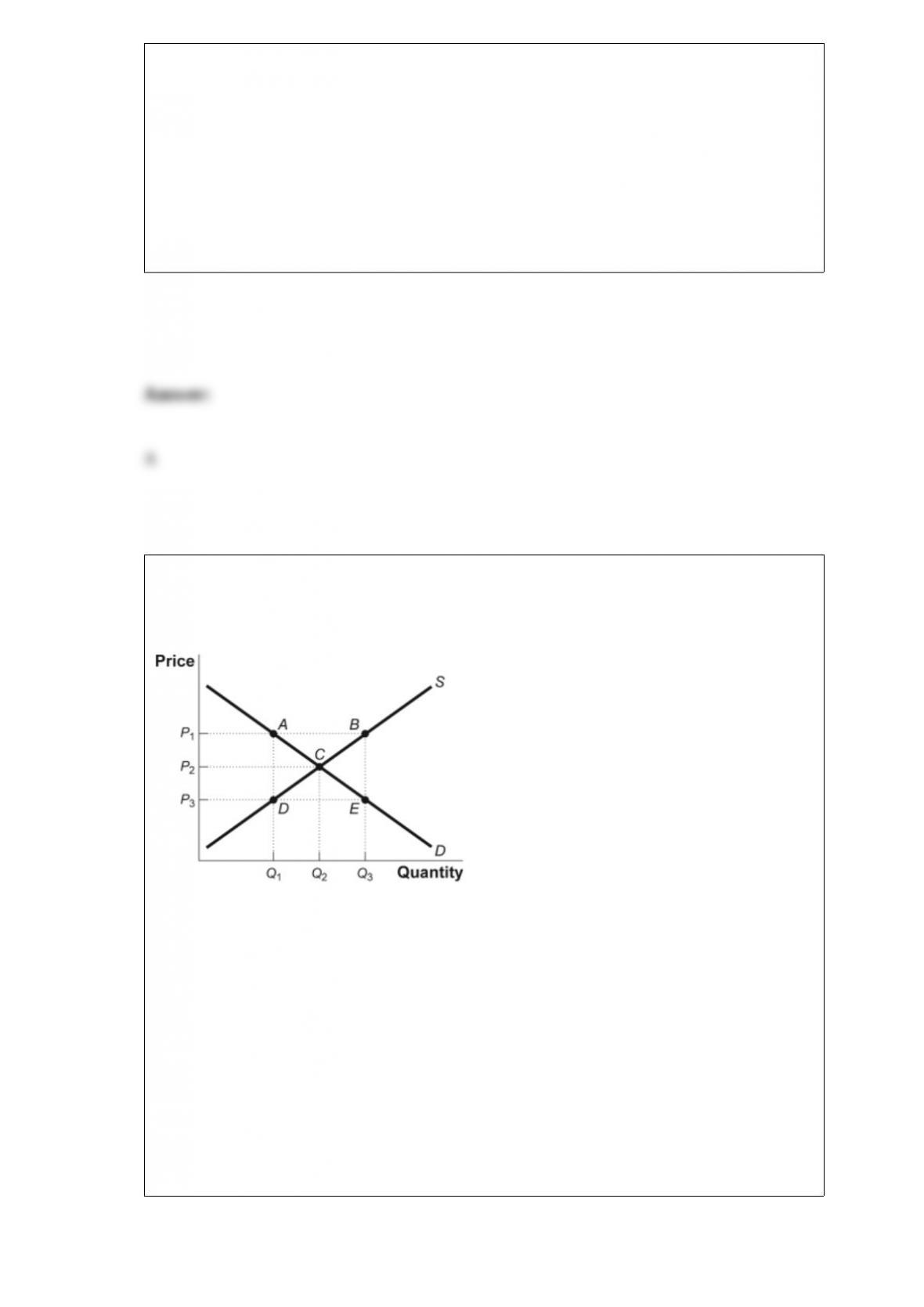
Figure: Supply and Demand in the Orange Juice Market
(Figure: Supply and Demand in the Orange Juice Market) Look at the figure Supply
and Demand in the Orange Juice Market. The market is in equilibrium at point C.
Suppose most people drink orange juice only with champagne. What will be the new
equilibrium point in the orange juice market if a law banning alcohol passes?
A) A
B) B
C) D
D) E
All of the following are costs associated with the imposition of a tax EXCEPT:
A) deadweight loss.
B) administrative cost.
C) revenues.
D) equilibrium pricing.
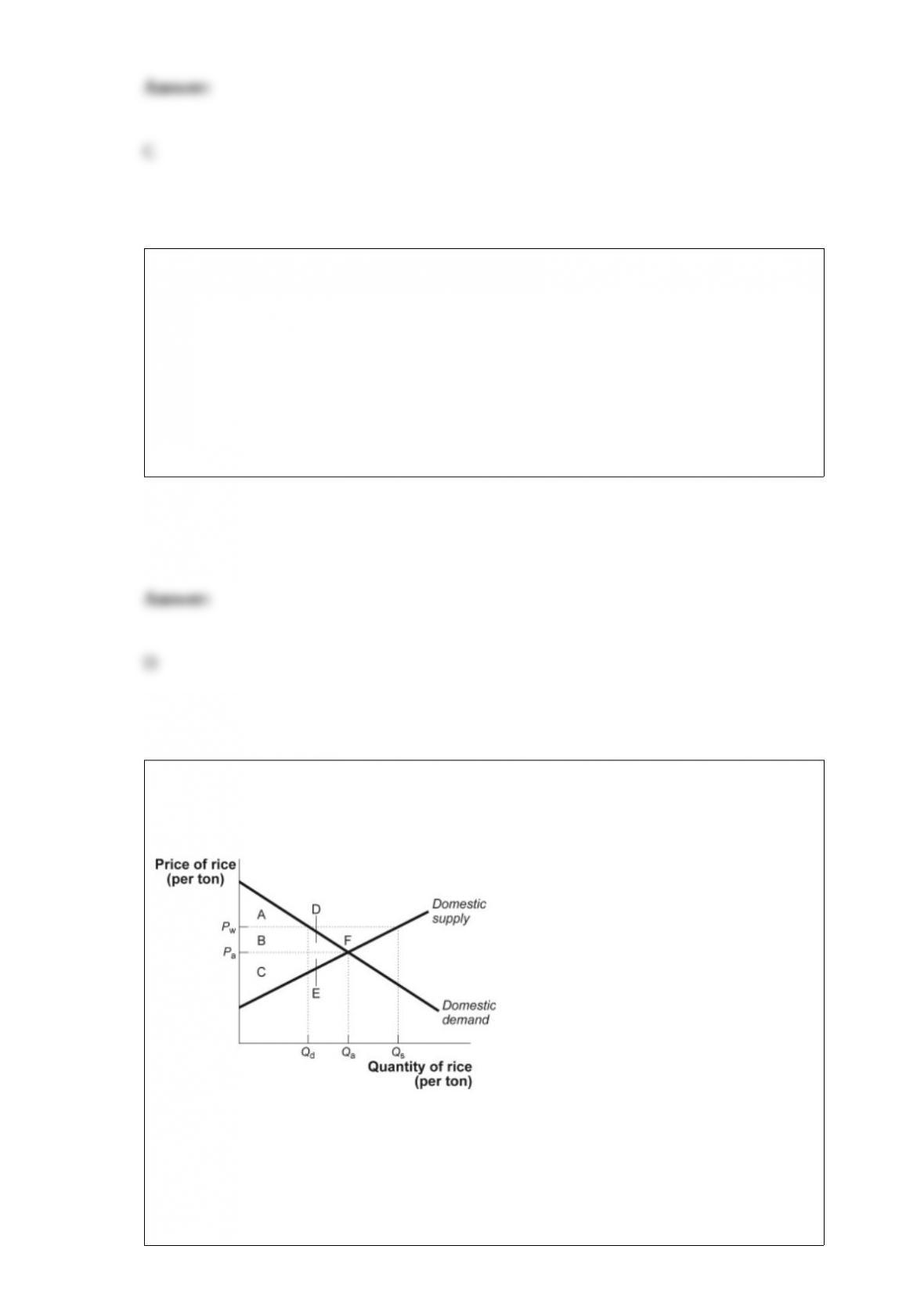
Figure: The Domestic Market for Rice
(Figure: The Domestic Market for Rice) Look at the figure The Domestic Market for
Rice. Assume that PA is the autarky price and PW is the world price. Before
international trade, consumer surplus is equal to the area:
A) A.
B) A + B.
C) A + B + C.
D) A + B + D.
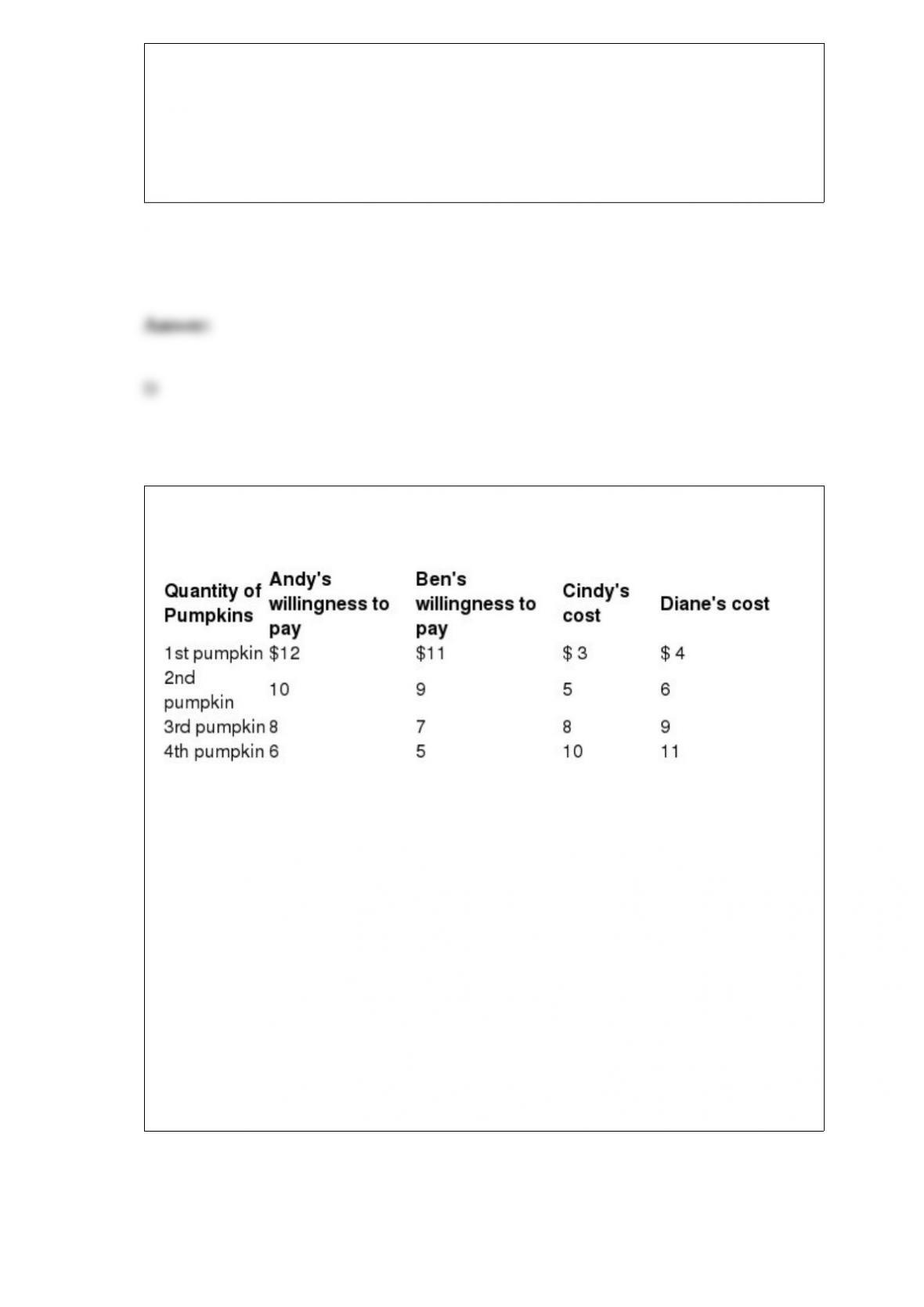
Table: Pumpkin Market
(Table: Pumpkin Market) There are two consumers, Andy and Ben, in the market for
pumpkins. Their willingness to pay for each pumpkin is shown in the table Pumpkin
Market. There are two producers of pumpkins, Cindy and Diane, and their costs are also
shown. The equilibrium price for pumpkins is $8 and the equilibrium quantity is 5. At
the equilibrium price and quantity, Andy buys _____ pumpkins and his consumer
surplus is_____.
A) four; $2
B) three; $6
C) two; $8
D) one; $4
Jane works part-time and earns $11,000 per year. Because she is below the poverty line,
she also receives $4,000 in various welfare benefits. Suppose she is offered a new job
that would pay her $14,000 and would bring her earnings high enough so that she no
longer qualified for any welfare benefits. This is what is known as a notch. Explain
what is happening with Jane and how could we modify the system to eliminate the
notch.
James spends his daily income of $50 on protein shakes (PS) and energy bars (EB).
Protein shakes are priced at $5 each, and energy bars are priced at $4 each. Provide the
equation for his budget constraint. If he spends half of his income on each item, how
many units of each will he consume?
What are some of the causes of poverty in the United States?
The seller of a product will sometimes offer a warranty that if the product is defective,
the seller will repair or replace it free of charge within a specified time. What is the role
of product warranties in lessening the problem of asymmetric information (or private
information) and increasing the number of transactions that are made?
Many people have severe food allergies such that even one bite of something might
send a person to the emergency room. For a person with a severe allergy to nuts, for
example, describe the total utility function from eating nuts.
You own a shoe store and need a new sales associate. You have a large stack of
applications, but unfortunately you have no idea who is a strong salesperson and who is
a weak one. What kind of problem are you facing and how can you solve it?
You read that college tuition is rising every year, and yet more students attend college
every year. Isn’t this a violation of the law of demand?
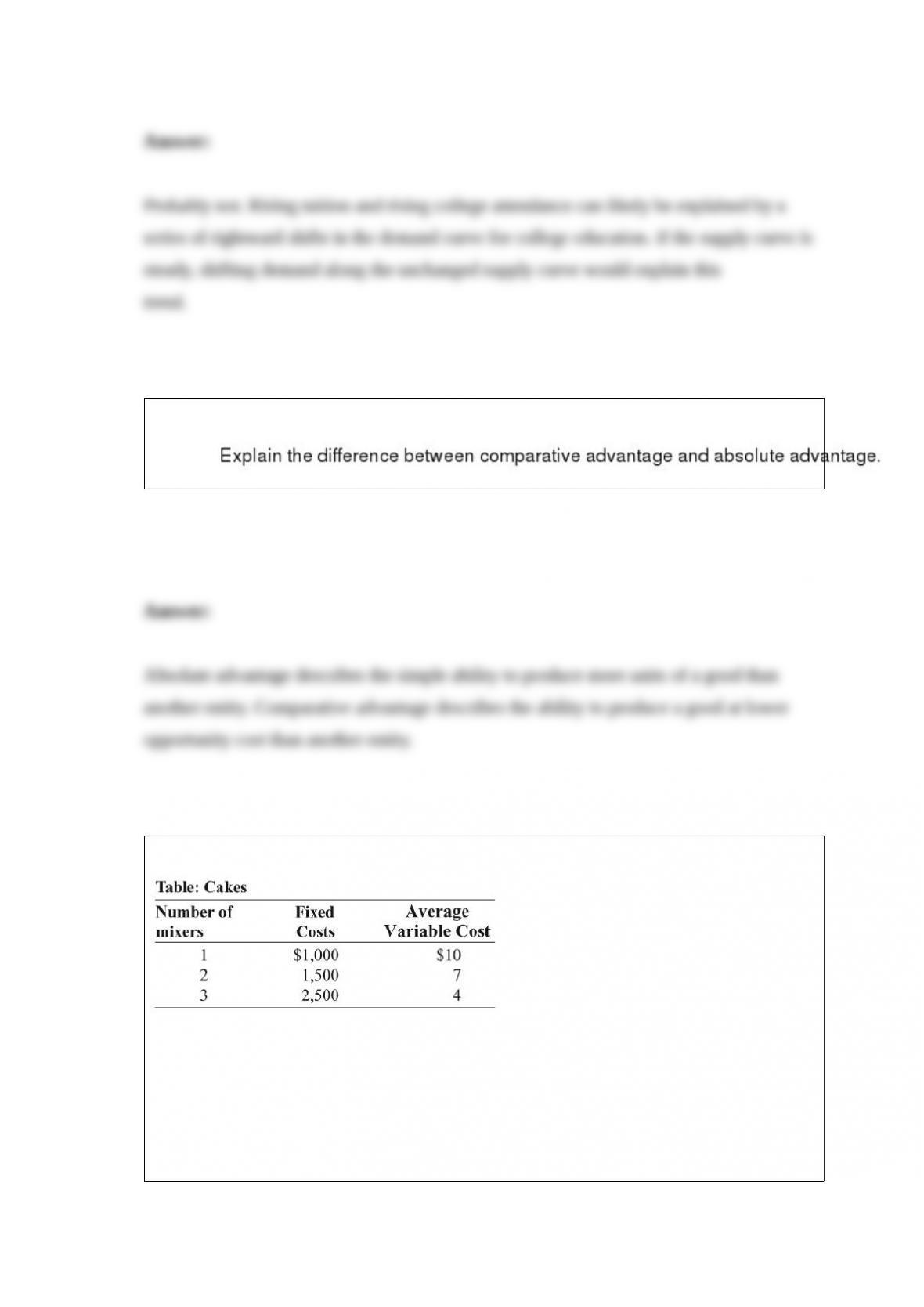
(Table: Cakes) Look at the table Cakes. Pat is opening a bakery to make and sell special
birthday cakes. Her estimated fixed and average variable costs if she purchases one,
two, or three mixers are shown in the table. Assume that average variable costs do not
vary with the quantity of output. Suppose that Pat used to produce 100 cakes, but she
has a sudden increase in demand, so that she begins to produce 200 cakes. Explain how
her average total cost will change in the short run and in the long run.
How have advancements in medicine contributed to the soaring cost of health care in
the United States? Isn’t medical progress a good thing?
Suppose the supply curve for soap bubbles has a slope of +1 and intersects the vertical
axis at a price of $2 per bottle. Interpret the meaning of both the y-intercept and the
slope.
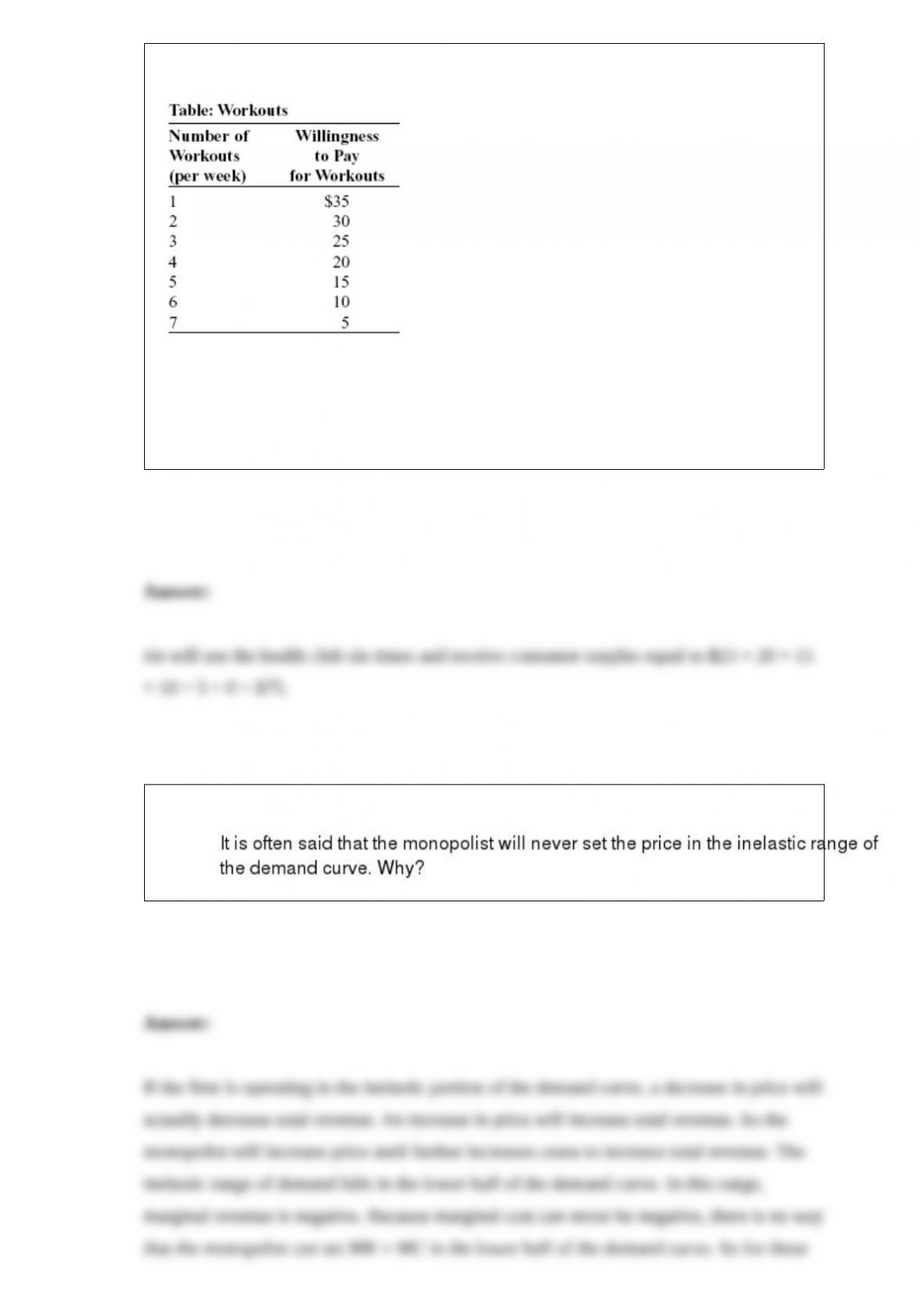
(Table: Workouts) Look at the table Workouts. Several times each week Eli works out at
a health club, but because he is not a member, he pays $10 each time he uses the club
facilities. How many times per week will Eli use the health club for a workout, and how
much consumer surplus does he receive?