
In the short run, the firm’s average fixed costs
a. always increase as output increases.
b. always decline as output increases.
c. equal zero.
d. remain constant as output expands.
Which of the following is true of high and variable rates of inflation?
a. When such rates are present, it will be difficult for people to accurately forecast next
year’s rate of inflation.
b. Inflation of this type will help promote economic growth and the efficient use of
resources.
c. People will respond to such rates by spending more time producing and less time
trying to protect their wealth and income from the uncertainty created by the inflation.
d. Inflation of this type will improve the information content delivered by market
prices.
Figure 4-17
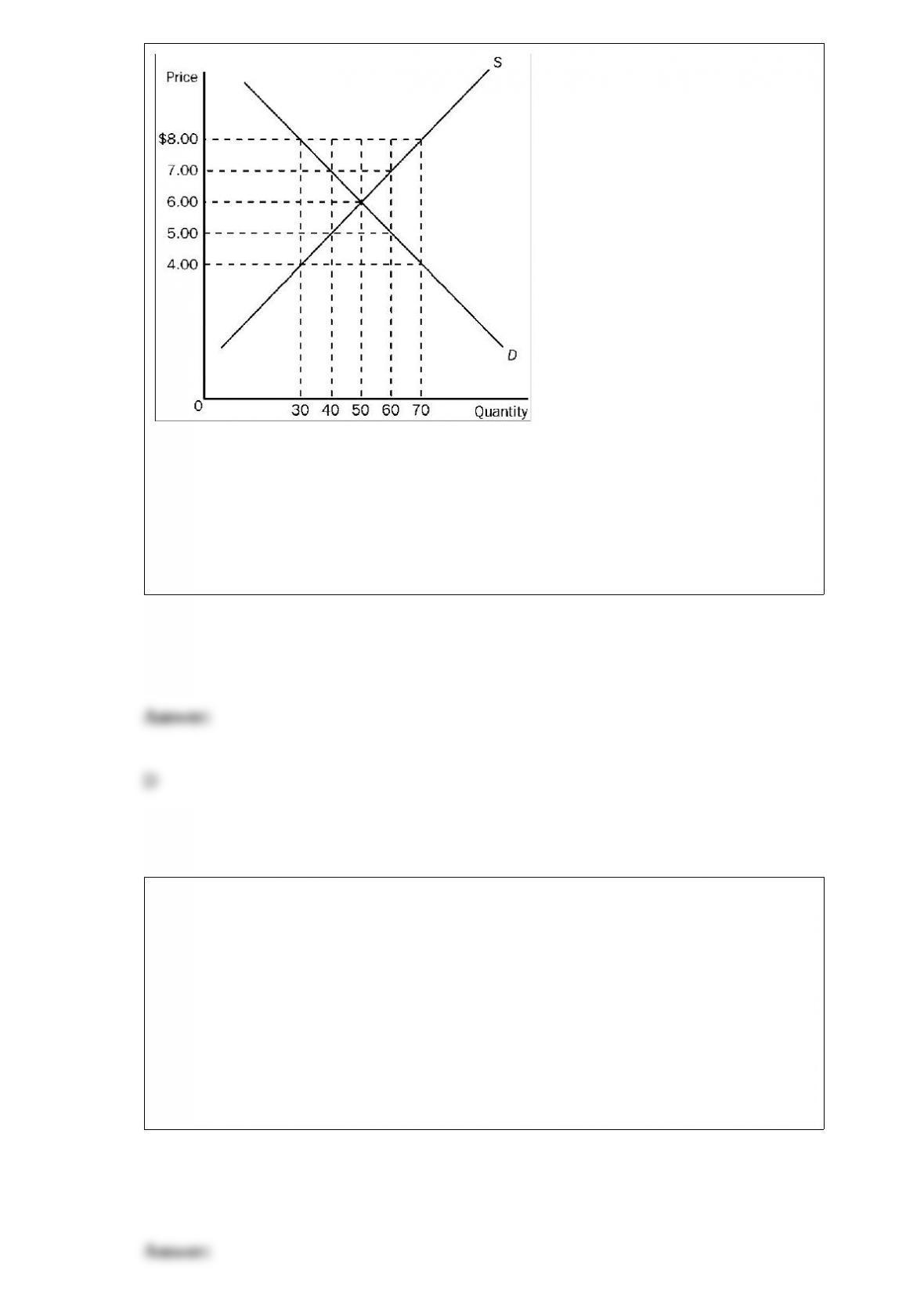
Refer to Figure 4-17. Suppose a price ceiling of $4.50 is imposed. As a result,
a. there is a shortage of 15 units of the good.
b. the demand curve will shift to the left so as to now pass through the point (Q = 35, P
= $4.50).
c. the situation is very much like the one created by a binding minimum wage.
d. the quantity of the good that is bought and sold is the same as it would have been had
a price floor of $7.50 been imposed.
Monetary policy pushed interest rates to historically low levels during 2002-2004, but
was more restrictive during 2005-2006. Economic analysis indicates that this policy
a. helped to smooth the ups and downs of the business cycle during this era.
b. contributed to the boom and bust of the housing market, and thereby the instability of
this era.
c. contributed to the housing bust of 2002-2004, but helped to restore stability to the
housing market in 2006-2008.
d. helped to bring inflation under control during 2002-2004, and thereby established a
foundation for a strong recovery during 2007-2010

Falling interest rates cause the market value of previously issued bonds to
a. rise.
b. fall.
c. remain unchanged.
d. increase during periods of inflation but decline during periods of deflation.
When economists say the quantity supplied of a product has increased, they mean the
a. supply curve has shifted to the left.
b. supply curve has shifted to the right.
c. price of the product has risen, and consequently, suppliers are producing more of it.
d. price of the product has fallen, and consequently, suppliers are producing less of it.
Which of the following will discourage investment?
a. well-defined property rights
b. monetary instability
c. a low and steady rate of inflation

d. low tax rates
The fact that barriers to entry are low in competitive price-searcher markets means that
if current firms are making economic losses,
a. these losses will remain in the long run because no firms can exit the market.
b. current firms will exit the market, causing the demand curves that face the remaining
firms to increase.
c. new firms will enter the market, causing the demand curves that face the existing
firms to decrease.
d. new firms will enter the market, causing no change in the demand curves that face
the existing firms in the market.
A fact based on observable phenomenon that is not influenced by differences in
personal opinion is called
a. an objective concept.
b. a subjective concept.
c. an unintended consequence.
d. ceteris paribus.

In 1964 civil rights legislation was passed
a. that made it illegal for women to make less than the minimum wage.
b. that created the No Woman Left Behind Commission.
c. prohibiting employers from discriminating based on race and gender.
d. requiring fields traditionally dominated by male workers to hire more female
candidates.
Empirical evidence suggests that the relative scarcity of most resources is
a. declining.
b. increasing slowly.
c. increasing rapidly.
d. largely unchanged over the past four decades.
Assume that you are a member of the U.S. House of Representatives from your home
state and district. Which of the following best explains why you have a strong incentive
to get the federal government to finance pork-barrel projects in your district?
a. Most of the benefits of pork-barrel projects within your district will accrue to your
constituents, while most of the costs will be imposed on voters from other districts.
b. Most of the costs of pork-barrel projects within your district will be imposed on your
constituents, while most of the benefits will accrue to voters from other districts.
c. Pork producers are a powerful political lobby that will influence the actions of
legislators in all districts.
d. This is a trick question; in a representative democracy, there is little incentive for
legislators to support pork-barrel projects.
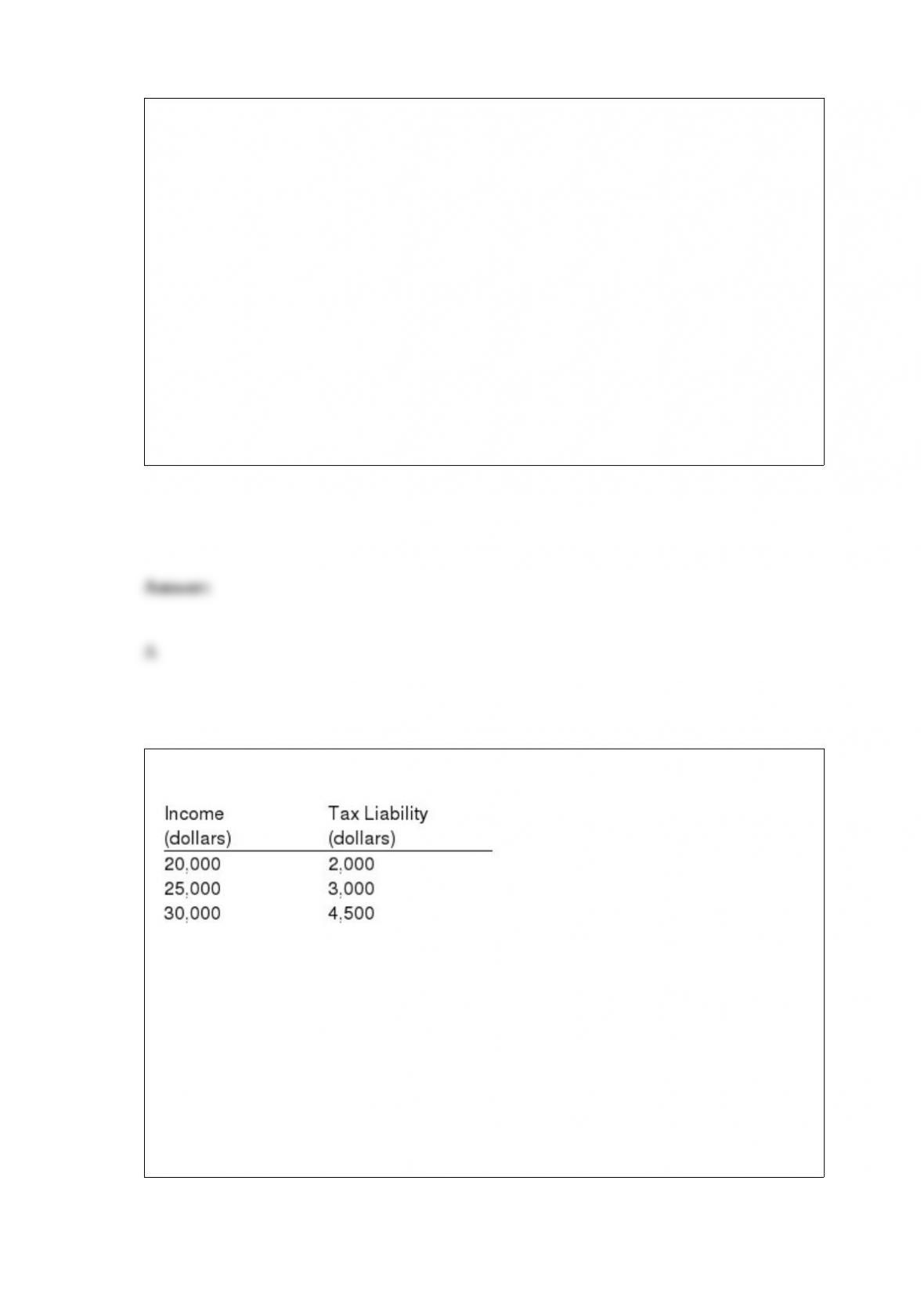
Use the table below to choose the correct answer.
The marginal tax rate on income in the $20,000 to $25,000 range is
a. 10 percent.
b. 12 percent.
c. 20 percent.
d. 30 percent.

Which of the following is a normative economic statement?
a. Congress should increase the legal minimum wage.
b. An increase in the legal minimum wage would cause unemployment to increase.
c. An increase in the legal minimum wage would cause unemployment to decrease.
d. An increase in the legal minimum wage would lead to more equality in the
distribution of income.
An analysis of housing prices between 1987 and 2008 indicates that prices
a. increased sharply in the five years leading up to the housing bust in 2007.
b. were relatively stable before dropping sharply in 2001.
c. rose steadily during the 1990s, but declined sharply beginning in 2001.
d. were erratic, but there was no discernable trend during either the 1990s or
2000-2006.

Assume, for the U.S., that the domestic price of beef without international trade is
lower than the world price of beef. This suggests that with trade,
a. the U.S. has a comparative advantage in the production of beef over other countries
and the U.S. will export beef.
b. the U.S. has a comparative advantage in the production of beef over other countries
and the U.S. will import beef.
c. other countries have a comparative advantage over the U.S. in the production of beef
and the U.S. will export beef.
d. other countries have a comparative advantage over the U.S. in the production of beef
and the U.S. will import beef.
Which of the following would be most likely to cause an increase in current aggregate
demand in the United States?
a. increased fear that the U.S. economy was going into a recession
b. an increase in the real interest rate
c. a reduction in the expected rate of inflation
d. rapid growth of real income in Canada and Western Europe
Which of the following calculates the cost of purchasing a specific bundle of goods and
services in each country and uses this measure to convert the incomes of different
countries to a common currency so they may be more accurately compared?
a. the consumer price parity (CPP) method
b. the purchasing power parity (PPP) method
c. the GDP deflator exchange (GDPDE) method
d. the inflation conversion factor (ICF) method
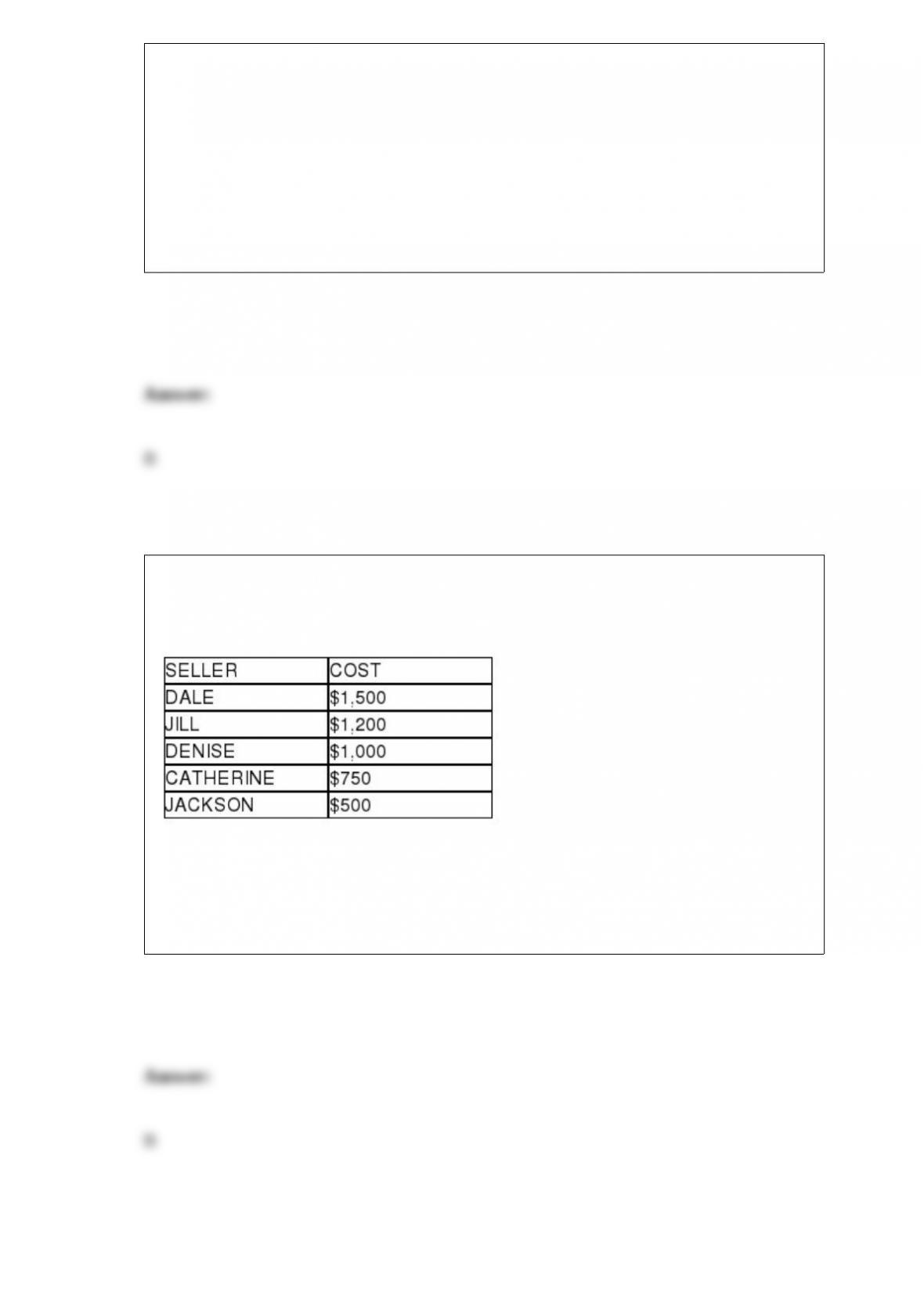
Table 3-2
Refer to Table 3-2. If the price is $1,000,
a. Denise is an eager supplier.
b. Catherine is an eager supplier.
c. Dale’s producer surplus is $500.
d. All of the above are correct.
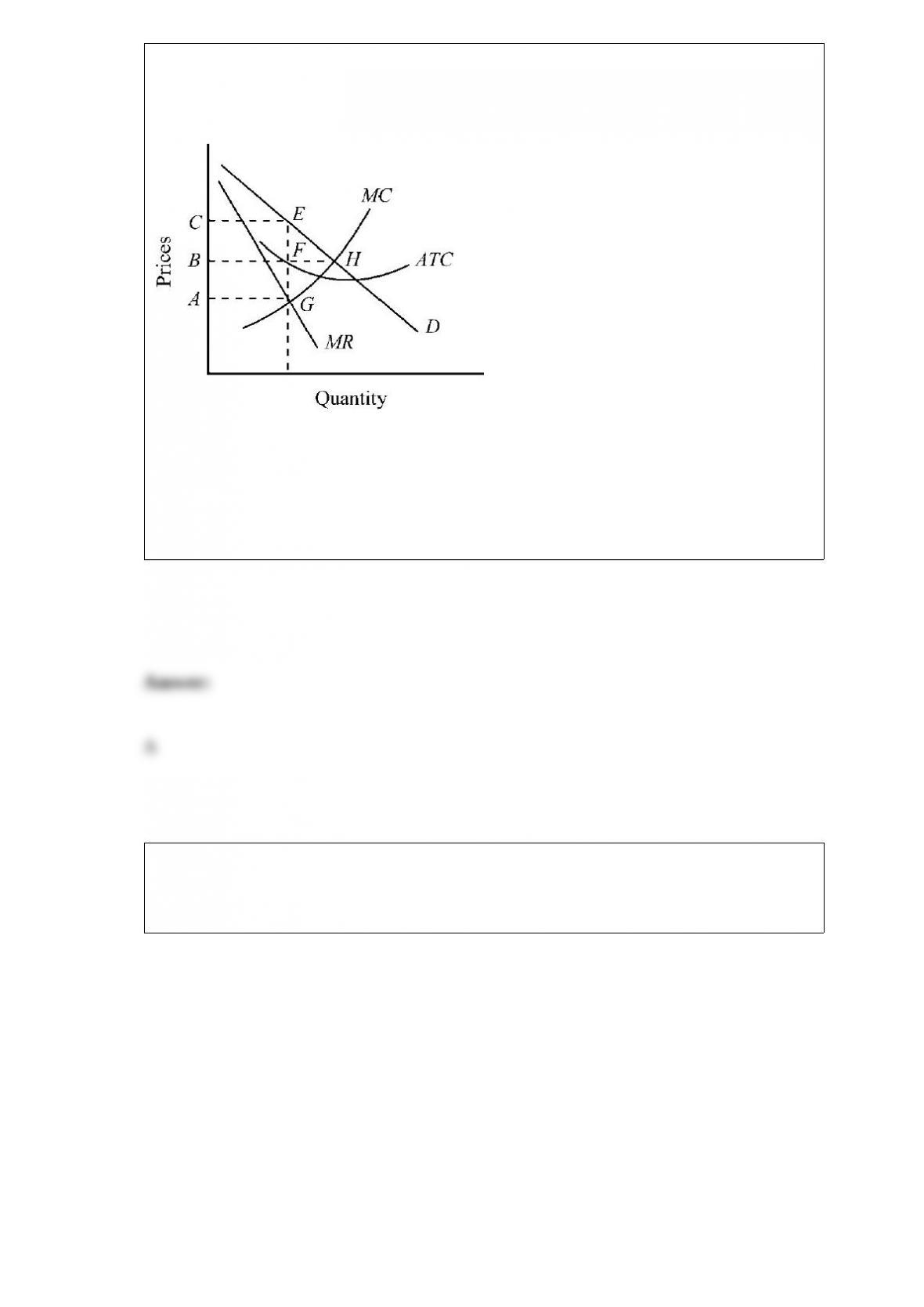
Figure 11-9
From Figure 11-9, indicate the maximum profit a pure monopolist with the cost and
demand conditions above would be able to achieve.
a. BFEC
b. AGEC
c. BHEC
d. EFH
Figure 4-20
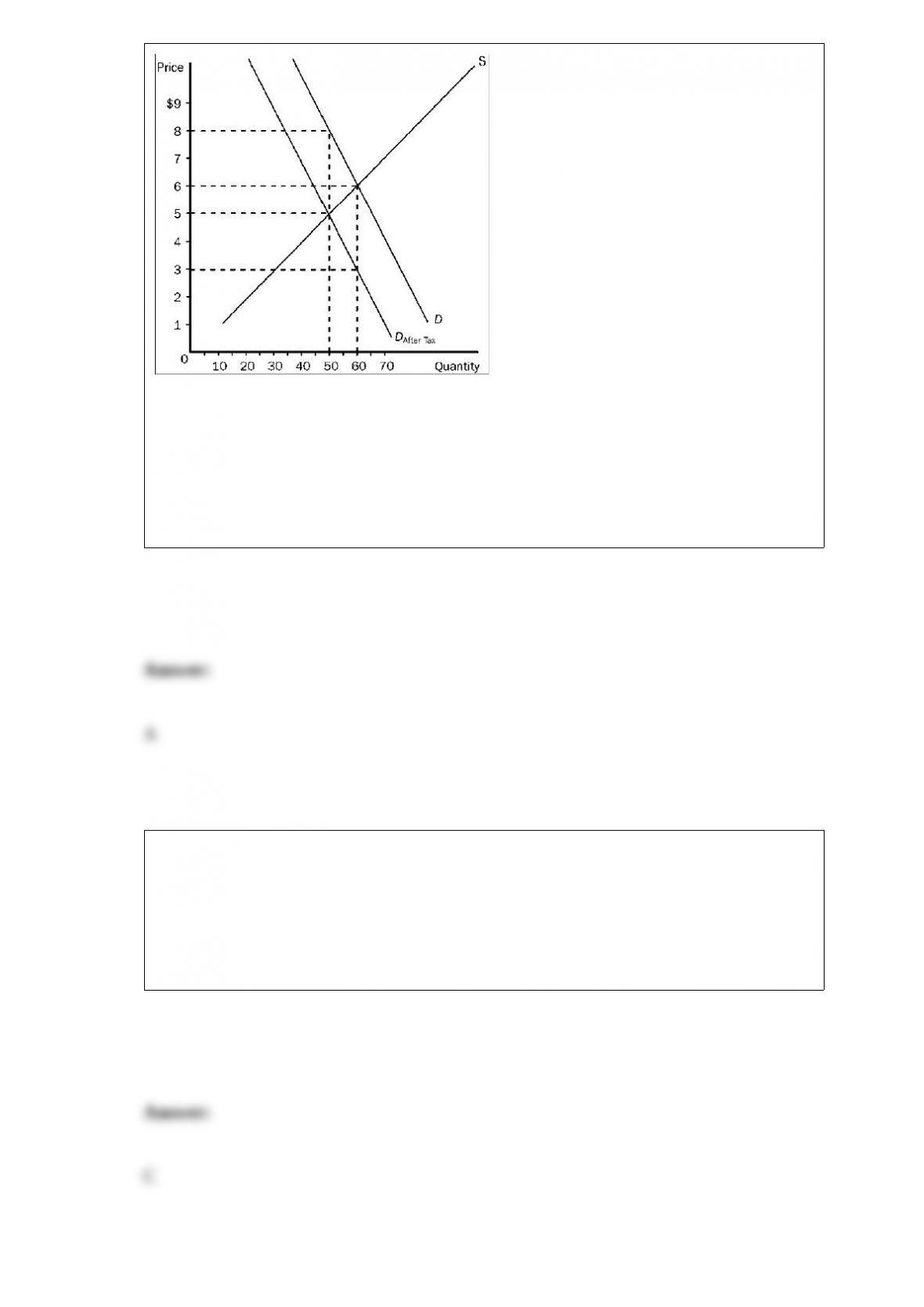
Refer to Figure 4-20. As the figure is drawn, who sends the tax payments to the
government?
a. the buyers
b. the sellers
c. A portion of the tax payments is sent by the buyers and the remaining portion is sent
by the sellers.
d. The question of who sends the tax payments cannot be determined from the figure.
Which of the following would not be included in GDP?
a. the real estate commission on the sale of a used home
b. an attorney’s fee for handling the sale of a used home
c. the value of a used home, at its sale price
d. fees paid to have the house cleaned

Senator DuMonde favors a government program that he believes will help save
endangered species. Economic analysis indicates that
a. because Senator DuMonde has good intentions, his new program will have the
desired results.
b. Senator DuMonde’s new program could have unintended consequences that might
result in an outcome different from what was intended.
c. regardless of any secondary effects, costs should not be considered when designing
environmental legislation.
d. because Senator DuMonde’s proposal is a government program, it will not have an
opportunity cost.
The new classical model implies that a
a. budget surplus will effectively retard inflation emanating from excess demand.
b. budget deficit will increase the real interest rate.
c. substitution of debt for tax financing will leave aggregate demand and real output
unchanged.
d. planned budget deficit will be a highly effective tool to combat a recession.

When both exports and imports are considered, the major advantage of international
trade is that it allows us to
a. seclude ourselves from foreign products.
b. consume a larger, more diverse quantity of goods and services at lower prices than
would otherwise prevail.
c. benefit at the expense of less-developed nations
d. maintain jobs for workers who would otherwise have little to do.
Legislation that offers immediate and easily recognized benefits, at the expense of costs
that are observable only in the distant future, is often enacted, even when economic
inefficiency results. In economics this is referred to as the
a. long-term effect.
b. political-fallacy effect.
c. shortsightedness effect.
d. inefficiency effect.
From the standpoint of society as a whole, rent seeking is
a. counterproductive because it takes resources away from the creation of wealth in the
private sector.
b. counterproductive because it fails to alter public policy.

c. productive because each interest group gains more than they spend on rent-seeking
activities.
d. productive because the resources used in rent seeking have no opportunity cost to
society.
Which of the following bestrepresents the effects of a decrease in the price of belts,
other things being equal?
a. An upward movement along the demand curve for belts.
b. A downward movement along the demand curve for belts.
c. A rightward shift in the demand curve for belts.
d. A leftward shift in the demand curve for belts.
Budget projections for 2014-2020 indicate both higher levels of government spending
and large budget deficits. According to the Keynesian view, this will lead to
a. an increase in aggregate supply during that decade.
b. weak aggregate demand and a continuation of recessionary conditions.
c. an increase in aggregate demand and real output.
d. higher interest rates and taxes that will retard future growth.

For the past several decades, the percentage of national income in the United States
allocated to human capital (employees and self-employed workers) has been
approximately
a. 20 percent.
b. 40 percent.
c. 60 percent.
d. 80 percent.
Other things being constant, countries with higher rates of saving
a. will have smaller GDPs than countries with lower rates of saving.
b. will have higher rates of investment, but slower growth.
c. will have higher rates of investment and growth.
d. will be operating at less than full employment and potential output.

If the Fed unexpectedly decreases the money supply, real GDP
a. increases because the resulting increase in the interest rate leads to a decrease in
investment.
b. increases because the resulting decrease in the interest rate leads to an increase in
investment.
c. decreases because the resulting increase in the interest rate leads to a decrease in
investment.
d. decreases because the resulting increase in the interest rate leads to an increase in
investment.
e. decreases because the resulting decrease in the interest rate leads to an increase in
investment.
Assume that during the last several years, the annual rate of inflation was 4 percent and
the annual growth rate of the money supply was 5 percent. During the last 12 months,
however, the monetary authorities have increased the money supply at a 12 percent
annual rate. The expected inflation rate for the next period will be
a. higher than 4 percent under the rational expectations hypothesis.
b. 4 percent under the adaptive expectations hypothesis.
c. higher than 4 percent under both the adaptive and rational expectations hypotheses.
d. both a and b.

The replacement of older products by newer improved ones is called
a. trickle-down economic growth.
b. creative destruction.
c. economies of scale.
d. planned obsolescence.
Suppose that a tax is placed on a particular good. If the sellers end up bearing most of
the tax burden, this indicates that the
a. demand is more inelastic than supply.
b. supply is more inelastic than demand.
c. government has required that buyers remit the tax payments.
d. government has required that sellers remit the tax payments.