
Payments by a corporation to its shareholders are known as
A) stocks.
B) bonds.
C) coupons.
D) dividends.
Some economists and lawmakers believe the Fed lost some of its independence when it
A) began printing money at the directive of the White House prior to the 2008
presidential election.
B) began working closely with the Treasury Department while dealing with the
financial crisis of 2008.
C) embarked on an expansionary monetary policy during the recession of 2007-2009.
D) began using the federal funds rate instead of M1 and M2 as a monetary policy target.
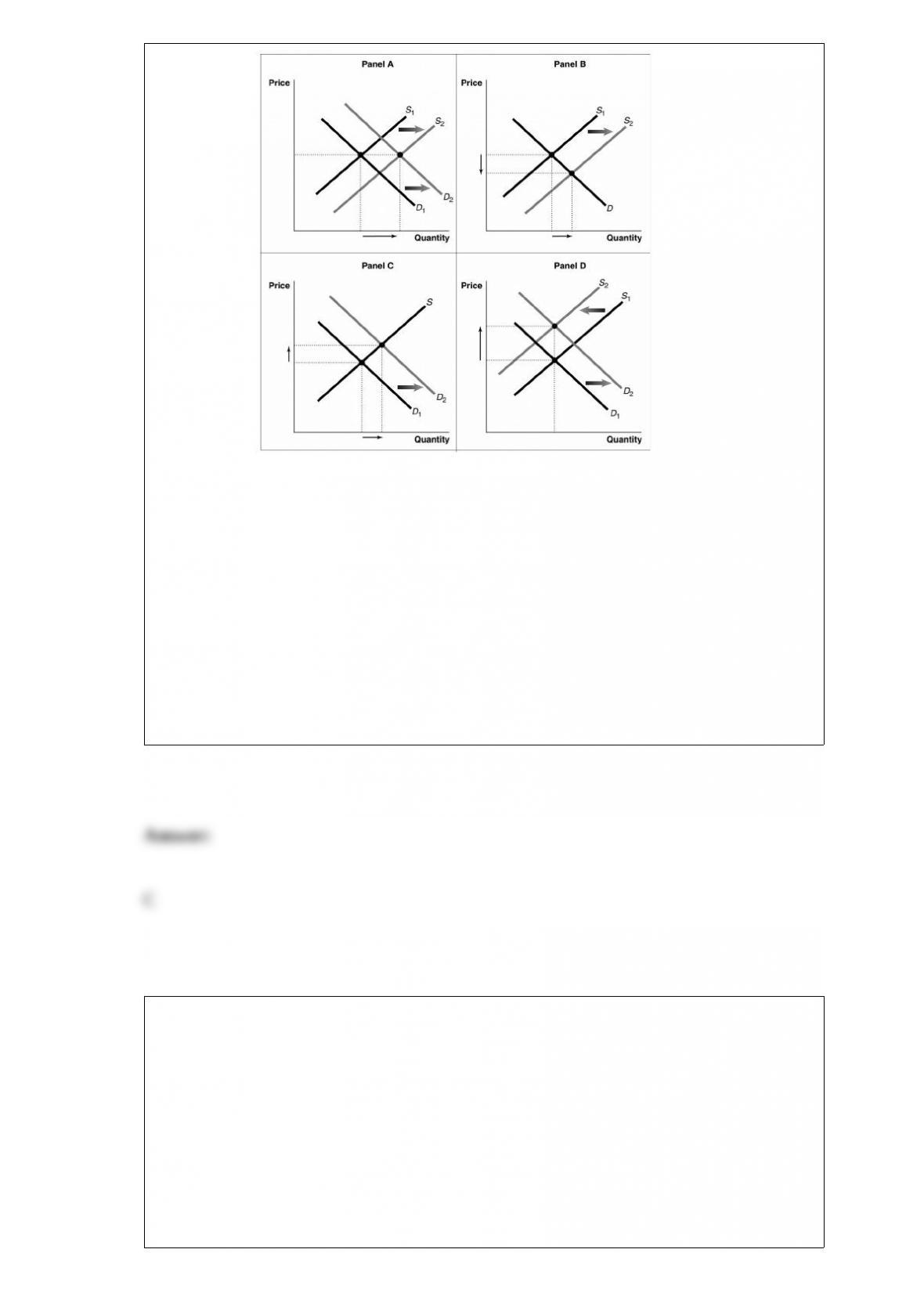
Figure 12-16
Which panel best represents the perfectly competitive organic produce market in which
firms are breaking even, economically, organic produce is considered a normal good,
and the average income level of consumers is rising?
A) Panel A
B) Panel B
C) Panel C
D) Panel D
Assume there is a shortage in the market for digital music players. Which of the
following statements correctly describes this situation?
A) The demand for digital music players is greater than the supply of digital music
players.
B) Some consumers will be unable to obtain digital music players at the market price
and will have an incentive to offer to buy the product at a higher price.
C) The price of digital music players will rise in response to the shortage; as the price

rises the quantity demanded will increase and the quantity supplied will decrease.
D) the shortage will cause an increase in the equilibrium price of digital music players.
Who hires the managers of a corporation?
A) the board of directors
B) stockholders
C) managers
D) employees
Monetary policy refers to the actions the
A) President and Congress take to manage the money supply and interest rates to
pursue their economic objectives.
B) Federal Reserve takes to manage the money supply and interest rates to pursue its
macroeconomic policy objectives.
C) President and Congress take to manage government spending and taxes to pursue
their economic objectives.
D) Federal Reserve takes to manage government spending and taxes to pursue its
economic objectives.

The Arrow impossibility theorem
A) explains why people can be rational as well as ignorant at the same time.
B) explains why voting systems do not consistently represent the preferences of voters.
C) explains why candidates for public office must represent the preferences of the
political middle.
D) explains why it is impossible, in most cases, to eliminate special-interest legislation
after it has become law.
When a recession ends,
A) interest rates decrease.
B) households decrease spending on durable goods.
C) the household sector decreases spending substantially.
D) firms increase the amount of borrowing.
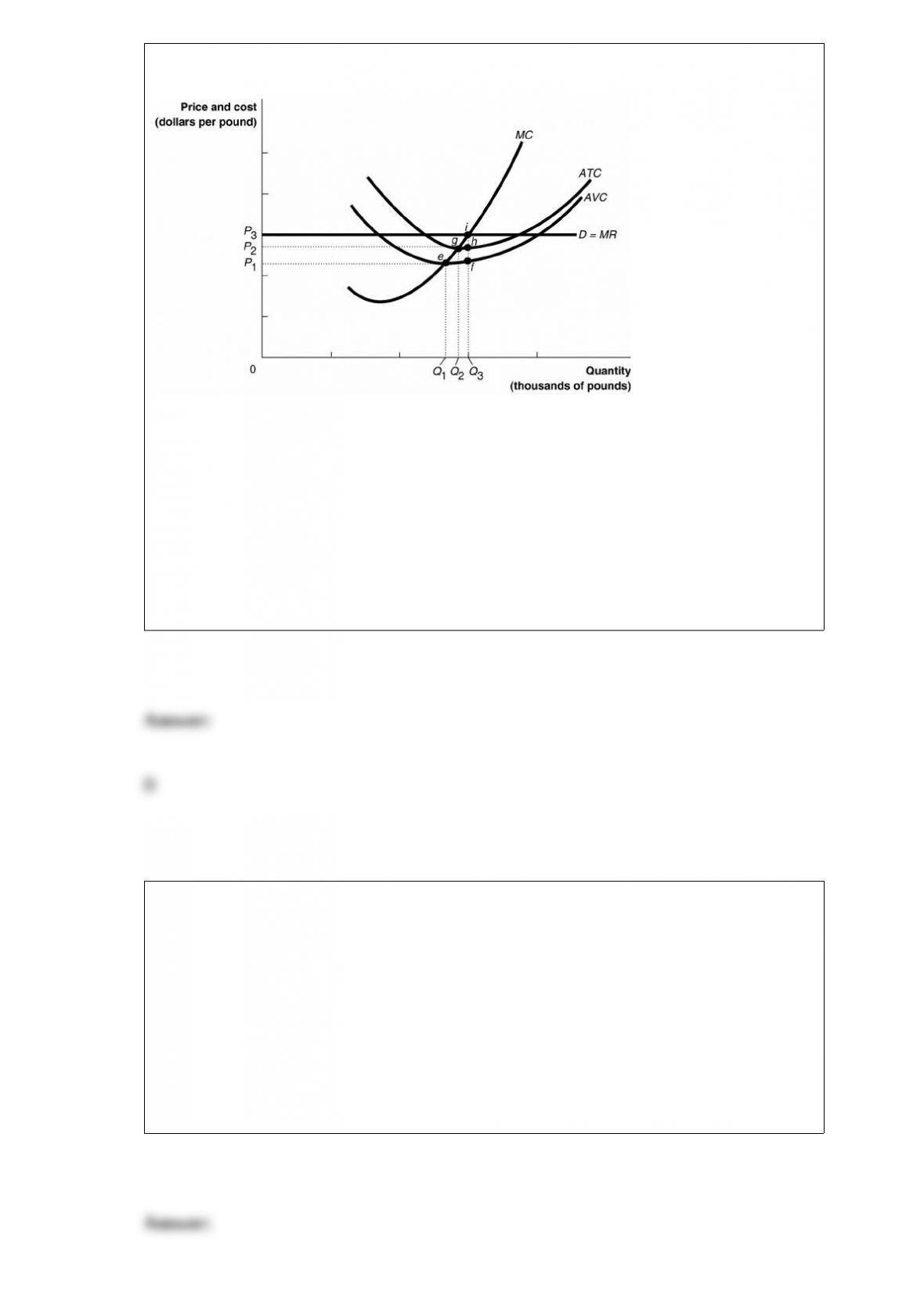
Figure 12-7
Figure 12-7 illustrates
the cost curves of a perfectly competitive firm. If the market price is P3 the firm
A) will break even.
B) will make a profit.
C) will earn enough revenue to cover its variable costs but not its fixed costs.
D) will produce a quantity of Q1.
Consider a downward-sloping demand curve. When the price of an inferior good
decreases, the income and substitution effects
A) work in the same direction to increase quantity demanded.
B) work in the same direction to decrease quantity demanded.
C) work in opposite directions, and quantity demanded increases.
D) work in opposite directions, and quantity demanded decreases.

Economists assume that rational people
A) never use all available information as they act to achieve their goals.
B) undertake activities that benefit others and hurt themselves.
C) only weigh the benefits and costs of the most desirable alternative actions.
D) respond to economic incentives.
If you are considering buying either an Apple iPhone or a Samsung Galaxy, and you
choose the Samsung only because the price is lower, then you consider
A) the iPhone and the Galaxy to be complements.
B) the iPhone and the Galaxy to be substitutes.
C) the iPhone to be a normal good and the Galaxy to be an inferior good.
D) the iPhone to be an inferior good and Galaxy to be a normal good.
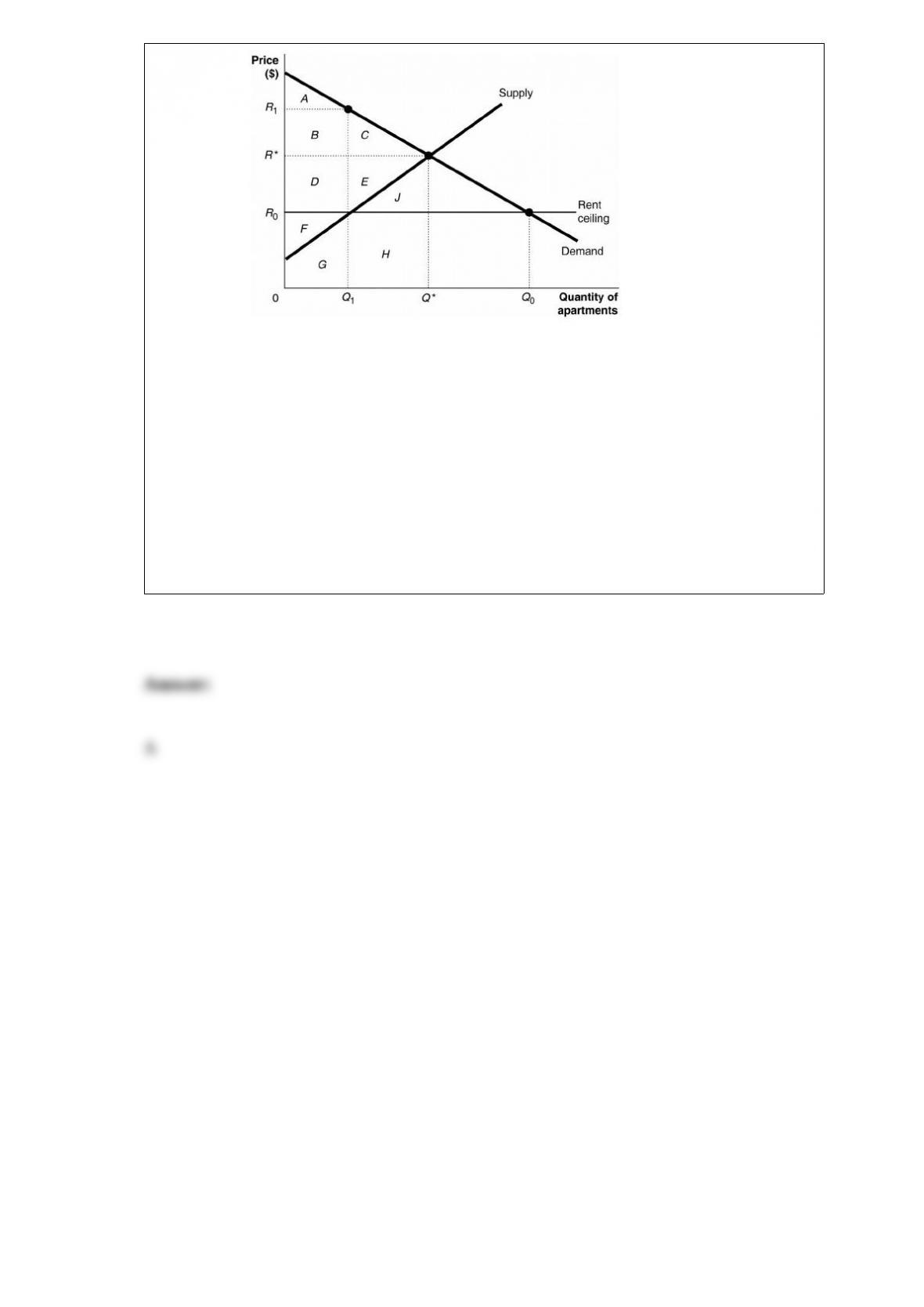
Figure 4-10 Figure 4-10 shows the
market for apartments in Bay City. Recently, the government imposed a rent ceiling at
R0. Suppose that instead of a price ceiling, the government imposed a price floor of R1.
What is the area representing consumer surplus after the imposition of the price floor?
A) A
B) A+ B + D
C) C + E
D) B + C + D + E