
You earn $500 a month, currently have $200 in currency, $100 in your checking
account, $2,000 in your savings accounts, $3,000 worth of illiquid assets and $1,000 of
debt. You have
A) money = $2,300, annual income = $6,000, and wealth = $5,000.
B) money = $300, annual income = $6,000, and wealth = $4,300.
C) money = $200, annual income = $500, and wealth = $4,300.
D) money = $300, annual income = $6,000, and wealth = $5,000.
All of the following are reasons why the wages of workers and the prices of inputs rise
more slowly than the prices of final goods and services except
A) unions are successful in pushing up wages.
B) firms are often slow to adjust wages.
C) contracts make prices and wages ‘sticky.”
D) menu costs make some prices sticky.
An advantage of the household survey over the establishment survey of the labor
market is that the household survey
A) is based on actual payrolls, rather than on unverified answers.
B) includes the number of self-employed persons.

C) includes the number of discouraged workers.
D) omits persons employed at newly opened firms.
In economics, the difference between a firm’s revenues and its costs is referred to as
A) physical capital.
B) profit.
C) capital gains.
D) factor payments.
Suppose the working-age population of a fictional economy falls into the following
categories: 90 are retired or homemakers; 60 have full-time employment; 20 have
part-time employment; 20 do not have employment, but are actively looking for
employment; and 10 would like employment but do not have employment and are not
actively looking for employment. The official unemployment rate as calculated by the
U.S. Bureau of Labor would equal
A) (20/60) x 100.
B) (20/80) x 100.
C) (30/80) x 100.
D) (20/100) x 100.

Congress and the president carry out fiscal policy through changes in
A) interest rates and the money supply.
B) taxes and the interest rate.
C) government purchases and the money supply.
D) government purchases and taxes.
The long-run aggregate supply curve shows the relationship between the ________ and
________.
A) inflation rate; quantity of real GDP demanded
B) real interest rate; quantity of real GDP supplied
C) nominal interest rate; quantity of real GDP supplied
D) price level; quantity of real GDP supplied
The Congressional Budget Office estimates that ________ of the increase in federal

spending on Medicare and Medicaid over the next 75 years will be due to increases in
the cost of providing health care.
A) very little
B) less than half
C) most
D) all
The Federal Reserve was established in 1913 to
A) prevent inflation by decreasing the money supply.
B) stimulate the economy by increasing bank reserves.
C) stop bank panics by acting as a lender of last resort.
D) prevent bad loans by requiring banks to hold reserves.
Figure 13-1
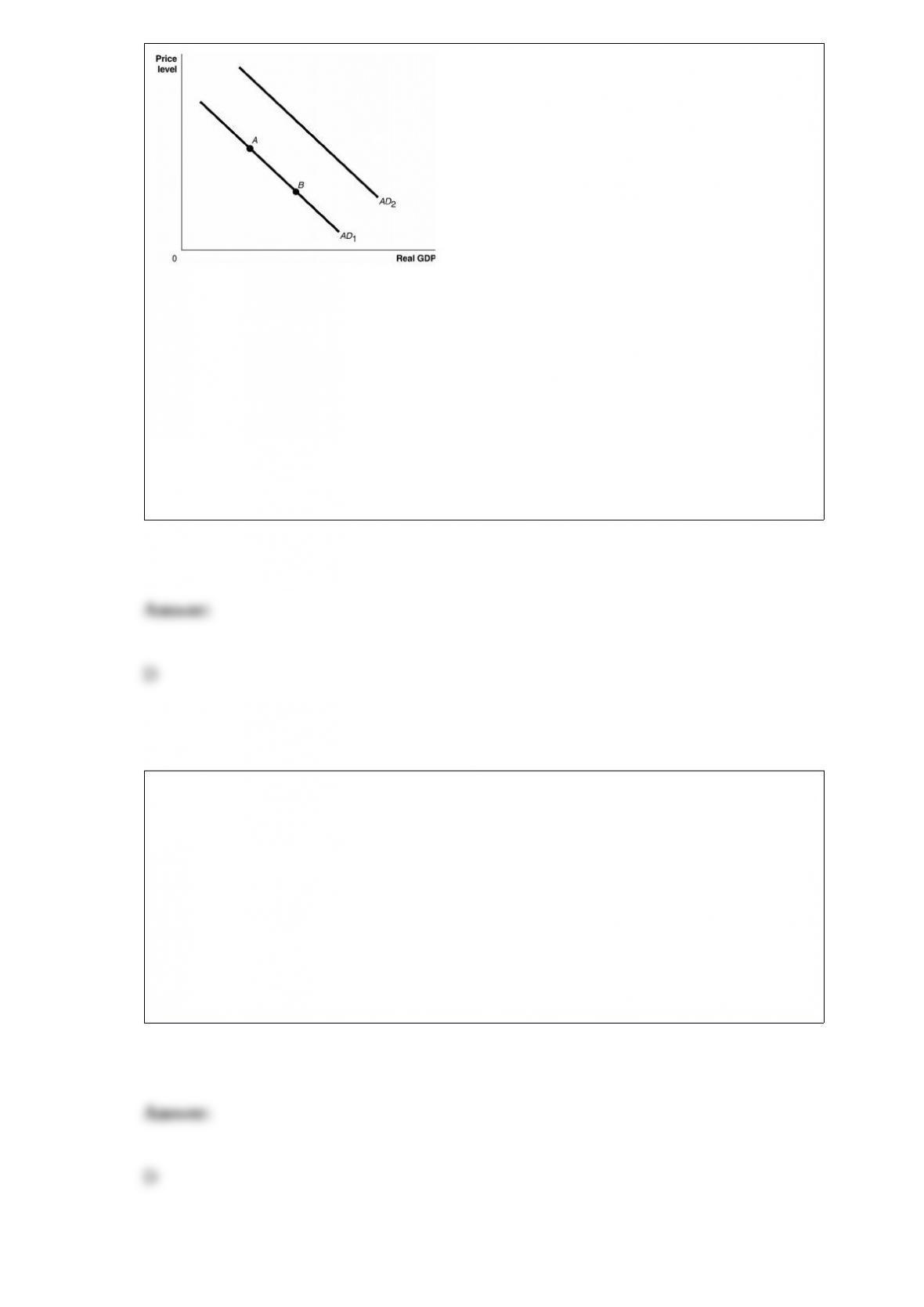
Refer to Figure 13-1. Ceteris paribus, an increase in the price level would be
represented by a movement from
A) AD1 to AD2.
B) AD2 to AD1.
C) point A to point B.
D) point B to point A.
GDP in a country grew from $10 billion to $14 billion over the span of 5 years. The
percentage change in GDP was
A) 4%.
B) 7%.
C) 10%.
D) 40%.

In the countries that have adopted inflation targeting, the inflation rate has typically
A) increased.
B) decreased.
C) decreased to zero.
D) not changed.
Which of the following would cause a decrease in the equilibrium price and decrease in
the equilibrium quantity of papayas?
A) a decrease in supply and an increase in demand
B) a decrease in demand
C) an increase in supply and an increase in demand greater than the increase in demand
D) a decrease in supply and a decrease in demand
The passage of the ________ in 1930 sparked a trade war that caused net exports to
decrease and real GDP to decrease.
A) Cellar-Kefauver Act
B) Sherman Antitrust Act
C) Clayton Act

D) Smoot-Hawley Tariff
The quantity theory of money implies that the price level will be stable (no inflation or
deflation) when the growth rate of the money supply equals
A) 0.
B) the growth rate of the price level.
C) the growth rate of the velocity of money.
D) the growth rate of real GDP.
The expansionary monetary and fiscal policies of the 1960s resulted in ________
inflation rates and ________ rates of unemployment.
A) high; high
B) low; low
C) low; high
D) high; low
Which of the following is not true about the composition of GDP in 2012?
A) The majority of consumer spending is on durable goods.
B) Purchases made by state and local governments are greater than purchases made by
the federal government.
C) Imports are greater than exports.
D) Business fixed investment is the largest component of investment.
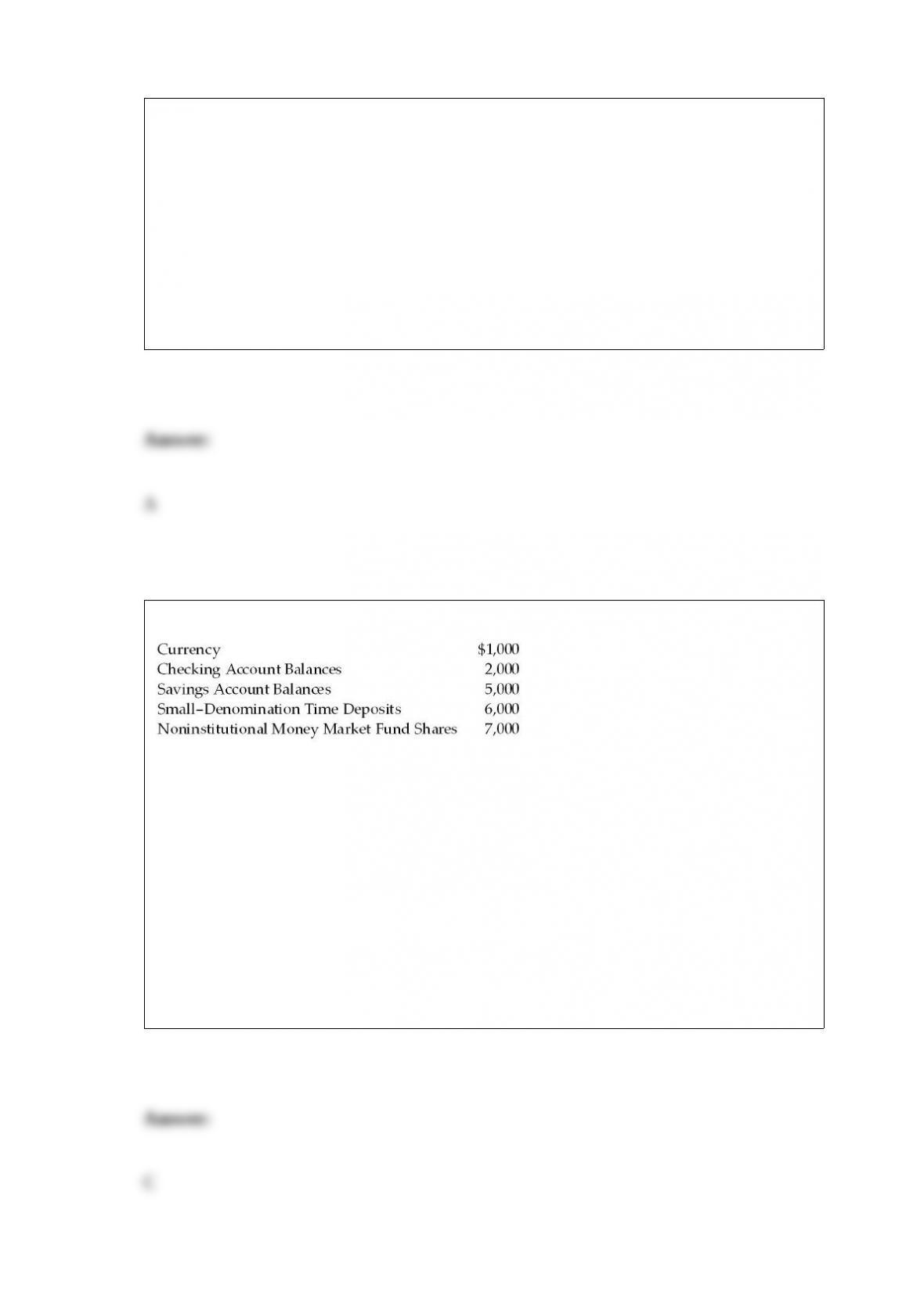
Scenario 14-1
Consider the information above for a simple economy. Assume there are no traveler’s
checks.
Refer to Scenario 14-1. M1 in this simple economy equals
A) $1,000.
B) $2,000.
C) $3,000.
D) $8,000.