
One point on a market supply curve represents $4 and 100 units quantity supplied. If
there are three suppliers, and at a price of $4 one of the suppliers supplies 23 units, then
which of the following combinations of price and quantity supplied might hold for the
other two suppliers?
a. At $4, quantity supplied could be 40 units for one supplier and 27 for the other.
b. At $4, quantity supplied could be 33 units for one supplier and 27 for the other.
c. At $4, quantity supplied could be 40 units for one supplier and 37 for the other.
d. At $4, quantity supplied could be 77 units for one supplier and 10 for the other.
e. There is not enough information to answer this question.
In agriculture during much of the 20th century, supply grew more than demand. Which
two farm problems are these?
a. the high-productivity problem and the income elasticity problem
b. the low-productivity problem and the income inelasticity problem
c. the high-productivity problem and the income inelasticity problem
d. the low-productivity problem and the income elasticity problem
e. none of the above
It is argued that certain industries should be protected from foreign competition because
they are needed to secure the United States from foreign aggression. This argument is

called the __________ argument.
a. saving domestic-jobs
b. low foreign wages
c. foreign export subsidies
d. national defense
Transfer payments are payments that are
a. made in return for goods and services currently supplied.
b. made in return for goods and services to be supplied in the future.
c. made in return for goods and services that were supplied in the past.
d. not made in return for goods and services currently supplied.
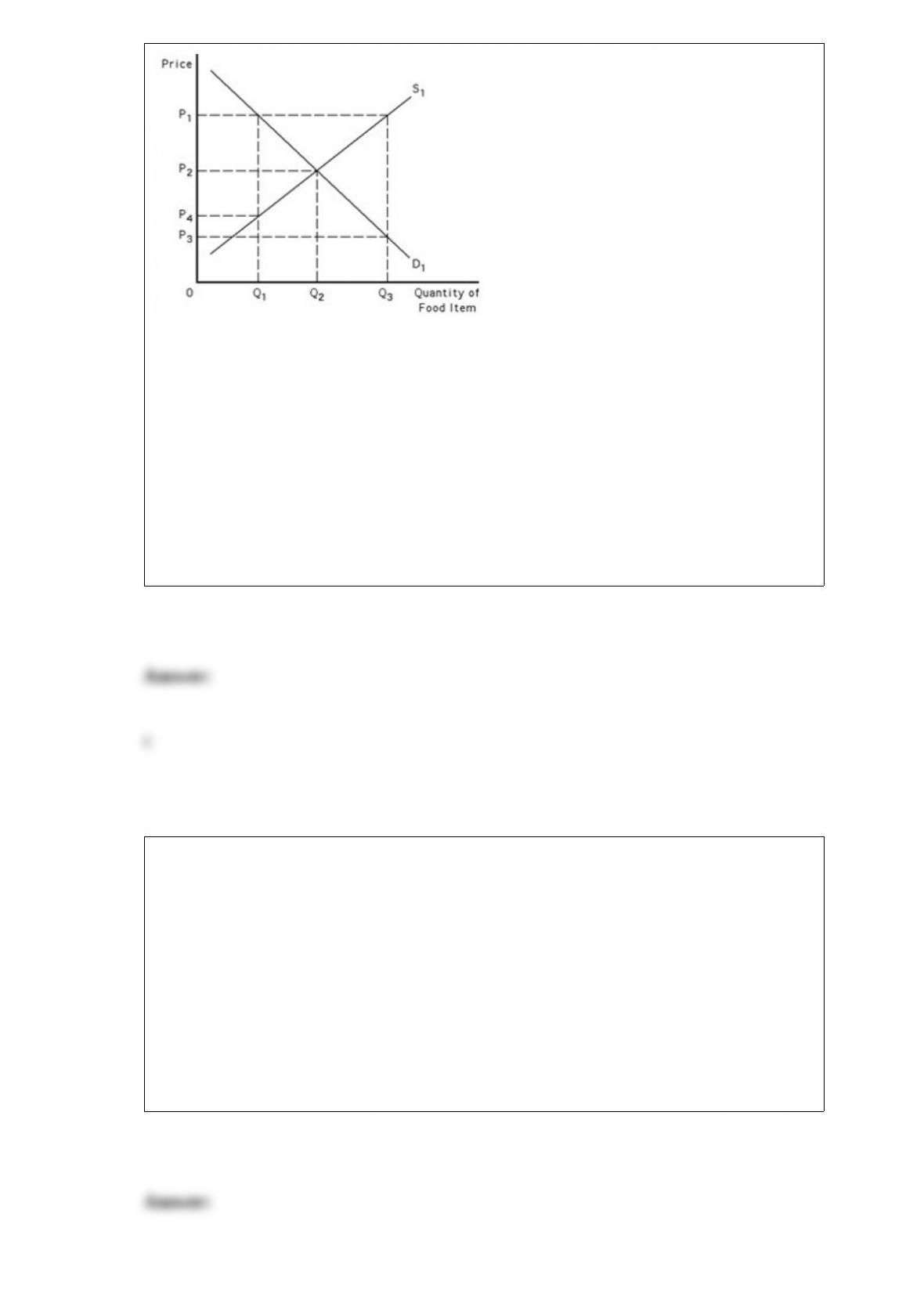
Refer to Exhibit 39-9. Under a target price system, with the target price set at P1, the
price at which consumers will buy the food item is
Exhibit 39-9
a. P1.
b. P2.
c. P3.
d. P4.
e. There is not enough information to answer the question.
Suppose that prices in the United States rise relative to prices in France. We expect that
(on the foreign exchange market) the demand for U.S. dollars will __________ and the
supply of dollars will __________.
a. increase; increase
b. increase; decrease
c. decrease; increase
d. decrease; decrease

Which of the following is an example of a monopolistic competitor?
a. General Motors
b. a wheat farmer in Iowa
c. a long-distance telephone company
d. a family-owned Italian restaurant
Which of the following statements is false?
a. Income elasticity of demand measures the responsiveness of quantity demanded to
changes in income.
b. Price elasticity of demand measures the responsiveness of quantity demanded to
changes in price.
c. Price elasticity of demand and the slope of a demand curve are the same thing.
d. The more substitutes for a good, the higher the price elasticity of demand, ceteris
paribus.

We would expect the total utility of diamonds to be __________ than the total utility of
water and the marginal utility of diamonds to be __________ than the marginal utility
of water.
a. higher; higher
b. lower; lower
c. higher; lower
d. lower; higher
Scientists are interested in finding out when their theories are wrong, as well as when
their theories are right.
a. True
b. False
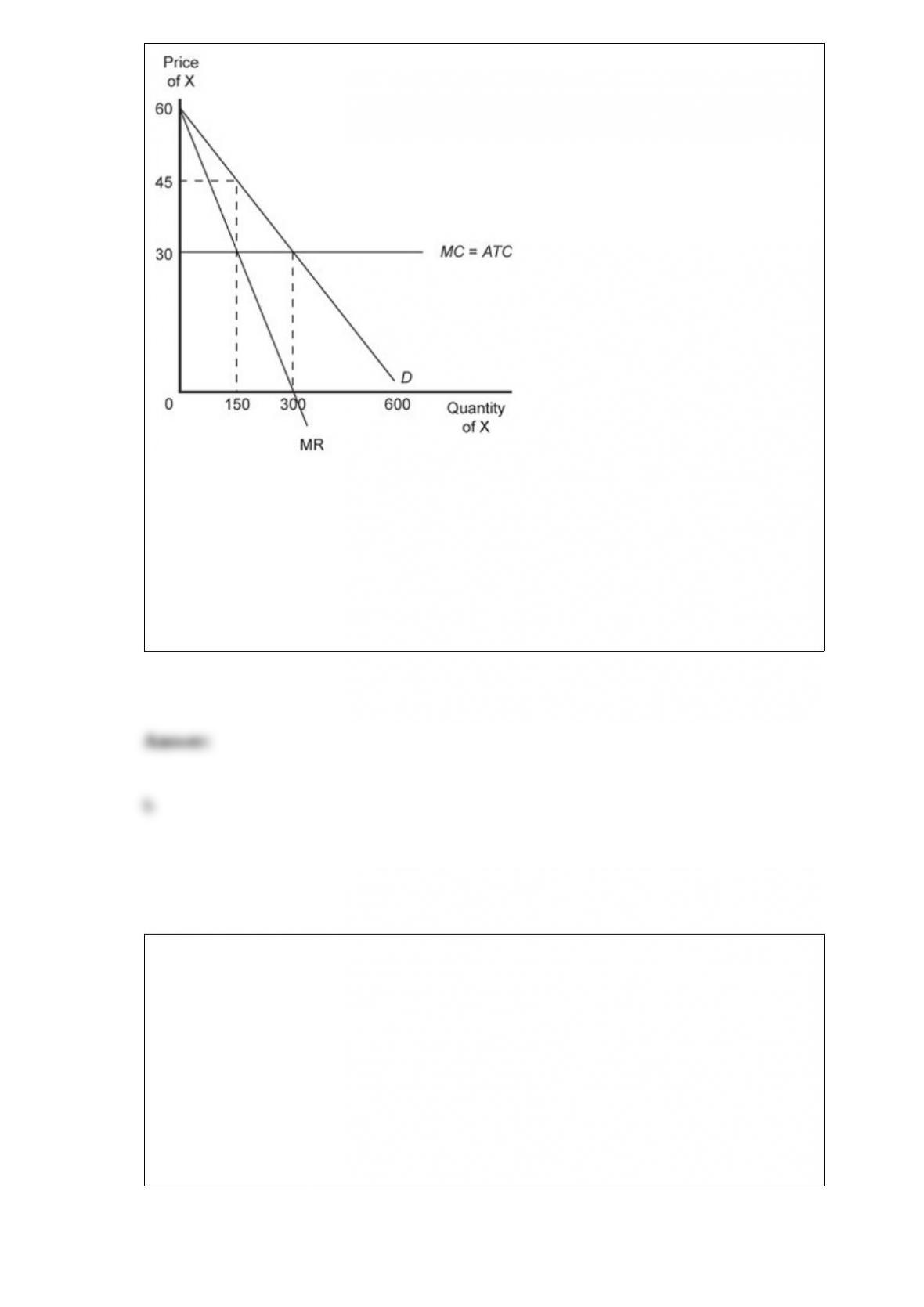
Refer to Exhibit 24-7. Let D be the demand curve facing a perfectly
price-discriminating monopolist. The marginal revenue it receives from selling the
150th unit of good X sold equals
Exhibit 24-7
a. $60.
b. $45.
c. $30.
d. $0, since it sells less than 150 units.
In long-run equilibrium, the perfectly competitive firm earns __________ economic
profits.
a. positive
b. zero
c. negative
d. any of the above
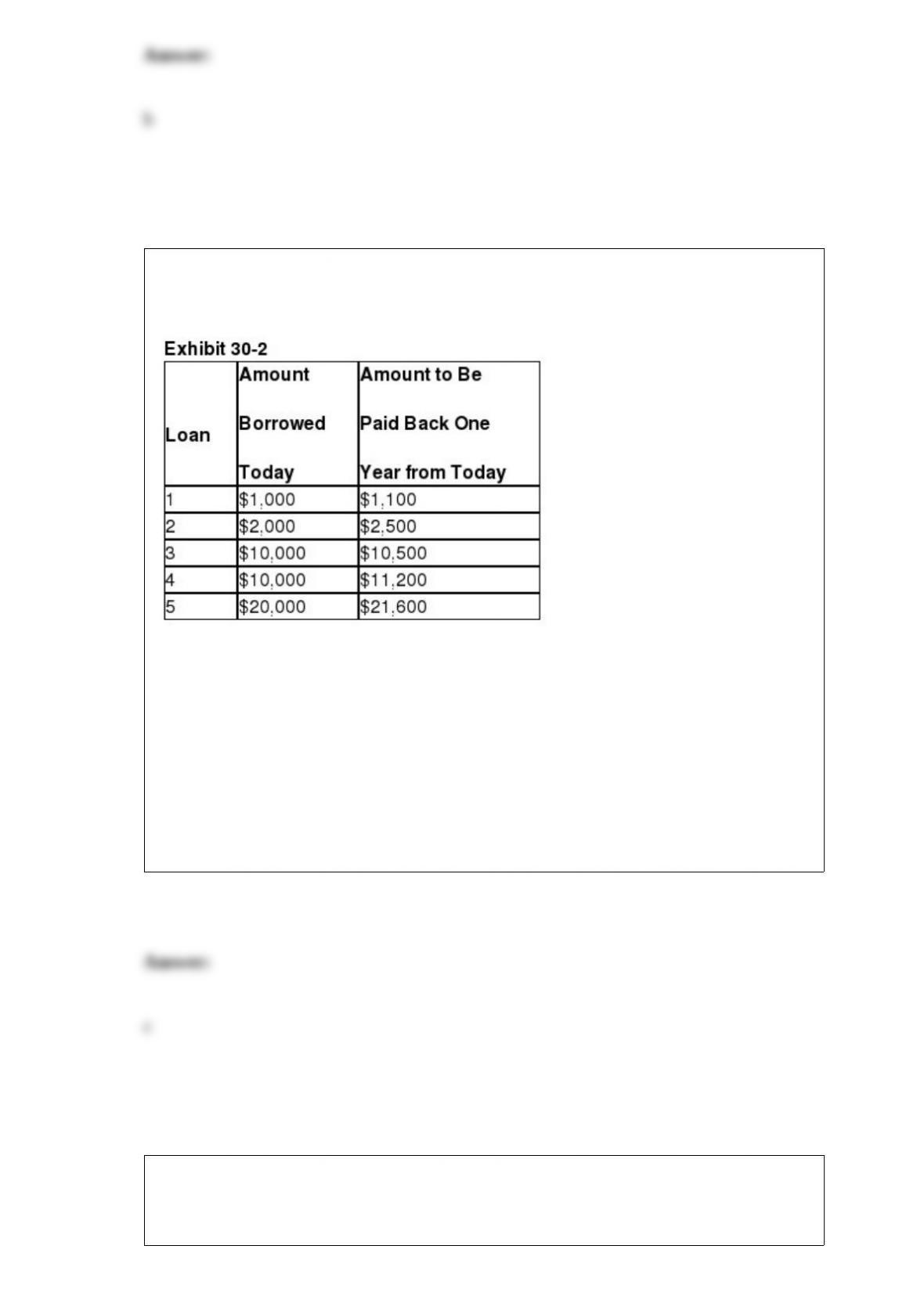
Refer to Exhibit 30-2. The interest and interest rate for loan 5 are, respectively,
a. $21,600 and 8.0 percent.
b. $21,600 and 10.8 percent.
c. $1,600 and 8.0 percent.
d. $1,600 and 10.8 percent.
e. none of the above
Which of the following statements is false?
a. Specialization and trade allow a country’s inhabitants to consume at a level beyond its

production possibilities frontier.
b. Some of the goods the U.S. exports include cars, coal, and wheat.
c. Some of the goods the U.S. imports include cars, oil, and coffee.
d. A country has a comparative advantage in producing that good it can produce at
lower opportunity cost than another country.
e. none of the above
Which of the following is probably not an acceptable solution to the problem of
diseconomies of scale?
a. reorganization
b. building a larger plant
c. dividing operations
d. hiring new managers
Simple majority rule can generate inefficient outcomes because
a. it does not register the intensity of voters’ preferences.
b. it cannot adjust for special interest lobbying efforts.

c. it does not adjust for the costs of rational ignorance.
d. people are often misinformed on what it is they are voting on.
e. none of the above
If the average variable cost curve is falling,
a. the MC curve must be below it.
b. marginal cost is greater than average variable cost.
c. the MC curve is necessarily falling.
d. the MC curve is necessarily horizontal (neither rising nor falling).
e. the MC curve is necessarily rising.
Which of the following statements is true?
a. Monopolistic competitive firms do not experience the law of diminishing marginal
returns when they produce output.
b. Monopolistic competitive firms face a downward-sloping demand curve and a
horizontal marginal cost curve.
c. There are many buyers and few sellers in the theory of monopolistic competition.

d. Monopolistic competitors are said to underutilize their present plant size.
e. none of the above
A simultaneous decrease in the demand and the supply of good X always leads to a
decrease in the price of good X.
a. True
b. False
Suppose Andrea is taking just two courses and is at a point on her PPF of grades for
those two courses.Now this PPF shifts inward and Andrea moves to a point on the new
PPF.Which of the following would be impossible after her PPF has shifted inward
compared to before the PPF shifted?
a. both of her grades to fall
b. both of her grades to rise
c. one of her grades to rise and the other grade to fall
d. one of her grades to fall while the other grade stays constant

Involuntary transfers are the type of transfers used in the case against government.
a. True
b. False