1) the u.s. “trade-remedy laws” could establish all of the following except:
a.import tariffs to protect u.s. firms seriously injured by foreign competition
b.countervailing duties which neutralize foreign export subsidies
c.antidumping duties which protect u.s. firms from imports sold at less-than-fair-value
d.economic sanctions levied against hostile nations
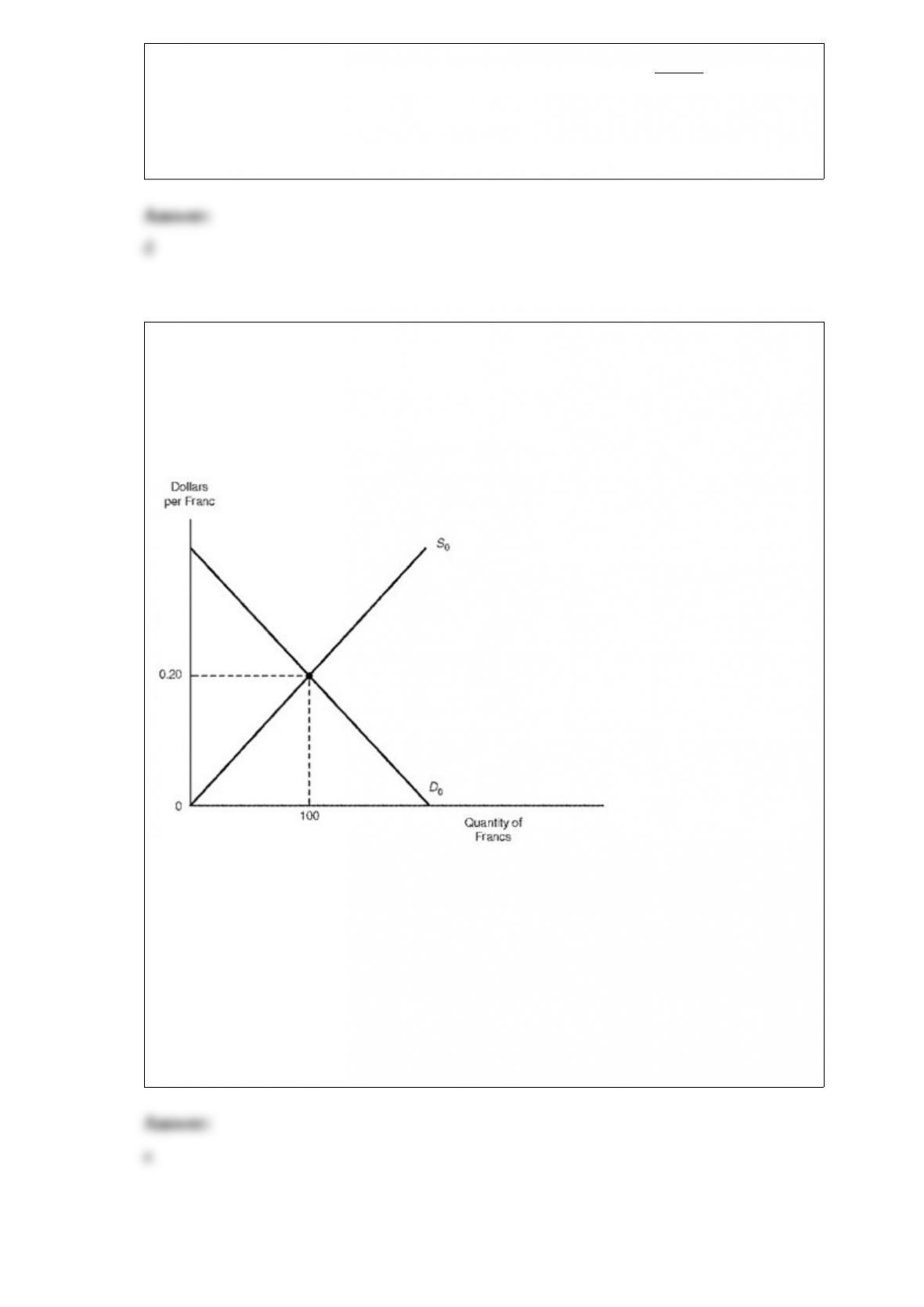
2) the figure below illustrates the supply and demand schedules of swiss francs in a
market of freely-floating exchange rates.
figure 12.1 the market for francs
refer to figure 12.1. should preferences for imports rise in the united states and fall in
switzerland, there would occur a (an):
a.increase in the demand for francs–decrease in the supply of francs-depreciation of the
dollar
b.increase in the demand for francs–decrease in the supply of francs-appreciation of the
dollar
c.decrease in the demand for francs–decrease in the supply of francs-appreciation of the
dollar
d.decrease in the demand for francs–increase in the supply of francs-depreciation of the
dollar
3) the u.s. demand for pesos would shift to the right if there occurred a (an):
a.change in preferences toward u.s. manufactured goods
b.increase in the dollar/peso exchange rate
c.decrease in the u.s. population
d.increase in the u.s. price level
4) the merchandise-trade account on the balance-of-payments statement is defined the
same way as “net exports” which constitutes part of the nation’s gross domestic product.
a.true
b.false
5) a u.s. investor’s extra rate of return on an investment in france, as compared to the
united states, equals the interest-rate differential adjusted for any change in the
dollar/franc exchange rate.
a.true
b.false
6) the appropriate expenditure-switching policy to correct a current account surplus is:
a.currency revaluation
b.currency devaluation
c.expansionary monetary policy
d.contractionary fiscal policy
7) as new regional trading arrangements are formed, the opportunity cost of remaining
outside:
a.increases
b.decreases
c.remains stable
d.none of these
8) under a floating exchange rate system, an increase in u.s. imports of japanese goods
will cause the demand schedule for japanese yen to:
a.increase, inducing a depreciation in the yen
b.decrease, inducing a depreciation in the yen
c.increase, inducing an appreciation in the yen
d.decrease, inducing an appreciation in the yen
9) which method of trading currencies involves the conversion of one currency into
another at one point in time with an agreement to reconvert it back to the original
currency at some point in the future?
a.forward transaction
b.futures transaction
c.spot transaction
d.swap transaction
10) on the u.s. balance of payments, the following transactions are debits, leading to
payments to foreigners: merchandise imports, travel expenditures, gifts to foreign
residents, and overseas investments by u.s. residents.
a.true
b.false
11) because the ricardian theory of comparative advantage was based only on a nation’s
demand conditions, it could not fully explain the distribution of the gains from trade
among trading partners.
a.true
b.false
12) reducing a current account deficit requires a country to:
a.increase private saving relative to investment
b.increase private consumption relative to saving
c.increase private investment relative to consumption
d.increase private investment relative to saving
13) international trade in goods and services is sometimes used as a substitute for all of
the following except:
a.international movements of capital
b.international movements of labor
c.domestic production of the same goods and services
d.domestic production of different goods and services
14) under a system of floating exchange rates, a u.s. trade deficit with japan will cause:
a.a flow of gold from the united states to japan
b.the u.s. government to ration yen to u.s. importers
c.an increase in the dollar price of yen
d.a decrease in the dollar price of yen
15) by establishing transplant factories in the united states, japanese automakers were
able to avoid export restrictions imposed by the japanese government, but not import
restrictions imposed by the u.s. government.
a.true
b.false
16) nations have typically placed greater importance to the goal of internal balance than
to the goal of external balance.
a.true
b.false
17) with a tariff on auto imports, increased domestic demand leads to a fall in the
number of autos imported and a rise in the number of autos produced domestically.
a.true
b.false
18) for most nations, the ratio of imports to total purchases in the public sector is much
higher than in the private sector.
a.true
b.false
19) in a two-product, two-country world, international trade can lead to increases in:
a.consumer welfare only if output of both products is increased
b.output of both products and consumer welfare in both countries
c.total production of both products, but not consumer welfare in both countries
d.consumer welfare in both countries, but not total production of both products