
________ tended to increase spending on health care in the United States.
A) The aging of the U.S. population, rather than advances in medical technology, has
B) Advances in medical technology, rather than the aging of the U.S. population, has
C) The aging of the U.S. population, as well as advances in medical technology, have
D) Neither the aging of the U.S. population, nor advances in medical technology, have
An economic principle that explains why people pursue different occupations is
A) absolute advantage.
B) international trade.
C) comparative advantage.
D) NAFTA.
According to Joseph Schumpeter, which of the factors of production is central to
economic growth?
A) land
B) labor
C) natural resources
D) the entrepreneur

If a consumer receives 20 units of utility from consuming two candy bars, and 25 units
of utility from consuming three candy bars, the marginal utility of the second candy bar
is
A) 25 utility units.
B) 20 utility units.
C) 5 utility units.
D) unknown as more information is needed to determine the answer.
A firm could continue to operate for years without ever earning a profit as long as it is
producing an output where
A) MR < ATC.
B) ATC > AVC.
C) MR > AVC.
D) AFC < AVC.

Which of the following price indices comes closest to measuring the cost of living of
the typical household?
A) GDP deflator
B) producer price index
C) consumer price index
D) household price index
The main purpose of most tariffs and quotas is to
A) raise revenue for the government.
B) reduce the prices consumers pay for goods and services.
C) reduce the foreign competition that domestic firms face.
D) improve the quality of goods and services imported into the country.
Table 16-3
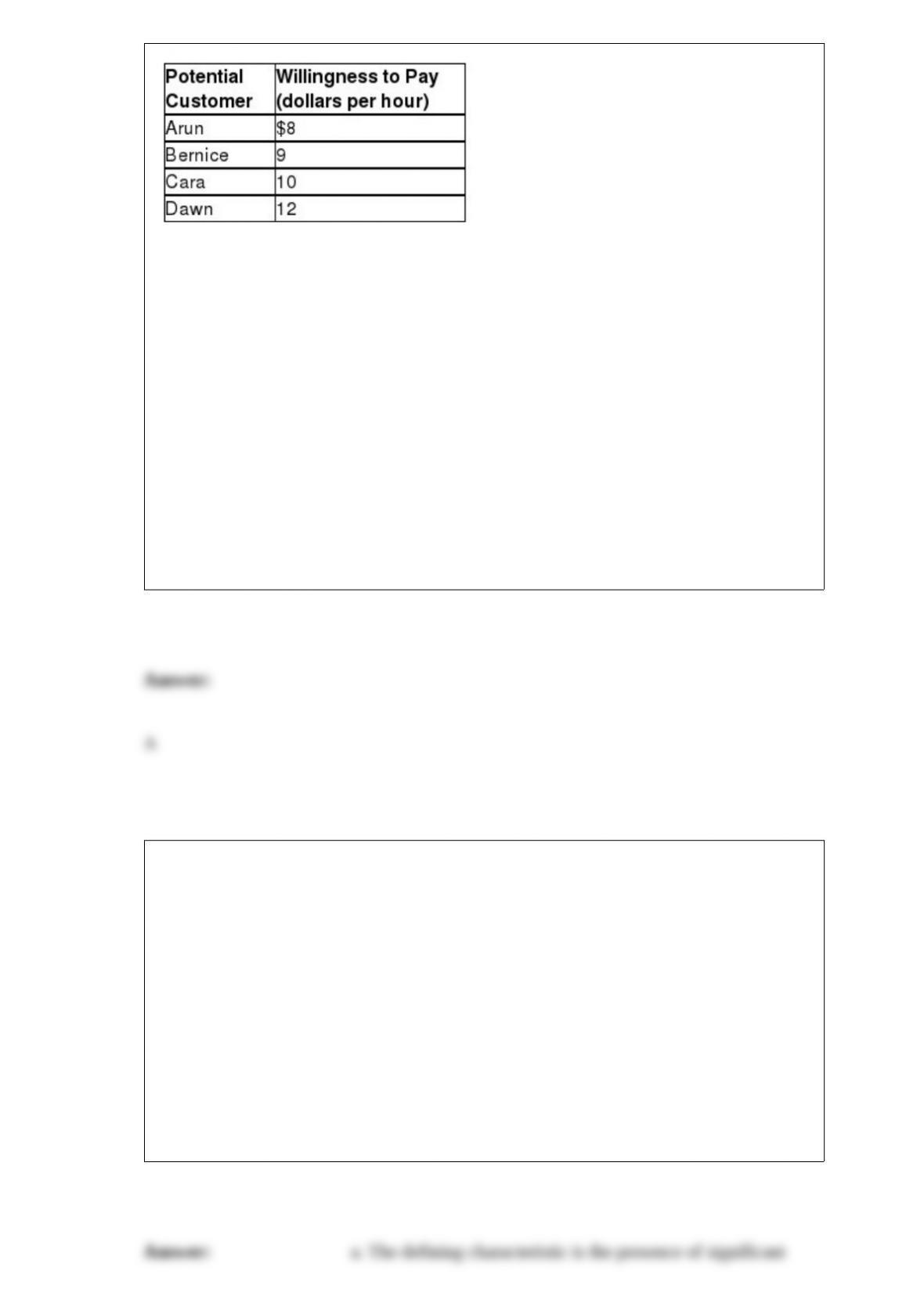
Julie plans to start a pet-sitting service. She surveyed her neighborhood to determine the
demand for this service. Assume that each person surveyed demands only one hour of
pet sitting services per period. Table 16-3 above shows a portion of her survey results.
Suppose Julie’s marginal cost of providing this service is constant at $7 and she decides
to charge each customer according to his or her willingness to pay. What is Julie’s total
revenue and how many hours of service will be purchased?
A) 4 hours and her total revenue = $39
B) 4 hours and her total revenue = $28
C) 1 hour and her total revenue = $7
D) 5 hours and her total revenue = $35
a. What is the defining characteristic of a natural monopoly?
b. Should the government break up a natural monopoly into two or more firms to make
the industry more competitive?
c. Suppose the government wants to ensure that some of the benefits of declining
average total cost are passed on to consumers. To achieve this goal, it requires that the
natural monopoly set its price equal to marginal cost. Is this a feasible goal? Explain.
d. What is an alternative to marginal cost pricing that ensures that consumers reap some
of the benefits of declining average total cost?
German automobile exports were hurt in 2008 as a result of the recession. How would
this decrease in exports have affected Germany’s aggregate demand curve?
A) The aggregate demand curve would have shifted to the right.
B) The aggregate demand curve would not have shifted, but there would have been a
movement up the aggregate demand curve.
C) The aggregate demand curve would not have shifted, but there would have been a
movement down the aggregate demand curve.
D) The aggregate demand curve would have shifted to the left.
Last year, the Pottery Palace supplied 8,000 ceramic pots at $40 each. This year, the
company supplied the same quantity of ceramic pots at $55 each. Based on this
evidence, The Pottery Palace has experienced
A) a decrease in supply.
B) an increase in supply.
C) an increase in the quantity supplied.
D) a decrease in the quantity supplied.
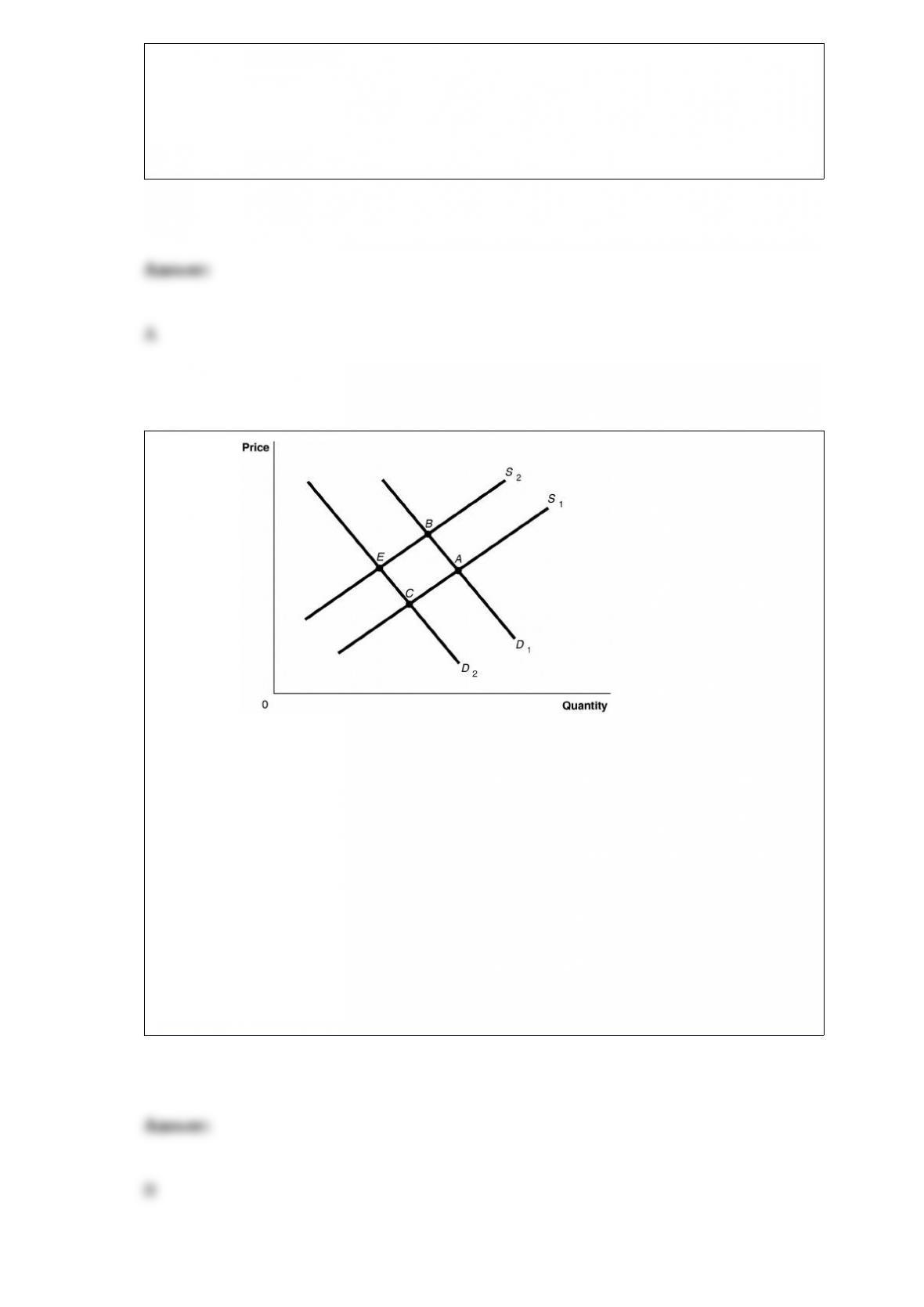
Figure 3-8
The graph in this figure illustrates an initial competitive equilibrium in the market for
sugar at the intersection of D1 and S2 (point B). If there is a decrease in the price of
fertilizer used on sugar cane and there is a decrease in tastes for sugar-sweetened soft
drinks, how will the equilibrium point change?
A) The equilibrium point will move from B to A.
B) The equilibrium point will move from B to C.
C) There will be no change in the equilibrium point.
D) The equilibrium point will move from B to E.