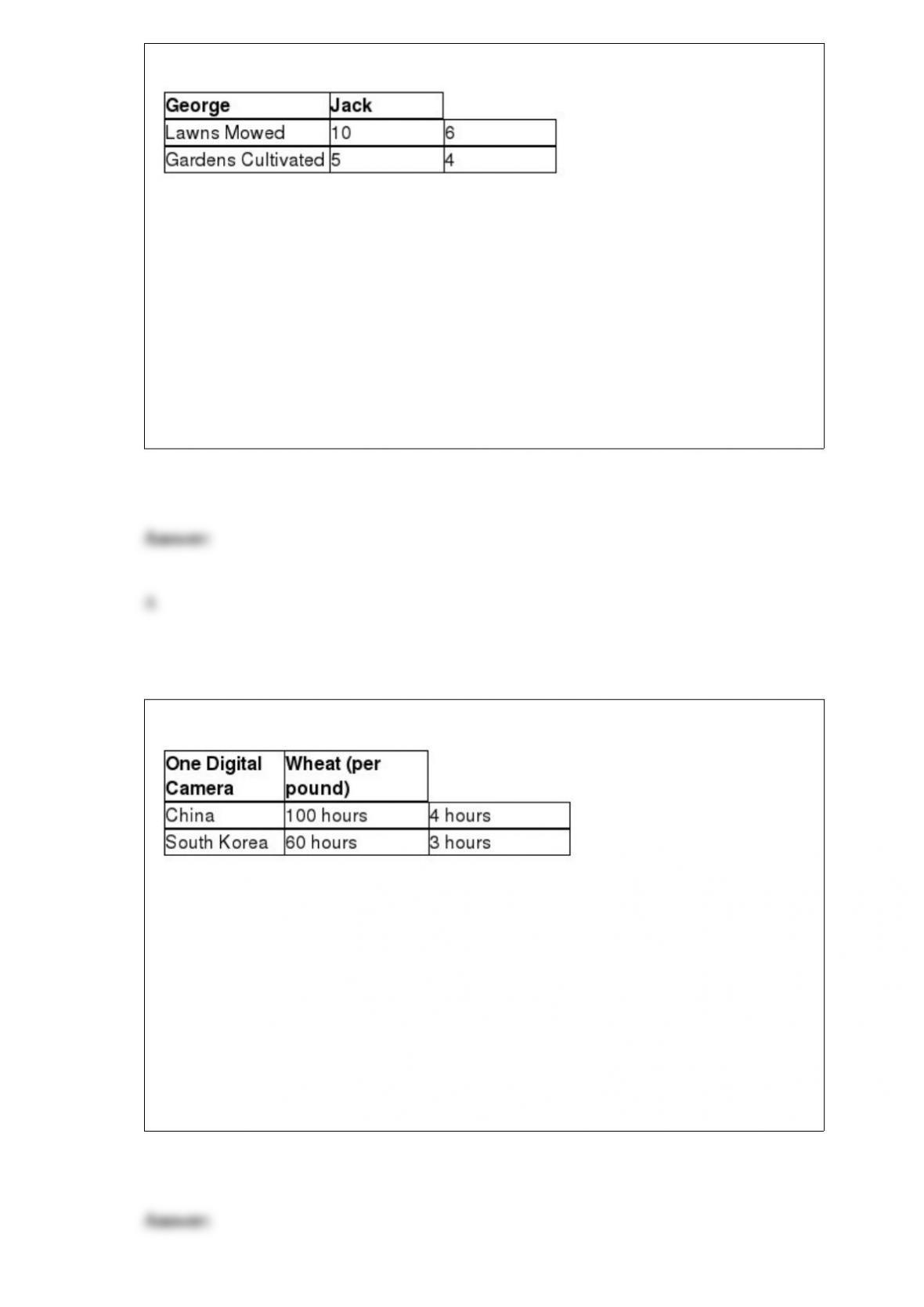
Table 2-15
Table 2-15 shows the output per day of two gardeners, George and Jack. They can
either devote their time to mowing lawns or cultivating gardens. What is George’s
opportunity cost of mowing a lawn?
A) half a garden cultivated
B) two lawns mowed
C) two-thirds of a garden cultivated.
D) one and a half lawns mowed
Table 2-8
Table 2-8 shows the number of labor hours required to produce a digital camera and a
pound of wheat in China and South Korea. What is South Korea’s opportunity cost of
producing one pound of wheat?
A) 60 digital cameras
B) 20 digital cameras
C) 5 digital cameras
D) 0.05 units of a digital camera

The factors of production include
A) wages.
B) capital.
C) investment.
D) transfers.
The simple deposit multiplier is the ratio of the amount of
A) new reserves created by the banks to the amount of deposits.
B) new reserves created by the banks to the amount of loans.
C) deposits created by the banks to the amount of new reserves.
D) loans issued by the banks to deposits created by the banks.
Some economists argue that the federal government should normally run a deficit at
potential GDP, with the borrowed funds applied to
A) consumption goods.
B) investment goods.
C) social security benefits.
D) health care costs.
In July, market analysts predict that the price of gold will rise in August. What happens
in the gold market in July, holding everything else constant?
A) The supply curve shifts to the right.
B) The supply curve shifts to the left.
C) The quantity demanded and the quantity supplied of gold increase.
D) The demand curve shifts to the left.
Figure 5-3 Figure 5-3 represents the market for
medical services with and without insurance, and the effect of a third-party payer
system on the demand for medical services. If consumers paid the full price of medical

services, the price they would pay is
A) $40.
B) $55.
C) $65.
D) >$65.
Which of the following explains why two firms, Apex and Bongo, would engage in
implicit collusion, rather than explicit collusion?
A) Implicit collusion allows Apex to increase its profits at the expense of Bongo
without Bongo knowing that collusion has occurred; if Apex engages in explicit
collusion, Bongo will realize collusion has taken place and retaliate against Apex.
B) Implicit collusion is less costly to both firms than explicit collusion; therefore,
profits will be greater for both firms if they engage in implicit collusion.
C) explicit collusion is illegal; if the managers of Apex and Bongo engage in implicit
collusion they may be within the law.
D) Implicit collusion always has an enforcement mechanism that forces both firms to
collude; explicit collusion does not have an enforcement mechanism.
A monopolistically competitive firm will
A) charge the same price as its competitors do.

B) always produce at the minimum efficient scale of production.
C) have some control over its price because its product is differentiated.
D) produce an output level that is productively and allocatively efficient.
Suppose real GDP is $12.6 trillion and potential GDP is $12.4 trillion. To move the
economy back to potential GDP, Congress should
A) lower government purchases by an amount less than $200 billion.
B) lower government purchases by $200 billion.
C) raise taxes by $200 billion.
D) lower taxes by $200 billion.
E) raise taxes by an amount more than $200 billion.
What does the PPI measure?
A) the average change in the prices paid for all goods produced in the economy over a
given year
B) the average of the prices received by producers of goods and services at all stages of
the production process
C) the level of production of goods and services generated in the economy in a given
year

D) the difference between the prices consumers pay for goods and services and the
prices producers pay for goods and services
How will an increase in labor productivity affect equilibrium in the labor market?
A) The supply of labor will increase and the equilibrium wage and quantity of labor
will increase.
B) The demand for jobs will increase and the equilibrium wage and quantity of labor
will increase.
C) The demand for labor will increase and the equilibrium wage and quantity of labor
will increase.
D) The demand for labor will decrease because fewer workers will be needed to
produce the same output. The equilibrium wage and quantity of labor will decrease.
A lumberjack loses his job because timber cutting restrictions were imposed by the EPA
to protect the spotted owl habitat. This lumberjack would be
A) frictionally unemployed.
B) cyclically unemployed.
C) structurally unemployed.
D) seasonally unemployed.

Suppose a decrease in the supply of wheat results in an increase in revenue. This
indicates that
A) the decrease in quantity sold is proportionately larger than the resulting change in
price.
B) the resulting increase in price is proportionately greater than decrease in quantity
sold.
C) the demand curve for wheat must be vertical.
D) the supply curve for wheat must be vertical.
The Fed
A) can easily distinguish the minor ups and downs of the economy from a recession.
B) can have difficulty distinguishing the minor ups and downs of the economy from a
recession.
C) always times its policy responses correctly.
D) can easily determine if a drop in production means a recession is inevitable.

Which of the following is not part of the “individual mandate” provision of the Patient
Protection and Affordable Care Act (ACA)?
A) Individuals are allowed to opt out of the insurance program if they can prove they
have no serious health issues and do so before the act fully takes effect in the year 2014.
B) By 2016, fines for not having health insurance will be the greater of $695 per person
or 2.5 percent of income.
C) Beginning in 2014, individuals who do not acquire health insurance will be subject
to a fine.
D) With limited exceptions, every resident of the United States will be required to have
health insurance that meets certain basic requirements.
Stricter laws and regulations to protect intellectual property rights
A) will help to create a more successful market system.
B) will only benefit those companies whose intellectual property rights have in the past
been ignored.
C) will tend to have little impact on an economy since intellectual property is not
tangible.
D) will create a stronger and more successful black market for intellectual property.
Table 16-3
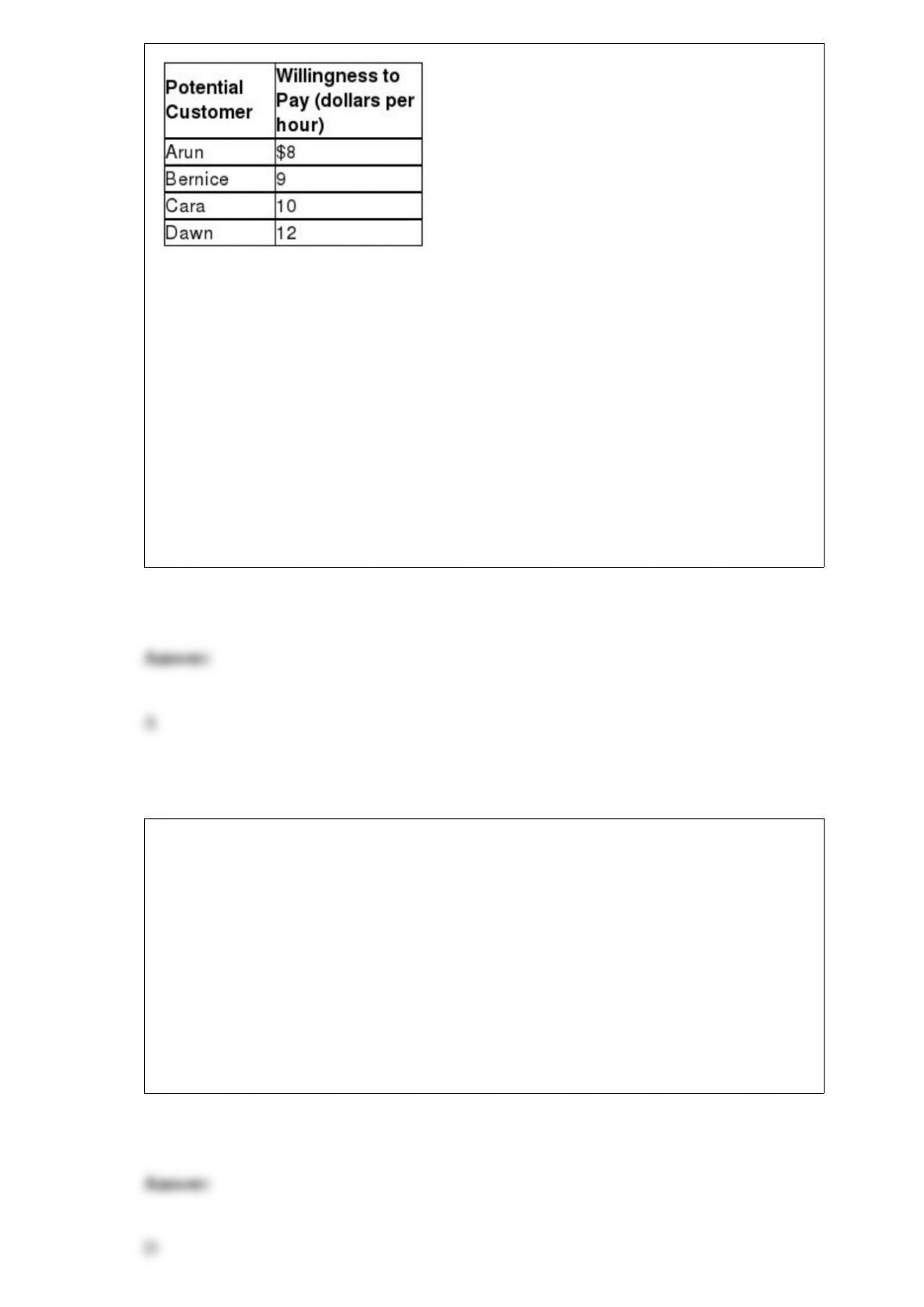
Julie plans to start a pet-sitting service. She surveyed her neighborhood to determine the
demand for this service. Assume that each person surveyed demands only one hour of
pet sitting services per period. Table 16-3 above shows a portion of her survey results.
If Julie charges $10 per hour, how many hours of pet sitting services will be purchased
and by whom?
A) 2 hours (1 hour by Cara and 1 hour by Dawn)
B) 1 hour by Cara only
C) 1 hour by Dawn only
D) 3 hours (1 hour each by Arun, Bernice and Cara)
All of the following represent Differences between stocks and bonds except
A) a stock can possibly pay dividends forever, but bonds have a fixed number of
payments.
B) Differences of opinion about a stock’s future may vary considerably but there is less
Difference about a bond’s future.
C) the future growth of a stock is more uncertain than the payments of a bond.
D) bonds represent partial ownership in a firm but stocks do not.
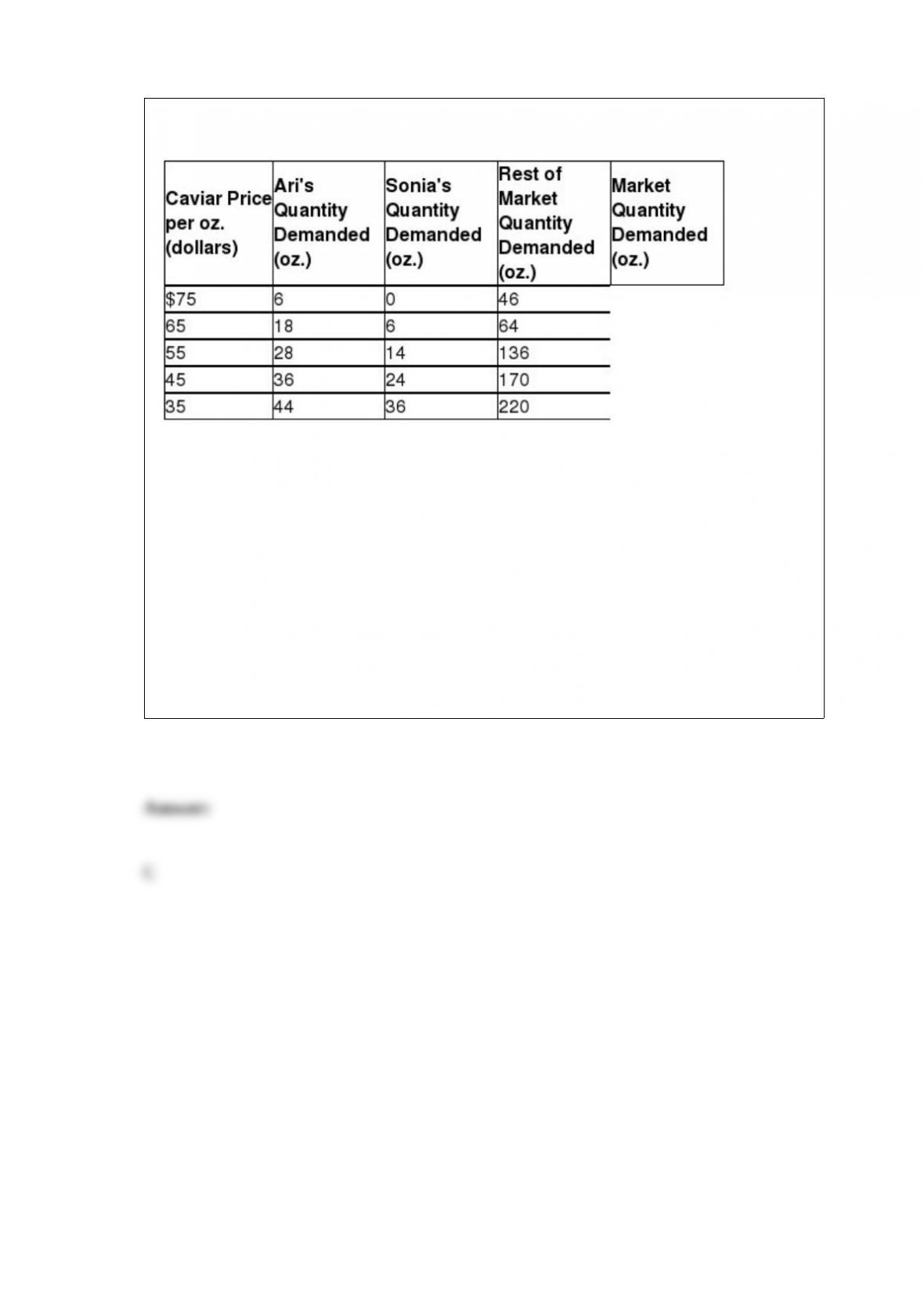
Table 3-2
The table above shows the demand schedules for caviar of two individuals (Ari and
Sonia) and the rest of the market. At a price of $55, the quantity demanded in the
market would be
A) 42 oz.
B) 136 oz.
C) 178 oz.
D) 233 oz.