
If for a firm the price of input A is four times the price of input B, costs will be
minimized for a given level of output when the
a. firm uses four times as much input A as input B.
b. total product of input A is four times greater than the total product of input B.
c. average product of input A is four times greater than the average product of input B.
d. marginal product of input A is four times greater than the marginal product of input
B.
e. total products of both A and B are equal to four times the marginal products of inputs
A and B.
The basic difference between rent and other payments for productive inputs is that
a. a reduction in rent will not influence the availability of the input; reductions in other
input payments will reduce their availability.
b. rent is earned income to the input owner; other input payments are unearned.
c. rent is payment for use of an input; other input payments are made to obtain input
services.
d. rent is payment for an input that has alternative uses; other input payments are for
unique inputs.
e. There are no basic differences among these payments.

The actual progressivity of a tax is often reduced by
a. giving the revenues from the tax to the poor.
b. raising rates on upper income brackets.
c. shifting the burden of the tax to those paying it.
d. the fact that people with incomes below $10,000 pay no taxes.
e. the use of legal loopholes by taxpayers.
Thomas Malthus felt the human population was in danger of outrunning its food supply
because
a. he thought population would increase at a geometric rate while land remained
essentially fixed in supply.
b. environmental pollution would eventually decrease the efficiency of agriculture.
c. the expected standard of living grows over time.
d. profits were insufficient to induce farmers to use their land properly.
e. the production possibilities curve shifts inward as population increases.
According to the textbook discussion, the principal way in which one generation can
impose a debt burden on succeeding generations is by
a. using up some of the nation’s productive capacity.
b. engaging in war.
c. failing to balance the budget.
d. maintaining stable price levels.
e. failing to pay off the national debt.
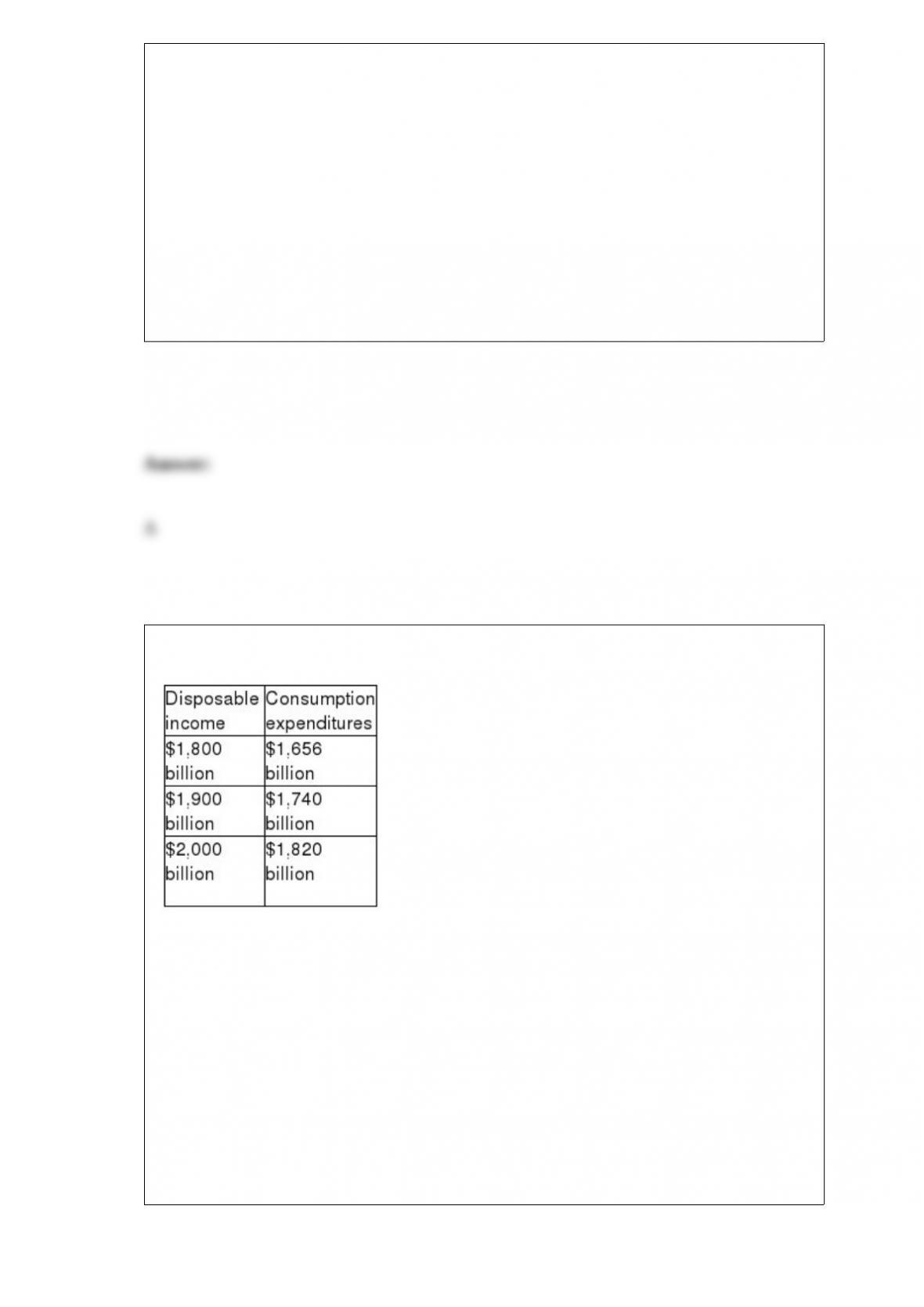
The following questions are based on the following information for a society:
If disposable income is $1,900 billion, saving is ________ billion.
a. $16
b. $20
c. $144
d. $160
e. $180

As compared to earlier years, the rate of growth of labor productivity in the United
States during the late 1990s and early 2000s
a. remained constant.
b. slowed slightly.
c. slowed considerably.
d. increased significantly.
e. slowed in the late 1990s but rose in the early 2000s.
Federal Reserve Bank holdings of securities consist mainly of
a. foreign currencies.
b. corporate stocks and bonds.
c. securities representing U.S. loans to foreign nations.
d. funds the Federal Reserve has borrowed from the Treasury.
e. U.S. government bonds, notes, and bills.

The following questions are based on the following diagram of a monopolist:
To maximize profits, the firm will produce an output rate of
a. 0A.
b. 0B.
c. 0C.
d. 0D.
e. 0E.
An excess of government expenditures over tax receipts
a. is called a surplus.

b. is a means of reducing the national debt.
c. is always desirable.
d. can lead to prolonged depression.
e. can stimulate the economy and raise GDP.
Inflationary conditions that emerge because of specific resource shortages or scarcities
are called ________ inflations.
a. cost-overrun
b. sedentary-spending
c. supply-side
d. demand-side
e. parity-price
The following questions are based on the following graph. The curves D and S
represent the market demand and supply curves for farm products in 1960. The curves
D1 and S1 represent the market demand and supply curves for farm products in It is
supposed that there were no support programs in either year.
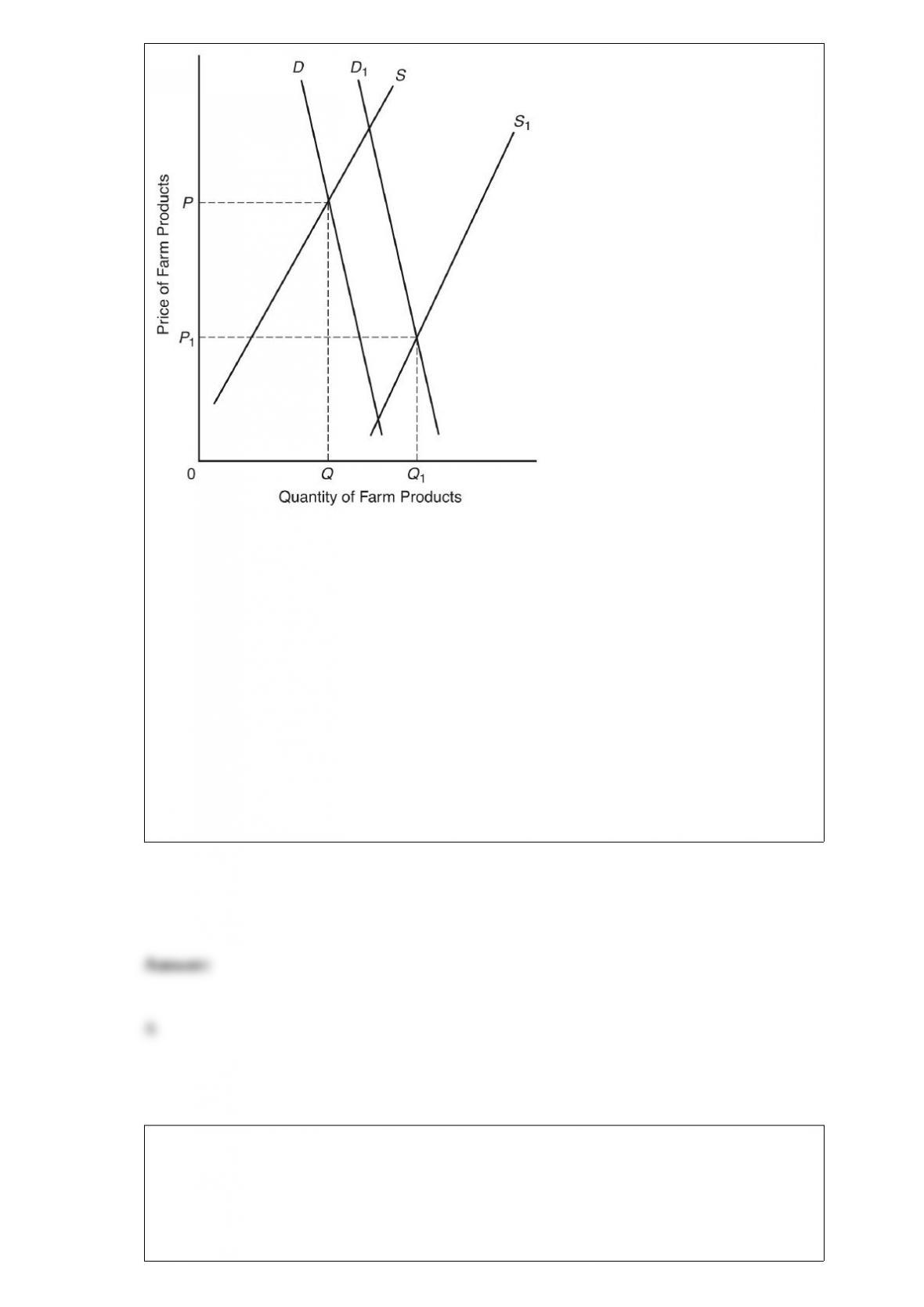
The steepness of the two demand curves can best be explained by the fact that
a. the quantity of food demanded does not vary much with the price of food because
food is a necessity.
b. the consumption of food per capita faces natural limits and hence responds by only a
small amount to changes in per capita income.
c. farmers have only limited control over their outputs.
d. there has been rapid technological change in agriculture.
e. poor farmers have been slow to leave the farming industry.
Henry George is best known for his view that
a. profits arise as a result of labor exploitation.
b. capital budgeting is an important activity for a corporation.
c. the rate of interest is determined by the liquidity preference theory.
d. all economic profit is the result of uncertainty.
e. land rent is unearned income that should be taxed away.
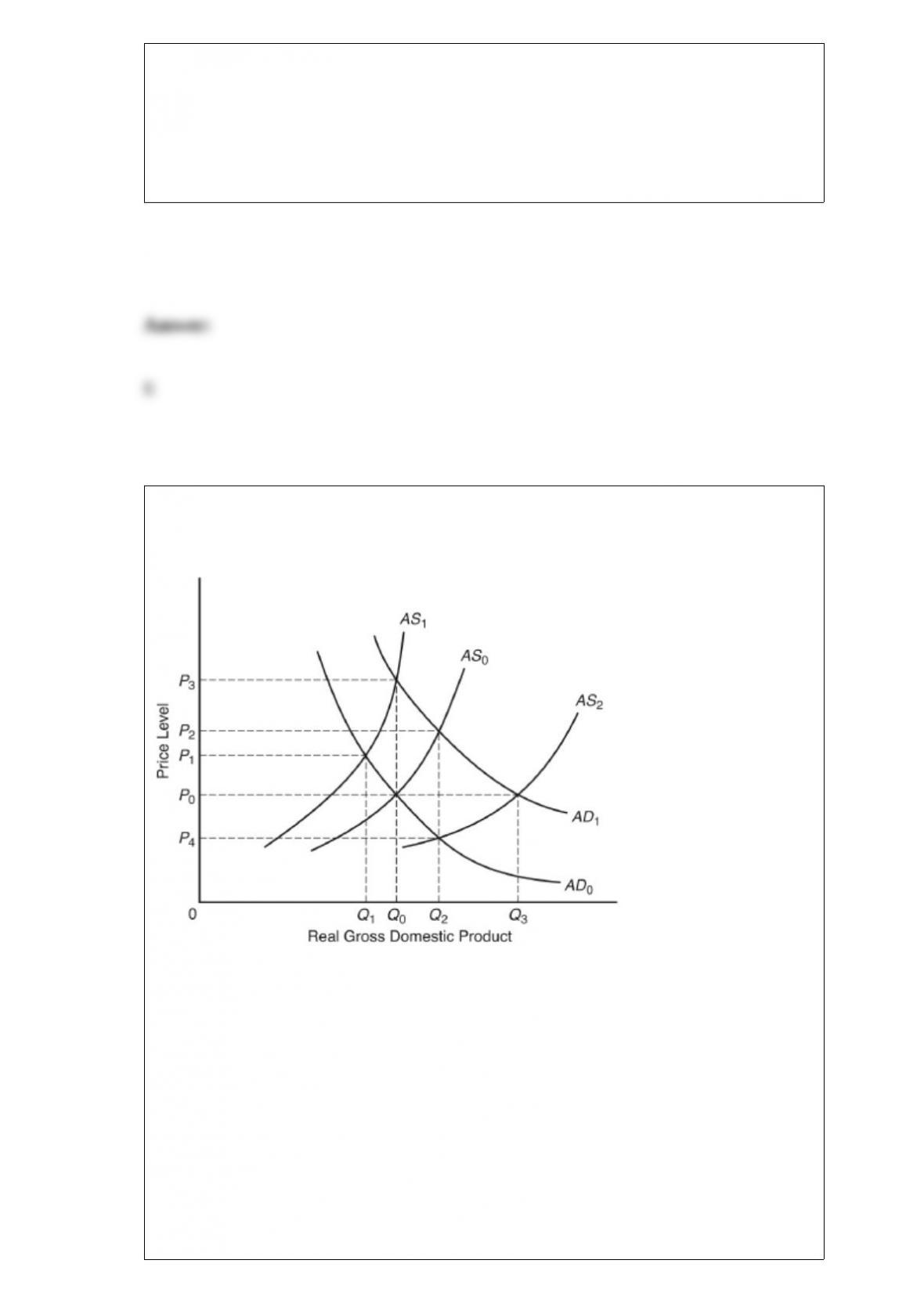
The following questions are based on the following diagram, in which existing
aggregate supply and demand curves are AS0 and AD0, respectively:
Significant increases in strategic input prices will
a. shift the aggregate demand curve to AD1.
b. leave the aggregate demand and supply unchanged.
c. shift the aggregate supply curve to AS2.
d. shift the aggregate supply curve to AS1.
e. shift aggregate demand to AD1 and aggregate supply to AS2.

The crude quantity theory of money states that
a. the money supply is fixed.
b. the equation of exchange is invalid.
c. the velocity of money changes as prices increase.
d. nominal and real GDP are normally identical.
e. the price level is proportional to the money supply.
A childless couple has a taxable income of $50,000 per year. They are in the 28 percent
marginal tax bracket. Their tax must be
a. less than $14,000.
b. $14,000.
c. more than $14,000.
d. below the average rate but above the marginal rate.
e. it is not possible to determine taxes without more information.
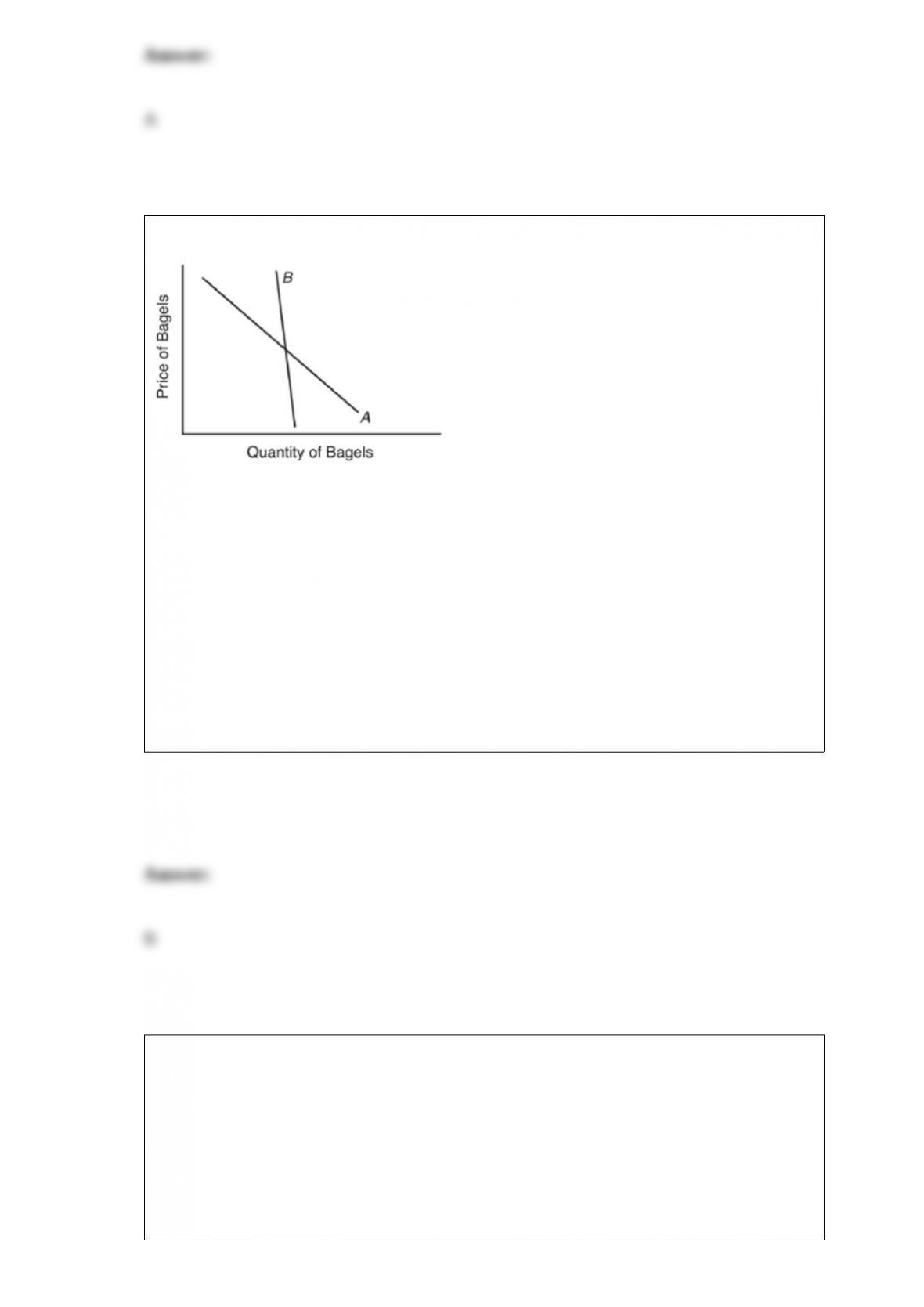
This diagram shows hypothetical demand curves for individuals A and B.
The differences in their slopes suggest that consumer A and consumer B
a. have very different income levels.
b. have different tastes.
c. are not subject to the law of diminishing marginal utility.
d. are charged different prices for the same commodity.
e. are offered different amounts to purchase.
Federal taxes on gasoline and cigarettes are examples of ________ taxes.
a. active
b. beneficial
c. cost of living
d. indirect business
e. exercise
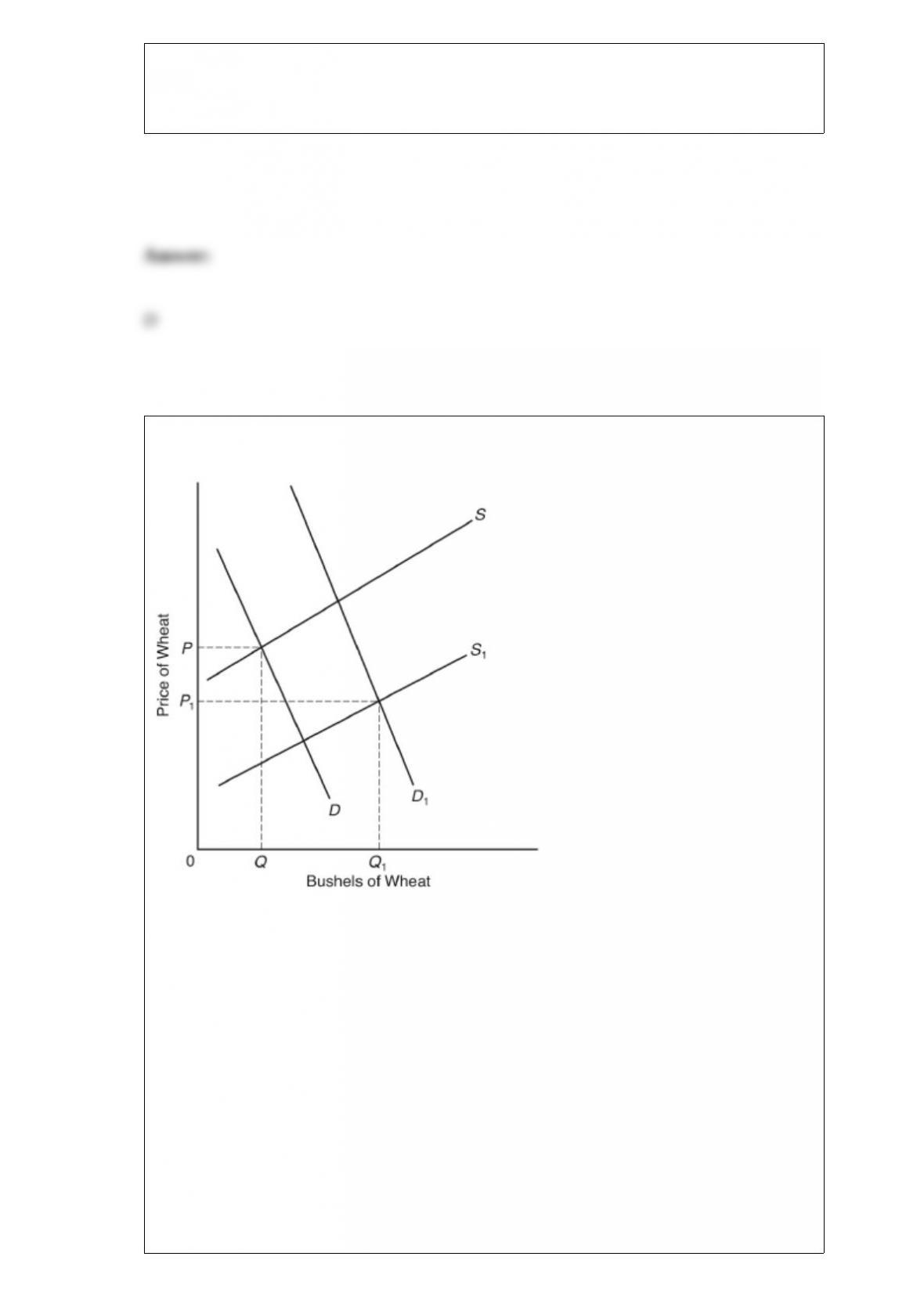
The following questions are based on the following graph:
The curves D and S represent the market demand and supply curves for wheat in 1960.
The curves D1 and S1 represent the market demand and supply curves in 2000. Assume
there were no support programs in either year.
In the graph
a. demand rose and supply fell.
b. demand fell and supply rose.
c. both demand and supply fell.
d. both demand and supply rose.

e. demand and supply remained unchanged, but the quantity demanded rose and the
quantity supplied fell.
If the government charges Crystal Clear Glass Company according to the estimated
pounds of waste it discharges into the atmosphere, this is an example of
a. direct regulation.
b. a tax credit.
c. an effluent fee.
d. private cost regulation.
e. a transferable emissions permit.
Labor’s ability to increase nominal wage rates
a. decreases as labor’s power and influence increase.
b. increases as government policy focuses on maintaining stable prices.
c. is unaffected by the amount of idle productive capacity.
d. is greatest when the government attempts to reduce the unemployment rate below the
natural rate.

e. is greatest when there is perfect competition in labor markets.
Various kinds of economic analysis to help senators and representatives evaluate
different budgetary programs and proposals are undertaken by the
a. Treasury Department.
b. Office of Management and Budget.
c. Internal Revenue Service.
d. Congressional Budget Office.
e. Office of Economic Opportunity.
The popularity of the annually balanced budget policy has increased in recent decades
because of a
a. realization that the deficit has been growing at a faster rate than GDP.
b. sharp decline in U.S. overseas borrowing.
c. growing business support of higher taxes to firms.
d. gradual decline in inflation rates.
e. growing surplus in the structural deficit.

Which of the following is the best example of labor?
a. eating a Big Mac
b. attending a rock concert
c. watching a late-night TV show
d. planning a corporate merger
e. sleeping in Economics class
If people are willing to pay $130 for a particular bicycle and its marginal cost is $80
a. bicycle producers enjoy a profit of $50.
b. bicycle production will be unprofitable.
c. too many resources are being allocated to the production of bicycles.
d. the social value of one more bicycle is $130.
e. the bicycle industry is perfectly competitive.

A theory composed of a number of assumptions from which predictions are deduced is
called a(n)
a. statistic.
b. event.
c. conclusion.
d. model.
e. allegory.
Which of the following is an important determinant of the price elasticity of demand for
a commodity?
a. the method of calculating the coefficient of elasticity
b. the importance of the commodity in consumers’ budgets
c. the number of buyers of the commodity
d. the number of sellers of the commodity
e. the cost of producing the commodity

In general, individuals and countries that attempt to be completely self-sufficient tend to
a. grow faster in the long run.
b. have a more equal distribution of income.
c. be assured of ongoing full employment.
d. experience a lower standard of living from the use of their resources.
e. be more productive and technically capable.
Income adjusted for changes in the price level is called ________ income.
a. fixed
b. money
c. nominal
d. current
e. real

The expression “there’s no such thing as a free lunch”” is
a. generally untrue.
b. irrelevant to the subject of economics.
c. a recognition that our capacity to produce goods is limited.
d. an example of normative economics.
e. applicable solely to the inefficient use of resources.
With which of the following would Milton Friedman probably agree?
a. All people should have equal incomes.
b. Economic and political freedoms are likely to be lost if we rely too heavily on
government to solve economic problems.
c. The nation suffers because too little is spent on governmental services such as
transportation, education, and urban renewal.
d. The price system involves substantial coercion and must be supervised carefully.
e. Government tends to be more efficient and to respond more quickly than the market.
The inverse relationship between the price of labor and the amount of labor used is

called the
a. labor production possibilities curve.
b. demand curve for labor.
c. total fixed cost curve.
d. money wage nexus.
e. employment function.
Both the new Keynesians and traditional Keynesians would disagree with which of the
following ideas?
a. Prices and wages tend to adjust slowly in the short run.
b. Real GDP adjusts to changes in aggregate demand.
c. Discretionary monetary and fiscal policies are necessary to keep the economy
stabilized.
d. Changes in business and consumer spending represent a substantial source of
economic instability.
e. Markets clear continuously.