
1) The M2 money supply is larger than the M1 money supply.
2) if all nations prohibited the international migration of labor, we would expect world
output to decline.
3) If the substitution effect outweighs the output effect, an increase in the price of a
substitute resource will increase the demand for labor.
4) u.s. immigrants (legal and illegal combined) have lower prison rates than the
native-born population.
5) The vast majority of the labor forces of the low-income DVCs are engaged in
agriculture.
6) Unemployment compensation is financed by taxes levied on employers.
7) the law of diminishing returns explains why the long-run average total cost curve is
u-shaped.
8) government assumes some responsibility for providing a minimum standard of living
for all citizens to compensate for the increase in income inequality caused by
government tax revenues and expenditures.
9) The following information about the cost ratios for two products-fish (F) and chicken
(C)-in countries Singsong and Harmony. Assume that production occurs under
conditions of constant costs and these are the only two nations in the world.
Singsong: 1F = 2C
Harmony: 1F = 4C
Refer to the above information. If these two nations specialize based on comparative
advantage:
A.Singsong will both produce chicken and catch fish.
B.Harmony will both produce chicken and catch fish.
C.Harmony will produce chicken and Singsong will catch fish.
D.Singsong will produce chicken and Harmony will catch fish.
10) Other things the same, we would expect the labor demand curve of a purely
competitive seller to be:
A.of unitary elasticity.
B.more elastic than that of an imperfectly competitive seller.
C.less elastic than that of an imperfectly competitive seller.
D.perfectly elastic.
11)
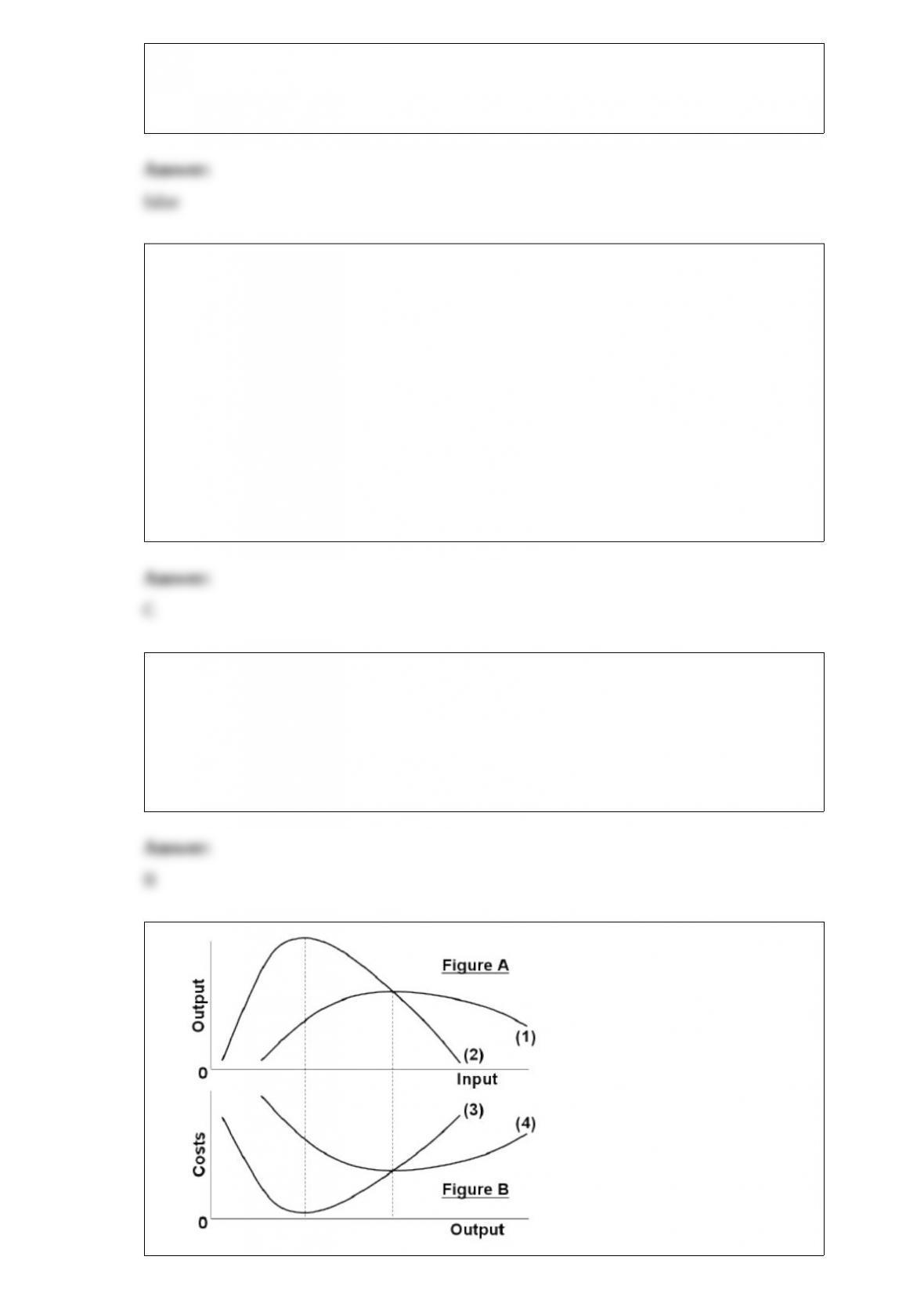
refer to the above short-run production and cost data. in figure b curve (3) is:
a.avc and curve (4) is mc.
b.mc and curve (4) is avc.
c.mc and curve (4) is afc.
d.afc and curve (4) is mc.
12) an antidrug policy which reduces the supply of heroin might:
a.increase street crime because the addict’s demand for heroin is highly inelastic.
b.reduce street crime because the addict’s demand for heroin is highly elastic.
c.reduce street crime because the addict’s demand for heroin is highly inelastic.
d.increase street crime because the addict’s demand for heroin is highly elastic.
13) economic systems differ according to what two main characteristics?
a.who owns the factors of production, and the methods used to coordinate economic
activity.
b.the technology used in production, and the quantity and quality of natural resources.
c.how goods are produced, and who gets them.
d.the political system in place, and the degree of scarcity facing the economy.
14)
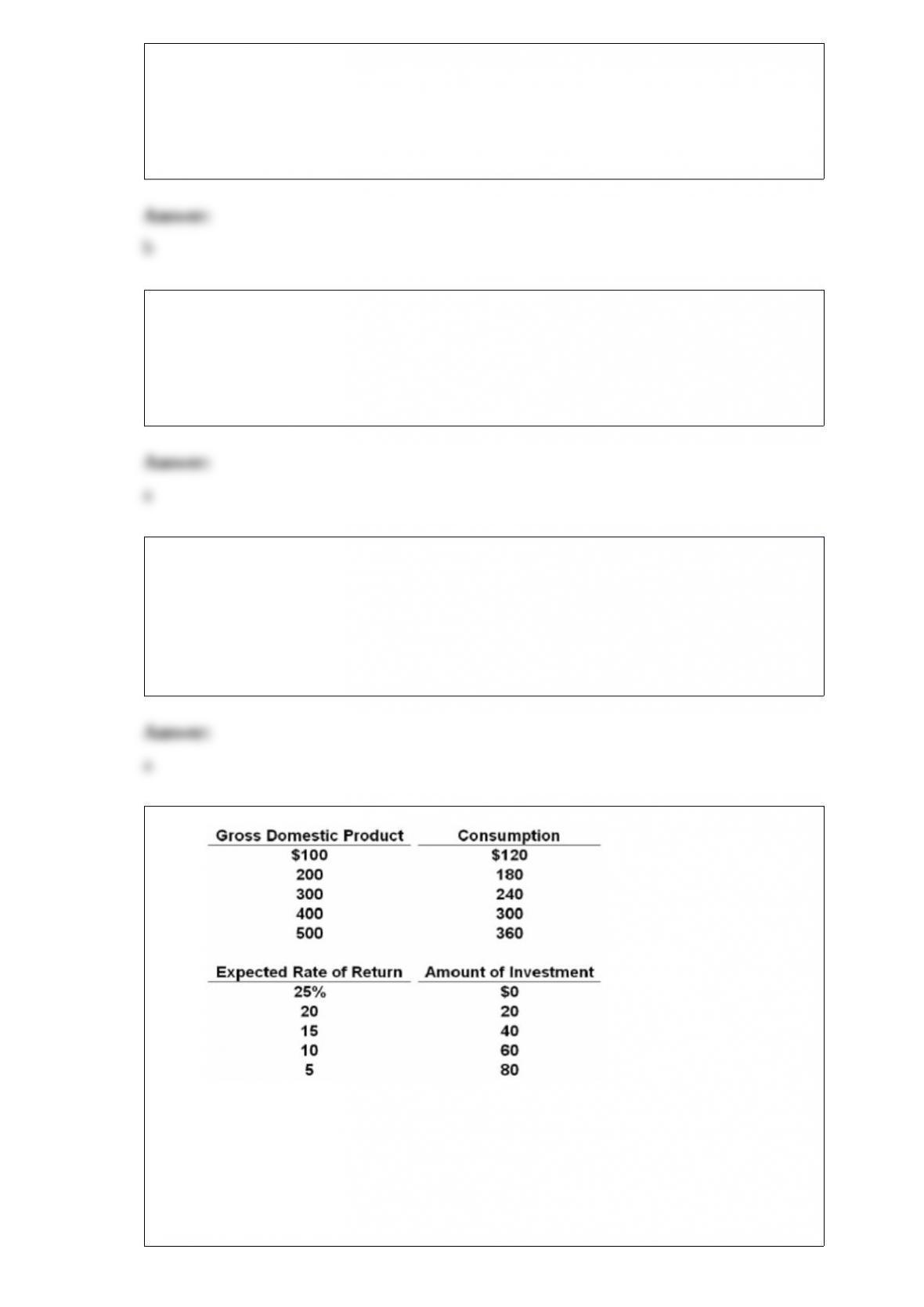
Refer to the above information. If the real interest rate is 10 percent, the equilibrium
GDP will be:
A.$100.
B.$200.
C.$300.
D.$400.
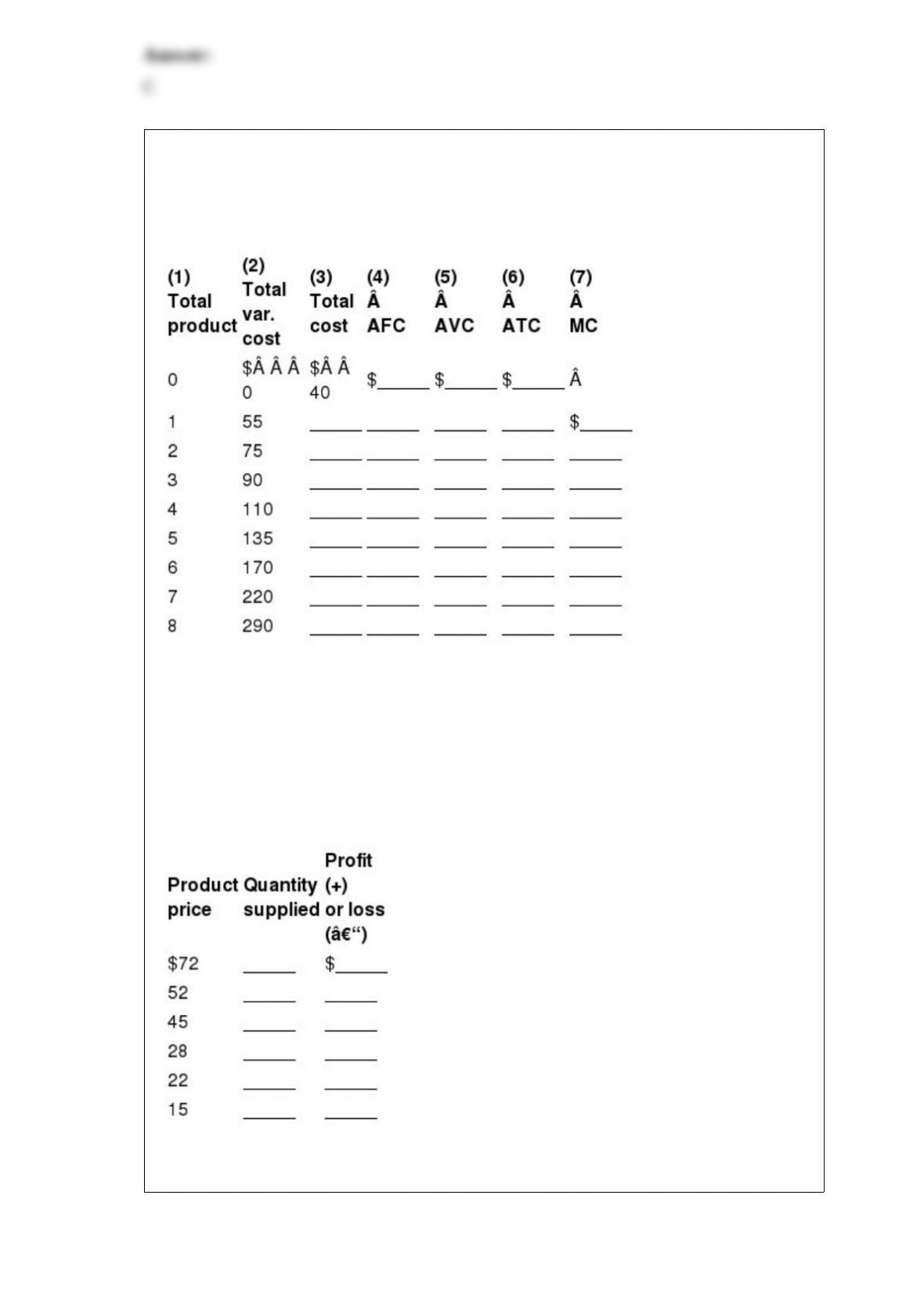
15) Assume a single firm in a purely competitive industry has variable costs as
indicated in the following table in column 2. Complete the table and answer the
questions.
(a)At a product price of $52, will this firm produce in the short run? Explain. What will
its profit or loss be?
(b)At a product price of $28, will this firm produce in the short run? Explain. What will
its profit or loss be?
(c)At a product price of $22, will this firm produce in the short run? Explain. What will
its profit or loss be?
(d)Complete the following short-run supply schedule for this firm.
Assume there are 500 identical firms in this industry, that they have identical cost data
as the firm above, and that the industry demand schedule is as follows:
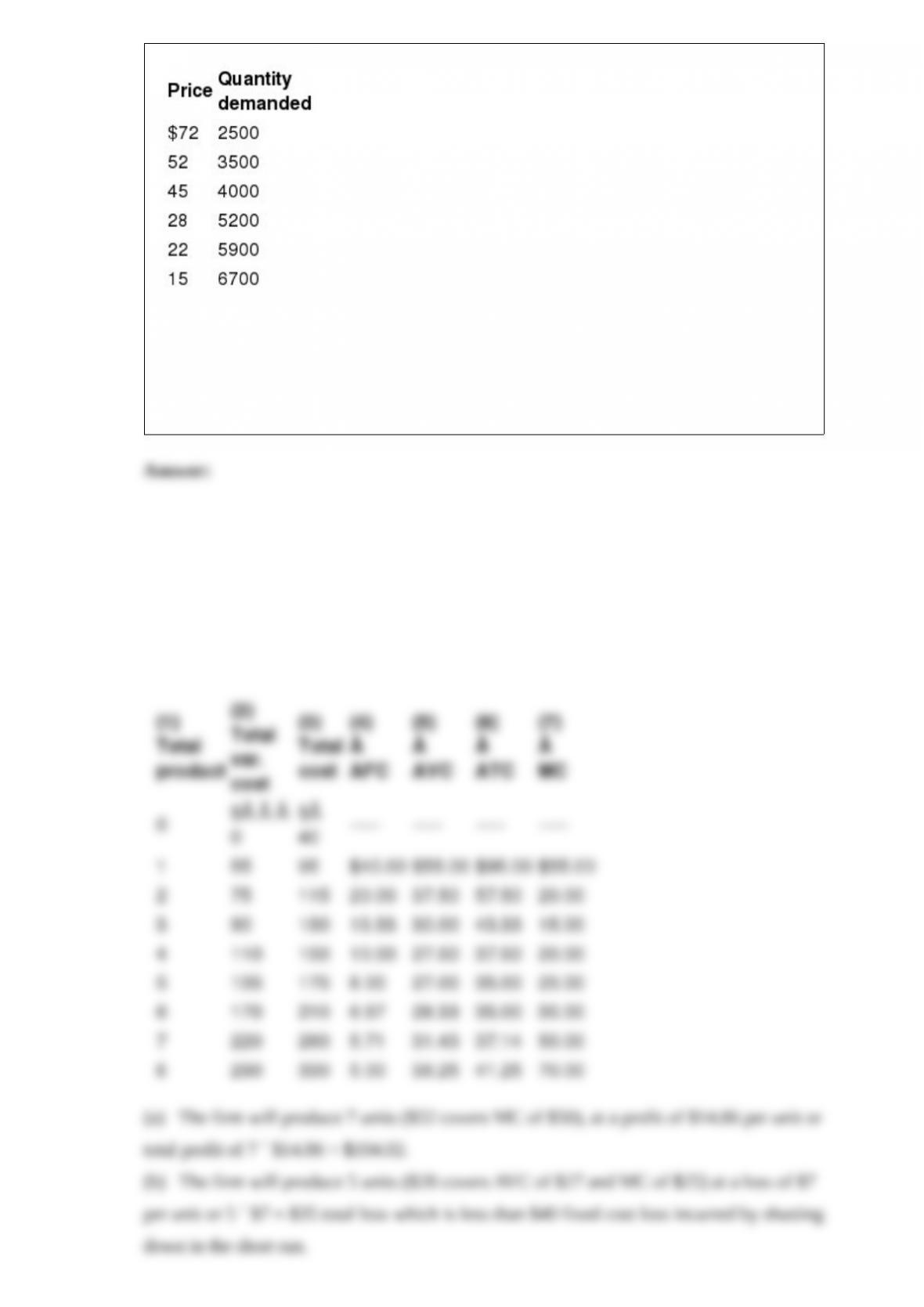
(e) What will the equilibrium price be?
(f) What will the equilibrium output for each firm be?
(g) What will profit or loss be per unit?
(h) What will profit or loss be per firm?
16) a progressive tax is such that:
a.tax rates are higher the greater one’s income.
b.the same tax rate applies to all income receivers, so that the rich pay absolutely more
taxes than the poor.
c.entrepreneurial income is exempt from taxation.
d.the revenues it yields are spent on transfer payments.
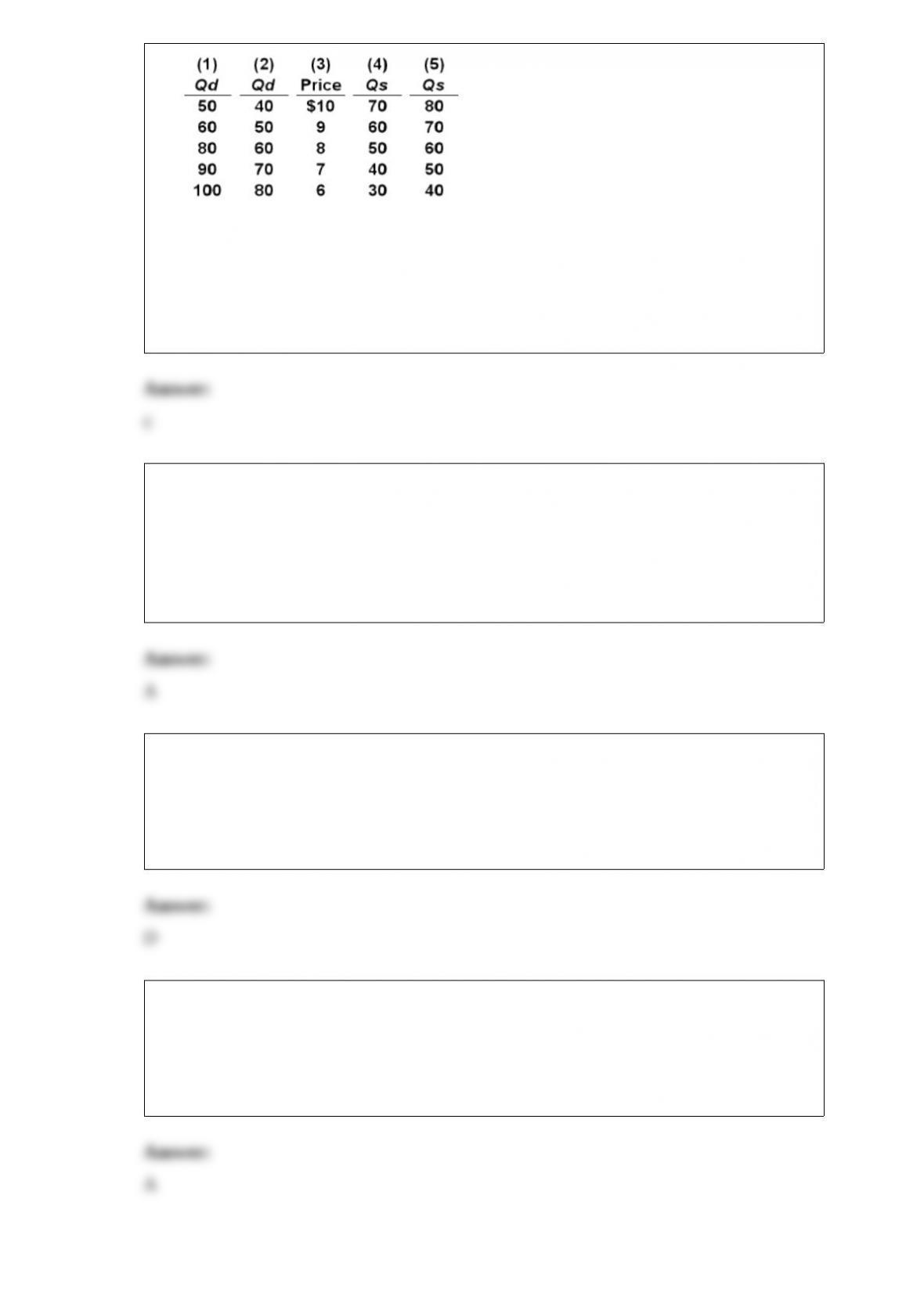
17)
refer to the above table. if demand is represented by columns (3) and (2) and supply is
represented by columns (3) and (5), equilibrium price and quantity will be:
a.$10 and 60 units.
b.$9 and 50 units.
c.$8 and 60 units.
d.$7 and 50 units.
18) When current government expenditures equal current tax revenues and the economy
is achieving full employment:
A.the standardized budget has neither a deficit nor a surplus.
B.the standardized budget may have either a deficit or a surplus.
C.fiscal policy is contractionary.
D.nominal GDP and real GDP are equal.
19) Which of the following is not an antitrust law?
A.the Sherman Act
B.the Clayton Act
C.the Celler-Kefauver Act
D.the Wagner Act
20) Which of the following is considered a renewable natural resource?
A.aquifers.
B.coal.
C.petroleum.
D.iron.
21) What arguments are made in support of social regulation?
22) Define fishery and describe the resource problem with fisheries.
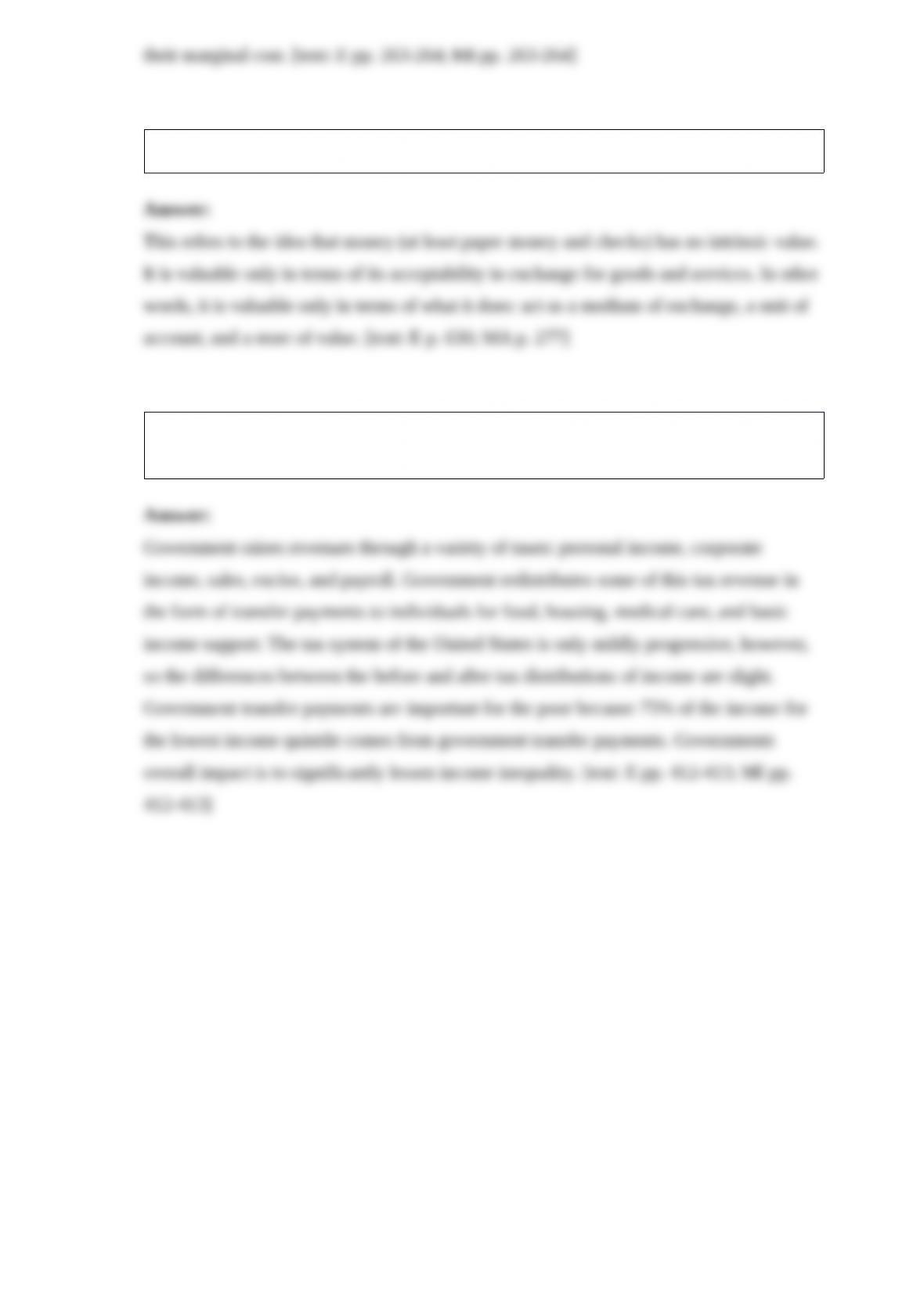
23)
Explain briefly and concisely the meaning and significance of the following equation:
24) Money is what money does. Explain.
25) How do government programs affect the distribution of income in the United
States?