
A tariff imposed on imported wine will cause the domestic ________ of wine to
increase and the domestic ________ of wine to increase.
A) price; production
B) cost; price
C) imports; exports
D) revenues; imports
In 2006, the infant mortality rate was 114 births per 1,000 for countries classified as
A) low-income.
B) lower middle-income.
C) upper middle-income.
D) high-income.
The idea of the U.S.-Canadian Free-Trade Agreement that ________ barriers to trade
including tariffs and quotas between the United States and Canada by 1998 was to
increase the amount that the United States exports to Canada and the amount that the
United States imports from Canada.
A) increased all
B) removed some
C) removed all
D) increased some
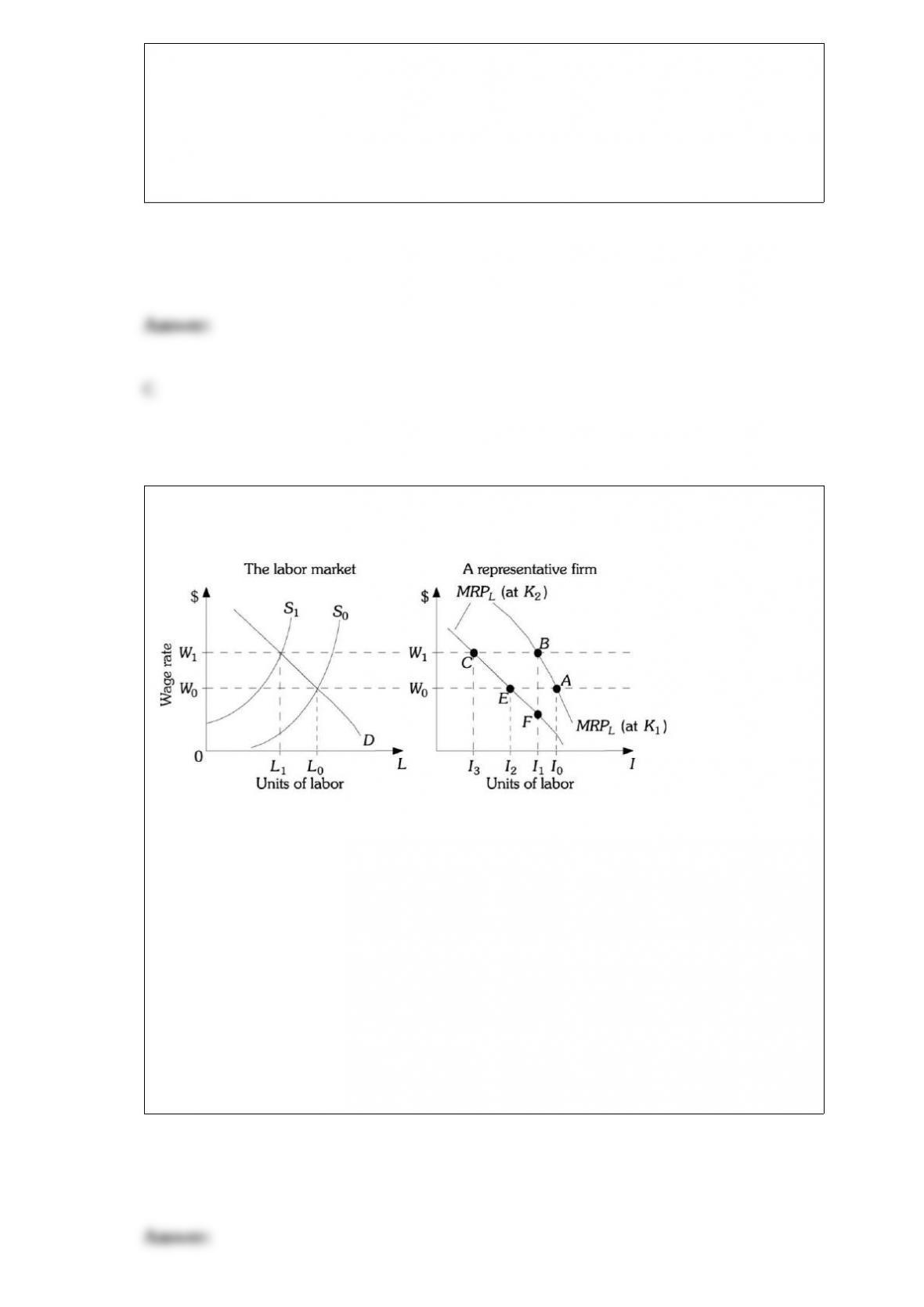
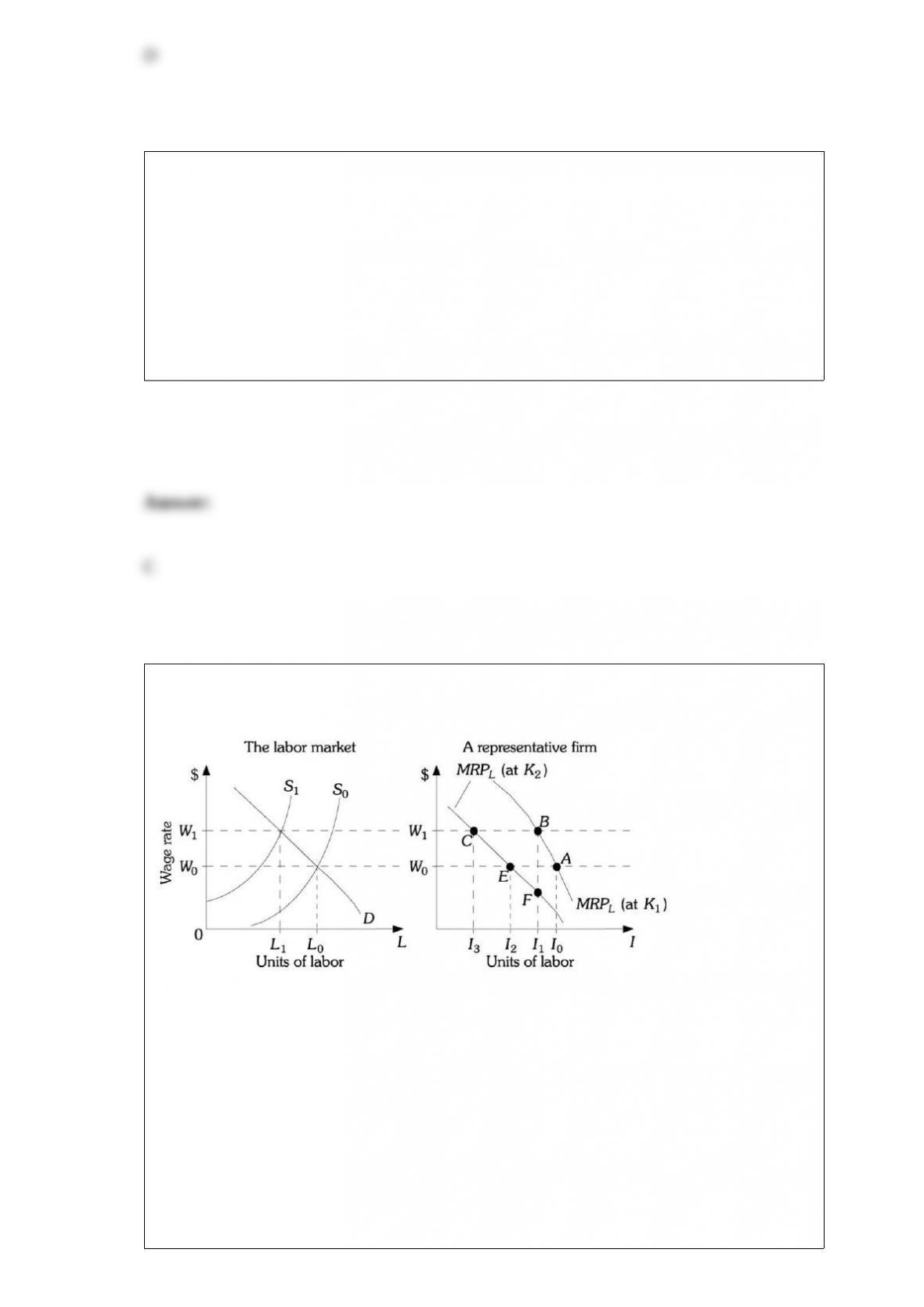
Figure 10.3
Refer to Figure 10.3. If labor supply is given by S1 and the firm is using K1 units of
capital, this firm should hire ________ units of labor to maximize profit.
A) I0
B) I1
C) I2
D) I3
Food stamps are ________.
A) only available to low-income families with children
B) fully funded through state tax revenues
C) vouchers that have a face value greater than their cost and that can be used to
purchase food at grocery stores
D) bought and sold in a perfectly competitive market
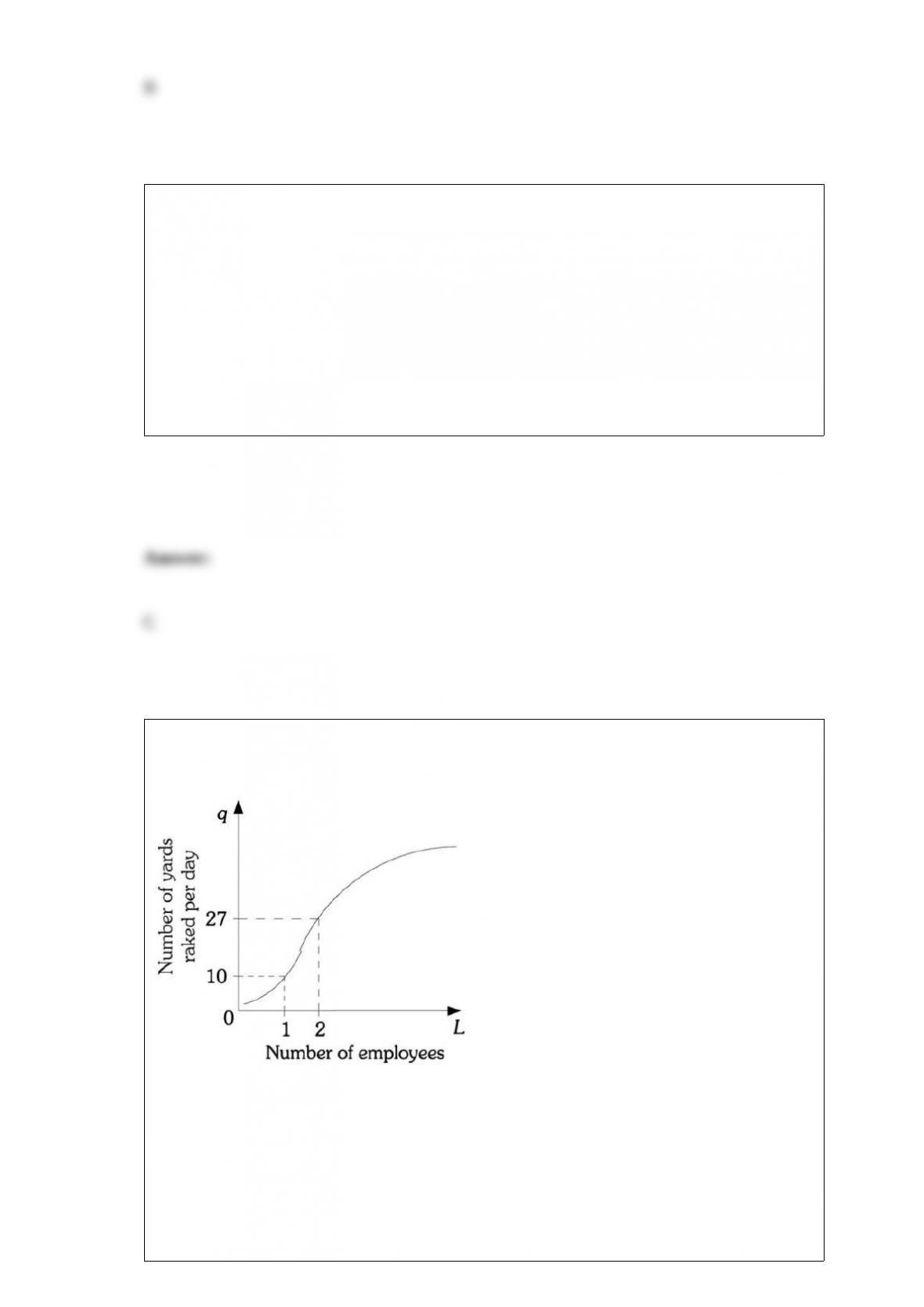
Figure 3
Refer to Figure 7.3. The marginal product of the first worker is ________ yards raked.
A) 10
B) 5

C) 17
D) 27
A tax added to the camping fee at national parks that is used to maintain and upgrade
camping facilities at national parks is a tax based on
A) the ability-to-pay principle.
B) vertical equity.
C) horizontal equity.
D) the benefits-received principle.
A mass transit authority charges subway fares of $2.50 during morning rush hours but
only $1.50 during late morning non-rush hours. Economists explain the fare difference
by the fact that the demand for subway rides during the morning rush hours is
________, but during the late morning it is ________.
A) more elastic; more inelastic
B) perfectly elastic; perfectly inelastic
C) more inelastic; more elastic
D) unit elastic; relatively inelastic

The marginal rate of transformation is the
A) slope of the production possibility frontier.
B) dollar value of the best forgone alternative.
C) process of using resources to produce new capital.
D) transformation of resources into a form that is useful to people.
Investors put up $52,000 to construct a building and purchase all equipment for a new
restaurant. The investors expect to earn a minimum return of 10 percent on their
investment. The restaurant is open 52 weeks per year and serves 900 meals per week.
The fixed costs are spread over the 52 weeks (i.e. prorated weekly). Included in the
fixed costs is the 10% return to the investors and $1,000 per week in other fixed costs.
Variable costs include $1,000 in weekly wages and $600 per week for materials,
electricity, etc. The restaurant charges $3 on average per meal.
In the short run, if the restaurant shuts down, it ________ variable costs and ________
revenue.
A) has; earns
B) has; earns no
C) has no; earns
D) has no; earns no

An individual earning $60,000 pays $12,000 in taxes. The marginal tax rate on any
income earned above $60,000 is 25%.
When this person earns $70,000, her tax payment would be
A) $2,500.
B) $14,500.
C) $17,500.
D) indeterminate from this information.
When there are more substitutes for a product, the ________ for the product is
________.
A) demand; less price elastic
B) demand; more price elastic
C) income elasticity; greater
D) income elasticity; smaller

The voting paradox is an example of the
A) impossibility theorem.
B) Coase theorem.
C) Tiebout hypothesis.
D) free-rider problem.
For the Coase theorem to apply, all of the following conditions must be satisfied
EXCEPT:
A) The basic rights of the individuals must be clearly understood.
B) There must be no impediments to bargaining.
C) Only a few people can be involved.
D) Liability rules must be established and enforced.
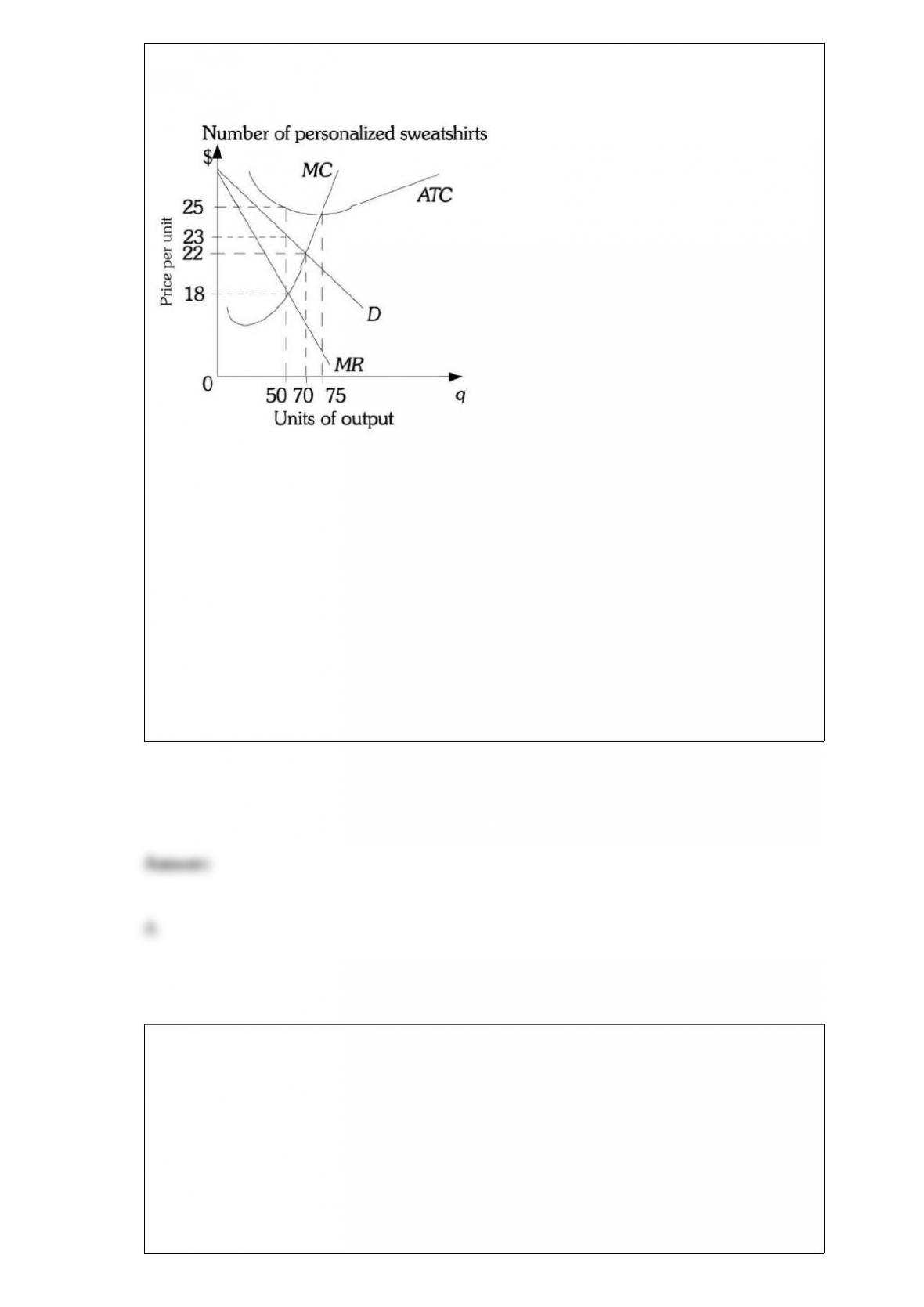
Figure 15.4
Refer to Figure 15.4. Assume the No-Sweat Sweatshirt Manufacturing Company has
fixed costs of $90 and is a monopolistically competitive firm. To maximize profits in
the short run, the firm should produce ________ personalized sweatshirts.
A) 0
B) 50
C) 70
D) 75
Taxes on a producing firm’s spillovers
A) are designed to make it easier for economists to measure spillovers.
B) will lead to a zero level of output.
C) are simply meant to force decision makers to consider the full costs of their actions.
D) are designed primarily as a way to raise money so that the government can

compensate the victims of the externality.
If a tax is placed on perfectly competitive firms that impose external costs on society,
the firm’s marginal cost curve will shift ________ and the industry supply curve will
shift to the ________.
A) down; left
B) down; right
C) up; right
D) up; left
The rationing mechanism in market economies is the adjustment of
A) supply.
B) demand.
C) quantity.
D) price.
The Russian transition to a market economy with ________ labor markets and
________ prices means that unemployment and higher prices are inevitable.
A) controlled; controlled
B) free; fixed
C) fixed; fixed
D) free; uncontrolled
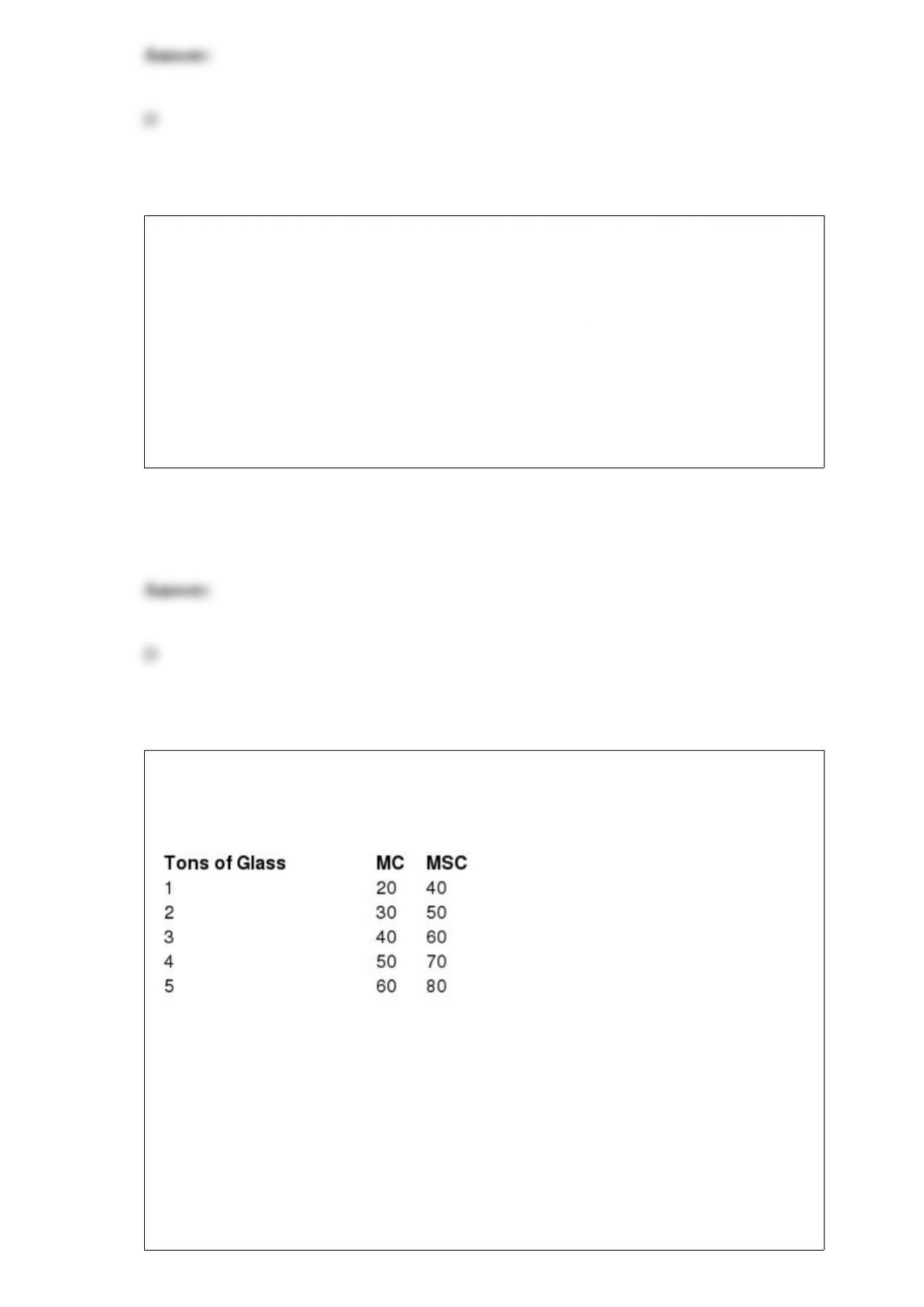
Table 16.2
Refer to Table 16.2. This glass-recycling firm is perfectly competitive and is NOT
forced to take damage costs into account. If the market price of glass is $50 a ton and
the firm behaves as a profit-maximizer, then total damage will be
A) $40.
B) $80.
C) $220.

D) $1,000.
Assume that the price of labor and capital have remained the same, but that the average
educational level of workers has increased and therefore the productivity of labor has
increased. This would lead a firm to
A) use a more capital-intensive production technology.
B) use a more labor-intensive technology.
C) not change its production technology, but to produce fewer units of output.
D) use only labor to produce the product.
Saying a firm will continue investing up to the point at which the marginal revenue
product of capital is equal to the price of capital is equivalent to saying that a firm will
keep investing in new capital up to the point where
A) the expected rate of return is zero.
B) economic profit is zero.
C) the expected rate of return is equal to the interest rate.
D) the price of capital equals the interest rate.
Tit-for-tat is a ________ game strategy in which a player ________ an opponent’s play.
A) repeated; ignores
B) repeated; responds in kind to
C) single; ignores
D) single; responds in kind to
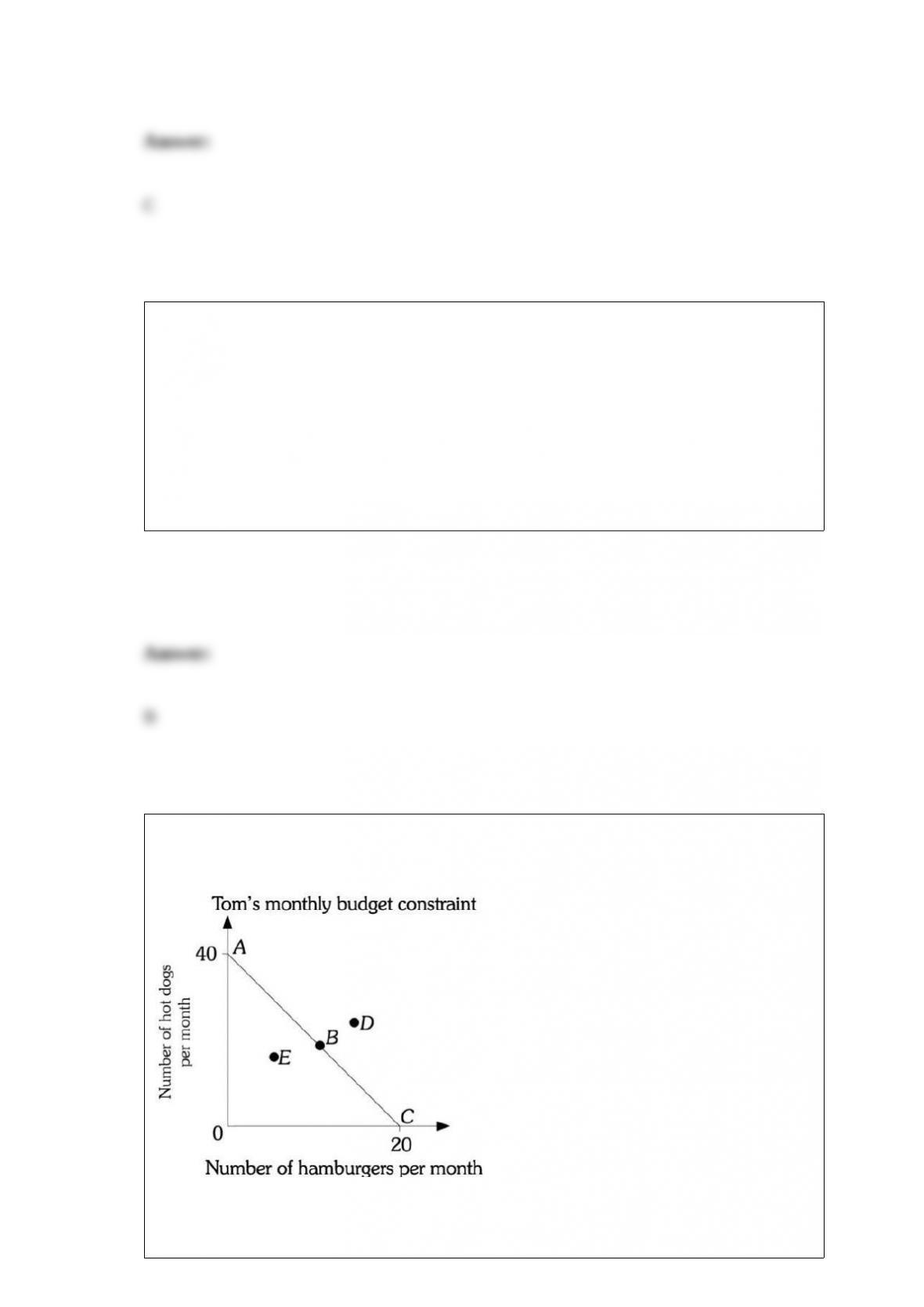
Figure 6.1
Refer to Figure 6.1. The slope of budget constraint AC is
A) -5.0.
B) -2.0.
C) -0.5.
D) indeterminate from this information because prices are not given.
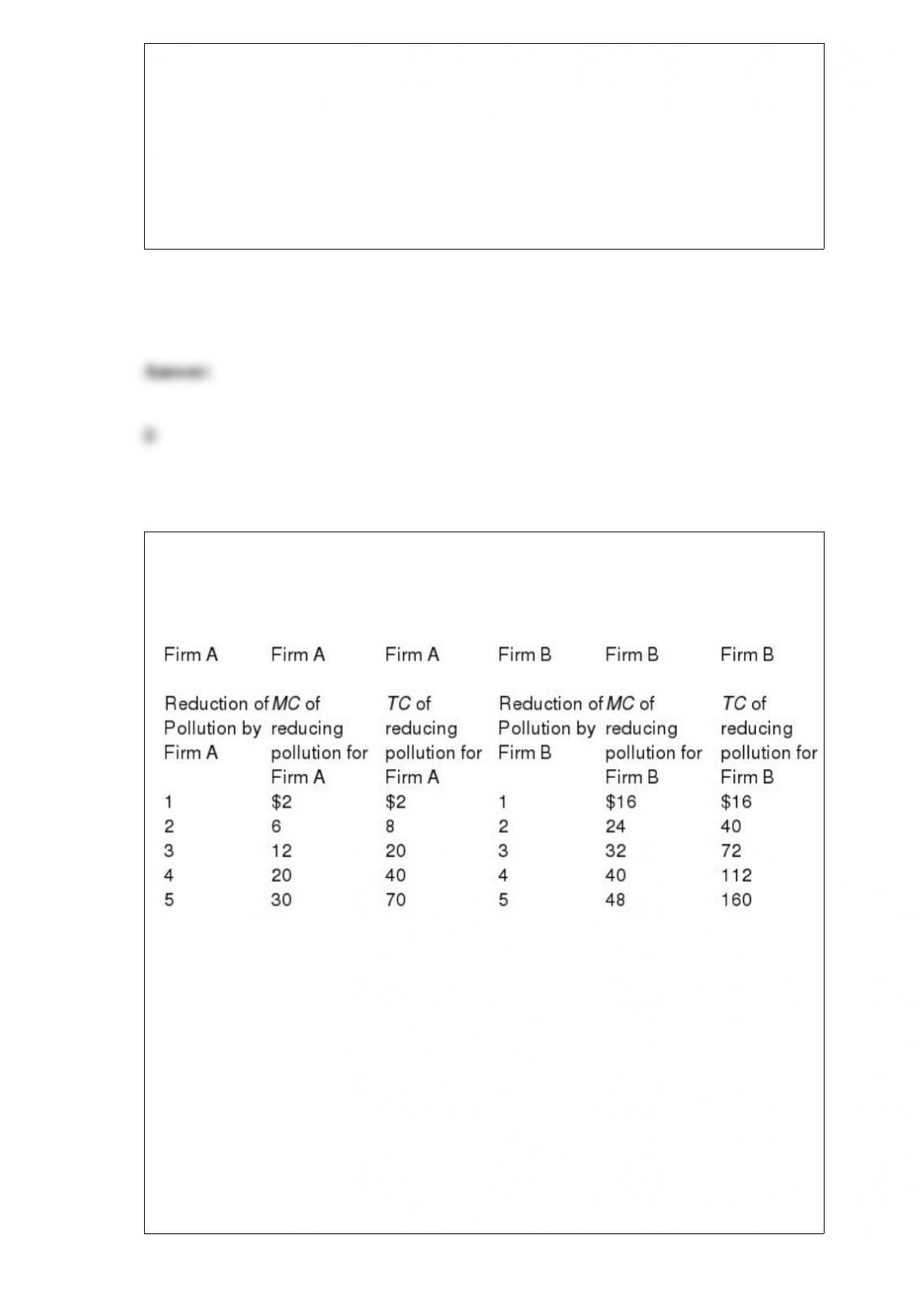
Table 16.4 shows the situation facing two firms, both of which are polluting. Assume
that each firm emits 5 units of pollution.
Table 16.4
Refer to Table 16.4. Suppose the government wants to reduce the total amount of
pollution from the current level of 10 to 4. To do this, the government caps each firm’s
emissions at 2 units and issues 2 permits to each firm. If firms are allowed to trade
permits, what is the total cost of the pollution reduction?
A) $48
B) $80
C) $86
D) $162

The amount of education that one has is an important factor in the determination of his
or her wage rate. This is best described as
A) a positive statement.
B) an example of the fallacy of composition.
C) a normative statement.
D) an example of marginalism.
You value your favorite shirt at $110. Someone else values it at $150, and that person is
willing to pay you $120 for your shirt. Would selling your shirt to this person for $120
be Pareto efficient?
A) No, because you did not receive the maximum amount the other person would have
been willing to pay for the shirt.
B) No, the person paid you $120 for the shirt so his net benefit was $30, while your net
benefit was $10. For this change to be Pareto efficient, each of you should have the
same net benefit.
C) Yes, because even though you gain from the trade and he loses, there is the potential
for you to compensate him for his loss.
D) Yes, because both of you are better off as a result of the trade.
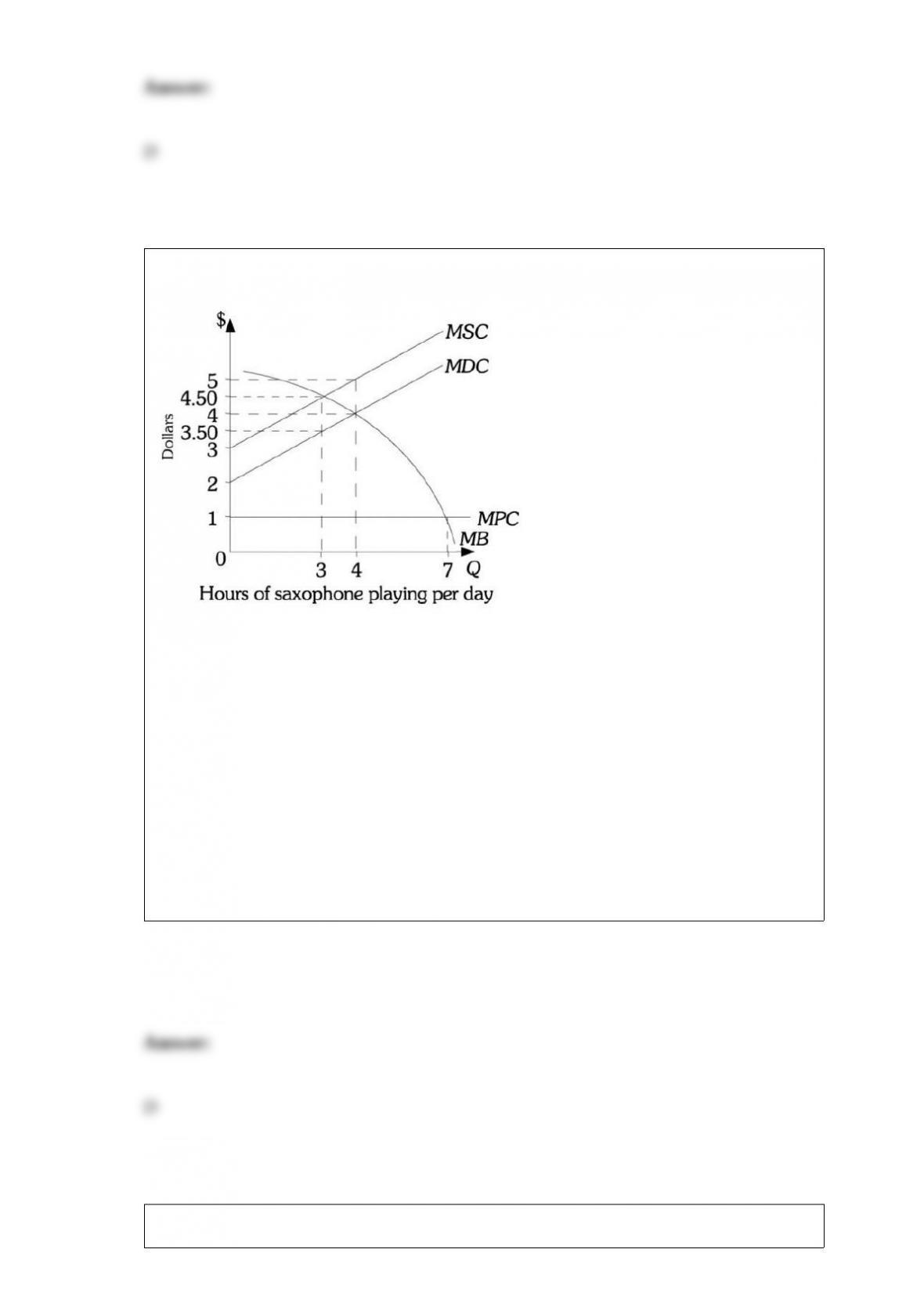
Figure 16.3
Refer to Figure 16.3. Bill and his wife are able to bargain with one another so that Bill
plays his saxophone for the efficient number of hours. This is an example of ________
theorem.
A) Arrow’s impossibility
B) the free-rider
C) the drop-in-the-bucket
D) the Coase
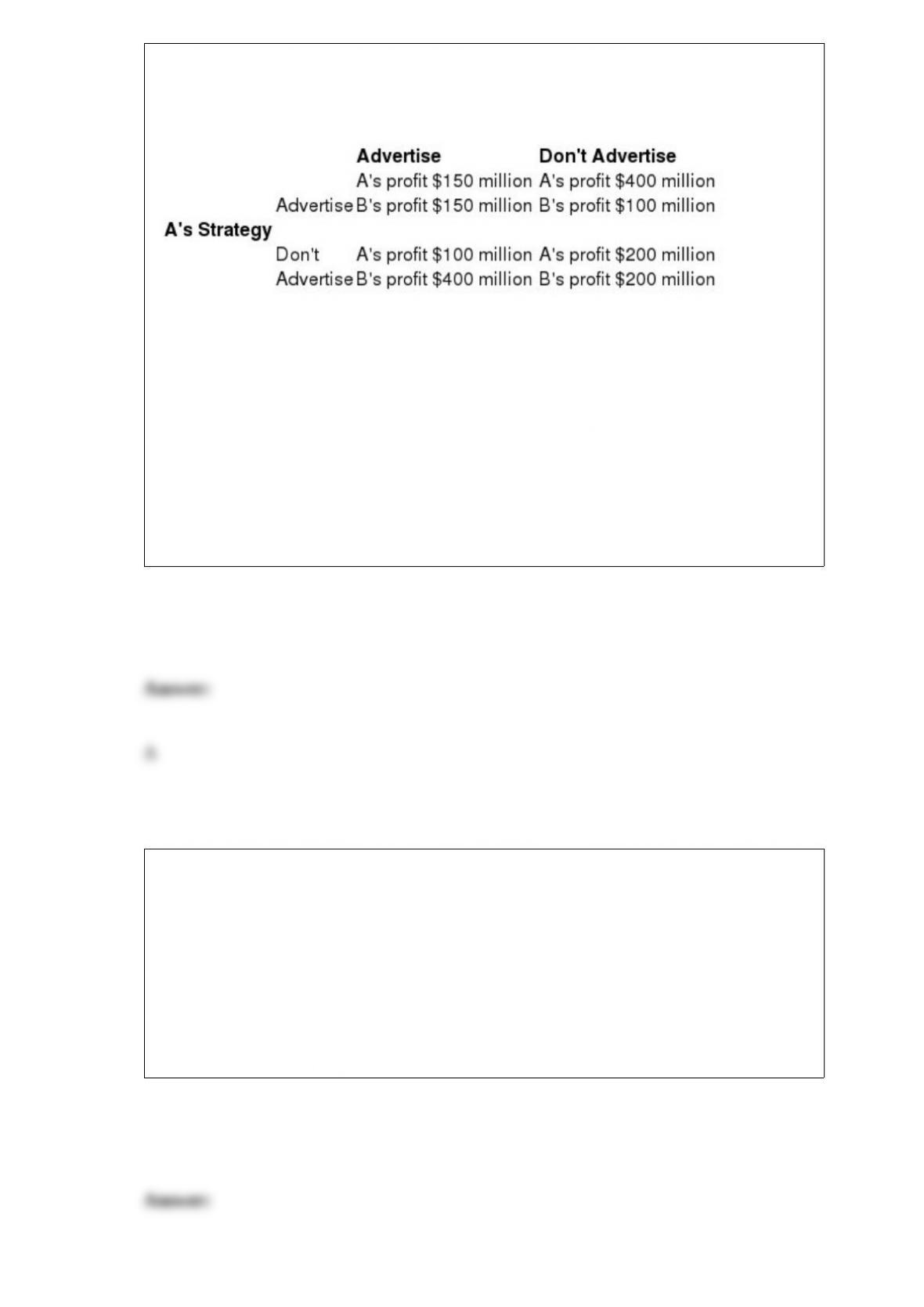
Table 14.3
B’s Strategy
Refer to Table 14.3. If both firms follow a maximin strategy, the equilibrium in the
game is ________.
A) (Advertise, Advertise)
B) (Don’t Advertise, Don’t Advertise)
C) (Don’t Advertise, Advertise)
D) (Advertise, Don’t Advertise)
The determinants of elasticity include
A) availability of substitutes.
B) price relative to income.
C) time.
D) all of the above
Property income takes the form of ________.
A) transfer payments
B) wages and salaries
C) profits, interest, dividends, and rents
D) compensating differentials
Figure 10.3
Refer to Figure 10.3. The market wage is initially W1 and the firm is initially at Point B.
Labor supply increases from S1 to S0. If the firm does not change the amount of capital
it employs, the firm will move to Point ________ to maximize profits.
A) A
B) C
C) E

D) F
If Microsoft is earning a rate of return greater than the return necessary for the business
to continue operations in the long run, then
A) total costs exceed total revenue.
B) total costs exceed a normal rate of return.
C) the normal rate of return is zero.
D) the firm is earning an economic profit.
What are ration coupons and what is their purpose? Provide a historical or current
example.
What is meant by variable cost? What kinds of things might be included in variable
cost?
Critically evaluate the following statement: “People in developing countries are not
poor because they have large families. Rather, they have large families because they are
poor.”
Suppose that, last year, the price of peanuts fell and the quantity sold increased. Use
supply and demand analysis to explain how these changes could have occurred.
Explain how the market supply curve is derived. Does the law of supply apply to the
market supply curve?
Comment on the following statement: “In economics, investment means a wide variety
of things including purchases of stocks, bonds, and other financial assets.”
Use the three basic questions to describe why perfect competition is efficient.
Explain the optimal strategy that a price discriminating firm would use when pricing in
markets with different elasticities.
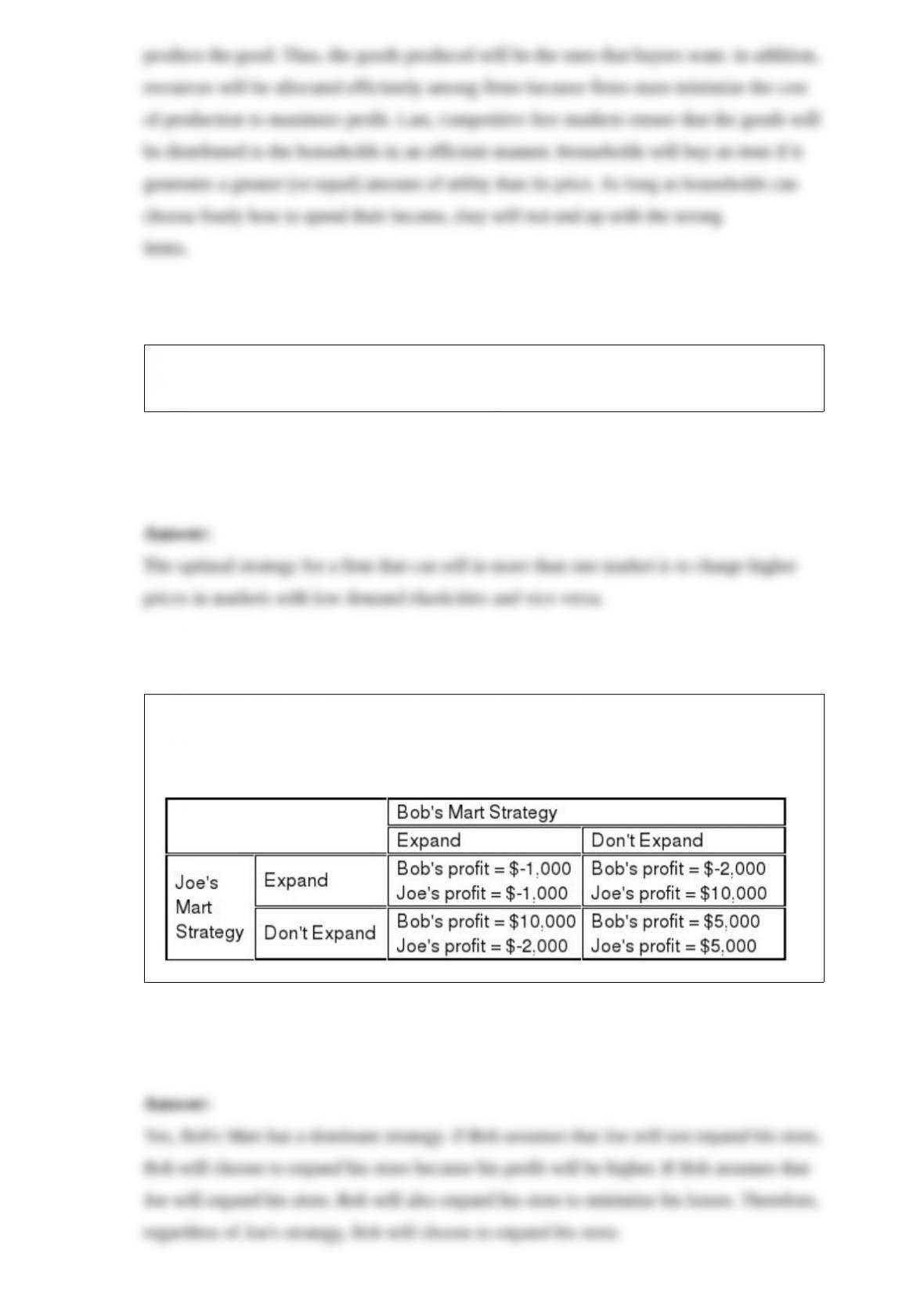
Bob and Joe both own convenience marts on opposite corners. Both firms are
considering expanding the size of their stores. The payoff matrix for this decision is
shown below. Does Bob’s Mart have a dominant strategy? Explain.
Scenario 1 – Suppose a testing company that administers college entrance exams is
concerned about random guessing. The multiple-choice exams that they administer
contain four choices with only one correct answer. Instead of simply awarding points
for correct answers and zero points for incorrect answers they choose instead to award 9
points for every correct answer and subtract 5 points for every incorrect answer.
Use Scenario 1 to answer the following question. Let’s assume that instead of designing
exams with four choices the exams have five choices. What is the minimum number of
answers a student would have to be able to eliminate as “incorrect” in order to make
guessing rationale now?
Consider the following scenario. Assume the price of gold in London is selling for
$1400 an ounce while in New York it is fetching a price of $1450 an ounce. What
would an economist say about the efficiency of this market? What would an economist
predict about what would happen next?
What is the difference between accounting cost and economic cost?
Explain the difference between financing investment with a business loan versus with
venture capital. What are the pros and cons of each?
Suppose that a state needs to build both prisons and schools with a budget limited to 10
million dollars. Schools cost $1 million each to build and prisons cost $2 million each
to build.
What is the maximum number of schools that can be built? The maximum number of
prisons?