1) Upon learning that his auto transmission is about to fail, Ray Roma sells his car to an
unsuspecting buyer. This circumstance illustrates:
A.asymmetric information.
B.the Coase theorem.
C.the moral hazard problem.
D.the principal-agent problem.
2) In a private closed economy, when aggregate expenditures equal GDP:
A.consumption equals investment.
B.consumption equals aggregate expenditures.
C.planned investment equals saving.
D.disposable income equals consumption minus saving.
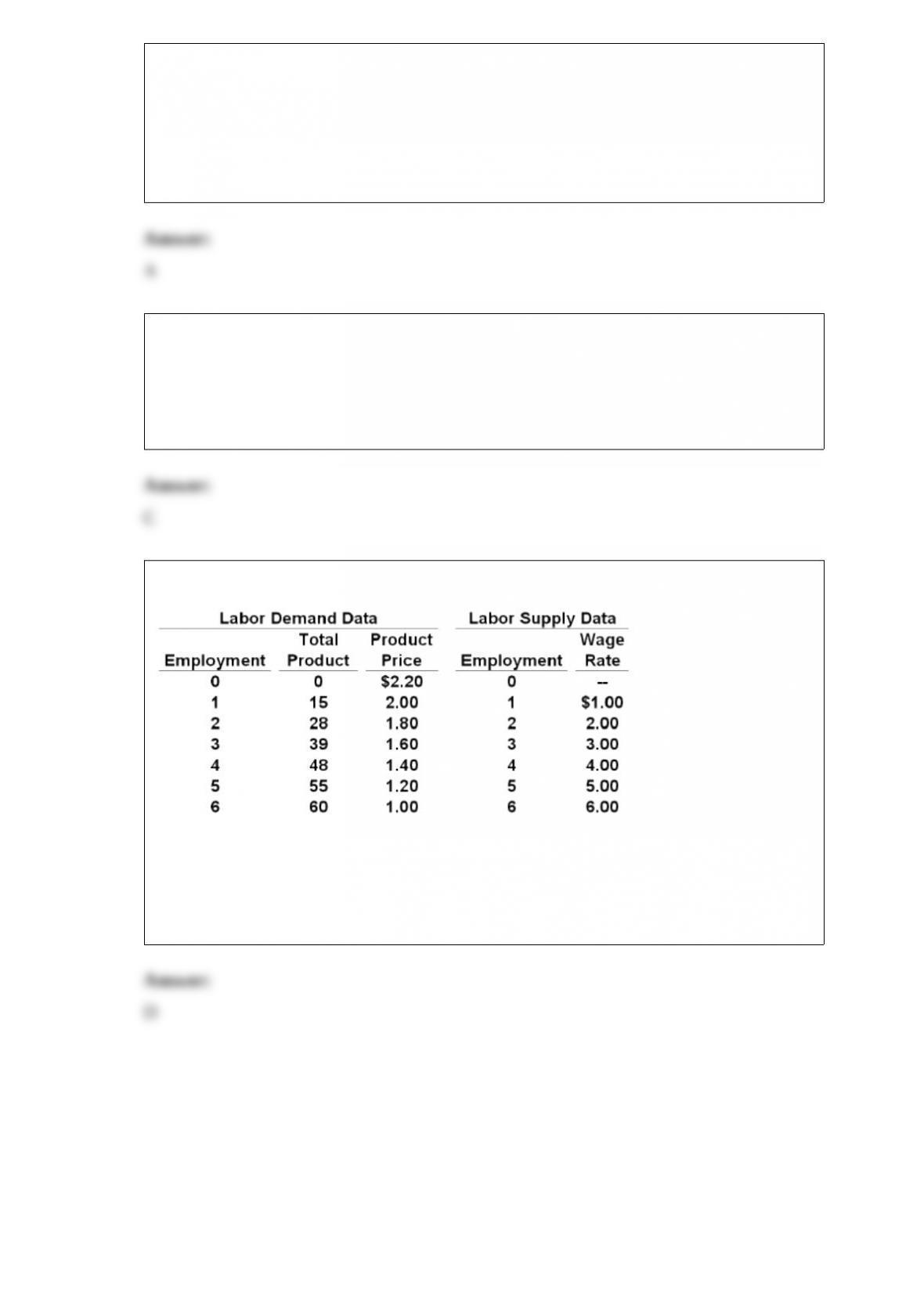
3)
Refer to the above data. What will be the profit-maximizing wage rate?
A.$6
B.$5
C.$4
D.$3
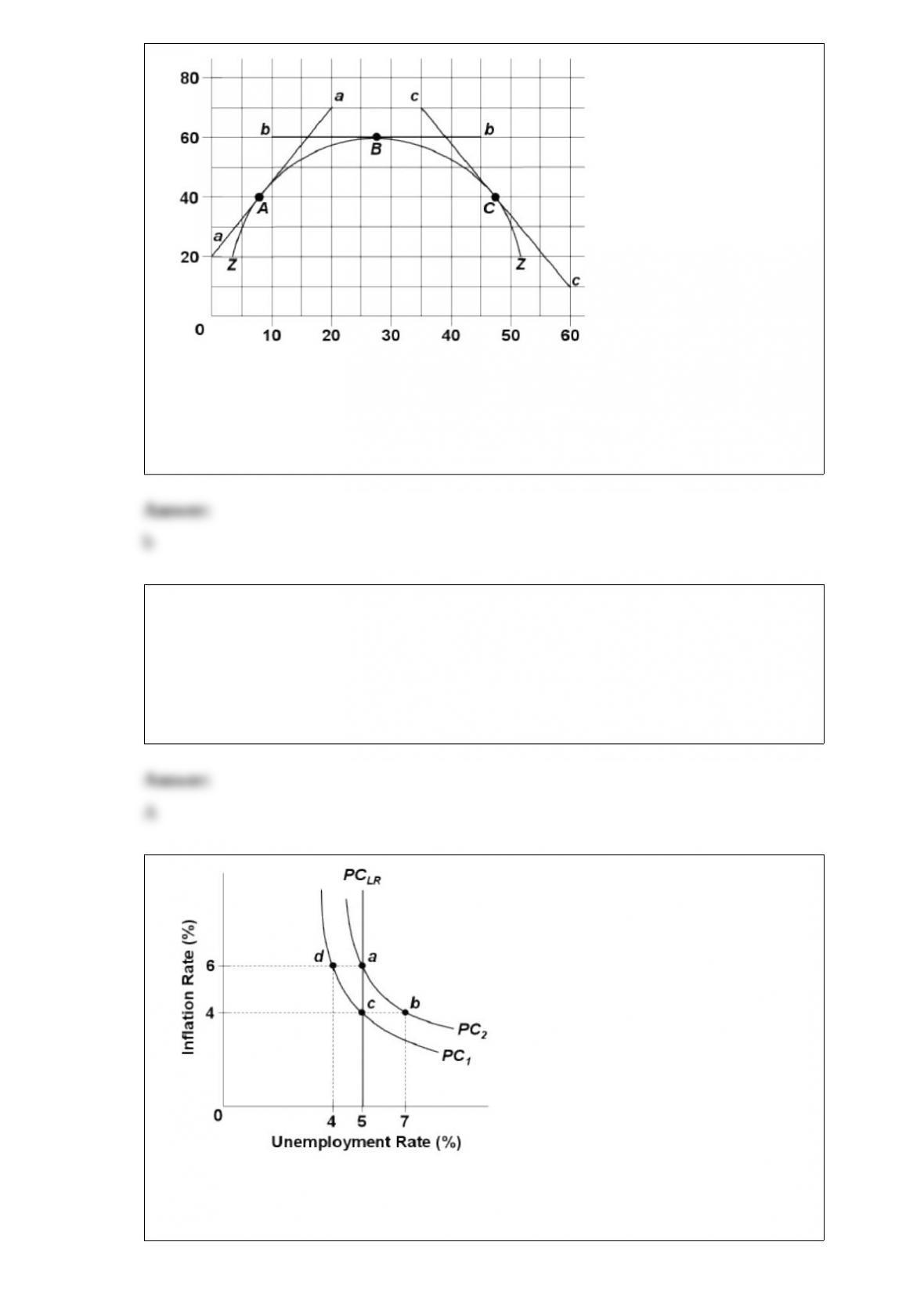
4)
refer to the above diagram. the slope of curve zz at point a is approximately:
a.+2.
b.+21/2.
c.-21/2.
d.+4.
5) An increase in aggregate expenditures resulting from some factor other than a change
in the price level is equivalent to:
A.a rightward shift of the aggregate demand curve in the AD-AS model.
B.a leftward shift of the aggregate demand curve in the AD-AS model.
C.a movement downward along a fixed aggregate demand curve in the AD-AS model.
D.a decrease in aggregate supply in the AD-AS model.
6)
Refer to the above diagram. Assume that the natural rate of unemployment is 5 percent
and that the economy is initially operating at point a where the expected and actual rates
of inflation are each 6 percent. If the actual rate of inflation unexpectedly falls from 6
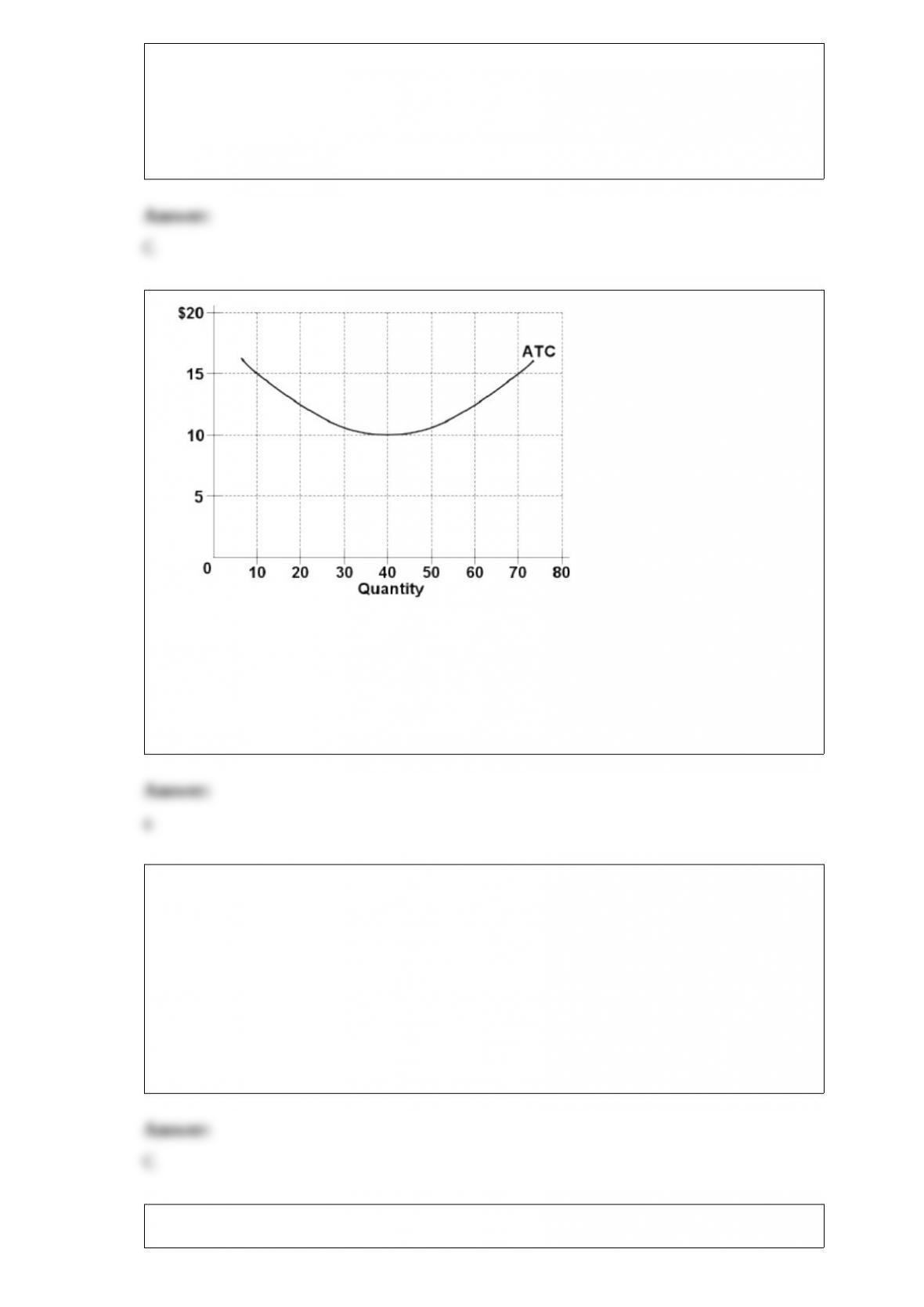
percent to 4 percent, then the unemployment rate will:
A.temporarily fall from 5 percent to 4 percent.
B.permanently fall from 5 percent to 4 percent.
C.temporarily rise from 5 percent to 7 percent.
D.permanently rise from 5 percent to 7 percent.
7)
refer to the above diagram showing the average total cost curve for a purely competitive
firm. at the long-run equilibrium level of output, this firm’s economic profit:
a.is zero.
b.is $400.
c.is $200.
d.cannot be determined from the information provided.
8) Which of the following describes the vicious circle of poverty?
A.Government spending for public goods is inflationary and this undermines incentives
to save and invest.
B.Higher incomes increase consumption at the expense of capital accumulation, which
causes income to fall.
C.Low per capita incomes cause low levels of saving and investment, which mean low
productivity and therefore low incomes.
D.A growing national income increases the demand for money, which increases the
interest rate and reduces investment.
9) Which of the following demographic groups does not bear a disproportionate burden

of poverty?
A.households headed by women
B.persons 65 or over
C.Hispanics
D.African-Americans
10) In a private closed economy, when aggregate expenditures exceed GDP:
A.GDP will decline.
B.business inventories will rise.
C.saving will decline.
D.business inventories will fall.
11) In terms of aggregate supply, the difference between the long run and the short run
is that in the long run:
A.the price level is variable.
B.employment is variable.
C.real output is variable.
D.nominal wages and other input prices are fully responsive to price-level changes.
12) The kinked-demand schedule that an oligopolist believes confronts the firm is given
in the table below. Compute the oligopolists total revenue at each of the nine prices, and
enter these figures in the table. Also compute marginal revenue for each unit between
the nine prices and enter these figures in the table.
(a)Where is the kink in the demand curve? What is the current selling price at that kink
and how much output will be demanded?
(b)What is the range of marginal cost that will keep the price set at the kink?
13) in 1996 mcdonald’s introduced its arch deluxe hamburger, which failed to catch on
with the public and was subsequently dropped from the menu. this failure illustrates the
idea of:
a.consumer sovereignty.
b.technological change.
c.downsloping demand.
d.specialization.
14) command systems are also known as:
a.market systems.
b.pure capitalism.
c.laissez-faire capitalism.
d.communism.
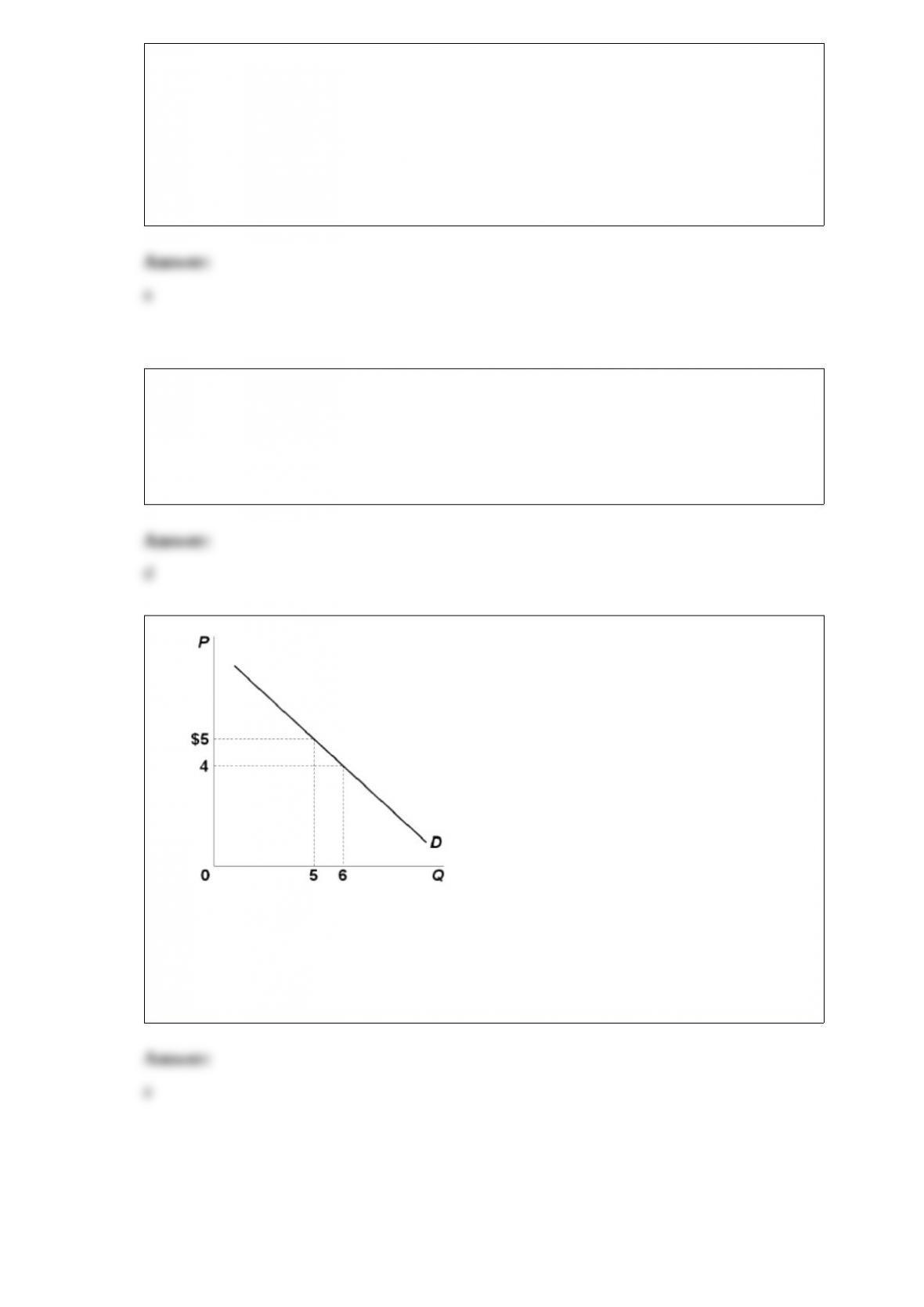
15)
the above diagram indicates that the marginal revenue of the sixth unit of output is:
a.-$1.
b.$1.
c.$4.
d.$24.
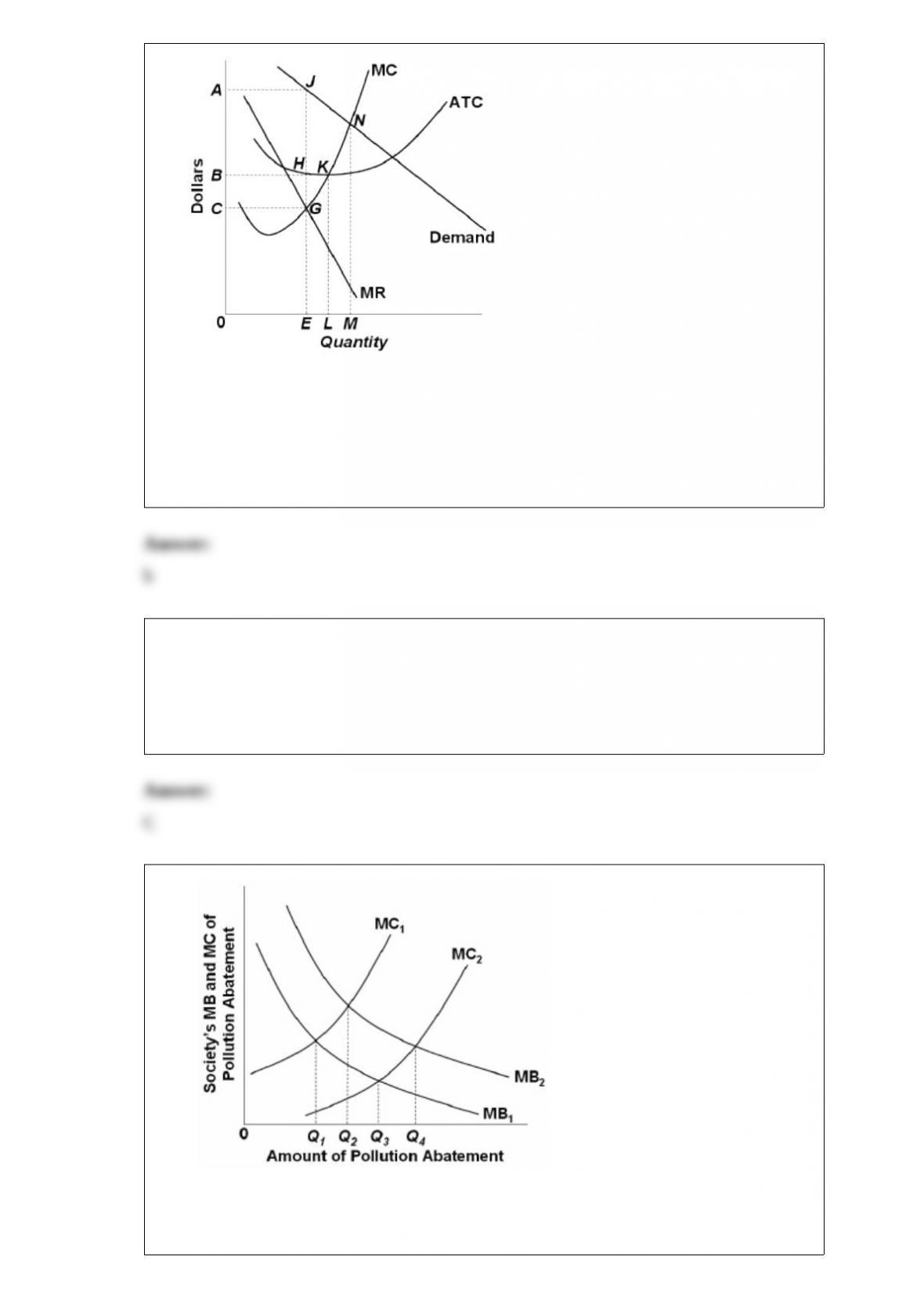
16)
refer to the above diagram. to maximize profits or minimize losses this firm should
produce:
a.e units and charge price c
b.e units and charge price a
c.m units and charge price n
d.l units and charge price lk
17) In new classical economics, the change in output caused by a “price-level surprise”:
A.is shown as a shift of the long-run aggregate supply curve.
B.does not alter the rate of unemployment, even in the short-run.
C.is soon reversed through a shift of the short-run aggregate supply curve.
D.permanently changes the rate of unemployment.
18)
Refer to the above diagram. Which one of the following might shift the marginal cost
curve from MC1 to MC2?
A.major new studies strongly linking cancer to pollution

B.improved technology for reducing pollution
C.a change in consumer tastes from services to manufactured goods
D.an increase in the price of recycled goods